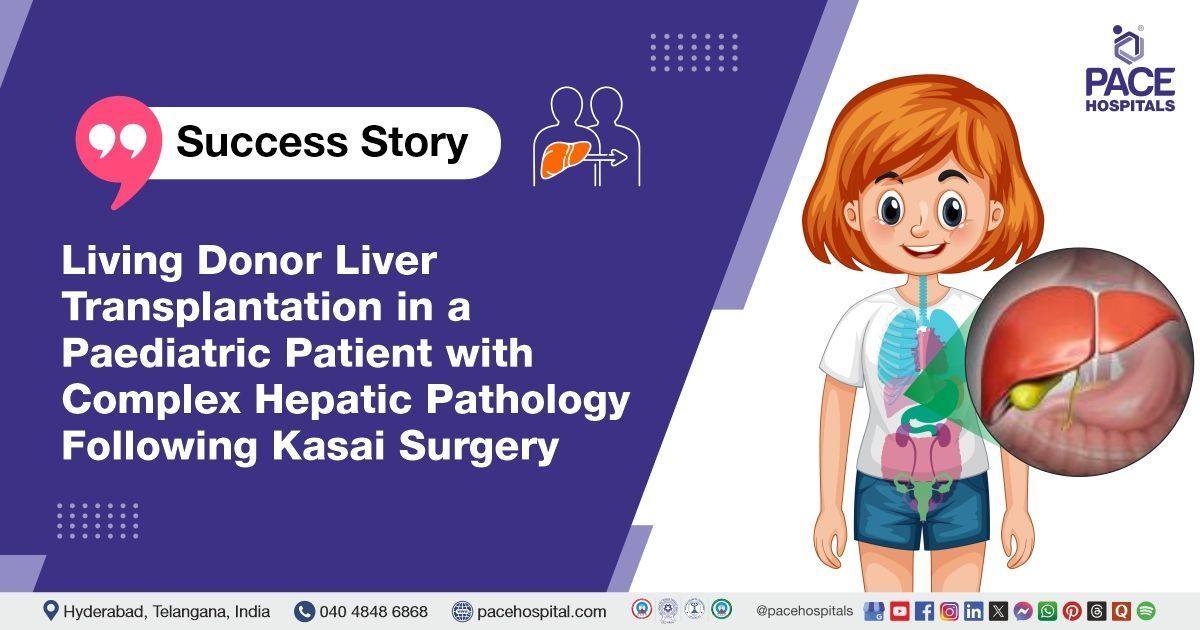
Living Donor Liver Transplantation in a Paediatric Patient with Complex Hepatic Pathology Following Kasai Surgery
PACE Hospitals
A 1-year-old baby with congenital biliary atresia underwent
a complex living donor liver transplant (LDLT)
at PACE Hospitals. Despite severe liver complications, the surgery was successful, providing the child with a second chance at life. The case highlights the importance of timely intervention in managing complex pediatric liver conditions.
A one-year-old, baby was presented to PACE Hospitals, Hyderabad, with chief complaints of jaundice for the past four months, along with intermittent fever. She was admitted for further management and treatment of congenital biliary atresia following a previous Kasai surgery.
Chief Complaints
The patient, a one-year-old female, presented with jaundice for the past four months, along with intermittent fever. She had a history of Kasai surgery performed at the age of 45 days. Her condition was associated with poor portal plate development and poor portal drainage, leading to the need for further intervention.
Medical History
The Baby had a history of extrahepatic biliary atresia, a congenital condition in which the bile ducts are obstructed or absent. At 45 days of age, she underwent Kasai surgery and duodenojejunostomy. Despite this intervention, her liver condition worsened, leading to complications such as retroperitoneal adhesions, portal vein hypoplasia, and an annular pancreas.
She was hospitalized for viral
pneumonia and cholangitis in March 2023, which further complicated her condition. A liver biopsy revealed biliary obstructive patterns, favouring biliary atresia, and an atretic gallbladder with an atretic duct.
Diagnosis
The diagnosis was confirmed as congenital biliary atresia with associated conditions, including an absent suprahepatic inferior vena cava (IVC), portal vein hypoplasia, annular pancreas, and biliary cirrhosis. The patient’s condition was complicated by extensive retroperitoneal adhesions and vascular anomalies. Preoperative imaging and laboratory tests showed severe cholestasis and liver dysfunction.
Medical Decision Making (MDM)
After a thorough evaluation, including imaging and laboratory investigations, a decision was made by the consulting surgical gastroenterologists,
Dr. CH Madhusudhan and
Dr. Suresh Kumar, to proceed with a
living donor liver transplantation. Given the complexity of her case, it was determined that this was the best course of action to provide a functional liver graft and improve her prognosis.
Surgical Treatment
Baby underwent a living donor liver transplantation (LDLT), with the left lateral lobe (segments 2 and 3) of the donor liver transplanted to her. The surgery was highly complex due to extensive adhesions, an absent suprahepatic IVC, and other vascular anomalies.
During the procedure, the graft was anastomosed (connected) to the recipient’s portal vein, hepatic artery, and hepatic vein using Prolene sutures.
Postoperative Care
The post-operative recovery was uneventful. The patient received intensive care post-transplant, with close monitoring of liver function, immunosuppressive therapy, and infection prevention. She was administered IV fluids, IV antibiotics, antifungals, immunosuppressants and other supportive medications. Liver enzymes improved over time, and the patient responded well to immunosuppression management.
In the post-operative period, the patient developed a transient high WBC count with elevated lymphocytes, which was managed conservatively. A Doppler ultrasound of the liver was performed regularly, which showed normal graft perfusion.
Dietary Recommendations
Baby was recommended a normal diet with a focus on nutritional support. A gradual transition to a regular diet was planned over the following weeks. The patient was also instructed to contact the emergency ward of PACE Hospitals immediately in case of fever, abdominal pain, or vomiting.
Post-Discharge Follow-up
The patient was advised to follow up with Dr. CH Madhusudhan in the outpatient department with histopathology (HPE) report after 1 week.
Share on
Request an appointment
Fill in the appointment form or call us instantly to book a confirmed appointment with our super specialist at 04048486868
Appointment request - health articles
Recent Articles