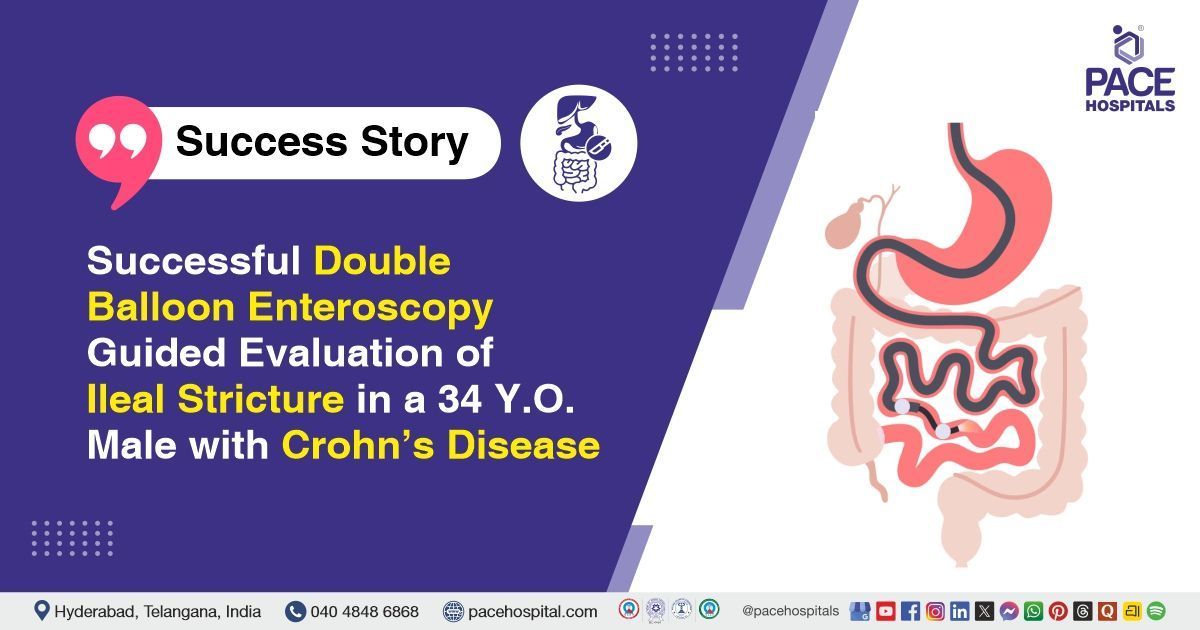
Successful Double Balloon Enteroscopy Guided Evaluation of Ileal Stricture in a 34 Y.O. Male with Crohn’s Disease
PACE Hospitals
PACE Hospitals’ expert Gastroenterology team successfully performed a Double Balloon Enteroscopy (DBE) on a 34-year-old male patient diagnosed with Crohn’s disease, associated with mild ileal stricture and sub-acute intestinal obstruction. The procedure aimed to assess the extent of Crohn’s disease, evaluate the strictures and prevent further complications.
Chief Complaints
A 34-year-old male patient with a body mass index (BMI) of 23 presented to the Gastroenterology Department at PACE Hospitals, Hitech City, Hyderabad, with chief complaints of severe abdominal pain in the right iliac fossa associated with two episodes of watery diarrhea without blood or mucus, one episode of vomiting, and fever.
Past Medical History
The patient had a history of recurrent bloating with borborygmi (normal rumbling, gurgling, or growling sounds from the stomach and intestine) lasting 1-2 days, which was relieved after passing stools or vomiting.
On Examination
On examination, the patient was conscious, coherent and oriented. Vital signs were normal, temperature was normal, and the oxygen saturation was normal. Abdominal tenderness was noted in the right iliac fossa.
Diagnosis
Upon admission to PACE Hospitals, the patient was thoroughly evaluated by the Gastroenterology team. He presented with severe abdominal pain in the right iliac fossa associated with two episodes of watery, loose stools, vomiting and fever. He had a history of recurrent bloating and borborygmi, which relieved after passing stools or vomiting.
The patient underwent some diagnostic evaluation. Ultrasound abdomen of the patient showed mild wall edema likely enteritis. All the routine laboratory investigations, like complete urine examination (CUE), liver function tests (LFTs), renal function tests (RFTs), culture and sensitivity tests, were done, and the complete blood picture revealed leucopenia (low white blood cell count) and low haemoglobin.
Based on the confirmed diagnosis, the patient was advised to undergo Crohn's disease Treatment in Hyderabad, India, under the expert care of the Gastroenterology Department, to manage the condition and prevent complications.
Medical Decision Making
After a detailed consultation with the consultant gastroenterologists, Dr. Govind Verma, Dr. Padma Priya, Dr. M Sudhir, a thorough evaluation was conducted considering the patient complaints of severe abdominal pain in the right iliac fossa, vomiting and fever, with a history of recurrent bloating and borborygmi. All relevant laboratory and imaging investigations were reviewed.
Based on the clinical and imaging investigations, it was determined that double balloon enteroscopy (DBE) was identified as the most appropriate intervention to dilate strictures, relieve symptoms and prevent further complications associated with this disease.
The patient and his family were counselled regarding the diagnosis, the procedure, risks and its potential to relieve symptoms and enhance the quality of life.
Surgical Procedure
Following the decision, the patient was scheduled to undergo Double Balloon Enteroscopy (DBE) in Hyderabad at PACE Hospitals under the expert care of the Gastroenterology Department.
The following steps were done during the procedure:
- Preparation: The patient was kept fasting, informed consent was obtained, and anesthesia either conscious sedation or general was arranged. The enteroscope, overtube, balloons, and necessary instruments were prepared and checked for proper function.
- Positioning and Insertion: The patient was positioned supine for oral entry or in the left lateral position for anal entry. The enteroscope which was lubricated, and the overtube, was gently inserted into the small intestine under direct visualization, using air or CO₂ insufflation to aid navigation.
- Balloon-Assisted Advancement: The technique relies on alternating balloon inflation. The overtube balloon was first inflated to anchor it in place. The enteroscope was then advanced, and its balloon was inflated to hold the scope tip. The overtube balloon was deflated, allowing it to slide forward. This push-and-pull sequence was repeated to progressively pleat the small intestine onto the scope for deeper access.
- Inspection and Intervention: The small bowel mucosa was examined for lesions, polyps, ulcers, strictures, or bleeding sites. Hemostasis, were performed as required.
- Withdrawal: After completing the inspection and interventions, both balloons were deflated. The enteroscope was slowly withdrawn while visualizing the mucosa to ensure nothing was missed, completing the procedure.
Postoperative Care
The procedure was uneventful, and the patient had abdominal distention after the procedure, which was managed with a Ryle's tube. He was on liquid diet and followed by soft diet. He showed significant symptomatic improvement and he was haemodynamically stable, then discharged with appropriate medical advice.
Discharge Medications
Upon discharge, the patient was prescribed medications for infection, immunosuppression, and pain management.
Emergency Care
The patient was informed to contact the emergency ward at PACE hospitals in case of emergency or having any symptoms like fever, vomiting and abdominal pain.
Review and Follow-up Notes
The patient was advised to return for a follow up visit with the Gastroenterologist in Hyderabad at PACE Hospitals after one week.
Conclusion
This case highlights a patient with Crohn’s disease associated with mild ileal stricture and subacute intestinal obstruction. The patient showed significant symptomatic improvement and was haemodynamically stable. The patient was discharged with appropriate medication therapy and follow-up instructions.
Complex Crohn’s Disease with Inflammatory Stricture and Systemic Inflammation
Crohn’s disease often presents with features of subacute intestinal obstruction due to chronic transmural inflammation of the bowel, requiring careful evaluation by a gastroenterologist / gastroenterology doctor. Elevated inflammatory markers along with anemia, leukocyte abnormalities, and hypoalbuminemia reflect active disease with systemic involvement. Advanced endoscopic techniques used in gastroenterology help identify inflammatory and fibrostenotic components of strictures, guiding treatment decisions.
Persistent or recurrent luminal narrowing increases the risk of obstruction despite optimal medical therapy. Nutritional compromise is commonly associated and must be addressed as part of comprehensive care. In such settings, a gastroenterologist may recommend surgical intervention when medical management alone fails to achieve long-term disease control.
Share on
Request an appointment
Fill in the appointment form or call us instantly to book a confirmed appointment with our super specialist at 04048486868
Appointment request - health articles
Recent Articles