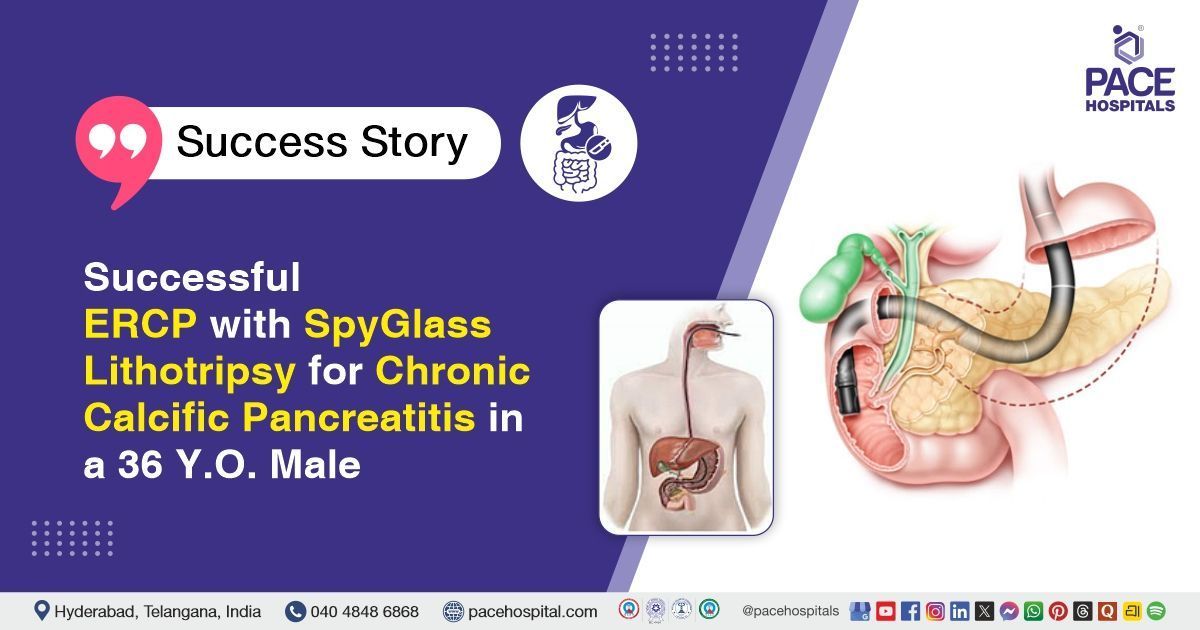
Successful ERCP with SpyGlass Lithotripsy for Chronic Calcific Pancreatitis in a 36 Y.O. Male
PACE Hospitals
The PACE Hospitals’ expert gastroenterology team successfully performed an Endoscopic Retrograde Cholangiopancreatography (ERCP) with SpyGlass-guided Lithotripsy and Pancreatic Duct (PD) Stenting on a 36-year-old male patient diagnosed with chronic calcific pancreatitis. The procedure was aimed at fragmenting and removing pancreatic ductal calculi, relieving ductal obstruction, and improving pancreatic ductal drainage, thereby alleviating pain and preventing further disease progression.
Chief Complaints
A 36-year-old male patient with a body mass index (BMI) of 22 presented to the Gastroenterology Department at PACE Hospitals, Hitech City, Hyderabad, with complaints of intermittent epigastric pain. There was no associated steatorrhea or weight loss reported.
Past Medical History
The patient had a history of chronic calcific pancreatitis, first diagnosed earlier. He had experienced intermittent epigastric pain since that time, without associated steatorrhea or weight loss. There was no history of other significant medical conditions such as diabetes, hypertension, or cardiac or renal disease.
On Examination
The patient was stable with normal vital signs. On general examination, there were no signs of jaundice or edema. CVS and respiratory system examination were normal, with clear lung fields and normal cardiovascular sounds. The chest wall and bony structures were normal. Abdominal examination showed no tenderness, masses, or organ enlargement.
Diagnosis
Following the clinical assessment, the Gastroenterology team conducted a comprehensive review of the patient’s medical history and abdominal symptoms.
To confirm the diagnosis and evaluate the extent of pancreatic involvement, the patient’s complaints of intermittent epigastric pain were considered, with no history of steatorrhea or weight loss.
Imaging studies, including magnetic resonance cholangiopancreatography (MRCP), demonstrated multiple calculi within the pancreatic duct along with ductal dilation, confirming the presence of chronic calcific pancreatitis. Laboratory investigations were within normal limits, and no systemic complications were noted.
Based on the confirmed diagnosis, the patient was advised to undergo Chronic Calcific Pancreatitis Treatment in Hyderabad, India, under the expert care of the Gastroenterology Department.
Medical Decision Making (MDM)
After a detailed consultation with consultant gastroenterologists, Dr. Govind Verma, Dr. M Sudhir, and Dr. Padma Priya, a comprehensive evaluation was performed to determine the most appropriate diagnostic and therapeutic approach. Considering the patient’s history of chronic calcific pancreatitis, intermittent epigastric pain, and previous medical history, an optimal treatment strategy was formulated.
Based on clinical assessment and imaging findings, including Magnetic Resonance Cholangiopancreatography (MRCP) showing multiple intraductal calculi with dilated main pancreatic duct and features of chronic calcific pancreatitis, it was determined that ERCP with SpyGlass-assisted lithotripsy and pancreatic duct stenting was identified as the most suitable therapeutic intervention to relieve ductal obstruction, remove pancreatic calculi, and minimize the risks associated with major pancreatic surgery.
The patient and his family members were counselled regarding the diagnosis, planned procedure, associated risks, and its potential to relieve symptoms and improve quality of life.
Surgical Procedure
Following the decision, the patient was scheduled to undergo ERCP with Spyglass-assisted Laser Lithotripsy and Pancreatic Duct Stenting Procedure in Hyderabad at PACE Hospitals under the expert supervision of the Gastroenterology Department.
The following steps were carried out during the procedure:
- Pre-Procedure Preparation: The patient was kept nil per oral (NPO) prior to the procedure. Baseline vital signs, including blood pressure, heart rate, and oxygen saturation, were recorded. Intravenous access was established, and prophylactic antibiotics were administered. The procedure, its purpose, benefits, and potential risks were explained to the patient, and informed consent was obtained.
- Sedation and Endoscopic Access: The patient was positioned in the left lateral decubitus position for optimal endoscopic access. Conscious sedation was administered, and continuous monitoring of vital signs was maintained throughout the procedure. A side-viewing duodenoscope (SVE) was carefully advanced through the esophagus and stomach into the second part of the duodenum (D2). The ampulla of Vater was identified and prepared for pancreatic duct cannulation.
- Selective Pancreatic Duct Cannulation: The pancreatic duct was selectively cannulated using a guidewire and cannula. Contrast was injected under fluoroscopy to confirm the ductal anatomy, presence of dilation, and multiple intraductal calculi. This step ensured accurate targeting of the stones for fragmentation.
- SpyGlass Pancreatoscopy: The SpyGlass Direct Visualization System was advanced into the pancreatic duct over the guidewire. This allowed direct visualization of the intraductal calculi, their size, number, and location. The ductal lining was examined to identify any strictures or irregularities before proceeding with lithotripsy.
- Laser Lithotripsy and Pancreatic Duct Stenting: Under SpyGlass guidance, laser lithotripsy was performed to fragment the pancreatic duct stones into smaller pieces. Following successful fragmentation, a 5 Fr × 7 cm pancreatic duct stent was deployed to maintain ductal patency and facilitate drainage. Correct placement of the stent was confirmed fluoroscopically, completing the procedure successfully.
Postoperative Care
The patient’s postoperative period was uneventful. He was managed with pain control medication, pancreatic enzyme supplementation, acid suppression, and supportive care. The patient remained stable and was discharged with medications and follow-up advice.
Discharge Medications
Upon discharge, the patient was prescribed medications for pancreatic enzyme replacement to aid digestion, nutritional supplementation, acid suppression for gastrointestinal protection, a laxative to prevent constipation, and an antibiotic for infection prophylaxis.
Emergency Care
The patient was informed to contact the emergency ward at PACE Hospitals in case of any emergency or development of symptoms such as fever, abdominal pain and vomiting.
Review and Follow-up Notes
The patient was advised to return for a follow-up visit after three months with the Gastroenterologist in Hyderabad at PACE Hospitals to review his condition.
Conclusion
This case highlights a patient with chronic calcific pancreatitis and multiple pancreatic duct calculi causing recurrent epigastric pain. The patient underwent successful ERCP with SpyGlass-guided lithotripsy and pancreatic duct stenting. The patient’s postoperative period was uneventful, and he was discharged stable with medications and follow-up advice.
Advanced Endoscopic Management of Chronic Calcific Pancreatitis
Minimally invasive endoscopic interventions play a key role in the management of chronic calcific pancreatitis with pancreatic duct calculi. A gastroenterologist / gastroenterology doctor can perform procedures such as SpyGlass-guided laser lithotripsy, which allows direct visualization and precise fragmentation of ductal stones, reducing the need for surgery. Pancreatic duct stenting helps maintain ductal patency and prevent obstruction-related complications.
Postoperative care typically includes pancreatic enzyme supplementation, acid suppression, nutritional support, and regular follow-up. These approaches help relieve symptoms, preserve pancreatic function, and improve quality of life. Careful patient selection, imaging guidance, and ongoing monitoring by a gastroenterology doctor are essential to optimize outcomes.
Share on
Request an appointment
Fill in the appointment form or call us instantly to book a confirmed appointment with our super specialist at 04048486868
Appointment request - health articles
Recent Articles