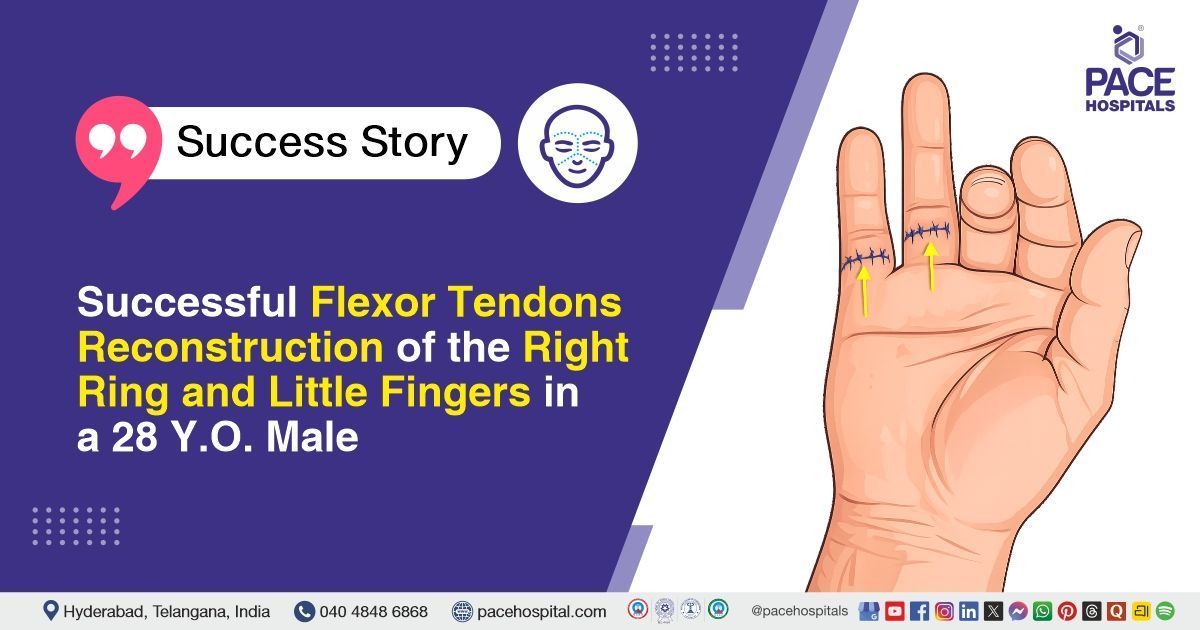
Successful Flexor Tendons Reconstruction of the Right Hand Fingers in a 28 Y.O. Male
PACE Hospitals
PACE Hospitals' expert Plastic and Reconstructive Surgery team successfully performed Exploration and Repair of the Zone II Flexor Tendons (flexor digitorum profundus and superficialis) of the right little finger, A2 Pulley Reconstruction of the Little Finger, and Flexor Digitorum Profundus (FDP) Reconstruction of the Right Ring Finger using a Flexor Digitorum Superficialis (FDS) Graft from the same (ring) Finger on a 28-year-old male patient. This addressed Zone II flexor tendon injuries in the right ring and little fingers, aiming to restore finger flexion, optimize hand function, and prevent long-term stiffness or deformity.
Chief Complaints
A 28-year-old male patient with a body mass index (BMI) of 22 presented to the Plastic and Reconstructive Surgery Department at PACE Hospitals, Hitech City, Hyderabad, with complaints of inability to fold the right ring and little fingers.
Past Medical History
The patient had no known past medical illnesses and had not undergone any previous surgeries. He had no known allergies to medications, foods, or other substances. There was no history of chronic illnesses such as diabetes, hypertension, or heart disease. Overall, his past medical and surgical history was normal.
On Examination
On examination, the patient was conscious, coherent, and cooperative. General physical examination revealed no pallor, jaundice, cyanosis, lymphadenopathy, clubbing, or pedal edema. Vital signs were stable. Local examination of the right hand showed inability to fold the ring and little fingers, with a healed scar over the affected area and mildly decreased sensation along the ulnar aspect of the little finger. The systemic examination was normal.
Diagnosis
Following the clinical examination, the Plastic and Reconstructive Surgery team conducted a thorough assessment, including a detailed review of the patient’s medical history, with presenting complaints of inability to fold the right ring and little fingers following an accidental cut injury. A focused evaluation of the right hand was performed to assess tendon integrity, finger mobility, and sensory function. Relevant investigations were carried out to ensure patient suitability for surgical management.
To confirm the diagnosis and determine the extent of involvement, the right hand was carefully examined. The assessment revealed Zone II flexor tendon injuries involving the flexor digitorum profundus (FDP) of the right ring and little fingers, with disruption of the A2 pulley of the little finger and decreased sensation along the ulnar aspect of the little finger. No local or systemic abnormalities were noted at the time of examination.
Based on the confirmed diagnosis, the patient was advised to undergo Zone II Flexor Tendon Injuries Treatment in Hyderabad, India, of the right ring and little fingers under the Plastic and Reconstructive Surgery team to restore finger flexion, improve hand function, and prevent long-term stiffness or deformity.
Medical Decision Making (MDM)
After a detailed consultation with Dr. Kantamneni Lakshmi, Senior Consultant Plastic, Reconstructive & Aesthetic Surgeon, a thorough clinical evaluation was performed focusing on the patient’s presentation of inability to fold the right ring and little fingers following an accidental cut injury. Relevant imaging and investigations were reviewed comprehensively to assess the extent of tendon injury, pulley involvement, and associated soft tissue damage.
It was determined that exploration and repair of the FDP of the right little finger, reconstruction of the A2 pulley of the little finger, and reconstruction of the FDP of the right ring finger using an FDS graft were identified as the most appropriate intervention to restore finger flexion, improve hand function, and prevent long-term stiffness or deformity.
The patient and his family members were counselled regarding the surgical procedure, potential intraoperative and postoperative risks, postoperative care, and expected functional recovery.
Surgical Procedure
Following the decision, the patient was scheduled to undergo Exploration and Repair of the FDP of the Right Little Finger, Reconstruction of the A2 Pulley of the Little Finger, and Reconstruction of the FDP of the Right Ring Finger Surgery in Hyderabad at PACE Hospitals using an FDS graft under the supervision of the expert Plastic and Reconstructive Surgery Department.
The following steps were carried out during the procedure:
- Anesthesia and Preparation: The patient was administered a right supraclavicular block for anesthesia. The surgical area was prepared under strict aseptic conditions, with the right hand thoroughly painted and draped to maintain sterility throughout the procedure.
- Surgical Exposure: A Bruner’s incision was made over the right ring and little fingers, providing adequate exposure of the injured flexor tendons. In addition, a distal palmar crease incision was performed to locate and retrieve the proximal cut ends of the flexor digitorum profundus (FDP) tendons that had retracted proximally due to the injury.
- Tendon Identification and Assessment: Upon exploration, the distal cut ends of the FDP tendons of the ring and little fingers were identified over the distal end of the middle phalanx. The FDP tendon of the ring finger could not be directly approximated, while the FDP tendon of the little finger was suitable for end-to-end repair. The integrity of the surrounding structures and pulleys was carefully assessed to plan for reconstruction.
- Tendon Repair and Reconstruction: The FDP of the right little finger was repaired end-to-end using 3-0 Prolene sutures. For the right ring finger, the flexor digitorum superficialis (FDS) tendon of the same finger was harvested and used as a graft to reconstruct the FDP tendon, ensuring proper tendon continuity. The A2 pulley of the little finger was reconstructed using the FDS graft from the ring finger to restore pulley function and prevent tendon bowstringing. The FDS tendons of both fingers were not repaired as part of the procedure.
- Wound Closure: After confirming hemostasis, the surgical wounds were closed meticulously using 3-0 and 4-0 Prolene sutures. An aseptic dressing was applied over the incisions, and a splint was placed to maintain proper finger alignment and protect the tendon repairs.
Postoperative Care
The procedure was completed uneventfully. The patient was treated with medications for infection prevention, pain management, and gastric protection during the hospital stay. The patient was discharged with the following advice.
Discharge Medications
Upon discharge, the patient was advised medications for infection prevention, pain relief, gastric protection, additional pain management, nutritional support, and inflammation reduction to aid in healing.
Advice on Discharge
The patient was advised to keep the limb elevated and perform passive movements of the right-hand fingers. A high-protein diet was recommended to support healing, and physiotherapy was suggested to aid in the recovery of hand function.
Emergency Care
The patient was informed to contact the emergency ward at PACE Hospitals in case of any emergency or development of symptoms such as pain, swelling or bleeding.
Review and Follow-up Notes
The patient was advised to return for a follow-up consultation with the Consultant Plastic, Reconstructive & Aesthetic Surgeon in Hyderabad at PACE Hospitals 2 days after discharge for wound evaluation with a prior appointment.
Conclusion
This case highlights a complex right-hand flexor tendon injury of the ring and little fingers, managed with exploration, FDP repair, and A2 pulley reconstruction using an FDS graft. The procedure was completed successfully under regional anesthesia without complications. Postoperative care focused on infection prevention, pain control, and early mobilization. The patient was discharged stable with instructions to support functional recovery and prevent stiffness.
Significance of Zone II Flexor Tendon Injury Management
Zone II flexor tendon injuries demand prompt recognition and precise surgical management to restore hand function and prevent long-term stiffness or deformity. Delayed or inadequate repair can lead to tendon adhesions, limited range of motion, and functional impairment. Surgical techniques such as direct tendon repair, tendon grafting, and pulley reconstruction are essential to re-establish normal biomechanics and prevent complications like bowstringing. Successful recovery relies on a multidisciplinary approach involving a skilled Plastic surgeon / Plastic surgery doctor, meticulous operative technique, and structured postoperative rehabilitation.
Patient education, adherence to physiotherapy, and proper limb care are critical to optimizing healing, maintaining finger mobility, and reducing the risk of recurrent injury. Early and comprehensive intervention significantly improves the chances of regaining full hand function and returning to daily or occupational activities.
Share on
Request an appointment
Fill in the appointment form or call us instantly to book a confirmed appointment with our super specialist at 04048486868
Appointment request - health articles
Recent Articles