Autism Spectrum Disorder (ASD): Types, Symptoms, Causes, Diagnosis & Treatment
PACE Hospitals
Written by: Editorial Team
Medically reviewed by: Dr. S Pramod Kumar - Consultant Neurophysician & Neuromuscular Specialist
Autism definition
Autism spectrum disorder (ASD) is commonly referred to as autism, and it is a neurological condition affecting the development of the brain, having a greater impact on the quality of life, affecting regular activities by impairing social communication and interaction, learning ability, repetitive behaviour, and showing a lack of interest in activities. Autism is a spectrum because its symptoms and severity range from requiring support to complete dependence on caregivers/parents.
Common symptoms of ASD include impaired social communication and interaction, repetitive behaviour and differences in sensory function. The main causes are not known, but it may develop due to contributing risk factors such as genetic, environmental and biological. Complications involve seizure disorders, anxiety, depression, gastrointestinal problems (GI), obsessive-compulsive disorder (OCD), eating disorders and obesity.
Diagnosis and treatment are managed by a doctor, often a neurologist, paediatrician, or psychiatrist, using supportive therapies and medical management to control symptoms.
Autism meaning
- Autism is derived from the Greek words AUTOS, meaning "self ", and ism, meaning "the state or action" (it implies a self-focused condition), coined in 1912 by Swiss psychiatrist Paul Bleuler.
- Spectrum originates from the Latin word specere, meaning to observe. Medically, it is termed that autism is not similar in everyone; it varies from one person to another, ranging from mild to severe behavioural conditions.
- Disorder, derived from the Latin word, was termed in 1704, which determines the disturbed state of the mind or body.
Autism spectrum disorder means differences in social communications and interaction, repetitive behaviour and lack of interest in various activities that affect the quality of daily life, whereas spectrum means the intensity of these factors varies based on abilities, severity and strengths, stating that support requirements to work independently among various individuals are seen, resulting in disturbance of the mental status.
Autism Prevalence
Global prevalence of autism
The prevalence of autism globally is reported to be about 0.8%, indicating that 1 in 127 people were affected according to the World Health Organisation (WHO), whereas the U.S. recorded 3.2% of children aged 8 years affected with autism, which means about 1 in 31 children are reported to be affected in this country. So overall, 0.8% people are affected with autism globally, but the highest rate is recorded in countries like the U.S.
Prevalence of autism in India
The prevalence of autism in India is 0.15%(15 per 10,000) stating that 15 cases recorder per 10,000 population among children age ranging from 1-10years in rural, urban and other population (tribal people) and in Chandigarh 2.25 cases of autism per 1000 children age ranging from 1.5-10 years are recorded (0.225% prevalence) when compared with other states such as Himachal Pradesh, Kerala, and Kolkata with cases recorded about (0.05%-0.36%). Overall, the data indicate that Western countries have a higher prevalence than India due to a lack of diagnostic tools, underdiagnosis, and limited awareness.
Types of Autism
Autism Spectrum Disorder (ASD) is a neurodevelopmental disorder which affects routine activities such as social interaction and communication, repetitive behaviour and lack of interest in activities. The dsm-5 criteria include the following levels:
- Level 1
- Level 2
- Level 3
Level 1: Individuals evaluated based on the requirement of support with autism spectrum disorders are classified under level 1, representing mild symptoms and struggling to interact and communicate in society. In this level, minimal support is required.
Level 2: At this level, individuals require moderate support to perform basic daily activities, such as communicating with others, and to avoid repetitive behavioural patterns, such as continuous hand movement or performing the same behaviour repeatedly, which affect the quality of life.
Level 3: In this stage, individuals with autism spectrum disorder struggle severely, impairing social engagement, including interaction and communication, indicating the very significant requirement of support.
Historical subtypes (pre-DSM-5)
The old classification of autism before 2013 included different types of autism spectrum disorder.
- Autistic disorder (classic autism)
- Asperger’s syndrome
- Pervasive Developmental Disorder-Not Otherwise Specified (PDD-NOS)
- Childhood Disintegrative Disorder (CDD)
Autistic disorder (classic autism): This type of autism is known as autistic disorder and represents the symptoms in early childhood. Individuals struggle to interact with others, showing a lack of interest and repetitive behavioural patterns. They also struggle to understand social mental status and emotional factors, making eye contact and participating in social conversation.
Asperger syndrome: Individuals with this syndrome have above-average intelligence and mild symptoms as compared to classic autism. Still, they struggle in understanding the social rules and social interactions, which result in distancing from friends and relations. Compared to classic autism, people with Asperger syndrome also show interest in particular subjects.
Pervasive Developmental Disorder-Not Otherwise Specified (PDD-NOS): It is used as a diagnostic criterion for individuals who don’t fit the classic Autism and Asperger syndrome and present milder symptoms. It is often used to describe late-onset autism.
Childhood Disintegrative Disorder (CDD): It is a rare condition in which children lose acquired skills, including cognitive functions such as language, learning, and motor function. The recovery of these skills can be seen during the developmental period between 2 and 10 years of age. CDD shares similarities with classic autism but differs in losing significant skills rapidly and suddenly.
Autism Symptoms
Autism spectrum disorder symptoms indicate the different types of behavioural patterns seen commonly, and do not indicate that the individuals experience all the following symptoms. The following signs and symptoms include:
- Social communication and interaction behaviours
- Repetitive behavior
- Differences in sensory function
- Developmental pattern and language delays
Social communication and interaction behaviours: Individuals make irregular or minimal eye contact with others, have difficulty in conversations, do not concentrate or look at the people who are speaking, show irregularity in enjoying activities, show a lack of interest, and show little emotion to others. Irrespective of social signs and understanding, they start speaking continuously about subjects of interest; there is no proper coordination between their gestures and facial expressions during communication; a lack of understanding of the other person’s opinion and actions; and difficulty making friends and understanding various social norms.
Repetitive behavior: People with autism spectrum disorder experience repetitive behavior called as echolalia which means repeating certain words and phrases repeatedly and showing keen interest in certain topics such as numbers, details or facts, concentrating more on the moving certain objects or parts of the object, finding difficulty in shifting from one activity to the other and feeling disappointed easily even due to a slight change in daily activities.
Differences in sensory function: Individuals with ASD are sensitive to sensory stimuli, such as sound, light, temperature, and clothing. People with ASD are more or less sensitive to these actions.
Developmental patterns and language delays: Children with autism show abnormality in normal development patterns, which means they usually lose the skills acquired early, like speech, or stop learning new skills at an age ranging from 18 to 24 months, and also delayed and restricted use of spoken language is commonly seen.
Autism Causes and Risk Factors
The exact primary causes of autism spectrum disorder are not known, but it may develop due to contributing risk factors such as genetic, biological and environmental. Multiple factors together increase the risk, rather than a single specific trigger. Reasons for autism include the following:
- Sibling with ASD
- Aged/older parents
- Born with less weight
- Down syndrome
- Fragile X syndrome
Sibling with ASD: The inheritance of autism spectrum disorder is due to passing the same genes within the family. If one child has ASD, then the chances increase up to 10-20% in developing this condition in a sibling because of the sharing of the same genes, which is called familial recurrence, and is less common in the normal population, about 1-2%.
Aged/older parents: Parental age is a significant risk factor in the development of ASD in children because of certain biological conditions, such as mutations in genes during early fetal development (de novo mutations) or epigenetic modifications, which alter gene function or expression of the DNA sequence itself and are associated with ageing.
Born with less weight: Low birth weight and autism are interlinked because a single cause is not enough to describe autism, but it involves the complex neurodevelopmental factors, which suggest that premature delivery and restrictive intrauterine growth lead to complications such as decreased oxygen supply to the brain, immature neural connections and inflammation. These factors contribute to the development of ASD in offspring with older parents.
Down syndrome: The development of autism in children with Down syndrome is suggestive of a higher frequency, i.e. up to 39%, but does not fulfil all other diagnostic criteria because of the sharing of similar genetic and neurodevelopmental factors.
Fragile X syndrome: The mechanism which indicates the development of ASD with fragile X syndrome includes a large repetition of CGG, which leads to epigenetic silencing by hypermethylation of the FMR1 gene. This silencing of genes leads to the production of fragile X mental retardation protein (FMRP), which generally controls the protein synthesis required for the normal functioning of neural signalling. Lack of FMRP results in neurological developmental impairment, showing an interlink between ASD and fragile X syndrome.
Autism Complications
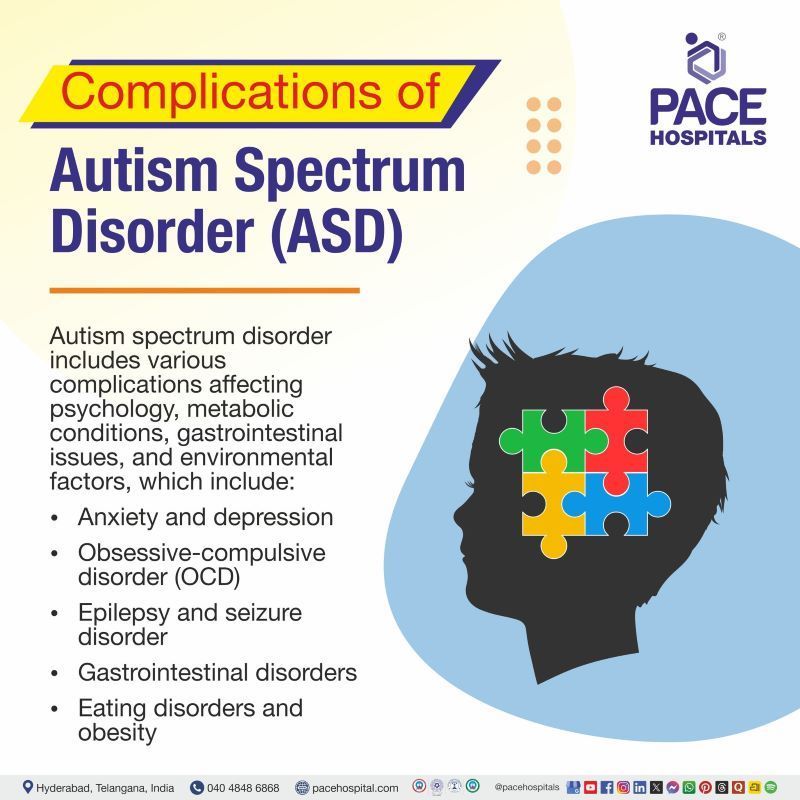
Autism spectrum disorder includes various complications affecting psychology, metabolic conditions, gastrointestinal issues, and environmental factors, which include:
- Anxiety and depression
- Obsessive-compulsive disorder (OCD)
- Epilepsy and seizure disorder
- Gastrointestinal disorders
- Eating disorders and obesity
Anxiety and depression: People with autism are anxious and depressed because of difficulty in social interaction and communication, resulting in emotional sadness and social distancing.
Obsessive-compulsive disorder (OCD): Individuals with OCD experience unwanted thoughts and repetitive behaviour, which affects the quality of their daily life, and usually, teenagers and the adult population are more affected than the general population.
Epilepsy and seizure disorder: Epilepsy and seizure disorder mean abnormal electrical activity in the brain that temporarily affects behaviour, movement and consciousness associated with ASD, which usually affects 5 % children ranging from age 5-7, 12.1% adults ranging from age 18-64 who are on treatment. It requires careful monitoring because frequency and severity vary.
Gastrointestinal disorders: Children are more prone to the development of gastrointestinal issues like abdominal pain, constipation or diarrhoea with ASD, which basically affects the quality of life of children, making them more uncomfortable to function in routine activities.
Eating disorders and obesity: Children in their developmental stage from infancy to adolescence with ASD are more prone to the risks of obesity because of a lack of exercise and due to the selective activity of types of food by children, which makes them malnourished, and their overeating habits due to the difficulty in understanding the fullness of their stomachs, making them obese.
Autism Diagnosis
Autism is a neurodevelopmental condition which presents impaired social communication and interaction, restricted interests and repetitive behaviour, and symptoms usually begin in early childhood, affecting quality of life. The autism diagnosis test is based on standard DSM-5 criteria, with close attention to developmental history and behavioural patterns. The steps in autism spectrum disorder diagnosis include:
- Developmental Screening
- Comprehensive Diagnostic Evaluation
- Applying DSM-5 Criteria
- Rule Out Differentials
- Genetic testing (fragile X, karyotype)
- Audiology
- Electroencephalogram (EEG) -seizures
- Metabolic screens
- Magnetic resonance imaging (MRI)
- Assess comorbidities (ADHD, anxiety)
Autism Spectrum Disorder Treatment
After diagnosis of ASD, intervention and support are necessary as soon as possible for the better outcomes of neurological development, and the autism treatment involves multiple stages, as mentioned below in the following steps:
- Behavioral approaches
- Developmental approaches
- Educational approaches
- Social-relational approaches
- Pharmacological approaches
- Psychological approaches
- Complementary and alternative approaches
Behavioral approaches
- Discrete trial training (DTT)
- Pivotal response training (PRT)
Developmental approaches
- Speech and language therapy
- Occupational therapy
- Sensory integration therapy
- Physical therapy
Educational approaches
- Treatment and education of Autistic and Related Communication Handicapped Children (TEACCH) approach
Social- relational approaches
- Developmental, Individual Differences, Relationship-Based mode (DIR model)
- Relationship Development Intervention (RDI)
- Social stories
- Social skill groups
Pharmacological approaches
- Physicians may prescribe medications to manage anxiety, depression, seizures, sleep and gastrointestinal problems.
Psychological approaches
- Cognitive behaviour therapy (CBT)
Complementary and alternative approaches
- Diets
- Herbal supplements
- Relaxation therapies
- Arts therapy
Why Choose PACE Hospitals?
Expert Super Specialist Doctors
Advanced Diagnostics & Treatment
Affordable & Transparent Care
24x7 Emergency & ICU Support
Autism Prevention
Prevention of autism spectrum disorder has no standard clinical evidence, so it indicates that autism cannot be prevented, but the following steps can manage it:
- Limited primary prevention
- Second prevention strategy
- Tertiary prevention strategy
Limited primary prevention: Primary prevention of autism is limited because it is a largely genetic condition, so it mainly focuses on strategies that reduce risk by prenatal care, rubella vaccination before pregnancy, avoiding harmful substances during pregnancy, managing fever and infections carefully during pregnancy and preventing environmental risk factors.
Secondary prevention strategy: Autism management is helpful by early screening, usually around 18-30months of age, early recognition of developmental signs such as limited eye contact, impaired social interaction, repetitive behaviour, and speech delay, followed by diagnosing autism early and providing supportive intervention in the first 2-3 years of life will be helpful.
Tertiary prevention strategy: This strategy helps provide supportive interventions through various therapies, such as behavioural approaches, speech and language therapy, occupational therapy, educational support, and social skills. After early diagnosis, autism can be managed, but it has no cure.
Difference between ADHD and Autism
ADHD vs Autism
Both Attention-Deficit Hyperactivity Disorder (ADHD) and autism are neurodevelopmental disorders sharing common symptoms such as making eye contact/attention, or behavioural difficulties, because of overlapping characteristics, diagnosis may be delayed. So, careful evaluation is necessary to ensure early diagnosis and treatment support. Below are the key differences between ADHD and autism.
| Parameters | ADHD | Autism |
|---|---|---|
| Definition | ADHD is a neurological development impairment condition that affects routine activities because of constant characteristics of inattentive hyperactivity and impulsivity. | Autism is also a neurodevelopmental condition which impairs social interaction and communication, social interests, sensory and cognitive behaviour, which affects the quality of life. Unlike ADHD, which affects attention and impulse control, autism mainly implies dysregulation of neural activity, which impacts emotional and behavioural patterns. |
| Etiology | Prenatal factors, genetic factors and early development in childhood are the causes of ADHD. | The exact cause is not known, but certain genetic factors, such as having siblings with ASD, biological factors (older parents) and autism associated with underlying disease conditions such as Down syndrome or Fragile X syndrome, can cause autism. |
| Pathophysiology | ADHD occurs because of an imbalance between the chemicals in the prefrontal cortex, which regulates impulse control and attention. | Autism occurs due to altered connectivity, early brain overgrowth, and chemical imbalance, leading to improper coordination of excitation and inhibition pathways, and altered synaptic elimination, resulting in impaired neural connectivity linked to repetitive behavioural patterns and cognitive dysfunction. |
| Symptoms | Severity varies, ranging from high cognitive and compensatory performance to severe functional impairment. | Impairs social communication and interaction, repetitive behaviour, differences in sensory function and lack of interests. |
| Diagnosis | It is evaluated using the Diagnostic and Statistical Manual, fifth edition (DSM-5), which is based on the criteria for 5 or more symptoms of inattention/hyperactivity-impulsivity for individuals 17 years and older. | It is diagnosed based on early-life history, including neurodevelopmental history, social communication and interaction, behaviour, interests, and cognitive function. |
Difference between Speech Delay vs Autism
Speech delay vs Autism
An individual with speech delay struggles to learn language and speak words without any neurodevelopmental complications. Still, autism is a developmental disorder that affects neural connectivity, resulting in impairments in social communication and interactions, social interest, and behaviour.
The following are the main differences between speech delay and autism:
| Feature | Speech delay | Autism |
|---|---|---|
| Development of speech | Speaking is delayed due to difficulty forming certain words or sounds, according to age criteria. | Pattern of speech is delayed and often irregular, and may include repetitive action (repeatedly speaking the same words) known as echolalia. |
| Showing interest socially | In this condition, people are interested in social interactions. | People with autism usually lack interest in interacting socially and make less eye contact, representing restricted social interaction compared to others. |
| Gestures implementation in daily life | Uses various gestures to communicate socially. | Often struggles to use gestures, such as body language, to communicate socially. |
| Behavioral pattern | A behavioural pattern is expected; no repetitive actions are observed, but speech is often delayed. | People with autism exhibit repetitive behaviour and limited interests socially. |
| Nature of response | In this case, the response to the name is seen, highlighting that people with speech delay are active in social communication. | People often do not respond to their names, which limits social communication. |
Frequently Asked Questions (FAQs) on Autism Spectrum Disorder
What is Autism?
Autism is a neurodevelopmental disorder that impairs social communication and interaction, repetitive behaviour, restricted interests and cognitive function, affecting daily life activities and resulting in poor quality of life.
Can autism be cured?
No, autism is not curable because it is a complex neurodevelopmental disorder affecting the quality of life due to altered social communication and interest, behaviour, and cognitive function. These social impairments can be managed through the approach of developmental, educational, social-relational, pharmacological, psychological, complementary, and alternative treatment options to improve neurological development outcomes.
Is autism genetic?
Yes, autism is caused most probably due to the sharing of the same genes from parents and siblings. Studies show that autism is largely genetic, which means it is due to the inheritance of genes instead of environmental causes and mutations.
What causes autism during pregnancy?
Maternal health conditions during pregnancy, such as activation of the immune system due to exposure to various viral infections, gestational diabetes, preeclampsia (a complication that occurs during pregnancy due to increased blood pressure resulting in organ damage) and obesity. These conditions lead to the depletion of nutrient supply to the fetus in pregnancy, resulting in impairment of neurological development.
What is the difference between ADHD and Autism?
The key differences between ADHD and Autism include that people suffering from ADHD face difficulty in social interactions because of inattention/impulsivity, whereas autism people with autism face these challenges because of inheritance. Additionally, ADHD interferes with memory, cognitive function and attention, whereas autism affects the thinking capability and focuses strongly on specific interests.
How does autism occur?
Autism results from altered connectivity, early brain overgrowth, serotonin imbalance, imbalance between excitation and inhibition, and altered synaptic pruning, leading to impaired neural connectivity, repetitive behavioural patterns and cognitive dysfunction.
When do autism symptoms appear?
Autism symptoms can appear at an early stage of childhood, before 2 years of age, presenting differences in behaviour, social communication, interaction, social interests, sensory information processing, and long-term challenges.
What is the meaning of autism?
Autism is derived from the Greek words AUTOS, meaning "self ", and ism, meaning "the state or action" (it implies a self-focused condition), coined in 1912 by Swiss psychiatrist Paul Bleuler.
Is autism a disease?
No, autism is not a disease, but it is a neurodevelopmental disorder, and it is a long-term condition that occurs because of abnormality of neural connectivity, resulting in difficulty in social communication and interaction, differences in processing sensory information, performing repetitive actions and alterations in emotion regulation and behaviour.
What are the 3 main symptoms of autism?
The 3 main symptoms of autism include social communication and interaction behaviours (Individuals make little or irregular eye contact with others, have difficulty in conversations and do not concentrate or look at the people who are speaking, and are irregular in enjoying activities), repetitive behaviours, and differences in sensory function.
What causes autism?
The causes of autism are genetic, biological, environmental, and mutational factors which is due to genetics which occur due to the inheritance of same genes from siblings and parents, premature deliveries and maintaining a short period of gap between pregnancies may lead to the development of autism and it is interlinked with Fragile X syndrome or Down syndrome which occurs due to the mutation of genes.
What are the different types of autism?
The different types of autism basically include classic Autism, Asperger syndrome, Pervasive Developmental Disorder-Not Otherwise Specified (PDD-NOS), and Childhood Disintegrative Disorder (CDD). All these are now classified under the current classification category of the Diagnostic and Statistical Manual of Mental Disorders (DSM-5).
When to consult a doctor for autism?
According to the American Academy of Paediatrics (AAP), it is recommended to consult a doctor in early childhood at around 9 months, 12 months and 30 months of age during routine checkups to screen for the risks of premature birth of fetus and born with low birth weight or having a sibling suffering from ASD to rule out any neurodevelopmental abnormalities. The following are the characteristics of looking for early signs and symptoms of autism:
- Difficulty in social communication and interaction.
- It is hard to understand, maintain, and manage the feelings of relationships and friendships in society.
- Struggling to make eye contact, difficulty in understanding body language and making gestures while speaking.
- Action of repetitive behaviour, such as repeating the exact words or phrases again and again.
- Lack of social sharing interests.
- Sensitive to the various sensory information of environmental factors such as cold, pain, temperature, sound, and light.
If these symptoms continue, it is best to see an autism specialist who can evaluate the cause and recommend the right treatment plan. Seek emergency assessment if a child shows no response to their name by 12 months, no speaking of at least two-word phrases by 24 months or sudden loss of acquired language or social skills is seen. A neurologist, paediatrician, or child psychiatrist can provide the best autism treatment to control the disorder and prevent complications.
Share on
Request an appointment
Fill in the appointment form or call us instantly to book a confirmed appointment with our super specialist at 04048486868
Appointment request - health articles
Recent Articles