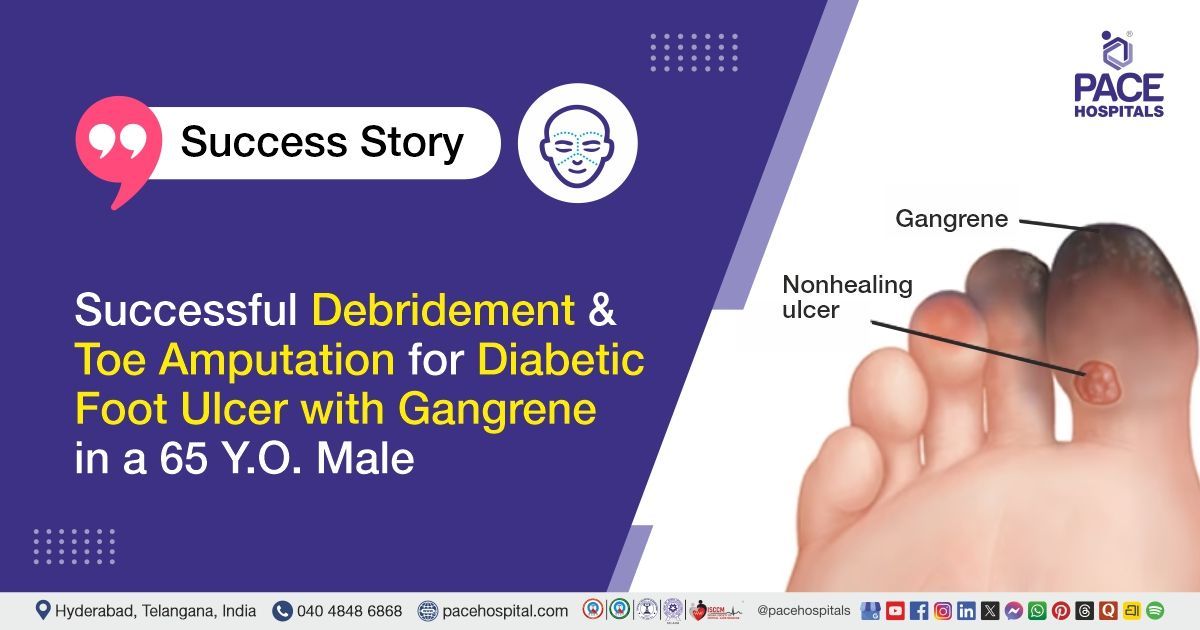
Successful Debridement & Toe Amputation for Diabetic Foot Ulcer with Gangrene in a 65 Y.O. Male
PACE Hospitals
PACE Hospitals' expert Plastic and Reconstructive Surgery team successfully performed Debridement and Amputation of the 1st and 3rd toes of the left foot in a 65-year-old male patient diagnosed with a left diabetic foot ulcer with gangrene affecting the 1st and 3rd toes. The aim of the procedure was to remove infected and gangrenous tissue from the affected toes, prevent the spread of infection to surrounding healthy tissues, promote proper wound healing, and preserve the function of the remaining foot.
Chief Complaints
A 65-year-old male patient with a body mass index (BMI) of 22 presented to the Plastic and Reconstructive Surgery Department at PACE Hospitals, Hitech City, Hyderabad, with complaints of an ulcer over the left foot for the past 2 months, associated with fever, redness of the limb, and pus discharge from the wound.
He had a history of a non-healing ulcer of the left foot, for which he underwent left 2nd toe amputation at an outside facility, followed by VAC dressings. He was also treated conservatively for cellulitis of the left lower limb and subsequently underwent debridement of the foot, followed by VAC dressing.
He then presented with discoloration of the left 1st and 3rd toes along with a persistent ulcer over the left foot for the past 4–5 days.
Past Medical History
The patient was a known case of hypertension and diabetes mellitus and was on regular medication. He had a history of cerebrovascular accident (CVA) 4 years prior and was on antiplatelet therapy. He also had a history of left orchidectomy and had undergone circumcision for phimosis. There were no known allergies.
On Examination
On examination, the patient was conscious, coherent, and oriented. General physical examination revealed no pallor, icterus, cyanosis, clubbing, lymphadenopathy, or pedal edema. Vital parameters were within normal limits. Local examination of the left foot revealed an ulcer with signs of infection, including slough, surrounding erythema, and discharge, along with discoloration of the 1st and 3rd toes suggestive of gangrene. Peripheral findings were consistent with an infected diabetic foot with associated cellulitis.
Diagnosis
Following the clinical examination, the Plastic and Reconstructive Surgery team conducted a thorough assessment, including a detailed review of the patient’s medical and surgical history with presenting complaints of an ulcer over the left foot for the past two months, associated with fever, redness, pus discharge, and discoloration of the left 1st and 3rd toes for the past few days.
A focused evaluation of the left foot was performed. Relevant investigations were reviewed, including complete blood picture (showing WBC count, RBC indices, platelets, differential counts), serum electrolytes (sodium, potassium, chloride), and MRI brain with angiogram to assess neurological status and intracranial vascular changes. These investigations helped assess the extent of infection, tissue necrosis, vascular compromise, and overall systemic health.
To confirm the diagnosis and determine the extent of tissue involvement, the left foot was carefully examined. The assessment revealed a left diabetic foot ulcer with gangrene of the 1st and 3rd toes, with associated cellulitis of the left lower limb.
Based on the confirmed diagnosis, he was advised to undergo Diabetic Foot Ulcer Treatment in Hyderabad, India, with gangrene of the 1st and 3rd Toes under the care of the Plastic and Reconstructive Surgery team to remove necrotic tissue, control infection, promote wound healing, and preserve the function of the remaining foot.
Medical Decision Making(MDM)
After a detailed consultation with Dr. Kantamneni Lakshmi, Senior Consultant Plastic, Reconstructive & Aesthetic Surgeon, along with cross-consultations from Dr. Tripti Sharma (Endocrinologist), Dr. S. Pramod Kumar (Neurologist), Dr. Abhik Debnath (Urologist), and Dr. Seshi Vardhan Janjirala (Cardiologist), a thorough clinical evaluation was performed focusing on the patient’s presentation of a non-healing left foot ulcer with gangrene of the 1st and 3rd toes. Diagnostic imaging and laboratory investigations were reviewed comprehensively to assess the extent of tissue necrosis, infection, and systemic involvement.
It was determined that the patient had a left diabetic foot ulcer with gangrene of the 1st and 3rd toes, associated with cellulitis of the left lower limb. Debridement and amputation of the left foot 1st and 3rd toes along with revision amputation of the 2nd metatarsal, was identified as the most effective intervention to remove necrotic tissue, control infection, and prevent further progression. The patient’s medical history, including diabetes mellitus, hypertension, prior cerebrovascular accident, and ongoing medications, was considered in perioperative planning to minimize surgical risks and optimize recovery.
The patient and his family members were counselled on the severity of the infection, the need for debridement and toe amputation, associated risks, and expected benefits, including infection control and limb preservation. Opinions of the endocrinologist, neurologist, urologist, and cardiologist were incorporated for optimal medical management.
Surgical Procedure
Following the decision, the patient was scheduled to undergo Debridement and amputation of the left foot 1st and 3rd toes surgery in Hyderabad at PACE Hospitals, along with revision amputation of the 2nd metatarsal under the care and supervision of the expert Plastic and Reconstructive Surgery team.
The following steps were carried out during the procedure:
- Anesthesia and Sterile Preparation: The patient was administered spinal anesthesia (S.A.). The left foot was thoroughly cleaned and painted with antiseptic solution. Sterile drapes were applied to maintain a completely aseptic surgical field.
- Incision: A precise incision was made on the plantar surface of the left foot to access the underlying infected and necrotic tissues. The incision was planned to allow adequate exposure of the 1st, 2nd, and 3rd toes and surrounding areas for thorough debridement and amputation.
- Debridement of Necrotic Tissue: All sloughed and infected tissue in the plantar and dorsal aspects of the affected area was meticulously removed. Care was taken to preserve viable tissue while ensuring complete excision of necrotic areas to reduce infection risk.
- Toe Amputation: 1st and 3rd toes were amputated up to the distal metatarsal shafts. Revision amputation of the 2nd metatarsal was performed to remove compromised tissue and ensure healthy margins. The amputations were executed with attention to proper tissue planes and preservation of surrounding structures.
- Hemostasis and Suturing: The operative site was washed thoroughly with sterile solution. Hemostasis was achieved using standard surgical techniques. Stay sutures (1 Ethilon) were applied to secure the tissue edges and maintain proper alignment.
Postoperative Care
During the postoperative period, the patient received medications for infection, anaerobic coverage, gastric protection, pain control, cholesterol management, blood sugar control, water balance, circulation improvement, urinary symptom management, and nutritional supplementation. Two units of Packed Red Blood Cell (PRBC) were transfused. Carotid Doppler showed stenosis, and opinions from the neurologist and interventional cardiologist were obtained. The cardiologist advised a carotid angiogram with possible angioplasty. He remained stable throughout and was discharged in a stable condition with instructions for follow-up and continuation of medications.
Discharge Medications
Upon discharge, the patient was advised to continue medications for infection control, gastric protection, pain relief, cholesterol management, blood thinning, blood sugar control, urinary symptom management, circulation improvement, fluid balance, wound healing, and nutritional supplementation. Topical agents were prescribed for local care of the foot and circumcision wounds. The medications were taken as per the prescribed schedule to ensure optimal recovery and prevent complications.
Advice on Discharge
The patient was advised to maintain limb elevation, undergo daily dressings, and follow proper wound care. He was also advised to adhere to a diabetic high-protein diet to support healing and overall recovery.
Emergency Care
The patient was informed to contact the emergency ward at PACE Hospitals in case of any emergency or development of symptoms like fever, vomiting or wound discharge.
Review and Follow-up Notes
The patient was advised to return for a follow-up consultation with the Consultant Plastic, Reconstructive & Aesthetic Surgeon in Hyderabad at PACE Hospitals after 4 days. He was also advised to review with the Cardiologist for a carotid angiogram and angioplasty after 4 days, and to follow up with the Endocrinologist, Dr. Tripti Sharma, in the OPD after one week.
Conclusion
This case highlights a complex presentation of a left diabetic foot ulcer with gangrene of the 1st and 3rd toes in a patient with multiple comorbidities, including diabetes, hypertension, and prior cerebrovascular accident. The patient underwent successful debridement and toe amputations, was managed with appropriate medical therapy, and remained stable throughout hospitalization. Multidisciplinary consultations were incorporated to optimize recovery and plan follow-up care.
Multidisciplinary Management of Complex Diabetic Foot Ulcers
Effective management of complex diabetic foot ulcers with gangrene requires a multidisciplinary approach involving a Plastic surgeon / Plastic surgery doctor along with other specialists. Early surgical intervention, including debridement and selective amputations when necessary, is essential to control infection and prevent further tissue loss. Close monitoring and optimization of comorbid conditions, such as diabetes, hypertension, and cerebrovascular disease, support stable recovery.
Integration of consultations from endocrinology, neurology, cardiology, and urology ensures comprehensive medical management and minimizes perioperative risks. Timely imaging and vascular assessment guide both immediate care and planning for future interventions. Structured postoperative wound care, limb elevation, and dietary management reinforce healing and functional recovery. Coordinated care, individualized planning, and careful follow-up are pivotal in achieving positive outcomes in high-risk patients.
Share on
Request an appointment
Fill in the appointment form or call us instantly to book a confirmed appointment with our super specialist at 04048486868
Appointment request - health articles
Recent Articles