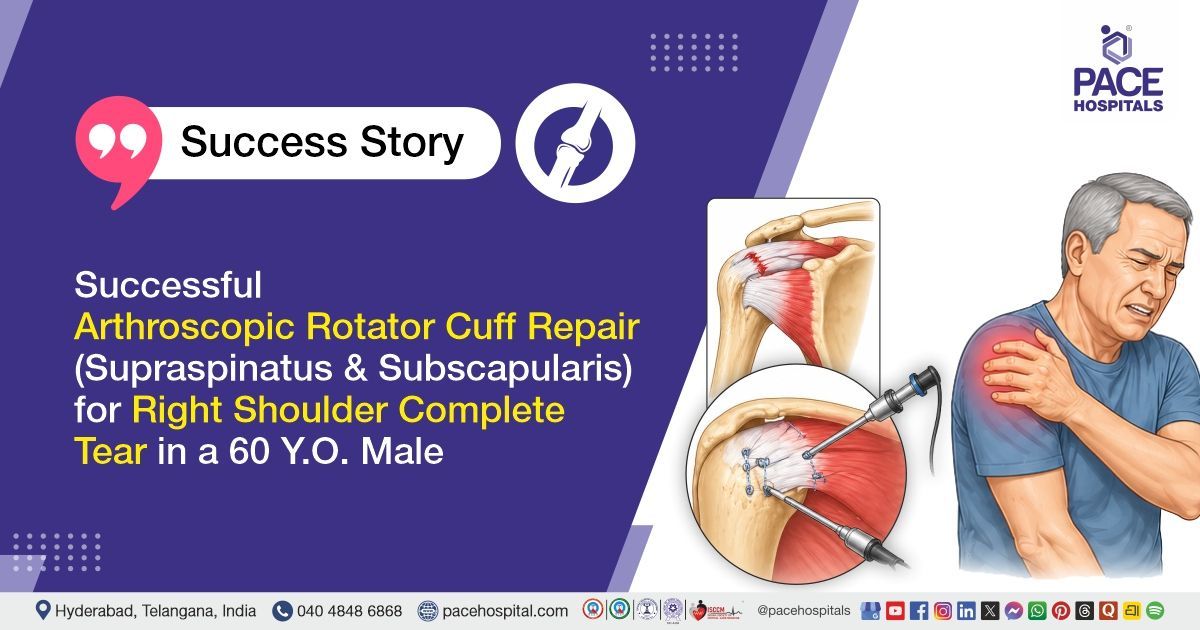
Successful Arthroscopic Rotator Cuff Repair for Complete Tear of Right Shoulder
PACE Hospitals
PACE Hospitals’ expert orthopaedic team successfully performed Diagnostic Arthroscopy followed by Subscapularis Repair, Subacromial decompression, Supraspinatus repair surgery, along with autologous platelet concentrate therapy, on a 60-year-old male patient diagnosed with a complete tear of the supraspinatus and subscapularis tendons of the right shoulder with subacromial bursitis and impingement syndrome. The aim of the procedure was to restore shoulder stability and function, relieve pain, improve range of motion, and prevent further degenerative changes.
Chief Complaints
A 60-year-old male patient with a body mass index (BMI) of 21, presented to the Orthopaedic Department at PACE Hospitals, Hitech City, Hyderabad, with complaints of pain over the right shoulder joint, associated with difficulty in carrying out daily routine activities like movements over the right shoulder or lifting weights. The patient was admitted for further management. There was no history of trauma, any other joint pain, known drug allergies, or chronic illness.
Past Medical History
The patient had no significant past medical history. There was no history of trauma, chronic medical illnesses, prior surgeries, or known drug allergies.
On Examination
On examination, the patient was conscious, coherent, and oriented. He was afebrile and hemodynamically stable, with normal respiratory status and adequate oxygen saturation on room air. Systemic examination revealed normal cardiovascular and respiratory findings, with no abnormalities detected in the abdominal or neurological systems.
Local examination of the right shoulder showed tenderness over the acromioclavicular joint and bicipital groove. There was restriction and pain during abduction beyond mid-range, along with significantly limited internal and external rotation due to pain. The Neer impingement test was positive, while the Hawkins test was negative. No distal neurovascular deficits were noted.
Diagnosis
Following the clinical evaluation, the Orthopaedic team at PACE Hospitals conducted a detailed assessment focusing on the patient’s complaints of right shoulder pain associated with difficulty in performing daily activities such as shoulder movements and lifting weights.
A comprehensive clinical and systemic examination was carried out to determine the severity of the condition. Examination of the right shoulder revealed tenderness over the acromioclavicular joint and bicipital groove. There was painful and restricted abduction beyond mid-range, along with gross limitation of internal and external rotation due to pain. The Neer impingement test was positive, suggestive of impingement pathology. No distal neurovascular deficit was noted. Systemic examination was within normal limits.
Based on these findings, the patient was advised to undergo
Complete rotator cuff tear Treatment in Hyderabad, India, under the care of the Orthopaedic Department to relieve pain, restore shoulder function, improve range of motion, and prevent further degenerative changes.
Medical Decision Making (MDM)
After a detailed consultation with Dr. Anand Agroya, Senior Orthopaedic Consultant, along with cross consultation with Dr. Snigda Panuganti, General Physician, a comprehensive evaluation was carried out considering the patient’s clinical symptoms of right shoulder pain associated with significant difficulty in performing daily activities such as lifting objects and overhead movements, along with restriction of the shoulder range of motion. The findings were correlated with clinical examination and radiological investigations, which revealed a complete tear of the supraspinatus and subscapularis tendons associated with subacromial bursitis and impingement syndrome of the right shoulder.
Based on the clinical presentation and examination findings, it was determined that arthroscopic subscapularis repair, supraspinatus repair, and subacromial decompression with autologous platelet concentrate therapy were the most appropriate therapeutic interventions. This decision was made with the intent to relieve pain, restore shoulder stability and function, repair the torn rotator cuff tendons, improve range of motion, and prevent further degenerative changes and long-term disability.
The patient and his family members were counselled regarding the diagnosis, the planned procedure, potential risks and benefits, postoperative care including immobilization and physiotherapy, expected recovery course, and the importance of regular follow-up for optimal functional outcomes.
Surgical Procedure
Following the diagnosis, the patient was scheduled to undergo Arthroscopic Subscapularis Repair, Supraspinatus Repair, and Subacromial Decompression Procedure in Hyderabad at PACE Hospitals under the supervision of the expert Orthopaedic Department.
The surgical procedure involved the following steps:
- Anaesthesia and Patient Positioning: The patient was administered general anaesthesia and positioned in the beach chair position. The right shoulder was carefully prepared and draped under strict aseptic conditions to ensure a sterile surgical field.
- Arthroscopic Portals and Diagnostic Evaluation: Standard arthroscopic portals (posterior, anterior, and lateral) were created. A diagnostic arthroscopy of the right shoulder joint was performed to evaluate intra-articular structures and confirm pathological findings.
- Intraoperative Findings Assessment: During arthroscopy, subacromial bursitis, Type III acromion, complete tears of the supraspinatus and subscapularis tendons, thickening of the superior and inferior glenohumeral ligaments, and fraying at the biceps tendon attachment were identified.
- Arthroscopic Repair and Decompression: Arthroscopic subscapularis repair and supraspinatus repair were performed using Sironix implants (Ceptre knotted PEEK sutures and Viplok knotless PEEK suture with titanium tip). Subacromial decompression was carried out to relieve impingement and improve subacromial space.
- Completion of Procedure and Closure: Autologous platelet concentrate system (Cyonics) was applied to enhance healing. Hemostasis was achieved, portals were sutured, a sterile dressing was applied, and the shoulder was immobilised. The procedure was completed successfully without complications.
Postoperative Care
Postoperatively, the patient was started on intravenous medications for infection prevention and pain control. The operated shoulder was supported with a shoulder immobilizer to protect the repair and aid healing. On postoperative day 1, the dressing was changed under sterile precautions and an X-ray confirmed proper implant positioning. The patient remained hemodynamically stable throughout the hospital stay. He was discharged with follow-up instructions.
Discharge Medications
Upon discharge, the patient was prescribed medications for the prevention of postoperative infection, control of pain and inflammation, and protection of the gastrointestinal tract. Additional medication was advised for relief of severe breakthrough pain if required. He was also continued on treatment for blood pressure control along with medication to maintain cardiovascular stability, including regulation of heart rate and blood pressure within normal limits.
Advice on Discharge
The patient was advised to continue regular shoulder range of motion exercises as instructed to support rehabilitation and improve joint mobility and functional recovery.
Emergency Care
The patient was advised to contact the
emergency ward at PACE Hospitals immediately in case of any emergency or if symptoms such as fever, increasing shoulder pain, or persistent vomiting occur.
Review and Follow-up Notes
The patient was advised to return for follow-up with the
Orthopaedic Doctor in Hyderabad at PACE Hospitals, after 5 days for wound dressing review in case of any soakage.
Conclusion
This case highlights a complete tear of the supraspinatus and subscapularis tendons associated with subacromial bursitis and impingement syndrome of the right shoulder. Arthroscopic rotator cuff repair with subacromial decompression was performed successfully using suture anchor fixation. The postoperative period was uneventful with stable clinical recovery. The patient was discharged in stable condition with advice for rehabilitation and follow-up.
Role of Arthroscopic Management in Complex Shoulder Pathologies
Arthroscopic techniques performed by an
Orthopaedic Doctor/Orthopaedic Surgeon have become the standard approach for managing complex shoulder disorders involving rotator cuff tears and impingement syndromes. They allow accurate visualization of intra-articular pathology with minimal soft tissue disruption. Repair of torn tendons using suture-based fixation provides stable anatomical reconstruction and promotes biological healing. Subacromial decompression effectively addresses mechanical impingement and reduces pain. The addition of biological augmentation may further enhance tendon healing and functional recovery. Compared to open procedures, arthroscopy offers reduced morbidity, faster rehabilitation, and improved postoperative outcomes. Overall, it plays a key role in restoring shoulder function and preventing long-term degenerative changes.
Frequently Asked Questions (FAQs)
What is the benefit of arthroscopy for this shoulder surgery?
Arthroscopy is a small-cut surgery done using a camera to see inside the shoulder joint. It helps the surgeon repair the damaged tendons with better accuracy. Since only small cuts are made, there is less pain after surgery. Healing is usually faster compared to open surgery. It also reduces scarring and allows early recovery.
Why were both supraspinatus and subscapularis tendons repaired?
Both tendons were completely torn (pulled apart into pieces), which affects shoulder strength and movement. Repairing only one tendon would not restore full function. Fixing both helps improve the stability of the shoulder joint. It also allows better lifting and rotation of the arm. This combined repair gives better long-term results.
Why is subacromial decompression done along with tendon repair?
Subacromial decompression helps create more space inside the shoulder. It removes pressure on the tendons during movement. Without this, the repaired tendon may get compressed again. It lessens pain and improves smooth movement. This step supports proper healing after surgery.
How long does recovery take after this combined shoulder surgery?
Recovery after this surgery usually happens in stages over a few months. Initial healing takes a few weeks, during which movement is limited. Gradually, exercises are started to improve motion and strength. Most daily activities can be resumed in 6–12 weeks. Full recovery and strength may take around 4–6 months, depending on healing.
Why was impingement treated during the same procedure?
Impingement means the tendon is getting pressed during shoulder movement. This can cause repeated damage and pain. Treating it during surgery helps prevent further injury. It allows smoother movement of the shoulder joint. It also improves the success of the tendon repair.
Why is a shoulder immobilizer needed after surgery?
A shoulder immobilizer is used to keep the arm in a fixed position. It protects the repaired tendon in the early healing stage. Sudden movements can disturb the repair. Keeping the shoulder still helps proper attachment of the tendon. Movement starts slowly after some time.
What are the possible risks after this type of surgery?
Some risks can occur after surgery, although they are not common. These include infection, stiffness, or re-tear of the tendon. Mild pain and swelling may be present in the beginning. In rare cases, nerve or implant-related problems may occur. Proper care and follow-up help reduce these risks.
How important are exercises after rotator cuff repair?
Exercises are very important for proper recovery after surgery. They help restore shoulder movement gradually. Without exercise, stiffness can develop in the joint. Strength also improves with regular physiotherapy. Following the advised exercise plan gives better long-term results.
What does subacromial bursitis mean in this case?
Subacromial bursitis means there is swelling in a fluid-filled sac in the shoulder. This sac helps smooth the movement of tendons. When inflamed, it causes pain and discomfort. It is commonly seen with rotator cuff tears. Treating it helps reduce pain and improve shoulder function.
How do suture anchors help in tendon repair?
Suture anchors are small devices used to attach the torn tendon to the bone. They hold the tendon firmly in place during healing. This allows the tendon to reattach properly over time. They remain inside the body and are usually safe. They support a strong and stable repair of the tendon.
Share on
Request an appointment
Fill in the appointment form or call us instantly to book a confirmed appointment with our super specialist at 04048486868
Appointment request - health articles
Recent Articles