World Malaria Day, 25 April 2026 - Theme and Importance
PACE Hospitals
World Malaria Day is a global healthcare awareness event observed annually on the 25th of April, a global call to various local and government healthcare authorities and policymakers to promote the action required to combat and eradicate malaria.
A parasitic infection, malaria, is spread by the female (Anopheles) mosquito and can cause severe, sometimes fatal illness. Malaria threatens 200 crore people every year, including residents of 90 endemic countries and 12.5 crore international tourists. Plasmodium parasites acquire a complex life cycle that results in periodic fevers. Most patients recover quickly from malaria symptoms after treatment, but severe complications such as severe malarial anaemia, cerebral malaria, coma, or death can occur if treatment is delayed.
World Malaria Day 2026 Theme
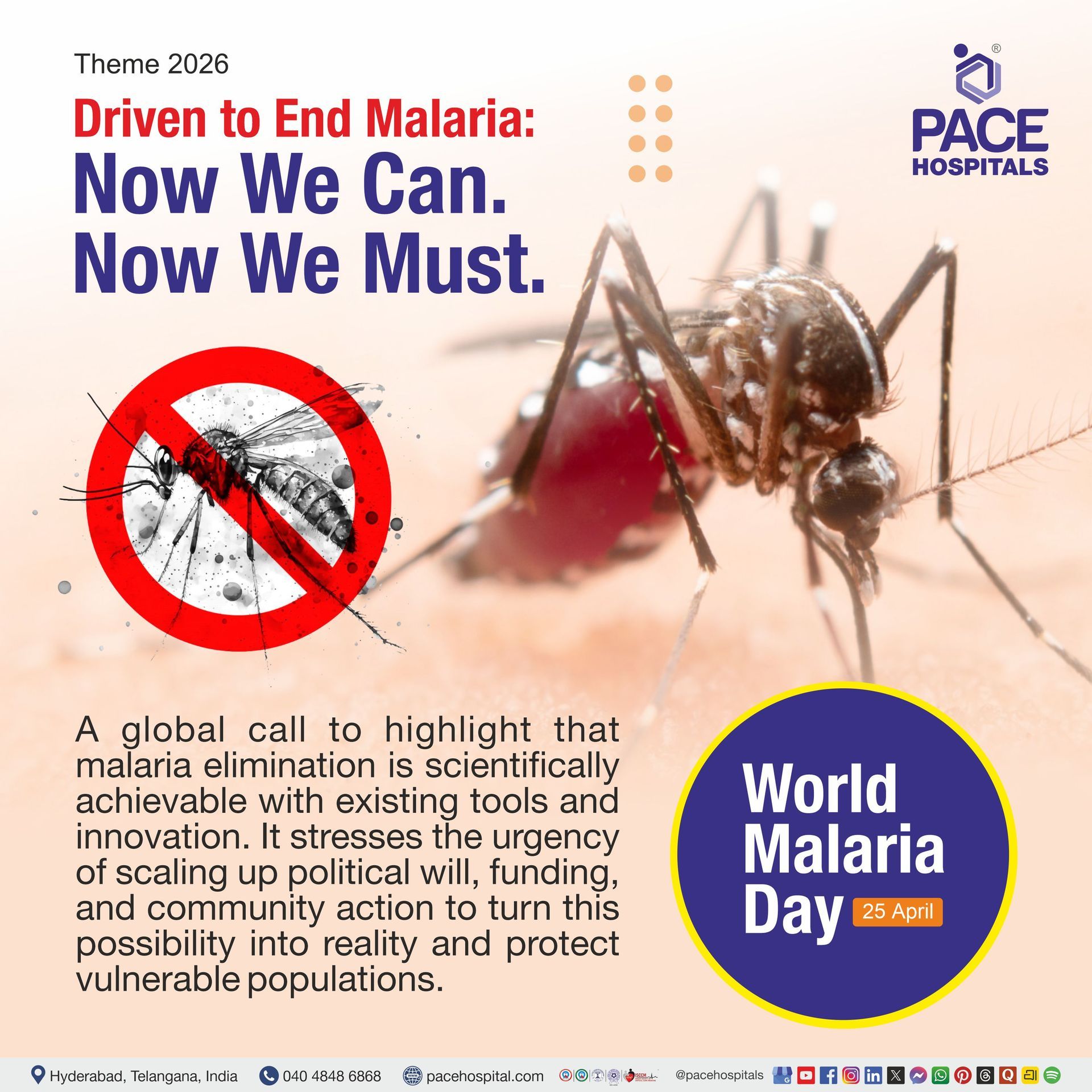
This year, 2026, the World Malaria Day theme is “Driven to End Malaria: Now We Can. Now We Must.” This theme highlights that malaria elimination is scientifically achievable with existing tools and innovation. It stresses the urgency of scaling up political will, funding, and community action to turn this possibility into reality and protect vulnerable populations.
Year-by-year World Malaria Day theme
- World Malaria Day 2025 Theme: Malaria Ends With Us: Reinvest, Reimagine, Reignite
- World Malaria Day 2024 Theme: Accelerating the fight against malaria for a more equitable world.
- World Malaria Day 2023 Theme: Time to deliver zero malaria: invest, innovate, implement
- World Malaria Day 2022 Theme: Harness innovation to reduce the malaria disease burden and save lives
- World Malaria Day 2021 Theme: Reaching the zero-malaria target
- World Malaria Day 2020 Theme: Zero malaria starts with me
- World Malaria Day 2019 Theme: Zero malaria starts with me
- World Malaria Day 2018 Theme: Ready to beat malaria
Importance of World Malaria Day (WMD)
Malaria is precisely one of the deadliest parasitic diseases in the world, accounting for over 21.9 crore cases and 4.35 lakh deaths in 2017 globally. In order to curb the count, increasing awareness about this disease and its prevention is a top priority, which includes educating the public on early symptoms, precautions, and treatment options. Research studies have shown early diagnosis, and treatment of malaria can reduce the mortality rate by increasing awareness of malaria symptoms and its prevention.
World Malaria Day is a platform to grab global attention and aid in reducing the risk of people being affected. This was evident in the year 2020, where due to the COVID-19 pandemic, there was a disruption in the awareness services by the World Health Organization (WHO), leading to a spike in malaria cases per 1000 people (from 81/1000 people in 2000 to 56/1000 people in 2019 followed by 59/1000 people in 2020). The mortality (death) rate in 2020 has increased to 12% compared to 2019. Worldwide, it was estimated that between 2000 and 2020, 106 lakh malaria deaths and 170 crore malaria cases were prevented. The WHO African Region had the greatest percentage of cases (82%) and deaths (95%) prevented, followed by the WHO South-East Asia Region (cases 10% and deaths 2 %).
History of World Malaria Day (WMD)
World Malaria Day, which was first commemorated in 2008, had evolved from Africa Malaria Day, which had been honoured by African countries since 2001. The commemoration provided an opportunity to evaluate the status of objectives targeted at preventing malaria and lowering its mortality in African nations. In 2007, it was proposed that Africa Malaria Day be renamed World Malaria Day at the 60th session of the World Health Assembly (a gathering hosted by the World Health Organization) in order to acknowledge the prevalence of malaria around the world and to raise awareness of the global campaign to eradicate the disease.
Prevention of Malaria disease
The following measures can help reduce the risk of mosquito bites
- Apply 20-35% N, N-Diethyl-Meta-Toluamide insect repellents to the body
- When outside at night, wear a dress with long sleeves and long pants
- Use mosquito nets over the bed during the night
- Before going to bed, spray pyrethrin or a related insecticide in the bedroom
- Never allow stagnant water in household surroundings
- Always close the water tubs with a lid
Share on
Request an appointment
Fill in the appointment form or call us instantly to book a confirmed appointment with our super specialist at 04048486868
Appointment request - health articles
Recent Articles