Successful Bilateral Liposuction and Gland Excision for Gynecomastia
PACE Hospitals
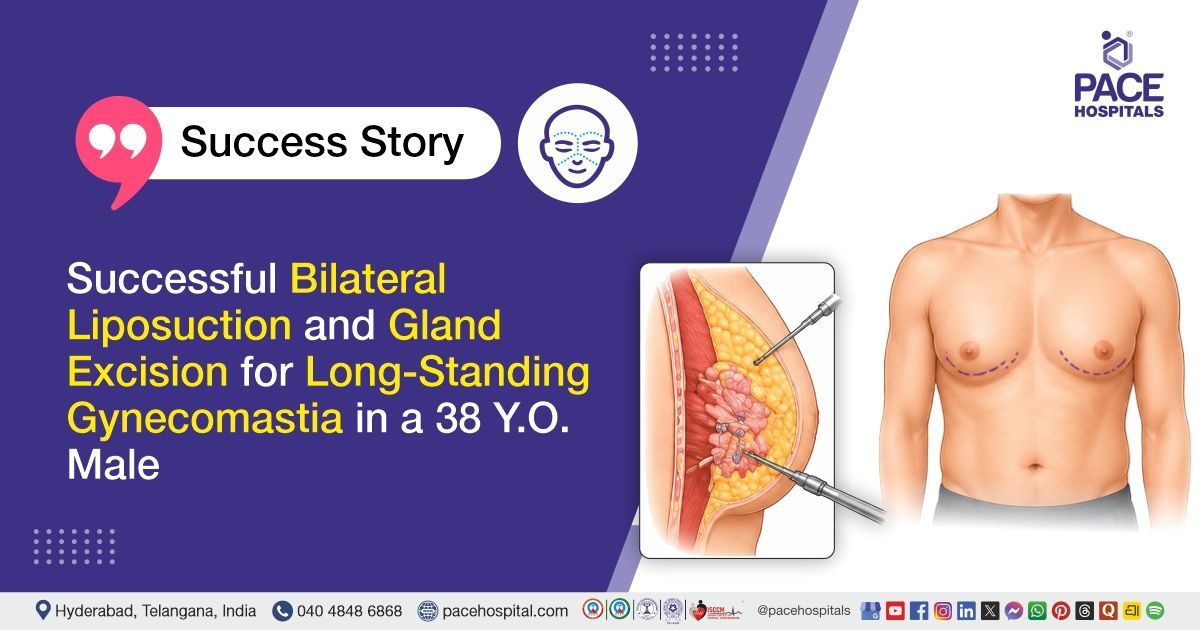
PACE Hospitals’ expert Plastic and Reconstructive Surgery team successfully performed Bilateral Liposuction and Gland Excision on a 38-year-old male patient diagnosed with bilateral gynecomastia Grade IIB, with the aim of correcting enlarged male breast tissue by removing excess fat and glandular tissue to restore a normal male chest contour.
Chief Complaints
A 38-year-old male with a body mass index (BMI) of 20 presented to the Plastic and Reconstructive Surgery Department at PACE Hospitals, Hitech City, Hyderabad, with complaints of bilateral chest enlargement for the past 15 years. The condition was long-standing and not associated with pain or any other symptoms.
Past Medical History
The patient was a known case of diabetes mellitus, and he was on regular medications. He had no history of hypertension, cardiovascular disease, or other chronic medical illnesses. He also had no known drug allergies.
On Examination
On examination, the patient was conscious, coherent, and oriented. There were no signs of pallor, icterus, cyanosis, lymphadenopathy, clubbing, or pedal edema. The general physical examination did not reveal any abnormalities. Vital signs were stable at the time of assessment.
Diagnosis
Following the clinical examination, the Plastic and Reconstructive Surgery team conducted a thorough assessment, including a detailed review of the patient’s medical history and presenting complaints of bilateral chest enlargement for 15 years, with no associated history of pain or other acute symptoms.
A focused clinical examination of the chest was performed to assess the extent and nature of the enlargement. Relevant clinical parameters were evaluated to rule out associated systemic or endocrine causes. The assessment primarily focused on identifying the degree of breast enlargement, the presence of glandular and fatty tissue, the symmetry of the chest wall, and any signs of underlying pathology.
To confirm the diagnosis, the chest examination findings were carefully correlated with clinical features. The evaluation revealed findings consistent with bilateral gynecomastia Grade IIB, indicating moderate to significant enlargement of male breast tissue due to a combination of glandular proliferation and fatty deposition.
Based on the confirmed diagnosis, the patient was advised to undergo Bilateral Gynecomastia Grade- IIB Treatment in Hyderabad, India, under the Plastic and Reconstructive Surgery team to remove excess fat and glandular tissue, correct chest contour deformity, and restore a more natural male chest appearance.
Medical Decision Making (MDM)
After a detailed consultation with Dr. Kantamneni Lakshmi, Senior Consultant Plastic, Reconstructive & Aesthetic Surgeon, a comprehensive evaluation was performed to determine the most appropriate diagnostic and therapeutic approach. Considering the patient’s long-standing history of bilateral chest enlargement for 15 years with no associated pain, along with clinical findings of excess fatty and glandular breast tissue, a focused examination of the chest was undertaken to assess the degree of deformity, symmetry, and tissue composition. The clinical assessment was consistent with bilateral gynecomastia Grade IIB, indicating moderate to significant enlargement due to both glandular proliferation and fatty deposition.
Based on the clinical findings and confirmed diagnosis, it was determined that bilateral liposuction with gland excision under general anesthesia was the most appropriate intervention to remove excess fat and glandular tissue, correct the chest contour deformity, and restore a natural male chest appearance, while also improving cosmetic outcome and patient satisfaction.
The patient and his family members were thoroughly counselled regarding the diagnosis, indication for surgery, procedural details, possible risks, benefits, and expected postoperative recovery course. Informed consent was obtained after ensuring their complete understanding and agreement with the proposed treatment plan.
Surgical Procedure
Following the diagnosis, the patient was scheduled to undergo Bilateral Liposuction Surgery in Hyderabad at PACE Hospitals, along with Gland Excision under the supervision of the expert Plastic and Reconstructive Surgery team.
The surgical procedure involved the following steps:
Anesthesia and Sterile Preparation: The procedure was performed under general anesthesia in strict aseptic conditions. The chest area was properly painted, draped, and prepared to maintain a sterile surgical field.
Port Placement and Tumescent Infiltration: Bilateral 5 mm axillary ports were inserted to access the chest area. Tumescent fluid (500 ml on each side) was infiltrated into the breast tissue to aid fat breakdown, reduce bleeding, and facilitate easier liposuction.
Liposuction Procedure: Liposuction was carried out on both sides of the chest, and approximately 600 ml of fatty tissue was aspirated from each side to reduce excess fat and improve chest contour.
Gland Excision: Bilateral inferior periareolar incisions were made, and the enlarged glandular tissue was carefully excised. The excised gland weighed 294 g on the right side and 322 g on the left side.
Hemostasis, Closure, and Dressing: Hemostasis was achieved, and the surgical site was irrigated with saline wash. The wound was closed in layers using 3-0 Vicryl and 3-0 Monocryl sutures. An aseptic dressing was applied, and a compression garment was placed. The procedure was completed uneventfully.
Postoperative Care
The postoperative period was uneventful, and the patient remained stable throughout recovery. Postoperative care was provided to prevent infection, control pain, and support proper wound healing. The patient was closely monitored for bleeding, discomfort, and any early complications, and supportive measures were given to ensure a smooth recovery. The patient showed good clinical progress and was discharged in stable condition with advice for follow-up and proper wound care at home.
Discharge Medications
The patient was discharged with medications aimed at preventing postoperative infection, reducing acidity and gastric irritation, relieving pain and inflammation, and supporting faster tissue healing. Additional treatment was advised to improve digestion, enhance nutritional recovery, and provide overall immune and metabolic support. Medications were also continued for optimal control of blood sugar levels. The patient was instructed to take all medicines regularly as prescribed and follow dietary and hydration advice for better recovery.
Advice on Discharge
The patient was advised to follow a diabetic high-protein diet to support healing and maintain blood sugar control. Proper wound care should be maintained to prevent infection and promote recovery. The patient was instructed to avoid lifting heavy weights and excessive chest movements during the recovery period. Continuous use of a compression garment for 6 weeks, both day and night, was recommended to support healing and improve chest contour.
Emergency Care
The patient was informed to contact the emergency ward at PACE Hospitals in case of any emergency or development of symptoms such as fever, increasing pain or swelling at the surgical site, wound discharge, or any signs of infection.
Review and Follow-up Notes
The patient was advised to return for a follow-up consultation with the Consultant Plastic, Reconstructive & Aesthetic Surgeon in Hyderabad at PACE Hospitals after 2 days.
Conclusion
This case highlights successful management of bilateral gynecomastia Grade IIB using combined liposuction and gland excision under general anesthesia. The procedure effectively corrected chest contour deformity with a good aesthetic outcome and no intraoperative or postoperative complications. The recovery was smooth, and the condition was well-controlled with appropriate postoperative care and follow-up planning.
Combined Surgical Approach in Gynecomastia Management
Gynecomastia is a common condition that can significantly affect physical appearance and psychological well-being. In moderate to severe cases, a combination of liposuction and gland excision is often preferred to effectively address both fatty and glandular components of breast enlargement. This dual approach helps achieve a more defined and natural male chest contour compared to a single technique. Careful preoperative evaluation by a Plastic surgeon / Plastic surgery doctor is essential to rule out underlying causes and ensure patient safety. Minimally invasive techniques are widely used to reduce scarring and improve cosmetic outcomes. Postoperative care, including compression therapy and follow-up, plays a key role in achieving optimal long-term results and reducing recurrence risk. Overall, appropriate case selection and a tailored surgical plan are crucial for maximizing patient satisfaction and functional as well as aesthetic improvement.
Frequently Asked Questions (FAQs)
What is the recovery process after gynecomastia surgery?
After surgery, wearing a compression garment is necessary to help reduce swelling and support healing. It’s important to avoid heavy lifting and strenuous activities for at least six weeks. Mild discomfort is common and can be controlled with pain medication. Follow-up visits with the surgeon will help track recovery, and most patients can return to light activities within a few days.
How soon can normal activities be resumed after surgery?
Light daily activities can typically be resumed a few days after surgery. However, strenuous exercises, including lifting heavy items or doing intense physical activity, should be avoided for at least six weeks. Following the surgeon’s advice will aid in a faster recovery, and once the six weeks pass, patients can slowly return to their usual activities. It’s crucial to avoid rushing recovery.
What is the purpose of the compression garment post-surgery?
The compression garment helps reduce swelling and supports the healing chest tissue. It aids in maintaining the desired shape of the chest and reduces the chance of complications. Wearing the garment consistently for six weeks, as advised, helps the skin adapt to the new chest contour, improving overall results.
Will there be visible scars after gynecomastia surgery?
Scars are a normal part of surgery, but the surgeon aims to make incisions in areas that are less noticeable, such as under the areola. Over time, these scars typically fade and become less visible. Proper care and following post-surgical instructions help reduce scarring, and with time, most scars become inconspicuous.
How does the surgery address both liposuction and gland excision?
The surgery uses two techniques: liposuction to remove excess fat and gland excision to remove abnormal tissue. Liposuction targets the fatty parts, and gland excision removes the glandular tissue causing gynecomastia. This combination ensures a smoother and more natural chest contour, with both procedures done through small incisions.
Is surgery safe for someone with diabetes?
The surgery can be safely performed on diabetic patients if their blood sugar levels are well-controlled before and after the procedure. Diabetic patients should get approval from their doctor beforehand. After surgery, blood glucose levels should be closely monitored, and hydration maintained. Healing may take longer, but with proper care, risks remain low.
How is post-surgical pain managed?
Post-surgical pain is typically mild and can be controlled with pain medication. Most patients feel discomfort for a few days, but it usually fades quickly. Swelling and tenderness around the chest area may occur but will lessen over time. If pain becomes severe or does not improve, it is important to contact the healthcare provider.
What precautions should be taken after surgery to prevent complications?
It’s important to follow the surgeon’s post-surgery instructions, such as wearing the compression garment and avoiding heavy lifting or excessive chest movement. Rest is essential to allow the body to heal properly. Any signs of infection, like redness, fever, or unusual pain, should be reported to the surgeon immediately. Keeping the surgical area clean is also important.
How long does it take for the results of the surgery to become apparent?
Results begin to show within a few weeks, but it can take several months for the final results to be fully visible. Swelling will decrease, and the improved chest shape will gradually appear. Healing continues for up to six months, so it's important to avoid rushing judgment about the results during this time. Regular follow-up visits will track progress.
Are there any long-term effects or risks associated with the surgery?
Long-term risks are minimal, though mild skin irregularities or changes in nipple sensitivity can occur. Scars may take time to heal, but are usually discreet. Infection or uneven healing can happen if proper care is not followed. Overall, the surgery has a high success rate, and continued follow-up care ensures lasting results.
Share on
Request an appointment
Fill in the appointment form or call us instantly to book a confirmed appointment with our super specialist at 04048486868
Appointment request - health articles
Recent Articles