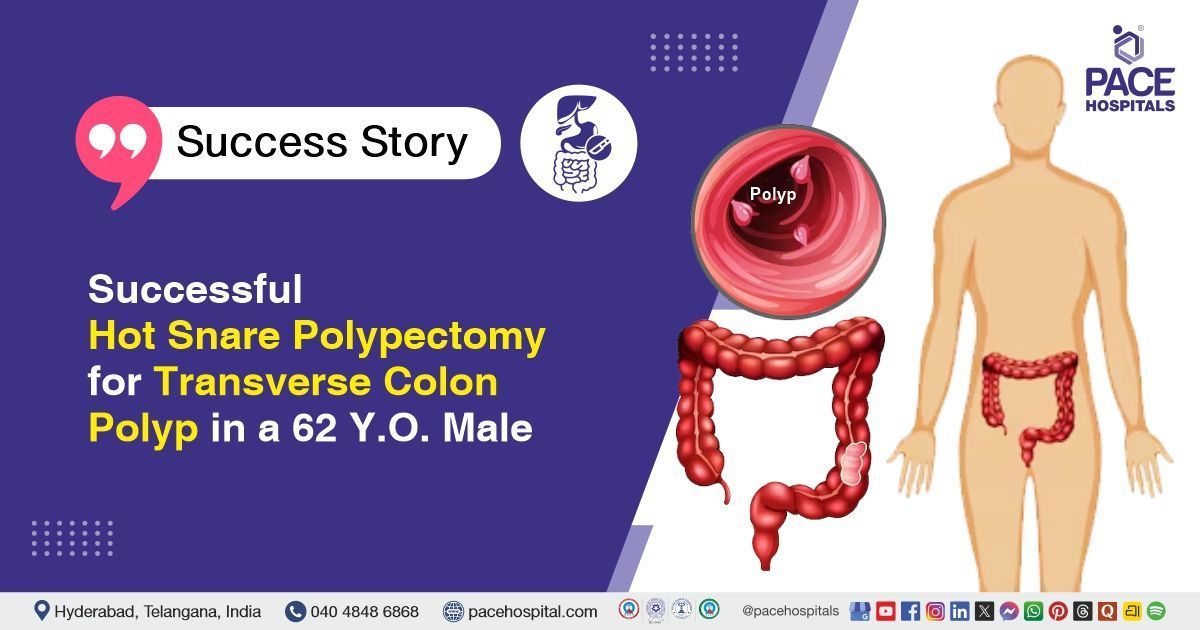
Successful Hot Snare Polypectomy for Transverse Colon Polyp in a 62 Y.O. Male
PACE Hospitals
PACE Hospitals’ expert Gastroenterology team successfully performed a Transverse Colon Hot Snare Polypectomy on a 62-year-old male patient who was diagnosed with a transverse colon polyp, non-oliguric acute kidney injury secondary to acute tubular necrosis (recovered), Escherichia coli urinary tract infection, ethanol-related acute pancreatitis, and scabies with lichenification.
Chief Complaints
A 62-year-old male with a
body mass index (BMI) of 20 presented to the Gastroenterology Department at
PACE Hospitals, Hitech City, Hyderabad, with chief complaints of fever for the past one day associated with generalised weakness, lower backache, and intermittent epigastric abdominal pain.
Past Medical History
The patient had a decades-long history of chronic alcohol use. He was a known case of type 2 diabetes mellitus and systemic hypertension on regular treatment. He had a prior history of supraventricular tachycardia, for which he underwent radiofrequency ablation. He had also been previously hospitalized for severe alcohol-related acute pancreatitis, complicated by acute kidney injury, sepsis, respiratory failure, and transient cardiac dysfunction, iron deficiency anemia, and scabies with lichenoid eruption all of which were managed conservatively with intensive supportive care.
On Examination
On general examination, the patient was conscious, coherent and oriented. Vital signs were within normal limits. Oxygen saturation was adequate on room air. Per abdomen examination revealed a soft, non-tender abdomen. No other abnormal findings were noted.
Diagnosis
Upon admission to PACE Hospitals, the patient was thoroughly evaluated by the Gastroenterology team. The patient presented with a history of fever associated with generalized weakness, lower back ache, and intermittent epigastric abdominal pain.
The patient underwent necessary investigations. Laboratory evaluation revealed anemia, deranged renal parameters suggestive of non-oliguric acute kidney injury secondary to acute tubular necrosis, elevated pancreatic enzymes consistent with acute pancreatitis, and urine culture positive for Escherichia coli. Imaging studies including ultrasound abdomen and CT abdomen showed features suggestive of resolving acute pancreatitis. MRCP revealed no evidence of common bile duct dilatation with a normal-caliber pancreatic duct. Upper gastrointestinal endoscopy and colonoscopy were performed, which revealed a transverse colon polyp. 2D echocardiography was suggestive of moderate-to-severe aortic regurgitation (AR); cardiology referral was obtained for clearance, including coronary angiogram (CAG), which advised mild cardiac risk.
Based on the confirmed diagnosis, the patient was advised to undergo Transverse Colon Polyp Treatment in Hyderabad, India, under the expert care of the Gastroenterology Department, to remove the polyp and prevent potential complications, including bleeding or malignant transformation.
Medical Decision Making (MDM)
After a detailed consultation with gastroenterologist Dr. Govind Verma, Dr. M Sudhir, Dr. Padma Priya, and Cross Consultation with nephrologist Dr. A Kishore Kumar, Dermatologist Dr. Shiva Shankar Marri, cardiologist, Dr. Seshi Vardhan Janjirala, and pulmonologist Dr. Pradeep Kiran Panchadi, a comprehensive evaluation was carried out in view of patient complaints of fever, generalized weakness, lower back ache, and intermittent epigastric abdominal pain, and the background of ethanol-related acute pancreatitis, type 2 diabetes mellitus, and systemic hypertension. All relevant laboratory investigations, urine culture reports, renal function trends, inflammatory markers, and imaging findings were reviewed.
Based on clinical assessment and investigation results, the patient was found to have an E. coli urinary tract infection with non-oliguric acute kidney injury (ATN pattern) along with resolving alcohol-related acute pancreatitis. Further evaluation revealed a transverse colon polyp, and detailed assessment through upper gastrointestinal endoscopy, colonoscopy, cardiac evaluation, and histopathological examination was undertaken to fully characterise the condition and associated risks.
It was determined that Transverse colon Hot snare Polypectomy was identified as the most appropriate intervention for complete and definitive polyp removal.
The patient and his family were counselled on the diagnosis, including infection, renal involvement, resolving pancreatitis, and colonic polyp pathology, the planned management, its associated risks, and its potential to improve health and quality of life.
Surgical Procedure
Following the decision, the patient was scheduled to undergo a Transverse colon Hot snare Polypectomy procedure in Hyderabad at PACE Hospitals under the expert care of the Gastroenterology Department.
The following steps were carried out during the procedure:
- Preparation and Sedation: The patient was positioned in the left lateral decubitus position. Conscious sedation was administered, and vital signs were continuously monitored.
- Colonoscope Insertion and Visualization: The colonoscope was advanced to the transverse colon. The polyp was identified, and its size, morphology, and location were carefully assessed.
- Polyp Resection: A snare device was placed around the base of the polyp. Electrocautery (hot snare) was applied to excise the polyp and achieve hemostasis.
- Specimen Retrieval: The excised polyp was retrieved through the colonoscope for histopathological examination.
- Site Inspection: The polypectomy site was examined for completeness of resection and any bleeding. Hemostatic measures were applied as necessary.
Postoperative Care
During the course of the hospital stay, the patient was managed with treatment for hydration, infection, acid-related gastrointestinal protection, cholesterol management, and heart protection. Histopathological examination was suggestive of tubular adenoma with low-grade dysplasia. The patient improved symptomatically and is being discharged with medications for continued management of these conditions.
Discharge Medications
Upon discharge, the patient was prescribed treatment for infection, acid-related gastrointestinal protection, bone and mineral supplementation, cholesterol management, blood pressure and heart support, blood sugar management, stomach lining protection, relief of itching or allergic symptoms, urinary tract infection management, and constipation relief. Additionally, topical treatments were prescribed for local skin conditions, general skin moisturization, and anti-inflammatory skin care. All medications were to be taken as advised for the specified durations, with some continued long-term as indicated.
Advice on Discharge
The patient was advised to follow a low-fat diet and a diabetic diet plan to support overall health, manage blood sugar levels, and promote recovery.
Emergency Care
The patient was informed to contact the emergency ward at PACE Hospitals in case of any emergency or development of symptoms such as fever, abdominal pain, vomiting.
Review and Follow-up Notes
The patient was advised to return for a follow-up with the Gastroenterologist in Hyderabad at PACE Hospitals after 2 weeks for further evaluation. He was also advised to review with the Nephrologist after 2 weeks with renal function test reports, with the Dermatologist after 2 weeks for scabies with lichenification, and with the Endocrinologist after 2 weeks with FBS, PLBS, and HbA1C reports.
Conclusion
This case highlights a patient with non-oliguric AKI (ATN-recovered), ethanol-related acute pancreatitis, and E. coli UTI, who was also found to have a transverse colon polyp. The patient underwent successful hot snare polypectomy, with histopathology confirming tubular adenoma with low-grade dysplasia. He improved clinically, remained stable, and was discharged with appropriate medical management, dietary advice, and planned follow-up.
Integrated Care Approach in Elderly Patients with Multi-Organ Involvement
Elderly patients with chronic conditions such as diabetes and hypertension are at higher risk for acute illnesses affecting multiple systems, including the kidneys, pancreas, and urinary tract and colon. Clinical presentation may include fever, abdominal pain, and generalized weakness and backache, often accompanied by lab abnormalities like elevated renal and pancreatic enzymes or positive urine cultures. Management often involves a multidisciplinary team, with input from a gastroenterologist / gastroenterology doctor, for pancreatic or gastrointestinal issues, along with diagnostic imaging, endoscopic interventions, targeted antibiotics, and fluid therapy. Early recognition and coordinated treatment can lead to recovery, prevent complications, and improve overall functional outcomes.
Share on
Request an appointment
Fill in the appointment form or call us instantly to book a confirmed appointment with our super specialist at 04048486868
Appointment request - health articles
Recent Articles