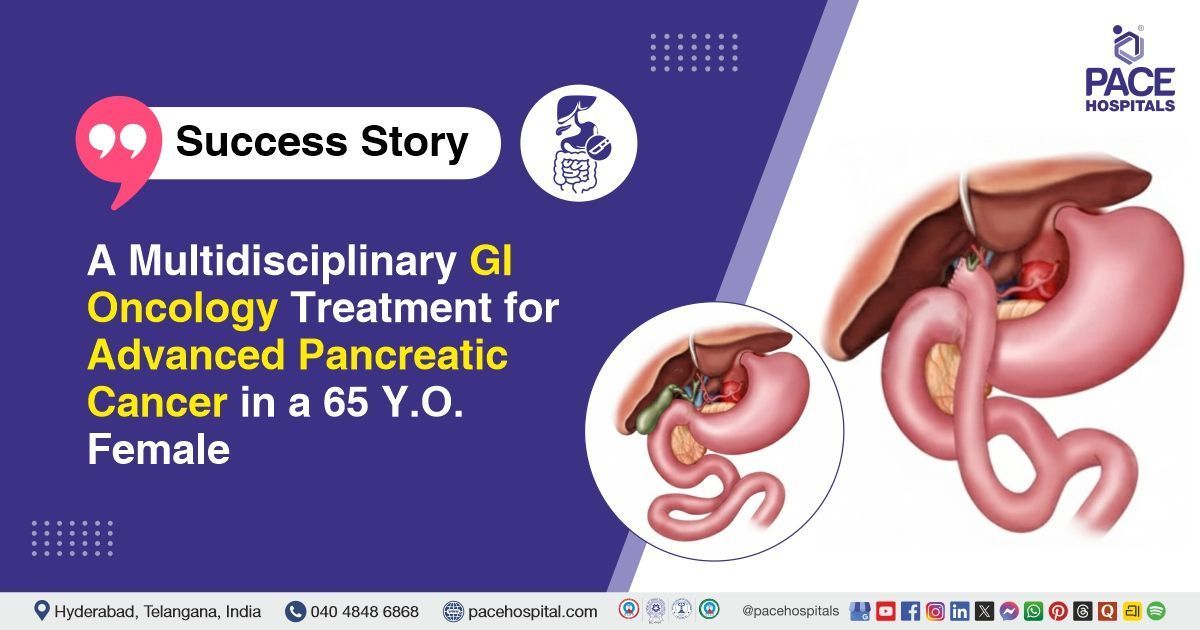
A Multidisciplinary GI Oncology Treatment for Advanced Pancreatic Cancer in a 65 Y.O. Female
PACE Hospitals
PACE Hospitals’ expert GI Oncology team successfully performed a Palliative Roux-en-Y Hepaticojejunostomy on a 65-year-old female patient from Somalia diagnosed with locally advanced, unresectable pancreatic head adenocarcinoma and liver metastasis confirmed by preoperative EUS-guided fine-needle biopsy (FNB). Intraoperatively, the procedure confirmed the full extent of disease involvement. It also provided effective biliary drainage to palliate obstructive jaundice, markedly improving the patient’s quality of life.
Chief Complaints
A 65-year-old female with a
body mass index (BMI) of 18 presented to the GI Oncology Department at
PACE Hospitals, Hitech City, Hyderabad, with a five-month history of epigastric pain associated with cough without expectoration and intermittent fever.
Past Medical History
The patient had a history of obstructive jaundice, for which ERCP with common bile duct stenting (SEMS in situ) had been performed at an outside hospital. There was a known pancreatic mass involving the uncinate process/head of the pancreas, which was initially under evaluation. The patient also had a history of bilateral bronchiectasis with recurrent lower respiratory tract infections, and bronchoalveolar lavage had grown Klebsiella pneumoniae. The patient was status post cholecystectomy. There was no history of hypertension, diabetes mellitus, thyroid disease, tuberculosis, or COVID-19 infection.
On Examination
On general examination, the patient was conscious and oriented, with stable vital signs. The patient was afebrile, normotensive, and maintaining adequate oxygen saturation on room air. Systemic examination revealed a soft, non-tender abdomen with no palpable masses or organomegaly. Bowel sounds were normal. Examination of the cardiovascular, respiratory, and central nervous systems was within normal limits.
Diagnosis
Upon admission to PACE Hospitals, the patient was thoroughly evaluated by the GI oncology team. The clinical assessment revealed a history of epigastric pain associated with cough without expectoration and intermittent fever for five months, along with features of obstructive jaundice for which the patient had previously undergone ERCP with common bile duct stenting. The patient also had a background history of bronchiectasis with recurrent lower respiratory tract infections.
The patient underwent detailed radiological, endoscopic, and laboratory investigations. Imaging studies and endoscopic evaluation identified a space-occupying lesion involving the uncinate process/head of the pancreas. Endoscopic ultrasound–guided fine needle biopsy confirmed pancreatic adenocarcinoma. EBUS-guided FNAC, performed under general anesthesia , evaluated associated lung findings. Intraoperative findings during diagnostic laparotomy revealed a hard mass involving the head of the pancreas with surface liver deposits suggestive of metastatic disease. Frozen section analysis confirmed adenocarcinoma. Histopathological examination of lymph node station 8 showed reactive lymphadenitis with no evidence of malignancy. Laboratory investigations demonstrated a cholestatic pattern of liver function tests with elevated alkaline phosphatase and bilirubin levels, anemia, and neutrophilic leukocytosis. Bronchoalveolar lavage and bile cultures grew Klebsiella pneumoniae.
Based on the confirmed diagnosis, the patient was advised to undergo Pancreatic Cancer Treatment in Hyderabad, India, under the expert care of the GI Oncology Department, to control the disease, relieve symptoms, and prevent further complications.
Medical Decision Making (MDM)
After a detailed consultation with the GI Oncology team, including Dr. Govind Verma, Dr. M Sudhir, Dr. Padma Priya, Dr. Suresh Kumar S, and cross consultation with pulmonologist Dr. Pradeep Kiran Panchadi, a thorough evaluation was conducted considering the patient’s complaints of epigastric pain, obstructive jaundice, history of chronic bronchiectasis, and prior ERCP with SEMS placement. All relevant laboratory investigations, imaging studies, operative findings, and prior procedural data were reviewed.
Based on these clinical and imaging findings, it was determined that a diagnostic laparotomy with frozen section followed by palliative Roux-en-Y hepaticojejunostomy was identified as the most appropriate intervention to relieve biliary obstruction, prevent recurrent cholestasis, and mitigate further complications associated with locally advanced, unresectable adenocarcinoma of the pancreatic head with liver metastasis.
The patient and her family members were counseled regarding the diagnosis, the planned procedure, its associated risks including bleeding, infection, anastomotic leak, and perioperative complications, and its potential to relieve symptoms, improve hepatic function, and enhance quality of life.
Surgical Procedure
Following the decision, the patient was scheduled to undergo Diagnostic Laparotomy with Frozen Section followed by Palliative Roux En Y Hepaticojejunostomy surgery in Hyderabad at PACE Hospitals under the expert care of the GI Oncology Department.
The following steps were carried out during the procedure:
- Exploration and Assessment: Under general anesthesia, a midline laparotomy was performed to access the abdominal cavity. Surface deposits were noted on the liver, suggesting metastasis. Kocherization of the duodenum was done to mobilize and visualize the pancreatic head. A firm mass involving the head of the pancreas was identified, confirming the tumor as locally advanced and unresectable.
- Biopsy and Frozen Section Analysis: Two core needle biopsies were taken from the pancreatic head mass and sent for frozen section analysis, which confirmed adenocarcinoma. Suspicious liver deposits were also biopsied to evaluate metastatic involvement. These intraoperative findings guided the surgical team to proceed with a palliative biliary bypass procedure.
- Preparation of the Roux Limb: A jejunal segment 30 cm distal to the duodenojejunal flexure was mobilized to create the Roux limb. The mesentery was carefully divided to allow a tension-free anastomosis. The limb was positioned retrocolically to reach the hepatic hilum for optimal biliary drainage.
- Creation of Jejuno-Jejunostomy: A side-to-side jejuno-jejunostomy was performed between the Roux limb and the proximal jejunum to maintain intestinal continuity. The anastomosis was checked for tension and hemostasis. This ensured proper passage of intestinal contents while isolating the Roux limb for bile drainage.
- Hepaticojejunostomy and Closure: The hepatic duct was dissected and an end-to-side hepaticojejunostomy was performed in interrupted sutures. A subhepatic drain was placed to monitor for bile leakage. Hemostasis was confirmed, the abdominal cavity irrigated, and the incision closed in layers. The procedure was completed uneventfully, and the patient was shifted to recovery.
Postoperative Care
The procedure was uneventful. During the postoperative period, the patient was closely monitored and managed with supportive care including maintenance of hydration, infection prevention, gastric acid suppression, circulatory support, and respiratory care. Nutritional support and general supportive measures were provided to aid recovery and promote wound healing. The patient showed gradual symptomatic improvement, remained hemodynamically stable, and tolerated oral intake before being discharged with instructions for continued home care and follow-up.
Discharge Medications
Upon discharge, the patient was prescribed medications for infection prevention, gastric acid control, pain and inflammation management, liver function support, fluid and electrolyte balance, nutritional supplementation, general vitamin and mineral support, and maintenance of hydration and electrolyte status.
Advice on Discharge
The patient was instructed to ambulate regularly, ensure proper wound care, and adhere to a low-salt, high-protein diet.
Emergency Care
The patient was informed to contact the emergency ward at PACE Hospitals in case of any emergency or development of symptoms such as fever, abdominal pain, or vomiting.
Review and Follow-up Notes
The patient was advised to return for a follow-up visit with the Gastroenterologist in Hyderabad at PACE Hospitals after 1 week for further evaluation.
Conclusion
This case highlights a diagnosis of locally advanced, unresectable adenocarcinoma of the pancreatic head with liver metastasis. The patient underwent a diagnostic laparotomy with frozen section followed by a palliative Roux-en-Y hepaticojejunostomy, which was performed uneventfully. During the hospital stay, supportive care was provided, resulting in symptomatic improvement. At discharge, the patient was stable and advised to maintain regular ambulation, proper wound care, and a balanced diet, with planned follow-up coordinated through International Patient Services to ensure seamless care and monitoring.
Multidisciplinary Challenges in Complex Pancreatic Disease
Management of advanced pancreatic malignancy often involves multiple organ systems and requires careful coordination between gastroenterology, surgery, and pulmonology. Patients are at high risk of obstructive jaundice, recurrent infections, nutritional deficiencies, and postoperative wound complications, particularly after palliative or extensive surgical procedures. Timely interventions such as image-guided biopsies, biliary stenting, and reconstructive surgeries by a surgical gastroenterologist / surgical gastroenterology doctor must be balanced with rigorous infection control, wound care, and nutritional optimization.
Continuous monitoring and multidisciplinary follow-up are essential to detect complications early and ensure appropriate supportive care. These cases emphasize the importance of integrated, patient-centered care, proactive complication management, and coordination across specialties to optimize outcomes in a high-risk, often frail population.
Share on
Request an appointment
Fill in the appointment form or call us instantly to book a confirmed appointment with our super specialist at 04048486868
Appointment request - health articles
Recent Articles