Obesity Is the Body’s Termite: Risks, NAFLD & Lasting Solutions
PACE Hospitals
Written by: Editorial Team
Medically reviewed by: Dr. Tripti Sharma - Consultant Endocrinologist (Adult & Paediatric), Physician & Diabetologist
Overview: Why call obesity a “body termite”?
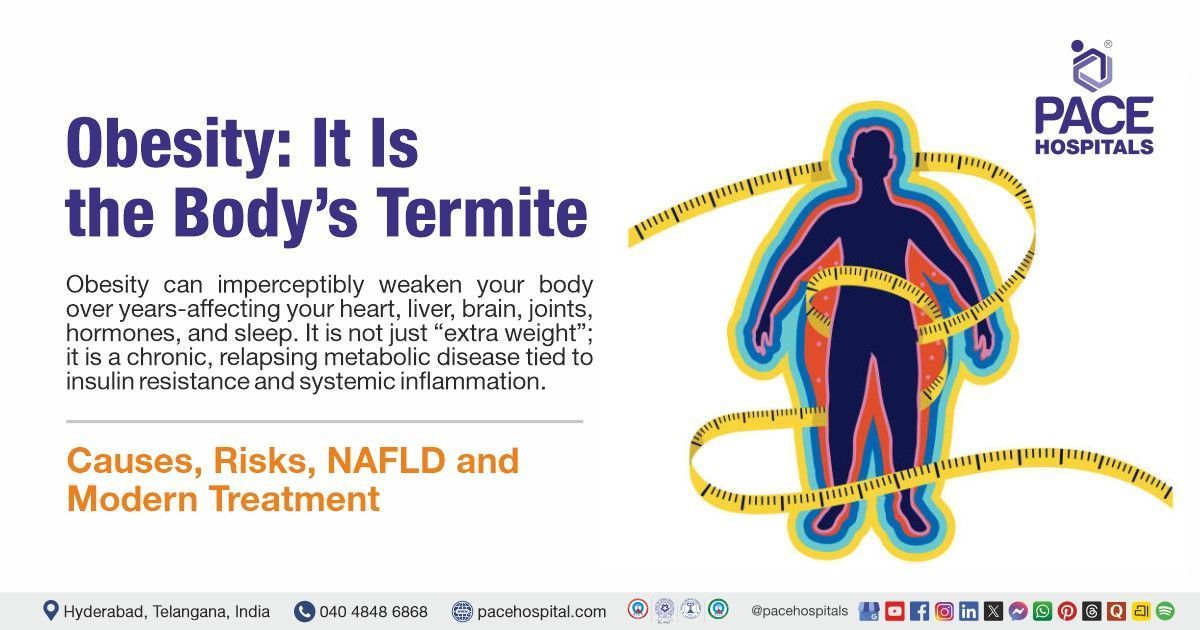
Like termites silently hollowing a strong structure, obesity can imperceptibly weaken your body over years—affecting your heart, liver, brain, joints, hormones, and sleep. It is not just “extra weight”; it is a chronic, relapsing metabolic disease tied to insulin resistance and systemic inflammation.
India is among the world’s most affected nations, with morbid obesity impacting an estimated ~5% of the population. Beyond appearance or BMI, obesity substantially raises the risk of type 2 diabetes, hypertension, coronary artery disease (CAD), cerebrovascular disease (stroke), gout, gallstones, sleep apnea, osteoarthritis, colon cancer, and—critically—non-alcoholic fatty liver disease (NAFLD).
At PACE Hospitals, Hyderabad, our Metabolic & Bariatric Unit, Endocrinology, and HPB & Liver teams manage obesity as a medical condition—using personalized nutrition, evidence-based medications, non-surgical endo-metabolic options, advanced bariatric surgery, and structured long-term follow-up.
What exactly is obesity?
Obesity is excess body fat that impairs health. Typical reference points:
- Body fat %: ~25–30% (women) and ~18–23% (men) are considered normal; >30% in women or >25% in men is obesity.
- BMI (kg/m²):
- 18.5–24.9: Healthy
- 25.0–29.9: Overweight
- ≥30: Obesity (Class I 30–34.9, Class II 35–39.9, Class III ≥40)
Note: In South Asians, metabolic risk starts at lower BMIs; many clinicians use BMI ≥23 as “at risk” and ≥25 as “obese equivalent” for counseling and screening.
How obesity harms the body (the “termite effect”)
Chronic overnutrition + genetic predisposition or family history of the disease → insulin resistance → high insulin, fat deposition, and inflammation. Subsequent outcomes:
- Type 2 diabetes and prediabetes
- Hypertension and dyslipidemia (↑LDL/Triglycerides, ↓HDL)
- Atherosclerosis → heart attack, stroke
- NAFLD/NASH → liver fibrosis, cirrhosis, HCC
- Obstructive sleep apnea → fatigue, arrhythmias, hypertension
- PCOS, infertility, erectile dysfunction
- Osteoarthritis (knee/hip), gout
- GERD, gallstones
- Certain cancers (colon, breast, endometrium)
Eighty percent of deaths related to obesity occur in people with BMI ≥30, underscoring the need for early, structured treatment.
Spotlight on NAFLD: obesity’s liver signature
Non-Alcoholic Fatty Liver Disease (NAFLD) spans a spectrum:
- Steatosis (fatty liver) → fat accumulation alone
- NASH (Non-alcoholic steatohepatitis) → fat + inflammation + cell injury
- Fibrosis → Cirrhosis → Hepatocellular carcinoma (HCC) risk
Key facts you should know:
- NAFLD is now one of the most common liver disease globally.
- It is strongly related to insulin resistance and abdominal obesity.
- Higher BMI correlates with greater liver damage.
- Many people are asymptomatic; NAFLD is often found via elevated ALT/AST or “bright liver” on ultrasound.
- Advanced disease brings ascites, variceal bleeding, encephalopathy, and liver failure.
- A significant share of “cryptogenic cirrhosis” is actually end-stage NAFLD/NASH.
Can NAFLD improve?
Yes—weight loss is the cornerstone. Even a 7–10% weight reduction can normalize enzymes and regress steatosis, and ≥10% can improve NASH/fibrosis in many patients. Bariatric surgery, where indicated, shows marked histologic improvement.
How PACE evaluates obesity & metabolic risk
A comprehensive work-up ensures precision therapy:
- Anthropometry & body composition: BMI, waist circumference, body fat %, visceral fat
- Metabolic panel: Fasting glucose, HbA1c, fasting lipids, insulin resistance markers
- Liver panel: ALT/AST, GGT, bilirubin; ultrasound ± FibroScan®/MRI-PDFF when needed
- Thyroid, vitamin D, B12 where appropriate
- Sleep apnea screening (STOP-BANG), ECG/Echo for cardiac risk
- Lifestyle & nutrition assessment, psychosocial and readiness-to-change appraisal
Based on findings, our team co-creates a tiered, long-term plan.
Treatment pathways at PACE Hospitals
Lifestyle therapy (foundation for all)
- Nutrition: Calorie deficit tailored to you; protein-forward, high-fiber; low added sugar; liberal vegetables; smart fats (nuts, seeds, olive/mustard oil).
- Meal structure: 3 meals + 1–2 planned snacks; avoid mindless grazing.
- Activity: 150–300 minutes/week of moderate activity + 2–3 sessions/week resistance training; NEAT (non-exercise activity) upgrades—walk breaks, stairs, standing tasks.
- Sleep & stress: 7–8 hours/night; mindfulness, CBT-i for insomnia; stress-eating strategies.
Medical therapy (when criteria met)
Under endocrinology supervision:
- Anti-obesity agents (as suitable for comorbidities & safety): GLP-1/dual agonists, orals where indicated.
- Diabetes, BP, lipid optimization: metformin/SGLT2/GLP-1 for T2D; ACEi/ARB for BP; statins/omega-3 for lipids.
- NAFLD support: weight loss, diabetes control; vitamin E in select non-diabetic NASH; manage dyslipidemia; avoid hepatotoxins.
Endoscopic & surgical options (durable results)
For BMI ≥32.5 with comorbidities or ≥37.5 (South Asian cut-offs), or failure of medical therapy:
- Bariatric procedures: Laparoscopic Sleeve Gastrectomy, Roux-en-Y Gastric Bypass, OAGB—performed by the PACE Bariatric & HPB team.
- Typical outcomes: 25–35% total body weight loss over 12–18 months; high remission rates for T2D, HTN, OSA; NAFLD/NASH improvement in many.
- Multidisciplinary pre-hab & aftercare service: nutritional coaching, micronutrient protocols, psychological support, physiotherapy, and lifelong follow-up.
Practical roadmap: from diagnosis to durable change
- Screen (BMI, waist, bloods, ultrasound)
- Stratify risk (diabetes, BP, sleep apnea, NAFLD stage)
- Start lifestyle protocol (diet, activity, sleep)
- Add meds if indicated (and safe)
- Consider bariatric when criteria met/plateau reached
- Monitor & maintain (quarterly to biannual reviews)
PACE’s integrated clinic model keeps you in one coordinated pathway with shared goals and transparent milestones.
Cost at PACE Hospitals, Hyderabad (indicative ranges)
| Service / Package | What’s Included | Estimated Cost (INR) | Estimated Cost (USD) |
|---|---|---|---|
| Obesity & Liver Risk Screening | Physician consult, BMI/body fat, KFT/LFT, lipids, HbA1c, ultrasound | ₹4,500–₹8,500 | $55–$100 |
| NAFLD Advanced Work-Up | Hepatology consult, extended labs, FibroScan®/MRI-PDFF (as advised) | ₹12,000–₹25,000 | $145–$300 |
| Medical Weight-Loss Program (3 months) | Dietitian plan, endocrinology reviews, behavior therapy, activity plan | ₹18,000–₹35,000 | $215–$420 |
| Bariatric Surgery (Sleeve / Bypass) | Pre-op work-up, laparoscopic surgery, 3–4 days stay, 3-month follow-up | ₹2,25,000–₹3,75,000 | $2,700–$4,500 |
Final estimates vary by case complexity, room category, add-on tests/medications, and comorbidities. Cashless/EMI support available.
Frequently Asked Questions (FAQs) on Obesity & NAFLD
Why is obesity called the “body’s termite”?
Because it silently damages vital systems—heart, liver (NAFLD/NASH), brain, hormones, joints—long before symptoms are obvious. Early screening and treatment prevent structural health "collapse."
How is obesity related to NAFLD/NASH?
Insulin resistance from obesity drives liver fat accumulation. Over time fat plus inflammation (NASH) leads to fibrosis and cirrhosis. Weight loss (≥10%) can improve NASH/fibrosis in many patients.
Can fatty liver reverse without surgery?
Often yes. A 7–10% weight loss via structured diet, activity, and optimized diabetes/lipids can normalize enzymes and reduce liver fat; ≥10% improves NASH in many.
Are anti-obesity medicines safe?
Modern agents of medications (e.g., GLP-1/GIP-based type) can be effective and safe when prescribed and monitored by specialists. They complement—not replace—nutrition and activity.
What results can I expect after surgery?
Average 25–35% total body weight loss in 12–18 months, improved glycemic control, BP and lipid normalization, better sleep apnea, and NAFLD improvement in many.
How much does treatment cost at PACE Hospitals?
Screening from ₹4,500, advanced NAFLD work-up ₹12,000–₹25,000, medical program ₹18,000–₹35,000, bariatric surgery ₹2.25–₹3.75 lakh (USD $2,700–$4,500). Final quote after consultation.
I’m South Asian with BMI 26—am I at risk?
Yes. South Asians develop metabolic complications at lower BMI. Get screened for waist circumference, blood pressure, HbA1c, lipids, and liver enzymes/ultrasound.
Which diet works best for obesity & fatty liver?
Calorie-deficit, protein-forward, high-fiber plan: vegetables, legumes, whole grains, nuts/seeds, minimally processed foods, limited added sugar and refined carbs. Diet is individualized at PACE.
When is bariatric surgery advised?
Typically for BMI ≥37.5, or ≥32.5 with comorbidities (T2D, HTN, OSA, NAFLD/NASH) in South Asians, or after failure of medical therapy. It offers durable weight loss and metabolic remission.
Which bariatric procedure is right for me?
Sleeve Gastrectomy vs Gastric Bypass depends on diabetes severity, reflux, liver disease stage, BMI, and eating patterns. The PACE Bariatric Board personalizes recommendations.
Share on
Request an appointment
Fill in the appointment form or call us instantly to book a confirmed appointment with our super specialist at 04048486868
Appointment request - health articles
Recent Articles