What Are the First Signs of Cancer? 15 Warning Symptoms You Should Never Ignore

PACE Hospitals
Written by: Editorial Team
Medically reviewed by: Dr. Ramesh Parimi, Senior Consultant – Surgical Oncology, Specialist in Cancer Surgery
Introduction
Recognizing the early warning signs of cancer in your body can be life-saving. While many symptoms are caused by non-cancerous conditions, knowing what to watch for helps you seek medical attention promptly when it matters most.
Cancer does not usually announce itself loudly. Sometimes the first signs are subtle—a persistent cough that won't go away, unexplained weight loss, or a small lump that seems harmless. Other times, there are no symptoms at all until the disease has progressed.
The good news: When cancer is detected in its earliest stages, treatment is often more effective and survival rates are significantly higher. Many early-stage cancers have cure rates exceeding 90%.
This comprehensive guide covers:
- The 15 most common early warning signs of cancer
- Specific symptoms by cancer type
- When symptoms warrant immediate medical attention
- How to differentiate concerning symptoms from normal health issues
- What to expect when you see a doctor
- Why early symptom recognition saves lives
Important: This article is for educational purposes. If you're experiencing any concerning symptoms, consult a healthcare professional / oncologist immediately. Don't diagnose yourself—many cancer symptoms overlap with benign conditions.
Remember: Most people with these symptoms do NOT have cancer, but evaluation is essential.
How Cancer Causes Symptoms
Before diving into specific warning signs, it's important to understand how and why cancer produces symptoms.
Why Cancer Causes Symptoms
Cancer affects your body in several ways:
1. Local Effects (Where the tumor grows)
- Tumor presses on nearby organs, nerves, or blood vessels
- Blocks passageways (airways, digestive tract, blood vessels)
- Causes pain, bleeding, or obstruction
Example: Lung tumor blocking airway → persistent cough
2. Systemic Effects (Felt Throughout the body)
- Cancer cells consume nutrients and energy
- Release substances that affect metabolism
- Trigger inflammatory responses
- Alter hormone production
Example: Cancer-related fatigue, weight loss
3. Immune Response
- Body recognizes something is wrong
- Fever, night sweats, fatigue
- Similar to fighting an infection
4. Metastatic Effects
- Cancer spreads to other organs
- New symptoms in distant locations
Example:
Colon cancer spreading to liver →
jaundice
Why Early Symptoms Are Often Subtle
Early-stage cancer symptoms are typically:
- Not dramatic - Easy to dismiss or attribute to other causes
- Intermittent - Come and go, not constant
- Non-specific - Could be caused by many conditions
- Mild - Don't significantly impact daily life
This is why many cancers aren't detected until later stages.
Advanced cancer symptoms are:
- More persistent
- More severe
- Multiple symptoms occurring together
- Progressively worsening
The Key to Early Detection
What matters most:
- Persistence - Symptoms lasting more than 2-3 weeks
- Progression - Symptoms getting worse over time
- Pattern changes - New symptoms that are unusual for you
- Combination - Multiple symptoms occurring together
Trust your instincts: You know your body best. If something feels wrong, get it checked.
Medical principle: "New, persistent, and progressive" symptoms deserve medical evaluation.
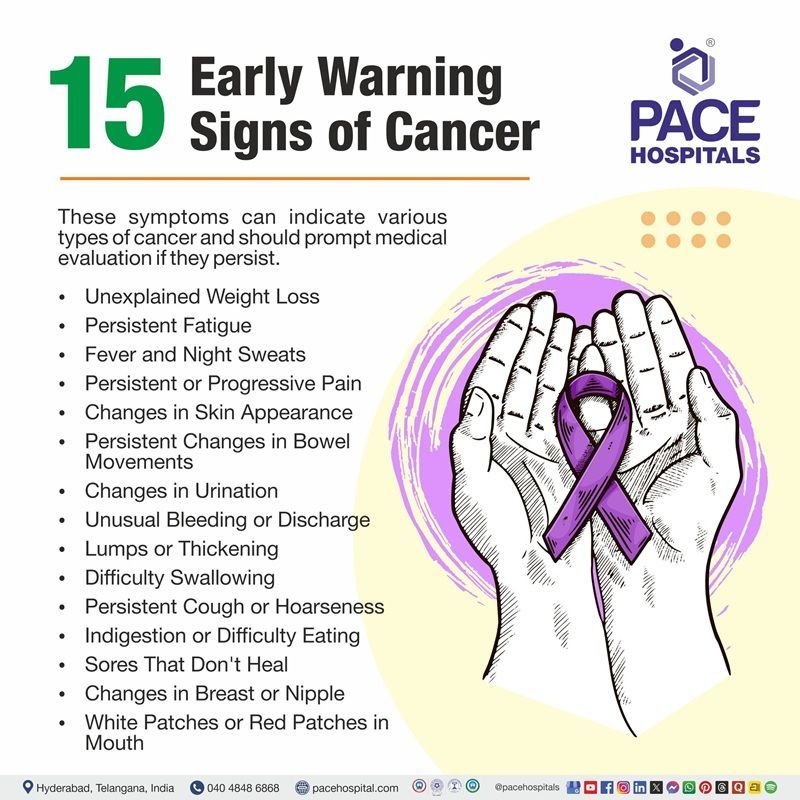
15 Early Warning Signs of Cancer You Should Never Ignore
These symptoms can indicate various types of cancer and should prompt medical evaluation if they persist.
- Unexplained Weight Loss
- Persistent Fatigue
- Fever and Night Sweats
- Persistent or Progressive Pain
- Changes in Skin Appearance
- Persistent Changes in Bowel Movements
- Changes in Urination
- Unusual Bleeding or Discharge
- Lumps or Thickening
- Difficulty Swallowing
- Persistent Cough or Hoarseness
- Indigestion or Difficulty Eating
- Sores That Don't Heal
- Changes in Breast or Nipple
- White Patches or Red Patches in Mouth
1. Losing Weight Without Trying (Unexplained Weight Loss)
What it is:
- Losing 10 or more pounds (4.5+ kg) over 3-6 months without changes to diet or exercise.
Why it's concerning:
Cancer cells consume massive amounts of energy and alter metabolism. Your body may also be fighting the disease, burning extra calories.
Cancers most commonly associated:
- Pancreatic cancer (often first symptom)
- Stomach cancer
- Esophageal cancer
- Lung cancer
- Lymphoma
- Leukemia
- Colorectal cancer
How to recognize it:
- Clothes fitting more loosely
- Others commenting on weight loss
- Loss of appetite accompanying weight loss
- No deliberate dieting or increased activity
When to worry:
- Loss of 5% or more of body weight in 6-12 months
- No intentional cause
- Accompanied by other symptoms
What's normal:
- Gradual weight loss from increased activity
- Intentional dietary changes
- Stress-related temporary loss
Take Action: See your doctor if you've lost significant weight unintentionally.
2. Extreme Tiredness That Doesn't Improve with Rest (Persistent Fatigue)
What it is:
Overwhelming exhaustion that significantly interferes with daily activities and doesn't improve after sleeping.
Cancer-related fatigue vs. normal tiredness
| Normal Fatigue | Cancer-Related Fatigue |
|---|---|
| Improves with rest | Persists despite rest |
| Related to activity | Not proportional to activity |
| Temporary | Ongoing (weeks/months) |
| Manageable | Debilitating |
Cancers commonly causing fatigue:
- Leukemia (bone marrow doesn't produce enough blood cells)
- Lymphoma
- Colon cancer (from bleeding/anemia)
- Stomach cancer
- Blood cancers
Additional symptoms to note:
- Weakness
- Difficulty concentrating
- Need for excessive sleep
- Inability to complete normal activities
When to worry:
- Fatigue lasting more than 2 weeks
- Severe enough to affect work/daily life
- Not explained by poor sleep or stress
- Accompanied by other symptoms
What's normal:
- Fatigue from poor sleep, stress, or illness
- Temporary exhaustion after exertion
- Energy improving with rest/sleep
Take Action: Document when fatigue started and severity; discuss with doctor.
3. Recurring Unexplained Fever (Fever and Night Sweats)
What it is:
- Recurring fever (>100.4°F/38°C) without obvious infection
- Drenching night sweats requiring clothing/bedding changes
Why it happens:
- Immune system reacting to cancer
- Cancer affecting temperature regulation
- Infection due to weakened immunity
Cancers most associated:
- Lymphoma (classic symptom)
- Leukemia
- Kidney cancer
- Liver cancer
Pattern to watch:
- Fever that comes and goes
- Night sweats multiple times per week
- Fever without cold/flu symptoms
- Chills accompanying fever
When to worry:
- Fever lasting more than a week
- Recurring fevers without explanation
- Night sweats plus weight loss
- Swollen lymph nodes accompanying fever
What's normal:
- Fever from infection (resolves in days)
- Occasional night sweats from room temperature
- Hormonal night sweats (menopause)
Take Action: Track fever patterns and associated symptoms; see doctor if recurring.
4. Persistent or Progressive Pain
What it is:
- Pain in one area lasting more than 2 weeks or pain that progressively worsens.
Why cancer causes pain:
- Tumor pressing on nerves, organs, or bones
- Inflammation around tumor
- Cancer in bones (very painful)
- Obstruction of organs
Pain by location and possible cancer:
Headache:
- Brain tumor
- Metastases to brain
- Different from typical headaches (worse in morning, with vomiting)
Back pain:
- Spinal tumors
- Kidney cancer
- Pancreatic cancer (radiates to back)
- Colon cancer
- Ovarian cancer
- Bone metastases
Chest pain:
- Lung cancer
- Esophageal cancer
- Lymphoma
Abdominal pain:
- Stomach cancer
- Liver cancer
- Pancreatic cancer
- Colorectal cancer
- Ovarian cancer (often vague, bloating)
Pelvic pain:
- Ovarian cancer
- Uterine cancer
- Cervical cancer
- Bladder cancer
Bone pain:
- Bone cancer
- Metastatic cancer to bones
- Multiple myeloma
When to worry:
- Pain lasting more than 2 weeks
- Pain worsening over time
- Pain not relieved by over-the-counter medication
- Pain accompanied by other symptoms
- New, unexplained pain
What's normal:
- Muscle strain pain (improves with rest)
- Arthritis pain (consistent pattern)
- Injury-related pain (clear cause)
Take Action: See doctor for unexplained persistent pain, especially if worsening.
5. Changes in Skin Appearance (Skin Changes)
What to watch for:
New or changing moles (ABCDE rule):
- Asymmetry - One half doesn't match the other
- Border - Irregular, scalloped, or poorly defined edges
- Color - Multiple colors (brown, black, tan, red, white, blue)
- Diameter - Larger than 6mm (pencil eraser size)
- Evolving - Changing in size, shape, or color
Other concerning skin changes:
- Sores that don't heal (>4 weeks)
- Jaundice (yellow skin/eyes) - liver or pancreatic cancer
- Darkening skin (hyperpigmentation)
- Redness or inflammation
- Excessive itching
- Unusual bleeding
Cancers indicated:
- Melanoma (deadliest skin cancer)
- Basal cell carcinoma
- Squamous cell carcinoma
- Pancreatic cancer (jaundice)
- Liver cancer (jaundice)
When to worry:
- Any changing mole
- New mole after age 30
- Bleeding or oozing skin lesion
- Jaundice (immediate medical attention)
- Sore not healing after 4 weeks
What's normal:
- Stable moles present for years
- Minor skin irritations that heal
- Age spots (flat, uniform color)
Take Action: Monthly skin self-exams; annual dermatologist exam; photograph moles to track changes.
6. Persistent Changes in Bowel Movements (Changes in Bowel Habits)
What to watch:
- Persistent diarrhea or constipation
- Change in stool consistency
- Feeling that bowel doesn't empty completely
- Narrowing of stool (pencil-thin)
- Blood in stool (bright red or black/tarry)
Why it happens:
- Tumor obstructing colon
- Tumor bleeding into digestive tract
- Cancer affecting bowel function
Blood in stool appearance:
- Bright red blood - Lower colon/rectal cancer (or hemorrhoids)
- Dark, tarry stool - Upper GI tract cancer (stomach, esophagus)
- Occult blood - Not visible (detected by test)
Cancers indicated:
- Colorectal cancer (most common)
- Stomach cancer
- Esophageal cancer
- Anal cancer
- Small intestine cancer
When to worry:
- Changes lasting more than 2 weeks
- Blood in stool (any amount)
- Black, tarry stools
- Alternating diarrhea and constipation
- Ribbon-like thin stools
- Accompanied by abdominal pain or weight loss
What's normal:
- Temporary changes from diet
- Occasional constipation or diarrhea
- Hemorrhoids (but still get checked)
Take Action: Any blood in stool warrants immediate medical evaluation; don't assume it's hemorrhoids.
7. Changes in Urination (Bladder Changes)
Symptoms to note:
- Blood in urine (hematuria)
- Pain or burning during urination
- Increased frequency
- Urgency (sudden strong need)
- Difficulty starting urine stream
- Weak flow
- Inability to urinate
Cancers indicated:
- Bladder cancer (blood in urine most common)
- Prostate cancer (urinary obstruction)
- Kidney cancer
Blood in urine specifics:
- Can be visible (pink, red, brown) or microscopic
- May be intermittent (comes and goes)
- Sometimes painless in bladder cancer
Prostate cancer symptoms (men):
- Difficulty urinating
- Weak stream
- Frequent nighttime urination
- Inability to empty bladder
- Blood in urine or semen
When to worry:
- Any visible blood in urine
- Persistent urinary symptoms (>2 weeks)
- Difficulty urinating
- Pain with urination not resolving with treatment
What's normal:
- Urinary tract infection (but treat and confirm resolution)
- Temporary frequency from excessive fluid
- Benign prostatic hyperplasia (but needs evaluation)
Take Action: Blood in urine requires immediate evaluation—never ignore it.
8. Abnormal Bleeding from Any Body Opening (Unusual Bleeding or Discharge)
Types of concerning bleeding:
Coughing up blood:
- Lung cancer
- Throat cancer
- Even small amounts are concerning
Vomiting blood:
- Stomach cancer
- Esophageal cancer
- May look like coffee grounds
Rectal bleeding:
- Colorectal cancer
- Anal cancer
Blood in urine:
- Bladder cancer
- Kidney cancer
Vaginal bleeding:
- Postmenopausal bleeding - endometrial cancer
- Between periods - cervical cancer
- After intercourse - cervical cancer
Nipple discharge:
- Blood-tinged or clear discharge
- From one breast only
- Breast cancer
Unusual discharge:
- Foul-smelling vaginal discharge - cervical cancer
- Penile discharge with blood
When to worry:
- ANY unexplained bleeding
- Bleeding from unusual locations
- Persistent bleeding
- Bleeding after menopause
- Blood-tinged discharge
What's normal:
- Menstrual bleeding (regular pattern)
- Small amounts from hemorrhoids (but verify)
- Nosebleeds from dry air
Take Action: Report ANY unusual bleeding to doctor immediately.
9. Palpable Masses Under the Skin (Lumps or Thickening)
Where to check:
- Breasts (women and men)
- Testicles (men)
- Lymph nodes (neck, armpits, groin)
- Under skin anywhere on body
Characteristics of concerning lumps:
- Hard and immovable (vs. soft and mobile)
- Irregular shape
- Painless (though some cancer lumps hurt)
- Growing over time
- Single lump (vs. multiple small lumps)
Breast lumps:
- Most common in upper outer quadrant
- May be accompanied by nipple changes
- Skin dimpling near lump
- Different from surrounding breast tissue
Testicular lumps:
- Firm mass on testicle
- May feel heavy
- Usually painless
- Swelling of testicle
Lymph node enlargement:
- Hard, fixed nodes
- Painless
- Multiple enlarged nodes
- Supraclavicular nodes (above collarbone) especially concerning
When to worry:
- Any new lump lasting more than 2 weeks
- Hard, fixed lumps
- Growing lumps
- Painless masses
- Multiple enlarged lymph nodes
What's normal:
- Moveable fatty lumps (lipomas)
- Temporarily swollen lymph nodes from infection (resolve in weeks)
- Cysts (soft, round, fluid-filled)
Take Action: Get any persistent lump examined—don't wait to "see if it goes away."
10. Dysphagia (Trouble Swallowing)
What it feels like:
- Food getting stuck in throat or chest
- Pain when swallowing
- Sensation of fullness in throat
- Choking or coughing when eating
- Needing liquids to wash food down
Cancers indicated:
- Esophageal cancer
- Throat cancer (pharyngeal)
- Stomach cancer
- Thyroid cancer (pressing on esophagus)
- Lung cancer (rare)
Progressive pattern:
- Initially difficulty with solids
- Later difficulty with liquids
- Weight loss from not eating
When to worry:
- Difficulty swallowing lasting more than 2 weeks
- Progressive worsening
- Pain accompanying swallowing
- Weight loss
- Regurgitation of food
What's normal:
- Occasional choking on food
- Temporary soreness from infection
- Acid reflux (but chronic reflux needs evaluation)
Take Action: Persistent difficulty swallowing (>2 weeks) requires endoscopy.
11. Cough or Voice Changes That Won't Go Away (Persistent Cough or Hoarseness)
Persistent cough:
- Lasting more than 3 weeks
- Worsening over time
- Not related to cold/infection
- Coughing up blood
- Different from usual cough
Hoarseness:
- Raspy, strained voice
- Lasting more than 2 weeks
- Progressive worsening
- No obvious cause (not from overuse)
Cancers indicated:
- Lung cancer
- Laryngeal (voice box) cancer
- Throat cancer
- Thyroid cancer
- Esophageal cancer
Red flags:
- Cough with blood
- Hoarseness with lump in neck
- Difficulty breathing
- Chest pain with cough
- Weight loss
When to worry:
- Cough lasting >3 weeks without improvement
- Hoarseness lasting >2 weeks
- Smoker with new or changing cough
- Blood in sputum
- Accompanying symptoms (weight loss, chest pain)
What's normal:
- Post-viral cough (resolves within 3-8 weeks)
- Temporary hoarseness from overuse
- Seasonal allergies
- Acid reflux causing chronic cough
Take Action: Smokers with persistent cough need chest X-ray or CT; hoarseness >2 weeks needs laryngoscopy.
12. Persistent Digestive Problems (Indigestion or Difficulty Eating)
Symptoms:
- Persistent heartburn
- Nausea
- Loss of appetite
- Feeling full after small amounts
- Bloating
- Vague abdominal discomfort
Why it's concerning:
- Stomach cancer often presents with vague symptoms
- Pancreatic cancer causes early satiety
- Ovarian cancer causes bloating
Cancers indicated:
- Stomach cancer
- Esophageal cancer
- Pancreatic cancer
- Ovarian cancer
- Liver cancer
Ovarian cancer "whisper" symptoms:
- Abdominal bloating
- Pelvic pressure
- Feeling full quickly
- Urinary urgency
- Vague but persistent
When to worry:
- Symptoms persisting despite treatment
- Progressive worsening
- Weight loss
- Symptoms multiple times per week for >2 weeks
- Blood in vomit or stool
What's normal:
- Occasional indigestion
- Temporary loss of appetite from stress/illness
- Heartburn responding to medication
Take Action: Persistent upper GI symptoms require endoscopy; women with persistent pelvic/abdominal symptoms need ultrasound.
13. Non-Healing Wounds (Sores That Don't Heal)
What to watch:
- Mouth sores lasting >2 weeks
- Skin sores not healing in 4 weeks
- Lesions that bleed easily
- Scaly patches
- Crusty areas
Locations:
- Mouth - under tongue, sides of tongue, floor of mouth
- Lips - especially lower lip in sun-exposed areas
- Genitals - vulva, penis, anus
- Skin - anywhere, especially sun-exposed areas
Cancers indicated:
- Oral cancer
- Skin cancer (basal cell, squamous cell)
- Genital cancers
- Anal cancer
Oral cancer risk factors:
- Tobacco use
- Heavy alcohol use
- HPV infection
- Betel nut chewing
When to worry:
- Sore lasting more than 2 weeks (mouth) or 4 weeks (skin)
- Growing lesion
- Bleeding lesion
- White or red patches in mouth
- Painless ulcer (paradoxically more concerning)
What's normal:
- Canker sores (heal in 1-2 weeks)
- Minor cuts (heal in days)
- Cold sores (resolve in 1-2 weeks)
Take Action: Mouth sores >2 weeks need oral surgeon evaluation; skin lesions >4 weeks need dermatologist biopsy.
14. Breast Changes Beyond Lumps (Changes in Breast or Nipple)
What to watch:
Nipple changes:
- Inversion (pulling inward)
- Discharge (especially bloody or clear)
- Flattening
- Pointing in different direction
- Rash or redness
Skin changes:
- Dimpling or puckering
- Redness or rash
- Orange-peel texture (peau d'orange)
- Thickening
- Warm to touch
Breast shape changes:
- One breast suddenly larger
- Unusual swelling
- One breast hanging lower
Inflammatory breast cancer signs:
- Rapid breast swelling
- Redness covering 1/3+ of breast
- Warm to touch
- Skin thickening
- May not have discrete lump
When to worry:
- Any nipple discharge (especially one breast)
- New nipple inversion
- Persistent rash on nipple (Paget's disease)
- Skin changes not related to infection
- Rapid breast changes
What's normal:
- Cyclical breast changes with periods
- Mild breast pain
- Temporary nipple discharge from squeezing
- Both breasts affected equally
Take Action: Any persistent breast changes require clinical exam and likely mammogram/ultrasound.
Read More: Breast Cancer - Early Signs, Symptoms, Types, Risk Factors and Prevention
15. Oral Lesions (Leukoplakia and Erythroplakia)
Leukoplakia (white patches):
- White patches that can't be scraped off
- On tongue, inner cheeks, gums, floor of mouth
- May be precancerous
- 5-17% become cancer
Erythroplakia (red patches):
- Velvety red patches
- Higher cancer risk than leukoplakia
- Often painless
- 50% are already cancer or become cancer
Mixed lesions (red and white):
- Highest concern
- Speckled appearance
Cancers indicated:
- Oral squamous cell carcinoma
- Tongue cancer
- Floor of mouth cancer
Risk factors:
- Tobacco use (smoking or chewing)
- Heavy alcohol use
- HPV infection
- Betel nut chewing
- Poor oral hygiene
When to worry:
- White or red patches lasting >2 weeks
- Patches in high-risk locations (floor of mouth, tongue borders)
- Rough or irregular texture
- Associated ulceration
What's normal:
- Temporary irritation from dental work
- Thrush (scrapes off easily, treated with antifungals)
- Fordyce spots (small yellow-white bumps, normal)
Take Action: Any persistent oral patch requires biopsy by oral surgeon or ENT.
Specific Early Symptoms by Cancer Type
Different cancers produce different early warning signs. Here are the most common cancers and their typical first symptoms:
1. Breast Cancer
First signs often include:
- Lump in breast or armpit (most common)
- Nipple discharge (especially bloody)
- Nipple inversion
- Breast skin dimpling
- Breast shape or size change
- Redness or thickening
Less common:
- Breast pain (usually not first symptom)
- Swelling
Who's at risk: Women who are above 40 years of age, family history, BRCA mutations or have dense breast tissue
Screening: Mammogram annually starting age 40-45
Read More: Breast Self Examination - Steps, Purpose, Importance and Advantages
2. Lung Cancer
First signs:
- Persistent cough (most common)
- Coughing up blood
- Chest pain
- Shortness of breath
- Hoarseness
- Recurrent lung infections
Later signs:
- Weight loss
- Bone pain
- Headache
Who's at risk: Smokers, former smokers, radon exposure, asbestos exposure
Screening: Low-dose CT for high-risk individuals (heavy smokers ages 50-80)
3. Colorectal Cancer
First signs:
- Change in bowel habits
- Blood in stool (bright red or black)
- Abdominal cramping
- Feeling of incomplete bowel evacuation
- Narrow stools
Later signs:
- Weight loss
- Fatigue (from anemia)
- Weakness
Who's at risk: Age 45+, family history, inflammatory bowel disease (IBD)
Screening: Colonoscopy starting age 45
4. Prostate Cancer
First signs (often none in early stage):
- Difficulty urinating
- Weak urine stream
- Frequent urination (especially at night)
- Blood in urine or semen
- Difficulty starting/stopping urination
Later signs:
- Bone pain (if metastasized)
- Erectile dysfunction
Who's at risk: Men 50+, African American ancestry, family history
Screening: PSA test + digital rectal exam (discuss with doctor)
5. Pancreatic Cancer
First signs (often vague):
- Upper abdominal pain radiating to back
- Loss of appetite
- Weight loss (significant)
- Jaundice (yellow skin/eyes)
- Light-colored stools
- Dark urine
- New-onset diabetes
Why it's deadly: Often no symptoms until advanced
Who's at risk: Smokers, chronic pancreatitis, family history, age 60+
Screening: No routine screening; high-risk individuals may get imaging
6. Ovarian Cancer
First signs (subtle "whisper" symptoms):
- Abdominal bloating or swelling
- Pelvic pressure or pain
- Feeling full quickly when eating
- Urinary urgency or frequency
- Changes in bowel habits
Pattern: Symptoms occurring nearly daily for >2 weeks
Why it's dangerous: Vague symptoms often dismissed as digestive issues
Who's at risk: Family history, BRCA mutations, age 50+, never pregnant
Screening: No routine screening; transvaginal ultrasound and CA-125 for high-risk
7. Skin Cancer (Melanoma)
First signs:
- New mole or changing mole
- ABCDE criteria (asymmetry, border, color, diameter, evolving)
- Bleeding or oozing mole
- Itchy or painful mole
Basal/Squamous cell signs:
- Non-healing sore
- Pearly or waxy bump
- Flat, flesh-colored lesion
- Scaly red patch
Who's at risk: Fair skin, sun exposure, tanning beds, many moles
Screening: Annual dermatologist exam, monthly self-checks
8. Bladder Cancer
First signs:
- Blood in urine (most common, may be painless)
- Frequent urination
- Painful urination
- Urgency
Who's at risk: Smokers, chemical exposure, chronic bladder infections
Screening: No routine screening; urinalysis for high-risk
9. Kidney Cancer
First signs (often none until advanced):
- Blood in urine
- Lump in side or abdomen
- Persistent back pain (below ribs)
- Unexplained weight loss
- Fever
- Fatigue
Who's at risk: Smokers, obesity, hypertension, dialysis patients
Screening: Often found incidentally on imaging for other reasons
10. Leukemia
First signs:
- Fatigue and weakness
- Frequent infections
- Easy bruising or bleeding
- Tiny red spots on skin (petechiae)
- Swollen lymph nodes
- Fever or night sweats
- Bone or joint pain
- Weight loss
Who's at risk: Varies by type; some forms in children, others in adults
Screening: CBC blood test shows abnormalities
11. Lymphoma
First signs:
- Painless swollen lymph nodes (neck, armpits, groin)
- Fever
- Night sweats (drenching)
- Weight loss
- Fatigue
- Itching
"B symptoms": Fever, night sweats, weight loss (indicate more advanced)
Who's at risk: Young adults (Hodgkin's) or older adults (Non-Hodgkin's)
Screening: Physical exam; biopsy of enlarged nodes
12. Stomach (Gastric) Cancer
First signs (often unclear):
- Feeling full after small meals
- Indigestion or heartburn
- Nausea
- Loss of appetite
- Vague abdominal pain
Later signs:
- Vomiting blood
- Black stools
- Weight loss
Who's at risk: H. pylori infection, diet high in smoked/salted foods, family history
Screening: Endoscopy in high-risk individuals
13. Esophageal Cancer
First signs:
- Difficulty swallowing (starts with solids, progresses to liquids)
- Chest pain or discomfort
- Weight loss
- Persistent heartburn
- Hoarseness or cough
Who's at risk: Chronic acid reflux (Barrett's esophagus), smoking, alcohol
Screening: Endoscopy for Barrett's esophagus
14. Thyroid Cancer
First signs:
- Lump in front of neck
- Hoarseness
- Difficulty swallowing
- Swollen lymph nodes in neck
- Neck or throat pain
- Often: Discovered incidentally on imaging
Who's at risk: Radiation exposure to neck, family history, women
Screening: Neck palpation during physical exam
15. Oral/Throat Cancer
First signs:
- Sore in mouth not healing (>2 weeks)
- White or red patch
- Lump in mouth or neck
- Persistent sore throat
- Difficulty swallowing
- Hoarseness
- Earache
Who's at risk: Tobacco, heavy alcohol, HPV infection
Screening: Oral exam by dentist or doctor
When Cancer Symptoms Require Medical Attention
When to See a Doctor? Not every symptom requires emergency care, but knowing when to seek help is crucial.
See Doctor IMMEDIATELY (Same Day/Emergency)
Urgent symptoms:
- Coughing up blood (more than streaks)
- Vomiting blood or coffee-ground material
- Severe abdominal pain
- Black, tarry stools (significant bleeding)
- Large amount of blood in urine
- Sudden severe headache with vision changes
- Difficulty breathing
- Seizures
- Sudden inability to urinate
- Jaundice (yellow skin/eyes)
- Severe bone pain with weakness
Take Action: Go to emergency room or call emergency services
Schedule Appointment Within Days
Concerning symptoms:
- Any blood in stool, urine, vomit, or sputum
- Unexplained weight loss (>10 lbs)
- Persistent pain (if more than 2 weeks)
- New lumps or masses
- Non-healing sores
- Difficulty swallowing
- Persistent hoarseness
- Postmenopausal vaginal bleeding
Take Action: Call hospital and request appointment within 2-3 days
Schedule Routine Appointment (Within 2-4 Weeks)
Symptoms to monitor:
- Persistent fatigue (If more than 2 weeks)
- Changes in bowel habits (If more than 2 weeks)
- Persistent cough (If more than 3 weeks)
- Skin changes or new moles
- Urinary changes
- Bloating or indigestion (If more than 2 weeks)
Take Action: Schedule regular appointment; keep symptom diary
Monitor and Watch (But Don't Ignore)
Less urgent but worth tracking:
- Mild symptoms that just started
- Intermittent symptoms
- Symptoms with obvious cause
Take Action:
- Document symptoms such as from which date started, frequency, severity
- Give it 1-2 weeks
- If persists or worsens, schedule appointment
- Don't wait months "to see what happens"
The "Two-Week Rule"
General guideline:
- Any new, unexplained symptom lasting more than 2 weeks warrants medical evaluation.
Why 2 weeks?
- Gives time for minor issues to resolve
- Prevents over-testing for temporary symptoms
- Catches persistent issues early enough to avoid future struggle
- Balances caution with practicality and through screening
Exceptions (see doctor sooner):
- Any bleeding or abnormal rupture
- Severe symptoms
- Rapidly worsening symptoms
- Multiple symptoms together
Don't Let These Stop You from Seeking Care
Common barriers:
❌ "I'm embarrassed"
✅ Doctors see and check everything; your health is more important
❌ "I'm scared of what they'll find"
✅ Not knowing doesn't prevent cancer; early detection improves outcomes and better way of living
❌ "I don't want to waste the doctor's time"
✅ Evaluating concerning symptoms is literally their job
❌ "It's probably nothing"
✅ Most likely true, but verification gives mental peace and rebuilds confidence
❌ "I can't afford it"
✅ Many screening tests are covered by insurance companies; financial assistance available
❌ "I'm too busy"
✅ Cancer treatment takes much more time than a screening appointment
Your life is worth a doctor's appointment.
Evaluating Cancer Symptoms: The Diagnostic Process
What to Expect at Your Doctor's Appointment? Understanding what happens during evaluation can reduce anxiety and help you prepare.
Step 1: Medical History
Your doctor will ask about:
Symptom details:
- When did it start?
- How often does it occur?
- Is it getting worse?
- What makes it better or worse?
- Associated symptoms?
Personal history:
- Previous cancers or precancerous conditions
- Chronic medical conditions
- Medications and supplements
- Allergies
Family history:
- Cancers in relatives (type, age at diagnosis)
- Hereditary cancer syndromes
- Lifestyle factors:
- Tobacco use ( either currently or previously)
- Alcohol consumption
- Diet and exercise
- Occupational exposures
Tip: Bring a written symptom diary with dates, descriptions, and severity ratings.
Step 2: Physical Examination
What the doctor will do:
General assessment:
- Vital signs (Check for blood pressure, pulse, temperature)
- Weight check
- Overall appearance
Focused examination based on symptoms:
- Lumps: Palpation to assess size, mobility, texture
- Abdominal pain: When pressing on abdomen and listening to bowel sounds
- Cough: Listening to lungs
- Skin changes: Close inspection, possibly dermoscopy
- Lymph nodes: Feeling neck, armpits, groin for enlargement
Specialized exams:
- Breast exam
- Pelvic exam
- Digital rectal exam
- Oral cavity examination
- Neurological exam
Step 3: Initial Testing
Common first-line tests:
Blood work:
- Complete blood count (CBC)
- Comprehensive metabolic panel
- Specific tumor markers (if indicated)
- Liver function tests
- Kidney function tests
Imaging:
- X-ray: Often first imaging test usually done for chest, bone
- Ultrasound: Breast lumps, abdominal masses, pelvic issues
- CT scan: Detailed cross-sectional images
- MRI: Better soft tissue detail
Other tests:
- Stool test: Occult blood for GI bleeding
- Urinalysis: Blood in urine
- Sputum cytology: Examining coughed-up mucus
- Endoscopy: Direct visualization (colonoscopy, upper endoscopy, bronchoscopy)
Read More: Can a CT Scan Detect Cancer
Step 4: Biopsy (If Needed)
Gold standard for cancer diagnosis:
Types of biopsies:
- Needle biopsy: Removing cells with needle
- Core biopsy: Removing tissue sample
- Excisional biopsy: Removing entire lump
- Endoscopic biopsy: During scope procedure
- Skin biopsy: Punch or shave biopsy
What happens:
- Usually local anesthesia
- Sample sent to pathologist
- Results in 3-7 days typically
- Determines if cancer present and type
Important: Only biopsy can definitively diagnose cancer
Step 5: Results and Next Steps
Possible outcomes:
No cancer found:
- Alternative diagnosis provided
- Treatment for benign condition
- Follow-up monitoring if needed
- Relief and gives peace of mind
Precancerous changes:
- Close monitoring
- Possible removal/treatment
- More frequent screening
Cancer diagnosed:
- Referral to oncologist or cancer specialist
- Additional staging tests
- Treatment plan discussion and get prepared for it
- Support services
Timeline
Typical diagnostic timeline:
- Initial appointment: Same visit
- Basic test results: Obtained within 1-3 days
- Imaging results: Takes 1-7 days
- Biopsy results: Received within 3-14 days
- Comprehensive diagnosis: Takes More Time around 2-4 weeks
- Waiting is hard, but thoroughness is important.
Questions to Ask Your Doctor
During the appointment:
- What conditions could cause these symptoms and signs?
- What tests do you recommend and why they are necessary?
- When will I get results?
- What should I watch for in the meantime?
- Should I modify any activities?
If cancer is suspected:
- What's the next step?
- Who will I see next?
- What's the timeline?
- Can you recommend resources?
If tests are negative:
- What else could this be?
- Do I need follow-up?
- When should I come back if symptoms persist?
Write questions down beforehand so you don't forget during the appointment.
Cancer Symptoms vs. Non-Cancer Causes
Most symptoms have benign explanations. Here's how to distinguish cancer from benign conditions:
1. Unexplained Weight Loss
Cancer: It can be significant if having weight loss of 10 pounds or more occurs rapidly with no dietary changes, accompanied by other symptoms
Not cancer:
- Stress or depression
- Hyperthyroidism
- Diabetes
- Malabsorption (celiac, Crohn's)
- Medications
- Dental problems affecting eating
Key difference: Cancer weight loss is progressive and unexplained
2. Fatigue
Cancer: Debilitating, doesn't improve with rest, worsening over weeks/months
Not cancer:
- Sleep disorders (apnea, insomnia)
- Anemia (iron deficiency)
- Depression
- Thyroid problems
- Chronic fatigue syndrome
- Vitamin deficiencies
- Medications
Key difference: Cancer fatigue is extreme and progressive
Read More: Can vitamin b12 deficiency be a sign of cancer
3. Fever and Night Sweats
Cancer: Recurring without infection, pattern of evening fevers, drenching night sweats
Not cancer:
- Infection (cold, flu, UTI)
- Menopause
- Medications
- Room temperature too warm
- Thyroid disorders
- Tuberculosis
Key difference: Cancer-related fevers are persistent and unexplained
4. Persistent Cough
Cancer: Worsening over weeks/months, smoker with changing cough pattern, blood in sputum
Not cancer:
- Post-viral cough (resolves in 3-8 weeks)
- Asthma
- Allergies
- GERD (acid reflux)
- Chronic bronchitis
- Medications (ACE inhibitors)
Key difference: Cancer cough worsens progressively and doesn't respond to typical treatments
5. Lumps
Cancer: Hard, immovable, irregular, painless, growing
Not cancer:
- Lipoma (soft, moveable, fatty lump)
- Cyst (fluid-filled, round, smooth)
- Fibroadenoma in breast (moveable, rubbery)
- Swollen lymph node from infection (tender, resolves)
- Abscess (painful, red, warm)
Key difference: Cancer lumps are typically hard and fixed
6. Changes in Bowel Habits
Cancer: Progressive worsening, blood in stool, narrow stools, incomplete evacuation feeling
Not cancer:
- Irritable bowel syndrome (alternating, related to stress/food)
- Hemorrhoids (bright red blood on surface)
- Infection (acute onset, fever)
- Inflammatory bowel disease (diagnosed by colonoscopy)
- Dietary changes
- Medications
Key difference: Cancer changes are persistent and progressive
7. Blood in Urine
Cancer: Painless blood, intermittent, visible or microscopic
Not cancer:
- Urinary tract infection (painful urination, urgency, fever)
- Kidney stones (severe pain)
- Enlarged prostate (benign)
- Vigorous exercise
- Menstruation
- Medications (blood thinners)
Key difference: Painless blood in urine is more concerning for cancer
8. Skin Changes
Cancer: Changing mole, non-healing sore, irregular borders, multiple colors
Not cancer:
- Seborrheic keratosis (waxy, "stuck-on" appearance)
- Age spots (flat, uniform color)
- Cherry angiomas (bright red, small)
- Psoriasis (scaly patches, both sides of body)
- Eczema (itchy, red, responds to treatment)
Key difference: Cancer skin lesions evolve and don't respond to typical treatments
9. Abdominal Bloating
Cancer (ovarian): Persistent, nearly daily, accompanied by pelvic pressure, urinary changes
Not cancer:
- IBS (related to bowel movements)
- Constipation
- Menstrual cycle changes
- Gas from diet
- Food intolerances
Key difference: Ovarian cancer bloating is constant and worsening
General Rules
More likely benign if:
- Acute onset (started suddenly)
- Comes and goes
- Related to specific trigger
- Responds to treatment
- Symptoms you've had before
- Multiple body parts affected symmetrically
More concerning for cancer if:
- Gradual onset
- Persistent (constant or frequent)
- Progressive (worsening)
- Doesn't respond to usual treatments
- New and different from past symptoms
- Localized to one area
- When in doubt, get checked.
Are You at Higher Risk? Know Your Cancer Risk Factors
Certain factors increase cancer risk, making symptom awareness even more critical.
1. Age
Cancer risk increases with age:
- 77% of cancers diagnosed in people 55+
- Median age at diagnosis: 66 years
- Children and young adults can get cancer, but it's less common
Take Action: Increase vigilance with symptoms after age 50
2. Family History
You're at higher risk if:
- First-degree relative (parent, sibling, child) had cancer
- Multiple relatives with same cancer type
- Cancer diagnosed at young age in family
- Rare cancers in family
Specific hereditary syndromes:
- BRCA1/BRCA2 (breast, ovarian)
- Lynch syndrome (colorectal)
- Li-Fraumeni syndrome (multiple cancers)
- FAP (colon)
Take Action: Start screening earlier, consider genetic testing, be extra vigilant about symptoms
3. Tobacco Use
30% of all cancer deaths linked to tobacco:
- Lung cancer (90% caused by smoking)
- Also: mouth, throat, esophagus, bladder, kidney, pancreas, cervix
Risk increases with:
- Pack-years (packs per day × years smoked)
- Duration of smoking
- Starting at young age
Action:
- Quit smoking (risk decreases over time)
- Annual low-dose CT screening if heavy smoker ages 50-80
- Be vigilant about respiratory symptoms
4. Previous Cancer Diagnosis
Cancer survivors at increased risk for:
- Recurrence of original cancer
- Second primary cancer
- Treatment-related cancers (radiation-induced)
Action:
- Follow surveillance protocols
- Report new symptoms immediately
- Maintain regular oncology follow-ups
5. Weakened Immune System
Higher cancer risk with:
- HIV/AIDS
- Organ transplant (immunosuppression)
- Autoimmune diseases
- Chronic steroid use
Cancers more common:
- Lymphoma
- Kaposi sarcoma
- Cervical cancer
- Liver cancer
Take Action: More frequent screening, prompt evaluation of symptoms
6. Chronic Infections
Infections that increase cancer risk:
- HPV → cervical, throat, anal cancer
- Hepatitis B/C → liver cancer
- H. pylori → stomach cancer
- EBV → lymphoma, nasopharyngeal cancer
Take Action: Get vaccinated (HPV, Hepatitis B), treat infections, monitor for symptoms
7. Occupational / Environmental Exposures
Carcinogens:
- Asbestos → mesothelioma, lung cancer
- Benzene → leukemia
- Radon → lung cancer
- Pesticides → various cancers
- Arsenic → skin cancer, bladder cancer, lung cancer
Take Action: Use protective equipment, regular health monitoring, be vigilant about symptoms
8. Lifestyle Factors
Obesity:
- Linked to 13 types of cancer
- Increases risk of breast, colon, kidney, esophageal, pancreatic cancer
Alcohol:
- Increases risk of mouth, throat, esophagus, liver, breast, colon cancer
- Risk increases with amount consumed
Take Action: Maintain healthy weight, limit alcohol, be aware of symptoms
9. Radiation Exposure
Previous radiation therapy:
- Breast cancer survivors → second breast cancer
- Hodgkin's lymphoma treatment → breast cancer, lung cancer
- Childhood cancer survivors → various second cancers
Take Action: Enhanced screening protocols, symptom vigilance
Read More: How do you detect cancer early
FAQs About Cancer Symptoms
Can you have cancer without any symptoms?
Yes, absolutely it can be possible.
Many early-stage cancers produce NO symptoms. This is why screening is so important:
Examples of "silent" cancers:
- Early breast cancer (no lump felt)
- Early colon cancer (no symptoms)
- Early prostate cancer (no symptoms)
- Ovarian cancer (vague symptoms easily dismissed)
- Pancreatic cancer (symptoms late)
This is why:
- Regular screening saves lives
- Don't wait for symptoms to get checked
- Age-appropriate screening even when feeling fine
How can I tell if my symptoms are serious?
Look for these "red flags":
Concerning patterns:
- Persistent - Lasting more than 2-3 weeks
- Progressive - Getting worse over time
- Unexplained - No obvious cause
- New - Different from anything you've experienced
Particularly worrisome symptoms:
- Any bleeding (coughing blood, blood in stool/urine, unusual vaginal bleeding)
- Unexplained weight loss
- Non-healing sores
- Hard, fixed lumps
- Progressive pain
When in doubt, get checked. Most symptoms are benign, but only a doctor can determine this.
How long should I wait before seeing a doctor?
Depends on the symptom:
Immediate (same day/ER):
- Coughing up significant blood
- Severe pain
- Inability to urinate
- Severe shortness of breath
- Jaundice
Within days:
- Any blood in stool, urine, or vomit
- Unexplained weight loss
- Hard lumps
- Postmenopausal bleeding
Within 2-4 weeks:
- Persistent cough (>3 weeks)
- Fatigue (>2 weeks)
- Changes in bowel/bladder habits
- Non-healing sore
General rule: 2 weeks for new, unexplained symptoms
Can stress or anxiety cause cancer symptoms?
Stress doesn't cause cancer, but can cause symptoms that mimic cancer:
Stress/anxiety can cause:
- Fatigue
- Digestive issues
- Headaches
- Body aches
- Sleep problems
- Appetite changes
However:
- Stress doesn't cause blood in stool/urine
- Stress doesn't cause lumps or masses
- Stress doesn't cause progressive weight loss
- Stress doesn't cause jaundice
Don't dismiss symptoms as "just stress" without medical evaluation.
If I have multiple symptoms, does that mean I have cancer?
Not necessarily, but it increases concern:
Multiple symptoms could indicate:
- Advanced cancer
- Systemic condition (not cancer)
- Multiple unrelated issues
- Anxiety amplifying awareness
More concerning patterns:
- Related symptoms (e.g., cough + weight loss + chest pain = lung concern)
- Symptoms in same body system
- Progressive cluster of symptoms
- Many benign conditions cause multiple symptoms such as thyroid disease, depression, vitamin deficiencies.
Take Action: Multiple persistent symptoms warrant medical evaluation.
Do cancer symptoms come and go?
It varies:
- Some cancer symptoms are intermittent:
- Blood in urine (bladder cancer) - can be on/off
- Abdominal pain - may wax and wane
- Fever - recurring pattern
Most cancer symptoms:
- Persist over time
- Occur frequently
- Progressively worsen
- Don't completely resolve
- Benign conditions often fluctuate more dramatically (IBS, allergies, stress-related).
Key: Persistent or recurring symptoms over weeks/months need evaluation.
I found information online that scared me. What should I do?
Take a breath, then take action:
Why "Dr. Google" is problematic:
- Information overload causes anxiety
- Can't assess your specific situation as it provides overall information not individual analysis
- Rare conditions often appear common in searches
- Can delay proper medical care
Better approach:
- Note your symptoms objectively
- See a real doctor for evaluation
- Use reputable sources (cancer.org, cancer.gov)
- Avoid diagnosis by internet
Remember: Most searches for symptoms lead to worst-case scenarios, but most symptoms are benign.
Can young people get cancer?
Yes, though less common:
Cancers in young adults (20s-30s):
- Testicular cancer (most common solid tumor in men 20-39)
- Melanoma
- Breast cancer (rare but possible)
- Thyroid cancer
- Lymphoma
- Leukemia
Cancers in children:
- Leukemia (most common)
- Brain tumors
- Lymphomas
- Neuroblastoma
Important: Don't dismiss symptoms because of young age. If something doesn't feel right, get evaluated as early it can be possible you might get cancer even at younger age.
How accurate am I at recognizing cancer symptoms?
It may vary - that's what and why doctors look upon:
You're good at:
- Noticing changes in your body
- Recognizing "something's wrong"
- Identifying persistent patterns
You're not good at (without training):
- Differentiating cancer from benign conditions
- Assessing severity accurately
- Knowing which tests are needed
Best approach:
- Trust your instincts that something's wrong
- See a doctor for expert evaluation
- Don't try to diagnose yourself
Studies show: Patients who report persistent symptoms often catch cancer early.
What if tests come back normal but I still have cancer symptoms?
Don't give up:
Possible scenarios:
- Cancer too early to detect (Go for retest in 3-6 months)
- Different condition causing symptoms
- Rare cancer not tested for
- Test limitations ( occasionally false negative reports also observed)
Actions:
- Follow up - Symptoms persisting after negative tests need reassessment
- Second opinion - Consider consulting another doctor
- Additional testing - Different tests may be needed
- Monitoring - Regular follow-ups with repeat testing
Trust your intuition: If something feels wrong despite normal tests, advocate for further evaluation.
Are cancer symptoms painful?
Not always - paradoxically, painless symptoms can be more concerning:
Often painless:
- Blood in urine (bladder cancer)
- Testicular lumps
- Breast lumps
- Swollen lymph nodes (lymphoma)
- Early skin cancers
Often painful:
- Bone cancer
- Pancreatic cancer
- Some advanced cancers
Key: Don't wait for pain. Painless concerning symptoms need evaluation too.
Can cancer symptoms appear suddenly or do they develop gradually?
Usually gradual, but varies:
Gradual onset (typical):
- Symptoms develop over weeks/months
- Slowly progressive
- May be initially dismissed
- Example: Gradual weight loss, progressive cough
Sudden onset (less common):
- Blood in urine appearing suddenly
- Sudden lump noticed
- Acute symptom from complication
Inflammatory cancers (occurs in rare cases):
- Can develop rapidly (within some days to weeks)
- Example: Inflammatory breast cancer
Key: Both patterns warrant thorough and proper evaluation.
Your Action Plan: What to Do Starting Today
Early recognition of cancer warning signs can save your life. Here's what to do:
This Week:
Perform self-examinations:
- Breast self-exam (Both women and men)
- Testicular self-exam (only for men)
- Skin check (Both women and men can do it)
- Oral cavity check (applicable for both men and women)
Assess your current health:
- Do you have any persistent symptoms?
- When did they start?
- Are they getting worse?
Review your risk factors:
- Family history
- Smoking history
- Age
- Previous cancers
If you have concerning symptoms: Schedule doctor appointment this week.
This Month:
- Schedule and complete overdue cancer screenings
- See doctor for any symptoms if lasting more than 2 weeks
- Educate family members about warning signs
- Establish or maintain relationship with experienced oncologist or primary care doctor
Ongoing:
- Follow screening guidelines strictly
- Know your body's "normal"
- Monthly self-examinations
- Report new or changing symptoms promptly
- Maintain healthy lifestyle and try to implement habits like Daily Exercise and NO Smoking/Alcohol
Remember These Key Points:
- Early detection dramatically improves outcomes - Stage 1 vs Stage 4 makes all the difference if caught early
- Most symptoms are NOT cancer - but only evaluation tests can confirm
- You know your body best - trust your instincts and give importance to what your body tells
- Persistence matters more than severity - Symptoms lasting more than 2 weeks need evaluation
- Painless doesn't mean harmless - Many cancer symptoms are painless
Don't Wait - Act on Symptoms
The difference between Stage 1 and Stage 4:
- Stage 1: 90%+ survival rates for many cancers
- Stage 4: 10-30% survival rates for most cancers
The window of opportunity is NOW. Every day counts when it comes to cancer detection. Symptoms are your body's warning system—listen to them.
Need Evaluation for Concerning Symptoms?
PACE Hospitals offers comprehensive cancer diagnostics:
- Expert oncologists and skilled diagnosticians
- Advanced imaging tests: CT scan, MRI, PET-CT
- Rapid diagnosis protocols and use of latest testing techniques
- Comprehensive cancer screening programs
- Multidisciplinary cancer care
- Don't wait on symptoms - Schedule your evaluation today.
Medical Disclaimer
Important: This article is to be used for educational purposes only and does not constitute medical advice. As cancer symptoms vary widely, and many of them have benign causes. Always consult with experienced and qualified healthcare professionals / oncologists for diagnosis and treatment. If you are experiencing symptoms, seek medical evaluation promptly rather than relying on internet information alone.
Share on
Request an appointment
Fill in the appointment form or call us instantly to book a confirmed appointment with our super specialist at 04048486868
Appointment request - health articles
Recent Articles