World Autism Awareness Day, 2 April 2026 - Neurodiversity | Theme & History
PACE Hospitals
World Autism Awareness Day is a global healthcare event celebrated on the 2nd of April every year, about the acceptance, support and the inclusion of autistic people, and for the advocation of their rights. Significant progress has been achieved in recent years, which facilitated in understanding autism and accepting the countless remarkable autistic champions labored diligently to share their victories and flourishes to the world.
The etiology of this developmental disability - autism spectrum disorder (ASD) can be traced to the development of differences in the brain. Autism patients could have socialization, communication and interaction problems associated with restricted or repetitive behaviors or interests. Also, their ways of learning, moving, or paying attention are distinct from other people differ.
Neurodiversity and the necessity of World Autism Awareness Day (WAAD)
Neurodiversity is a term originally coined by Australian sociologist, Judy Singer, in the late-1990s, encompassing the virtually infinite neurocognitive differences between various people. It identifies the differences in the nervous system every person has and by which they bring a different set of skills and needs. The autistic spectrum is one of the various neurominorities among dyspraxia, dyslexia, attention deficit hyperactivity disorder etc.
Despite the increasing facilitation of inclusion of various people from neurominority into the society and workplaces, autistic people nonetheless do experience prejudice among other difficulties.
Autistic persons, like all other communities, have a wide range of gifts and problems that are sometimes overlooked by the environment into which they are born. Furthermore, knowledge and acceptability levels vary substantially among countries.
The neurodiversity paradigm, developed by Judy Singer, is now used by medical practitioners, researchers, and academics worldwide.
World Autism Awareness Day, 2026 Theme
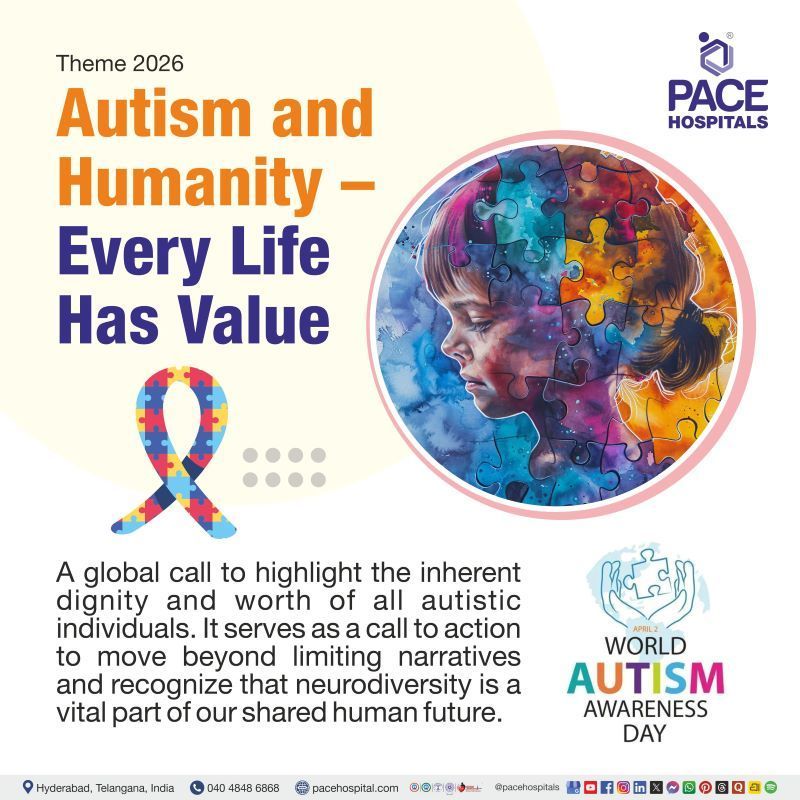
This year, 2026, the theme of World Autism Awareness Day is “Autism and Humanity – Every Life Has Value”. This theme emphasizes the inherent dignity and worth of all autistic individuals. It serves as a call to action to move beyond limiting narratives and recognize that neurodiversity is a vital part of our shared human future.
Year by year, themes of World Autism Awareness Day
- World Autism Awareness Day 2025 theme: Advancing Neurodiversity and the UN Sustainable Development Goals (SDGs)
- World Autism Awareness Day 2024 theme: Moving from Surviving to Thriving: Autistic Individuals share regional perspectives
- World Autism Awareness Day 2023 theme: Transforming the narrative: Contributions at home, at work, in the arts and in policymaking.
- World Autism Awareness Day 2022 theme: Inclusive Quality Education for All
- World Autism Awareness Day 2021 theme: Inclusion in the Workplace: Challenges and Opportunities in a Post-Pandemic World
- World Autism Awareness Day 2020 theme: The Transition to Adulthood
- World Autism Awareness Day 2019 theme: Assistive Technologies, Active Participation
History of World Autism Awareness Day
In the 76th plenary meeting conducted on 18th of December 2007, the United Nations designated the 2nd of April as World Autism Awareness Day, has been observed every year since 2008.
The United Nations Department of Global Communications in collaboration with the Institute of Neurodiversity (ION), an organization founded and run by neurodiverse individuals for neurodiverse individuals and their allies, organizes the World Autism Awareness Day in 2026.
ION is headquartered in Switzerland, with a presence in fourteen countries. ION is trying to build a society in which neurodiverse people feel welcomed, represented, included, empowered, and heard.
Risk factors of Autism
- Genetics plays a prominent role in ASD. Studies found that in identical twins, if one child has ASD, then the other will have 36-95% chance of also having ASD.
- Siblings of children with ASD have a 2-8% risk of also developing the disorder
- Parental history of psychiatric disorders, and in particular schizophrenia and affective disorders, has been linked to an increased risk for autism.
- Children born prematurely (2500 gm) are associated with 2-fold increased risk for autism
- Foetal exposure to insecticides such as chlorpyrifos has been linked to a higher risk of autism
- Exposure of pregnant mothers, especially during 1st or 2nd trimester, to viral or bacterial infections, increases the risk for neuropsychiatric diseases including autism in their children by 13%.
Share on
Request an appointment
Fill in the appointment form or call us instantly to book a confirmed appointment with our super specialist at 04048486868
Appointment request - health articles
Recent Articles