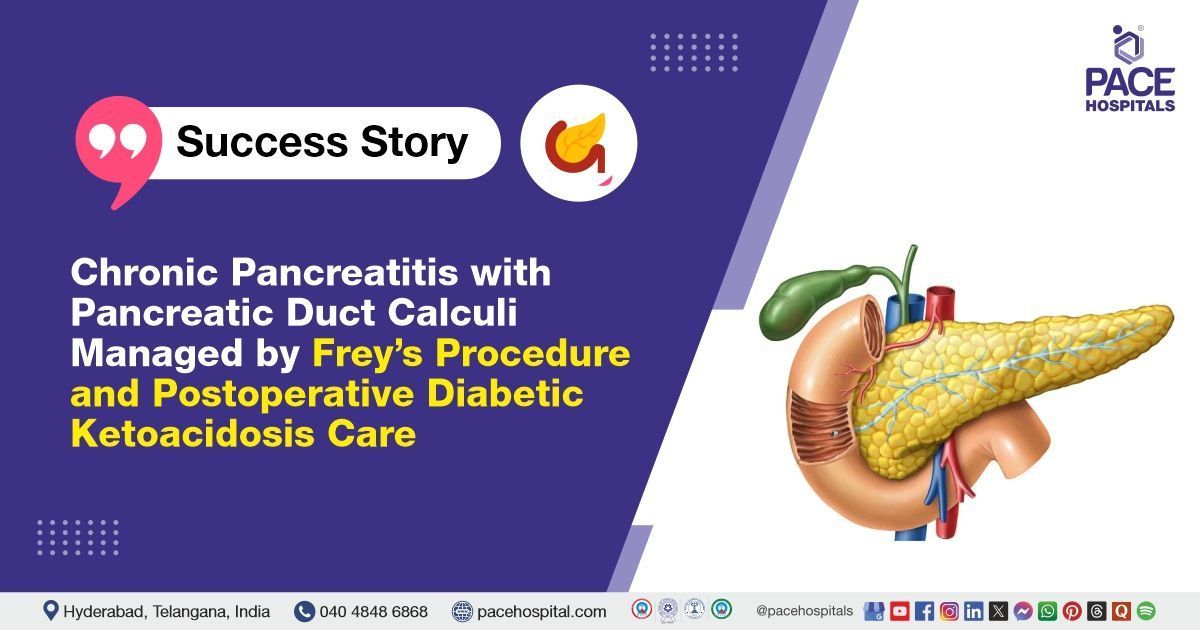
Frey’s Procedure for Chronic Pancreatitis with Pancreatic Duct Calculi
PACE Hospitals
A 57-year-old male patient was diagnosed with chronic pancreatitis complicated by diabetic ketoacidosis (DKA), underwent Frey’s procedure (longitudinal pancreaticojejunostomy) with cholecystectomy.
Chief Complaints
A 57-year-old male patient presented to the Surgical Gastroenterology Department of
PACE Hospitals, Hyderabad, with the chief complaints of abdominal pain and generalized weakness for a week. The patient was apparently asymptomatic a week ago, and then he developed pain involving the epigastric region, radiating to the back.
Medical History
Upon detailed medical investigation, the patient was found to have a five-year history of chronic pancreatitis. He was also a known case of Diabetes mellitus with uncontrolled blood sugar levels at the time of admission. The patient denied any history of previous surgeries.
Diagnosis
The patient was diagnosed with chronic pancreatitis with pancreatic duct calculi. He was also diagnosed with diabetic ketoacidosis (DKA), which developed postoperatively.
Medical Decision Making (MDM)
Upon admission, the patient’s liver function tests (LFTs) were abnormal, and his blood glucose levels were found to be uncontrolled. A CECT of the abdomen with IV contrast confirmed the presence of chronic calcific pancreatitis with a dilated main pancreatic duct, multiple ductal calculi, and peripancreatic fat stranding.
Given the patient’s elevated bilirubin and alkaline phosphatase (ALP) levels, an MRCP was performed to rule out common bile duct (CBD) strictures or stones, which was normal. Initially, the patient was managed with IV fluids, insulin therapy, pain management, antibiotics, and other supportive treatments.
Treatment Procedure
After discussing the treatment plan with the family, the surgical gastroenterologist, bariatric and metabolic surgeon, GI and HPB oncologist and liver transplant surgeon, along with Dr. Suresh Kumar S, decided to proceed with Frey’s procedure for definitive management of chronic pancreatitis with ductal obstruction.
Intraoperative Findings
During the surgery, the pancreas was found to be atrophic with multiple ductal calculi. The gallbladder of the patient was found distended, leading to the decision to perform a cholecystectomy.
The patient underwent Kocherization, and the pancreatic head was mobilized. A longitudinal incision was made in the main pancreatic duct, and ductal calculi were removed. A head coring procedure was performed to relieve the obstruction.
The Roux-en-Y pancreaticojejunostomy was created to establish pancreatic drainage. The surgical procedure was uneventful, and the patient was shifted to the ICU for postoperative monitoring.
Post-Surgical Course & Management of Diabetic ketoacidosis
On postoperative day (POD) 1, the patient developed diabetic ketoacidosis (DKA), which was identified based on high blood glucose levels, positive urine ketones, and metabolic acidosis. An endocrinology consultation was obtained for further management. The DKA was managed successfully with IV insulin therapy, IV fluids for dehydration, electrolyte correction, and close glucose and ketone monitoring.
Over the next few days, the patient gradually stabilized, his pain subsided, his urine ketones turned negative, and his blood glucose levels normalized. The patient was later shifted to the ward and continued on IV antibiotics, analgesics, and supportive care. By the time of discharge, the patient was hemodynamically stable, pain-free, and maintained euglycemia with well-controlled blood sugar levels.
Wound Care
The patient was advised to keep the surgical wound clean and dry. He was instructed to monitor any signs of infection, such as redness, swelling, or pus discharge.
Blood Sugar Monitoring
The patient was instructed to check blood glucose levels (GRBS) thrice daily. He was advised to monitor fasting and postprandial glucose levels to ensure proper glycemic control. A diabetic diet was recommended, emphasizing low sugar intake, high fiber content, and frequent small meals to prevent sudden glucose fluctuations.
Emergency Care Review
The patient was advised to seek immediate medical attention if he experienced any of the symptoms like High fever, Severe abdominal pain or Persistent vomiting.
Follow-Up Plan
The patient was instructed to follow up after five days in the Gastroenterology OPD. Additionally, he was advised to follow up with the Endocrinology OPD in five days for reassessment of his glucose control and potential insulin therapy adjustments.
Need for surgical intervention due to the interaction between chronic pancreatitis and diabetes mellitus
Chronic pancreatitis (CP) and diabetes mellitus (DM) frequently coexist due to progressive pancreatic damage, often necessitating surgical intervention. Intractable pain unresponsive to medical therapy may require procedures like Frey’s or the Whipple’s procedure. Ductal obstructions causing bile or pancreatic duct strictures often necessitate surgical decompression. Advanced CP leads to type 3c DM, worsening glycemic control, and in some cases, metabolic surgery is considered. Large or infected pseudocysts and necrosis may require surgical drainage or necrosectomy. Chronic inflammation increases the risk of pancreatic malignancy, warranting surgical evaluation. When endoscopic management fails, or severe exocrine insufficiency leads to malabsorption, surgery becomes a crucial option.
Share on
Request an appointment
Fill in the appointment form or call us instantly to book a confirmed appointment with our super specialist at 04048486868
Appointment request - health articles
Recent Articles