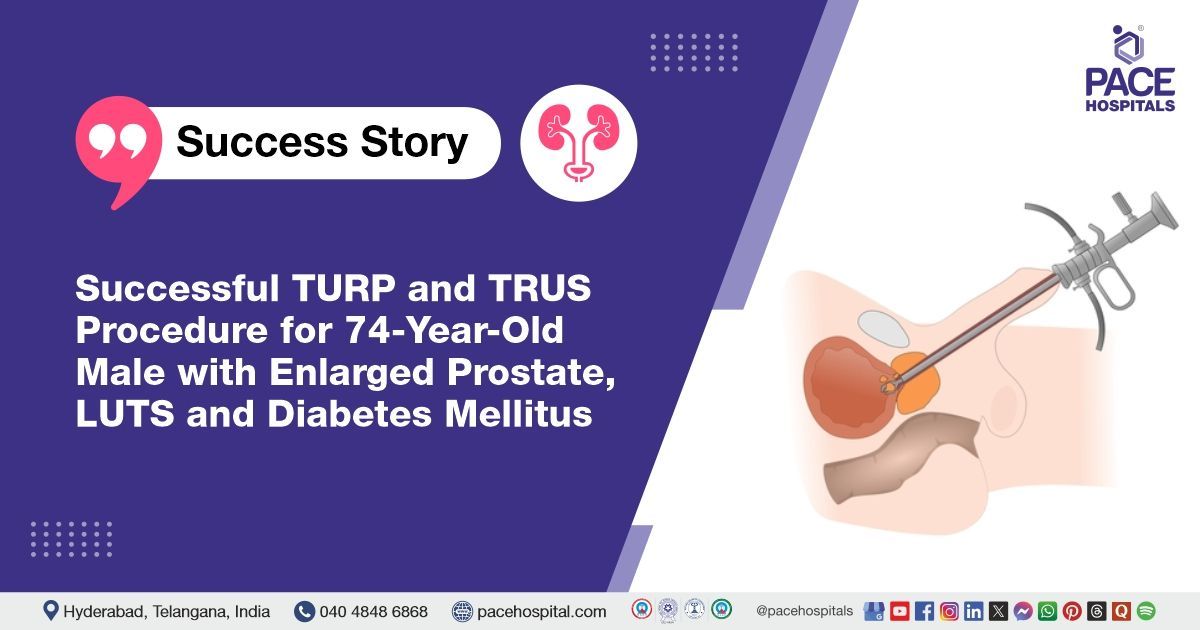
Successful TURP and TRUS Procedure for 74 Y.O. Male with Enlarged Prostate, LUTS and DM
PACE Hospitals
The Urology team at PACE Hospitals successfully carried out a Transurethral Resection of the Prostate (TURP) along with a Transrectal Ultrasound for a 74-year-old male patient suffering from an enlarged prostate, Lower Urinary Tract Symptoms (LUTS), Diabetes Mellitus (DM), and Hypertension (HTN).
Chief Complaints
A 74-year-old male patient presented with the chief complaints of poor urine flow at
PACE Hospitals, Hitech City, Hyderabad.
Medical History
The patient was a known case of diabetes mullites and Hypertension.
Diagnosis
Upon admission to PACE Hospitals, the patient's vitals were stable. After a thorough physical examination, the doctors noted that he had poor urine flow.
Diagnostic tests confirmed that he had an enlarged prostate, Lower Urinary Tract Symptoms (LUTS), Diabetes Mellitus, and Hypertension.
Surgical Procedure
After consultations with the consultant urologist, Dr. Abhik Debnath it was determined that Transurethral Resection of the prostate (TURP) along with a Transrectal Ultrasound (TRUS) was the most effective method for treating the patient.
The Transurethral Resection of the Prostate (TURP) is performed to relieve symptoms of an enlarged prostate, such as poor urine flow, while the Transrectal Ultrasound (TRUS) helps in evaluating the prostate's size and guide the treatment.
Intra operative Findings
The operation notes describe that the patient had a trabeculated bladder, which means the bladder’s muscle walls were thickened or scarred. The prostate was found to be irregular, with a large median lobe. Due to the irregular shape of the prostate and a borderline Prostate-Specific Antigen (PSA) level of 4.25 ng/ml, the medical team decided to take a prostate biopsy using TRUS (Transrectal Ultrasound) during the TURP procedure.
The biopsy involved removing 4 small tissue samples from the prostate to check for any abnormalities or signs of prostate cancer. This approach helps ensure a comprehensive diagnosis while addressing the patient's symptoms.
Postoperative Care
The postoperative recovery was smooth (with no complications), and the patient was discharged in a stable condition.
Discharge Medications
Upon discharge, the patient was prescribed antibiotics, antipyretics, proton pump inhibitors (PPIs), lactulose, and multivitamin supplements. He was also advised to continue their diabetes and hypertension medications as per the prescribed instructions and to consult a local physician for further follow-up.
Advice on Discharge
The patient was advised to avoid lifting heavy weights, bending forward, and straining during bowel movements. Additionally, He was advised not to travel for long hours on buses, autos, or two-wheelers.
Mild discomfort in the flank or suprapubic area, occasional blood in the urine, cloudy urine, mild burning sensation, and slight leakage may be experienced but are expected to resolve within 7-10 days. A diabetic low-salt diet was recommended.
Emergency Care
The patient was informed to contact the Emergency Ward at PACE Hospitals in case of any emergency or the development of symptoms like fever, abdominal pain, or vomiting.
Review and Follow-up Notes
The patient was advised to consult Dr. Abhik Debnath after two weeks for a review of the biopsy results, basic tests, and additional prostate imaging.
Role of TURP with TRUS in Enlarged prostate lower urinary tract (LUTS)
Transurethral Resection of the Prostate (TURP) and Transrectal Ultrasonography (TRUS) are essential for managing an enlarged prostate and Lower Urinary Tract Symptoms (LUTS). TURP helps remove excess prostate tissue, alleviating symptoms like urinary retention and decreased urine flow.
Meanwhile, TRUS offers real-time imaging of the prostate, allowing for precise measurement of its size, shape, and identification of any abnormalities. Additionally, TRUS enables a safe and accurate prostate biopsy if necessary. Together, TURP and TRUS form a comprehensive approach to both diagnosing and treating Benign Prostatic Hyperplasia (BPH), improving urinary function and reducing the risk of complications.
Share on
Request an appointment
Fill in the appointment form or call us instantly to book a confirmed appointment with our super specialist at 04048486868
Appointment request - health articles
Recent Articles