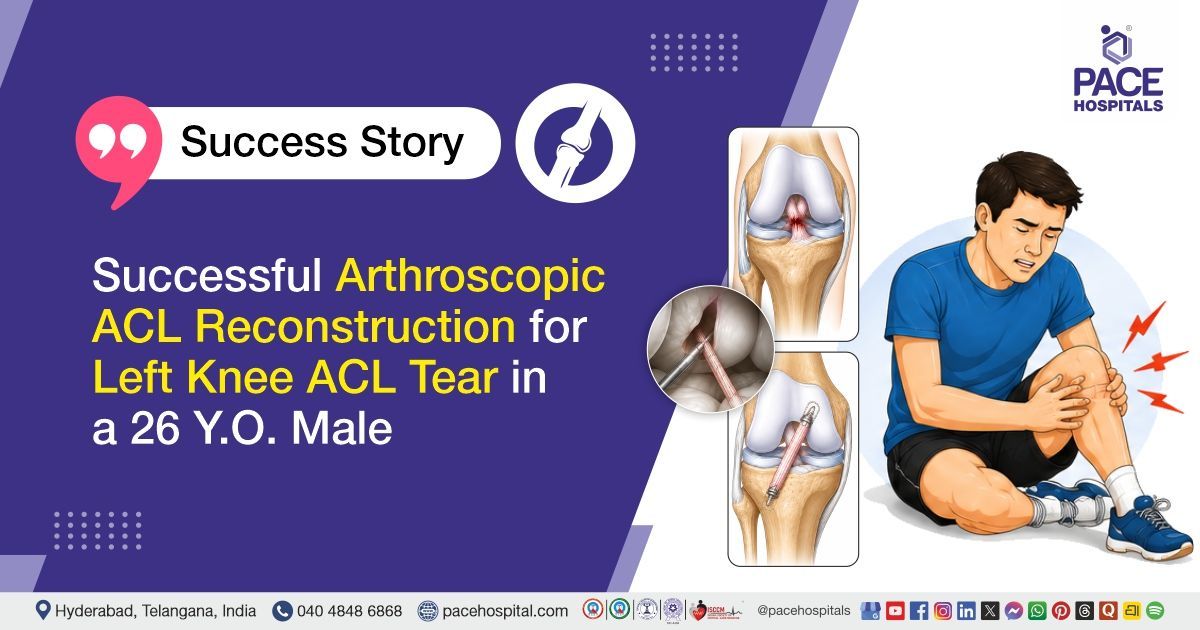
Successful Arthroscopic ACL Reconstruction for Left Knee ACL Tear in a 26 Y.O. Male
PACE Hospitals
PACE Hospitals’ expert Orthopaedic team successfully performed Arthroscopic Anterior Cruciate Ligament (ACL) Reconstruction of the Left Knee on a 26-year-old male patient diagnosed with an Anterior Cruciate Ligament (ACL) tear of the Left Knee. The procedure was undertaken to restore knee stability and function, relieve pain, and facilitate the patient’s safe return to daily activities and sports, while helping to prevent further joint damage and long-term complications.
Chief Complaints
A 26-year-old male patient with a body mass index (BMI) of 21 presented to the Orthopaedic Department at PACE Hospitals, Hitech City, Hyderabad, with complaints of pain and instability in the left knee. The patient reported experiencing these symptoms for the past month following a twisting injury sustained while playing badminton. The condition was associated with difficulty performing daily activities due to persistent knee pain.
Past Medical History
The patient had no significant past medical or surgical history and no known comorbidities.
On Examination
On examination, the patient was conscious, coherent, oriented, and hemodynamically stable. General physical examination was normal, with no evidence of pallor, icterus, lymphadenopathy, clubbing, or cyanosis. Local examination of the left knee revealed joint effusion and clinical signs of anterior cruciate ligament instability, while distal neurovascular status was intact.
Diagnosis
Following the clinical evaluation, the Orthopaedic team at PACE Hospitals conducted a detailed assessment of the patient’s complaints of pain and instability in the left knee, associated with difficulty performing daily activities following a twisting injury sustained while playing badminton.
A thorough clinical examination revealed left knee joint effusion and a positive anterior drawer test, indicating anterior cruciate ligament instability. The distal neurovascular status was intact, and general physical examination showed no significant abnormalities. Further evaluation with MRI of the left knee confirmed a complete anterior cruciate ligament (ACL) tear. Based on the clinical presentation, examination findings, and imaging results, the patient was diagnosed with an anterior cruciate ligament tear of the left knee.
Based on these findings, the patient was advised to undergo
Left Knee
Anterior Cruciate Ligament (ACL) Tear Treatment in Hyderabad, India, under the care of the Orthopaedic Department to restore knee stability, improve joint function and mobility, alleviate pain, and facilitate a safe return to daily activities and sports while preventing further joint damage.
Medical Decision Making (MDM)
After a detailed evaluation by Dr. Raghuram, Consultant Orthopaedic Surgeon, the patient was assessed for pain and instability of the left knee associated with difficulty in performing daily activities following a twisting injury sustained while playing badminton. Clinical examination revealed left knee effusion and a positive anterior drawer test, suggestive of anterior cruciate ligament insufficiency. Distal neurovascular status was intact, and the patient was clinically stable with no significant systemic abnormalities. MRI of the left knee confirmed an anterior cruciate ligament tear.
Based on the clinical findings, imaging results, and the patient's functional limitations, it was determined that Arthroscopic Anterior Cruciate Ligament (ACL) Reconstruction of the Left Knee was the most appropriate management approach. This decision was made to restore knee stability, improve joint function and mobility, alleviate pain, facilitate a return to daily activities and sports, and prevent further joint damage and long-term complications.
The patient and his family members were counselled regarding the diagnosis, the planned arthroscopic reconstruction procedure, graft harvesting and fixation techniques, potential risks and benefits, postoperative rehabilitation protocol,
physiotherapy requirements, expected recovery timeline, and the importance of regular follow-up to achieve optimal functional outcomes.
Surgical Procedure
Following the diagnosis, the patient was scheduled to undergo Left Knee Arthroscopic Anterior Cruciate Ligament (ACL) Reconstruction Surgery in Hyderabad at PACE Hospitals under the supervision of the expert Orthopaedic Department.
The surgical procedure involved the following steps:
- Patient Positioning and Preparation: The patient was positioned in a supine position on the operating table, and the left lower limb was prepared and draped under sterile conditions. A tourniquet was applied to ensure a bloodless surgical field throughout the procedure.
- Diagnostic Arthroscopy: Arthroscopic evaluation of the left knee was performed, which revealed a complete tear of the anterior cruciate ligament (ACL) with intact and normal meniscal structures.
- Graft Harvesting and Preparation: The semitendinosus and hamstring tendons were harvested and carefully prepared as an autologous graft for ACL reconstruction.
- Tunnel Creation and Graft Fixation: Femoral and tibial tunnels were created according to the size of the prepared graft. The graft was then passed through the tibial and femoral tunnels and positioned appropriately. Fixation was achieved using an adjustable loop on the femoral side and a biodegradable interference screw (9 × 25 mm) on the tibial side.
- Final Assessment and Wound Closure: Intraoperative assessment confirmed good graft tension and stability. Hemostasis was achieved, and the wound was closed in layers under sterile conditions.
Postoperative Care
The postoperative period was uneventful, and the patient had a stable recovery during the hospital stay. Early mobilization was initiated with assisted ambulation as tolerated to promote functional recovery of the left knee. Supportive care was provided to prevent infection, control pain, and reduce postoperative inflammation.
Regular wound care and dressing changes were performed, and the surgical site remained clean and healthy without signs of infection or complications. The patient showed satisfactory clinical progress and was hemodynamically stable at the time of discharge.
Discharge Medications
Upon discharge, the patient was prescribed medications aimed at preventing postoperative infection, reducing gastric acidity and protecting the gastric mucosa, controlling postoperative pain and inflammation, supporting tissue healing and recovery, and promoting overall wound healing and immune support following surgery.
Advice on Discharge
The patient was advised to continue with a normal diet as tolerated. Physiotherapy was recommended, including supervised walking training and stair-climbing exercises for one week to aid functional recovery and improve knee strength and mobility following surgery.
Emergency Care
The patient was informed to contact the emergency ward at PACE Hospitals in case of any emergency or development of symptoms such as severe pain in the operated left knee, increasing swelling at the surgical site, or fever.
Review and Follow-up Notes
The patient was advised to return for a follow-up visit with the Orthopaedic Doctor in Hyderabad at PACE Hospitals after 1 week for dressing change.
Conclusion
This case highlights a 26-year-old male who sustained a complete left knee anterior cruciate ligament (ACL) tear following a sports-related twisting injury. The patient underwent successful arthroscopic ACL reconstruction with graft fixation to restore knee stability and function. The postoperative period was uneventful with satisfactory recovery and mobilization. The patient was discharged in stable condition with advice on physiotherapy and regular follow-up for optimal functional outcome.
Arthroscopic Management of Knee Ligament Injuries
Arthroscopic reconstruction has become a cornerstone in the management of knee ligament injuries due to its minimally invasive nature and high precision. It allows direct visualization of intra-articular structures, enabling accurate diagnosis and effective treatment with reduced tissue trauma under the expertise of an orthopaedic doctor / orthopaedic surgeon. Modern graft selection and fixation techniques provide strong mechanical stability while supporting biological healing of the ligament. Early surgical management helps restore joint stability, prevent progressive joint degeneration, and improve long-term functional outcomes. Postoperative rehabilitation plays a key role in regaining muscle strength, joint mobility, and functional capacity. Structured physiotherapy and gradual return-to-activity protocols are essential for optimal recovery. Overall, arthroscopic techniques significantly enhance patient outcomes in ligamentous knee injuries.
Frequently Asked Questions (FAQs)
How does arthroscopic ACL reconstruction help restore knee stability?
Arthroscopic ACL reconstruction replaces the torn anterior cruciate ligament with a tendon graft to restore stability of the knee joint. The graft functions as a strong support structure that controls forward and rotational movements of the knee. This helps the patient regain confidence during walking, running, and sports activities. Proper rehabilitation is important for the graft to heal and function effectively over time.
Why was hamstring tendon graft used for ACL reconstruction?
A hamstring tendon graft is commonly used because it provides good strength and heals well while requiring only a small incision at the site where it is taken from. Once placed in the knee, the graft slowly becomes incorporated with the surrounding bone and tissues over time. It helps provide long-term stability and is often chosen for active patients. The final decision on graft type depends on factors such as the patient’s age, activity level, and the surgeon’s assessment.
What is the purpose of drilling tunnels in the femur and tibia during ACL reconstruction?
Small tunnels are made in the femur and tibia to position the graft where the original ACL was located. Correct placement of these tunnels is important to restore normal knee movement and stability. They help hold the graft securely while it heals and joins with the bone. Accurate positioning plays a key role in achieving good surgical results.
Why are adjustable loop devices and biodegradable screws used in ACL surgery?
These fixation devices are used to hold the graft firmly inside the bone tunnels during the early healing period. Adjustable loop devices secure one end of the graft, while biodegradable screws support fixation on the other side. This keeps the graft stable and prevents unwanted movement while healing takes place. Gradually, the graft integrates with the bone and takes over the function of the original ligament.
How soon can walking begin after ACL reconstruction surgery?
Walking is usually started early after surgery under the guidance of the orthopaedic team and physiotherapists. Early movement helps improve blood flow, reduce stiffness, and maintain muscle strength. The amount of weight-bearing is decided by the surgeon based on how the patient is recovering. A planned rehabilitation program is important to ensure safe improvement in mobility.
Why is physiotherapy important after ACL reconstruction?
Physiotherapy plays an important role in restoring knee movement, improving muscle strength, and enhancing balance and coordination. It helps reduce stiffness and prevent muscle weakness after surgery. Rehabilitation also helps the knee gradually adapt to daily activities and a return to normal physical activity. Regular physiotherapy is important for achieving better long-term recovery.
How long does it take for the reconstructed ACL graft to heal completely?
Improvement in symptoms is usually seen within a few months, but complete healing of the graft takes longer. During this time, the graft slowly joins with the bone and adapts to work like a normal ligament. Recovery differs from person to person depending on age, activity level, and how well rehabilitation is followed. Returning to strenuous activity too early may increase the risk of reinjury.
When can sports activities be resumed after ACL reconstruction?
Return to sports is based on recovery of strength, stability, joint movement, and overall function rather than a fixed time period. Most patients need several months of rehabilitation before getting back to sports activities. The orthopaedic surgeon and physiotherapist check recovery through clinical examination and functional tests. A slow and gradual return to sports is advised to prevent the risk of reinjury.
What factors influence the success of ACL reconstruction surgery?
Good results depend on correct surgical technique, proper fixation of the graft, and following the rehabilitation plan carefully. Factors such as age, muscle strength, and the overall condition of the knee also influence recovery. It is important to avoid returning to high-impact activities too early to protect the healing graft. Regular follow-up visits help monitor progress and ensure proper recovery.
Can ACL reconstruction help patients return to an active lifestyle?
ACL reconstruction is done to restore knee stability and help patients return to normal daily activities and sports. Many patients recover well after surgery with proper rehabilitation. Good outcomes depend on following physiotherapy advice and maintaining muscle strength. Long-term knee health is improved with regular exercise and measures to prevent further injury.
Share on
Request an appointment
Fill in the appointment form or call us instantly to book a confirmed appointment with our super specialist at 04048486868
Appointment request - health articles
Recent Articles