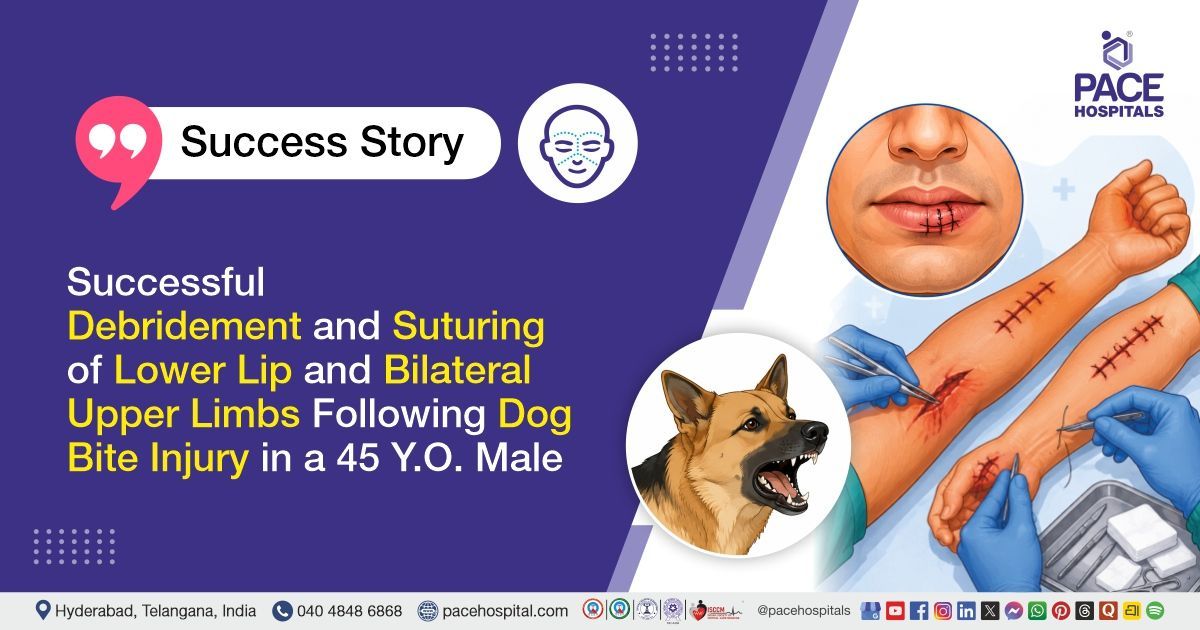
Successful Debridement & Suturing of Lower Lip & Bilateral Upper Limbs Following Dog Bite Injury
PACE Hospitals
PACE Hospitals’ expert Plastic and Reconstructive Surgery team successfully performed Debridement and Suturing on a 45-year-old male diagnosed with a dog bite injury to the lower lip and bilateral upper limbs. The procedure aimed to thoroughly clean and remove contaminated and non-viable tissue, prevent infection, promote optimal wound healing, and restore both functional and cosmetic outcomes.
Chief Complaints
A 45-year-old male patient with a body mass index (BMI) of 21 presented to the Plastic and Reconstructive Surgery Department at PACE Hospitals, Hitech City, Hyderabad, with complaints of an alleged history of dog bite injury sustained at home. The patient reported injury to the lower lip and bilateral upper limbs, associated with bleeding from the wound sites. There was no history of loss of consciousness, vomiting, seizures, ear bleeding, or nose bleeding following the incident.
Past Medical History
The patient had no known medical illnesses and no history of previous surgical interventions. He had a documented history of allergy to certain medications.
On Examination
On examination, the patient was conscious, coherent, and cooperative. General examination revealed no pallor, icterus, cyanosis, clubbing, lymphadenopathy, or pedal edema. Vital signs were stable. Local examination showed dog bite injuries over the lower lip and bilateral upper limbs with lacerations and avulsed skin. The wounds showed surrounding soft tissue injury, and hemostasis was maintained. No other external injuries were noted.
Diagnosis
Upon admission to PACE Hospitals, following the clinical examination, the Plastic and Reconstructive Surgery and Orthopaedic teams conducted a thorough assessment, including a detailed review of the patient’s medical history and a focused evaluation of his dog bite injuries involving the face and upper limbs.
To confirm the diagnosis and determine the extent of soft tissue injury, the patient underwent detailed clinical and radiological evaluations, including a CT scan of the face. The imaging revealed a linear deep laceration involving the lower lip with minimal adjacent soft tissue edema and a few air foci. Additionally, injuries involving the bilateral upper limbs were noted, consistent with open bite wounds affecting the right upper arm, right elbow, left elbow, and bilateral forearms. No associated facial bone fractures were identified. However, associated mucosal thickening of the paranasal sinuses was noted, suggestive of inflammatory changes.
Based on the confirmed diagnosis, the patient was advised to undergo Dog Bite Treatment in Hyderabad, India, under the care of the Plastic and Reconstructive Surgery team to achieve optimal functional and cosmetic outcomes.
Medical Decision Making (MDM)
After a thorough evaluation by Dr. Kantamneni Lakshmi (Consultant Plastic Surgeon), and in coordination with cross-consultations from Dr. Snigda Panuganti (Consultant General Physician), and Dr. Raghuram (Consultant Orthopedic Surgeon), a comprehensive assessment was carried out to determine the most appropriate management plan for the patient diagnosed with dog bite injuries involving the lower lip and bilateral upper limbs.
Based on the clinical findings of laceration over the lower lip and multiple open bite wounds involving the right upper arm, right elbow, left elbow, and bilateral forearms, with associated bleeding, soft tissue injury, and contamination, it was determined that wound debridement and primary suturing under general anaesthesia was the most appropriate treatment approach. This decision was made after careful evaluation of the extent of soft tissue damage, risk of infection, including rabies-related complications, need for thorough wound cleansing, prevention of progressive tissue necrosis, and restoration of optimal functional and aesthetic outcomes.
The patient and his family members were counselled regarding the condition, the need for surgery, associated risks and benefits, and the importance of postoperative care, including proper wound care, completion of the anti-rabies vaccination schedule, medication adherence, regular dressing changes, infection monitoring, and follow-ups.
Surgical Procedure
Following the diagnosis, the patient was scheduled to undergo a Debridement and Primary Suturing Procedure in Hyderabad at PACE Hospitals, under the supervision of the expert Plastic and Reconstructive Surgery team.
The surgical procedure involved the following steps:
- Anaesthesia and Patient Preparation: The patient was taken up for surgery under general anaesthesia. After achieving adequate anaesthetic depth, the patient was placed in a supine position. All involved areas were thoroughly cleaned, painted with antiseptic solution, and draped in a sterile manner to maintain aseptic surgical conditions.
- Wound Exploration and Assessment: A detailed intraoperative assessment of all wound sites was performed, including the lower lip and bilateral upper limbs. The extent of tissue damage, contamination, and devitalized tissue was carefully evaluated to plan appropriate debridement and repair.
- Surgical Debridement and Irrigation: All wounds were thoroughly debrided to remove contaminated, non-viable, and devitalized tissue. This was followed by copious saline wash to reduce bacterial load and ensure adequate wound cleansing.
- Layered Wound Closure and Suturing: The split laceration over the lower lip was closed in three layers using absorbable sutures to achieve proper anatomical alignment and optimal cosmetic outcome. Avulsed skin wounds over both upper limbs were also approximated and sutured to ensure secure wound closure and tissue alignment.
- Hemostasis and Post-Procedure Care: Meticulous hemostasis was achieved to control bleeding. Following confirmation of secure wound closure, aseptic dressings were applied over all surgical sites. The procedure was completed uneventfully, and the patient was shifted for postoperative care in stable condition.
Postoperative Care
Postoperatively, the patient was closely monitored for vital signs, pain, and wound condition. Regular aseptic dressings were performed, along with measures to prevent infection and promote optimal wound healing of the lower lip and bilateral upper limb injuries. Supportive care was provided for pain control, hydration, and overall recovery. The postoperative period remained uneventful, and the patient showed steady improvement and was discharged in stable condition.
Discharge Medications
Upon discharge, the patient was prescribed medications to prevent wound infection, support local wound care, provide gastric protection, relieve pain, and reduce inflammation and edema. Additional support included nutritional supplementation to promote healing and antiseptic oral care to maintain hygiene and aid recovery of the lower lip wound.
Advice on Discharge
The patient was advised to maintain proper wound care with regular aseptic dressing changes and to adhere strictly to the anti-rabies vaccination schedule (0, 3, 7, 14, and 28 days) as per protocol. The patient was also advised to follow a diabetic diet to support overall healing and recovery.
Emergency Care
The patient was informed to contact the emergency ward at PACE Hospitals in case of any emergency or development of symptoms such as fever, increased pain or swelling at the wound sites, wound discharge or bleeding, or signs of infection.
Review and Follow-up Notes
The patient was advised to return for a follow-up consultation with the Consultant Plastic, Reconstructive & Aesthetic Surgeon in Hyderabad at PACE Hospitals after 2 days for dressing.
Conclusion
This case highlights multiple dog bite injuries involving the lower lip and bilateral upper limbs, managed with timely surgical debridement and layered suturing under general anaesthesia. The postoperative course was uneventful, and the patient was discharged in stable condition with advice for wound care, completion of the rabies vaccination schedule, and follow-up advice.
General Management of Soft Tissue Injuries Following a Dog Bite
Soft tissue injuries due to dog bites require immediate and systematic management under the guidance of a Plastic Surgeon / Plastic Surgery Doctor to prevent infection and ensure optimal functional and aesthetic outcomes. Initial management includes thorough wound cleansing and copious irrigation to reduce bacterial contamination and remove debris. Careful debridement of devitalized tissue is performed when indicated to promote healthy wound healing and reduce infection risk. Decisions regarding wound closure are made based on the extent of injury, contamination level, and anatomical location. Prompt administration of rabies post-exposure prophylaxis, along with tetanus immunization is essential in all dog bite cases. Adequate pain control, infection prevention measures, and regular sterile dressing changes support effective recovery. Structured follow-up with the Plastic Surgery team is important to monitor healing, identify complications early, and ensure satisfactory functional and cosmetic outcomes.
Frequently Asked Questions (FAQs)
Why was surgery needed for this dog bite injury?
Surgery was needed because the dog bite caused wounds on the lower lip and both upper limbs. In dog bite injuries, the wound may contain saliva, dirt, bacteria, and damaged tissue. Simple dressing may not be enough for deeper wounds. So, the surgeon cleaned the wound properly, removed unhealthy tissue, and closed the wound with sutures for better healing.
What does debridement mean in a dog bite wound?
Debridement means deep cleaning of the wound and removal of damaged or contaminated tissue. This is an important step in dog bite treatment because it helps reduce the risk of infection. After debridement, the wound edges become cleaner and healthier, which helps the sutures hold better and allows the wound to heal properly.
Why was the lower lip wound sutured in layers?
The lower lip has different layers, including the skin, muscle, and inner lining of the mouth. When the cut is deep, closing only the outer skin may not give proper shape or strength. Layered suturing helps bring each layer back into place. This helps restore the lip shape, supports healing, and gives a better cosmetic result.
Is it safe to stitch a dog bite wound?
Yes, suturing can be done in selected dog bite wounds after proper wound cleaning and debridement. Facial wounds, especially lip injuries, are often repaired early because the face has a good blood supply, and appearance is also important. The doctor decides based on the depth of the wound, infection risk, contamination, and time since the bite.
Why was general anaesthesia used for this procedure?
General anaesthesia was used because the patient had multiple wounds and a deep lower lip injury that needed careful repair. It allows the surgeon to clean and suture the wounds properly without pain or movement. This is useful when wounds are painful, deep, or present in sensitive areas like the face and mouth.
Why is rabies vaccination needed even after wound repair?
Wound cleaning and suturing support proper healing of the injury, but they do not provide protection against rabies. Protection from rabies is achieved only through timely anti-rabies vaccination as prescribed by the doctor. It is important to complete the full vaccine schedule as advised, even if the wound shows improvement after treatment. Skipping or delaying doses may reduce the effectiveness of protection against infection.
Why is rabies immunoglobulin given in some dog bite cases?
Rabies immunoglobulin is given in high-risk dog bite injuries to provide immediate protection against rabies. It is usually used for deep wounds, bleeding bites, or injuries involving areas like the face, hands, or multiple sites. It works at the wound site to neutralize the virus quickly before the vaccine response develops. It is administered along with the rabies vaccine to ensure both immediate and long-term protection.
What wound care is needed after dog bite suturing?
The wound should be kept clean and dry as advised by the doctor. Dressings should be changed only as instructed during follow-up. The patient should avoid touching the wound repeatedly or applying home remedies. Fever, pain, swelling, pus discharge, bad smell, redness, or wound opening should be shown to the doctor immediately.
Will a dog bite injury on the lower lip leave a scar?
A scar can form after any deep cut, especially on the face. However, proper plastic surgical repair can help reduce visible scarring and improve the final appearance. The result depends on wound depth, infection control, healing response, dressing care, and follow-up. Later scar care may also be advised if needed.
Why is follow-up with a plastic surgeon important after dog bite repair?
Follow-up is important to check wound healing, dressing condition, sutures, infection signs, and lip alignment. In facial injuries, the doctor also checks whether the shape and movement of the lip are healing well. Missing follow-up can delay treatment if an infection, wound gap, or poor scar healing develops.
Share on
Request an appointment
Fill in the appointment form or call us instantly to book a confirmed appointment with our super specialist at 04048486868
Appointment request - health articles
Recent Articles