Successful Left Distal Biceps Tendon Repair for Traumatic Elbow Injury in a 43 Y.O. Male
PACE Hospitals
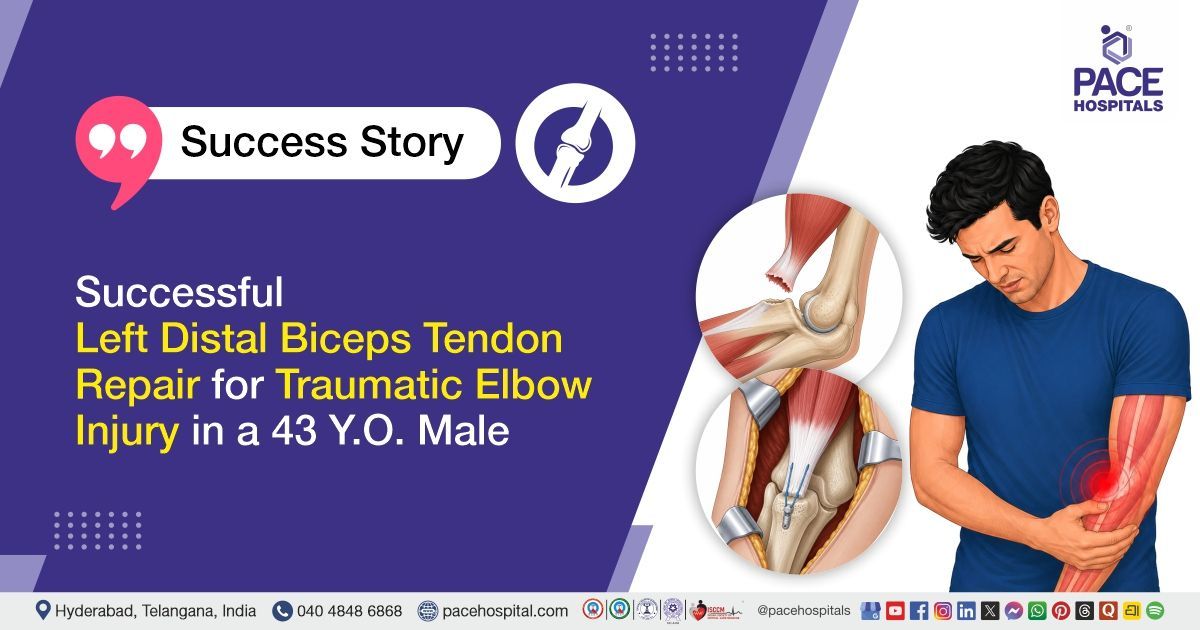
PACE Hospitals’ expert Orthopaedic team successfully performed a Distal Biceps Tendon Repair Surgery on the left elbow on a 43-year-old male patient diagnosed with a left distal biceps tendon tear. The procedure involved reattaching and stabilizing the ruptured tendon to restore elbow flexion and forearm supination strength, relieve pain, and improve overall function and mobility of the upper limb.
Chief Complaints
A 43-year-old male patient with a body mass index (BMI) of 22 presented to the Orthopaedic Department at PACE Hospitals, Hitech City, Hyderabad, with complaints of pain and swelling in the left arm following a slip and fall at home. The patient also had difficulty using the left upper limb, bending the elbow, and lifting weights. There were no complaints of numbness in the left upper limb.
Past Medical History
The patient had no significant past medical or surgical history and no known comorbidities. There was no history of previous upper-limb injuries, neurological disorders, or drug allergies.
On Examination
On general examination, the patient had no pallor, icterus, lymphadenopathy, clubbing, or cyanosis. On clinical examination of the left upper limb, swelling was present over the left arm, with tenderness noted in the distal biceps region. Popeye sign was present, suggestive of biceps tendon injury. Flexion weakness was noted in the left elbow, indicating reduced strength while bending the elbow. There were no distal neurovascular deficits, and distal circulation, sensation, and motor functions were intact.
Diagnosis
Following the clinical evaluation, the Orthopaedic team at PACE Hospitals conducted a detailed assessment of the patient's complaints of pain and swelling in the left arm following a slip-and-fall injury at home. The symptoms were associated with difficulty using the left upper limb, particularly during elbow flexion and while lifting weights. There were no complaints of numbness or sensory disturbances in the affected limb.
A thorough clinical examination revealed swelling and tenderness over the distal biceps region of the left arm, along with a positive Popeye sign and weakness of elbow flexion. Distal neurovascular status was intact, and no significant abnormalities were noted on general physical examination.
Further radiological evaluation showed a normal X-ray of the left elbow, while MRI demonstrated a complete tear of the distal biceps tendon with proximal tendon retraction of up to 3 cm. Based on the clinical presentation, examination findings, and imaging results, the patient was diagnosed with a left distal biceps tendon tear.
Based on these findings, the patient was advised to undergo Left Distal Biceps Tendon Tear Treatment in Hyderabad, India, under the care of the Orthopaedic Department to anatomically reattach the ruptured tendon, restore elbow flexion and forearm supination strength, relieve pain, improve upper-limb function, and facilitate an early return to daily activities while minimizing the risk of long-term functional impairment.
Medical Decision Making (MDM)
After a detailed evaluation by Dr. Raghuram (Consultant Orthopaedic Surgeon), the patient was assessed for pain and swelling in the left arm following a slip-and-fall injury at home. The patient also reported difficulty using the left upper limb, particularly during elbow flexion and while lifting weights. Clinical examination revealed swelling and tenderness over the distal biceps region, a positive Popeye sign, and weakness of elbow flexion, suggestive of a distal biceps tendon rupture. Distal neurovascular status was intact, and the patient was clinically stable with no significant systemic abnormalities.
Based on the clinical findings, imaging results, and the patient's functional limitations, it was determined that left distal biceps tendon repair was the most appropriate management approach. This decision was made to anatomically reattach the ruptured tendon, restore elbow flexion and forearm supination strength, improve upper-limb function, alleviate pain, facilitate an early return to daily activities, and prevent long-term disability associated with untreated tendon rupture.
The patient and his family members were counselled regarding the diagnosis, the planned surgical repair procedure, the use of suture anchor fixation for tendon reattachment, the potential risks and benefits of surgery, the postoperative immobilization and rehabilitation protocol, the expected recovery timeline, and the importance of adherence to follow-up visits and physiotherapy to achieve optimal functional outcomes.
Surgical Procedure
Following the diagnosis, the patient was scheduled to undergo Left Distal Biceps Tendon Repair in Hyderabad at PACE Hospitals under the supervision of the expert Orthopaedic Department.
The surgical procedure involved the following steps:
- Patient Positioning and Surgical Preparation: The patient was placed in the supine position under general anesthesia. A pneumatic tourniquet was applied to the upper arm to provide a bloodless surgical field. The left upper limb was prepared and draped in a sterile manner, and the operative site was marked prior to incision.
- Surgical Exposure and Tendon Identification: A transverse incision was made below the elbow flexion crease to expose the distal biceps tendon. Careful soft tissue dissection was carried out to identify and protect the surrounding neurovascular structures. The ruptured and retracted distal biceps tendon was located, mobilized, and prepared for repair by debriding the tendon ends and ensuring adequate length for anatomical reattachment.
- Preparation of the Radial Tuberosity Footprint: The radial tuberosity, which serves as the anatomical insertion site of the distal biceps tendon, was exposed and prepared. The tendon footprint was refreshed to create an optimal healing surface and facilitate secure tendon-to-bone fixation.
- Tendon Reattachment and Fixation: The prepared distal biceps tendon was anatomically reattached to the radial tuberosity using a double-loaded all-suture anchor Sutures were passed through the tendon and securely tied to achieve a robust fixation. The repair was assessed intraoperatively to confirm appropriate tension, stability, and restoration of the native tendon anatomy.
- Wound Closure and Immobilization: After achieving meticulous hemostasis, the surgical wound was closed in layers using absorbable Vicryl sutures for the deeper tissues and skin staples for the skin closure. A sterile dressing was applied, and an above-elbow plaster-of-Paris (POP) slab was placed to protect the repair and immobilize the elbow during the initial healing period.
Postoperative Care
The postoperative period was uneventful. The patient was managed with appropriate infection prevention medications, pain control, and supportive care measures. Regular wound care and sterile dressings were performed, and the surgical site was found to be clean with no signs of infection or complications. The operated limb was immobilized and closely monitored, and the patient remained clinically stable throughout the hospital stay. The patient was discharged in a stable condition with advised follow-up care.
Discharge Medications
Upon discharge, the patient was prescribed medications to prevent infection, reduce inflammation and pain, provide gastric protection, enhance musculoskeletal healing, and provide nutritional supplementation to support tissue repair and recovery after surgery. The treatment regimen was advised for a specified duration as part of routine postoperative care to ensure optimal healing and prevent complications.
Advice on Discharge
The patient was advised to keep the immobilization slab intact and dry. Regular active movements of the fingers were encouraged as instructed to maintain circulation and prevent stiffness.
Emergency Care
The patient was informed to contact the emergency ward at PACE Hospitals in case of any emergency or development of symptoms such as severe pain in the operated left elbow, increasing swelling at the surgical site, fever, wound discharge, numbness, tingling, or discoloration of the fingers, or any restriction in finger movements.
Review and Follow-up Notes
The patient was advised to return for a follow-up visit with the Orthopaedic Doctor in Hyderabad at PACE Hospitals after 10 days for a suture removal.
Conclusion
This case highlights a traumatic left distal biceps tendon tear managed successfully with surgical repair using suture anchor fixation. The patient had an uneventful postoperative recovery with restoration of limb stability and function and was discharged in stable condition with appropriate rehabilitation advice and follow-up care.
Importance of Early Repair in Distal Biceps Tendon Rupture by Orthopaedic Surgeon
Distal biceps tendon ruptures are relatively uncommon injuries but can lead to significant functional impairment if not promptly diagnosed and managed by an orthopaedic doctor / orthopaedic surgeon. Early clinical recognition, supported by MRI confirmation, plays a crucial role in preventing chronic weakness of elbow flexion and forearm supination. Surgical repair using suture anchor fixation at the radial tuberosity provides strong anatomical reattachment and reliable functional outcomes. Timely intervention helps restore near-normal upper limb strength and prevents long-term disability.
Postoperative immobilization followed by structured rehabilitation is essential for tendon healing and optimal recovery. Careful handling of the tendon during surgery and accurate anatomical placement are key determinants of surgical success. With appropriate management, most patients achieve good functional recovery and return to daily activities without significant limitations.
Frequently Asked Questions (FAQs)
Is distal biceps tendon repair a major surgery?
Distal biceps tendon repair is a procedure done to reattach the torn biceps tendon near the elbow. It is not usually as extensive as major surgeries like joint replacement, but it is still an important tendon repair surgery. The procedure helps improve elbow bending strength and forearm rotation. Good post-surgery care and proper rehabilitation are important for a smooth recovery.
Why is surgery recommended for a distal biceps tendon tear with tendon retraction?
When the distal biceps tendon is completely torn and pulled upward, surgery may be needed to bring it back to its normal position. In this case, the MRI showed that the tendon had retracted by about 3 cm. Repairing helps restore the tendon attachment and supports better arm strength. Early repair may also make treatment easier before the tendon becomes stiff or shortened.
What does distal biceps tendon repair with a suture anchor mean?
This means the torn tendon is brought back and fixed to its original attachment site near the elbow using a strong anchor. The anchor helps hold the tendon firmly in place while it heals. Over time, the tendon heals back to the bone. During this healing period, the repair must be protected from strain or heavy use.
How long does the tendon take to heal after distal biceps repair?
The tendon usually takes a few months to heal strongly after surgery. Most patients need to protect the repaired tendon for at least 3–4 months. Heavy lifting and strenuous activities are usually avoided during this period. Complete recovery may take around 4–6 months, depending on the injury, repair, rehabilitation, and overall health of the patient.
Why is an above-elbow slab or POP applied after distal biceps repair?
An above-elbow slab or POP is applied to protect the elbow after surgery. It helps limit movements that could put stress on the repaired tendon. This support is especially important during the early healing period. Patients should keep the slab intact and follow the doctor’s instructions until the follow-up visit.
Why are finger movements advised after elbow tendon repair?
Finger movements are usually recommended to help decrease swelling and stiffness and to improve blood flow in the hand. These exercises are generally safe when done as advised because they do not put stress on the repaired biceps tendon. However, it is important to avoid lifting, pulling, or strong gripping activities until your doctor says it is safe.
When can physiotherapy start after distal biceps tendon repair?
Physiotherapy usually starts gradually, based on the surgeon’s advice and the strength of the repair. In the beginning, the focus is on reducing swelling and allowing protected movement. Strengthening exercises are added slowly at a later stage. This step-by-step approach helps the tendon heal safely without putting too much pressure on it.
When can a patient return to work after distal biceps tendon repair?
Return to work depends on the type of job. Patients with desk jobs may return earlier if pain is under control and the arm is well protected. People doing manual work, lifting, pushing, or pulling may need more time before returning to full duties. Many patients return to work in about 3 months, but heavy work may take longer.
What is the role of the radial tuberosity in distal biceps repair?
The radial tuberosity is the natural attachment site of the distal biceps tendon on the forearm bone. In this case, the tendon footprint at the radial tuberosity was prepared, and the tendon was repaired back to its anatomical position.
What are the possible risks after distal biceps tendon repair?
Most patients recover well after distal biceps tendon repair. However, like any surgery, there can be some risks such as infection, stiffness, nerve irritation, weakness, reduced elbow movement, abnormal bone formation near the elbow, or, rarely, tendon re-tear. Patients should contact their doctor if they notice increasing pain, fever, wound discharge, worsening swelling, numbness, or any unusual symptoms.
Share on
Request an appointment
Fill in the appointment form or call us instantly to book a confirmed appointment with our super specialist at 04048486868
Appointment request - health articles
Recent Articles