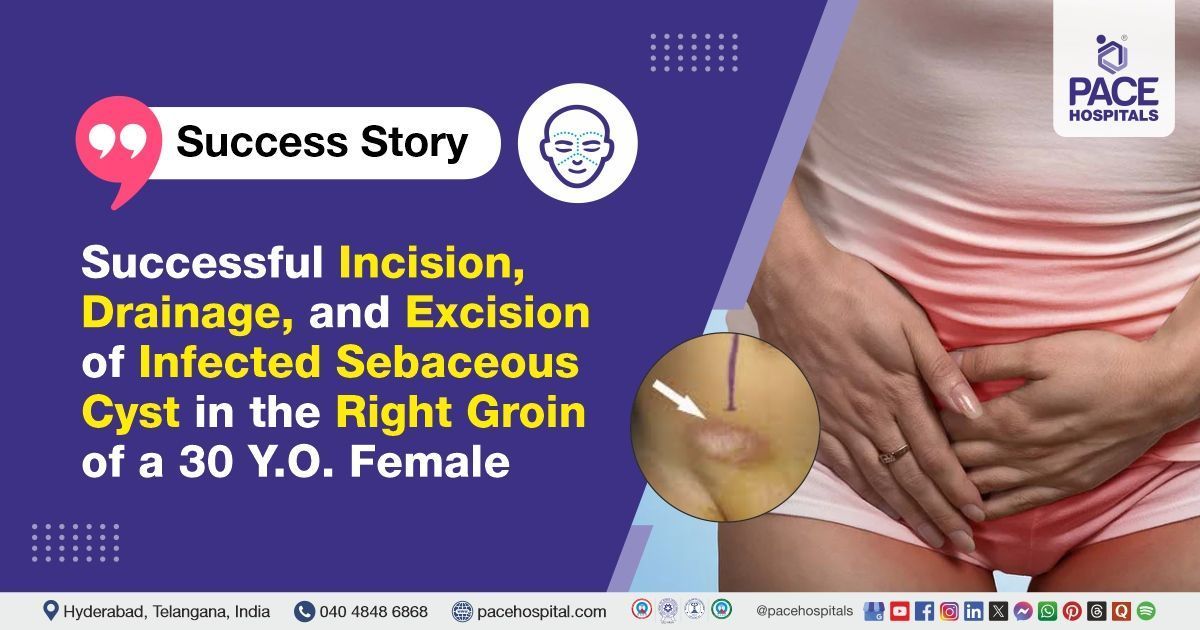
Successful Incision, Drainage, and Excision of Infected Sebaceous Cyst in the Right Groin of a 30-Y.O. Female
PACE Hospitals
PACE Hospitals' expert Plastic and Reconstructive Surgery team successfully performed an Incision and Drainage along with Excision of the cyst wall in a 30-year-old female patient diagnosed with an infected sebaceous cyst in the right groin. The procedure aimed to relieve the infection, eliminate the cyst, and prevent recurrence.
Chief Complaints
A 30-year-old female patient with a
body mass index (BMI) of 20.1 presented to the Plastic and Reconstructive Surgery Department at
PACE Hospitals, Hitech City, Hyderabad, with a one-week history of swelling in the right groin. The swelling was associated with pain and pus discharge, for the past one day.
Past Medical History
The patient was a known case of migraine and was on regular medication. She had no other known medical illnesses and no history of any previous surgeries.
On Examination
On general examination, the patient was conscious, coherent, and cooperative. There were no signs of pallor, icterus, cyanosis, lymphadenopathy, clubbing, or pedal edema. Her vital signs were within normal limits. Local examination of the right groin revealed a tender, fluctuant swelling with surrounding erythema and signs of localised infection. There was purulent discharge from the swelling, indicating an underlying infected sebaceous cyst. No signs of systemic spread or additional areas of concern were noted on examination.
Diagnosis
Following the clinical examination, the Plastic and Reconstructive Surgery team conducted a thorough assessment, including a detailed review of the patient’s medical and surgical history with presenting complaints of swelling in the right groin for the past one week, associated with pain and purulent discharge for one day.
A focused evaluation of the swelling was performed. Ultrasound and other relevant investigations were done to rule out any underlying abscess or deeper tissue involvement. Additionally, laboratory investigations were conducted to assess infection status and overall systemic health.
To confirm the diagnosis and determine the extent of tissue involvement, the right groin was carefully examined. The assessment revealed an infected sebaceous cyst with localized abscess formation. There were signs of local infection, but no systemic complications were noted at the time of discharge.
Based on the confirmed diagnosis, she was advised to undergo
Infected Sebaceous Cyst Treatment in Hyderabad, India, under the care of the Plastic and Reconstructive Surgery team to prevent further spread of infection.
Medical Decision Making
After a detailed consultation with Dr. Kantamneni Lakshmi, Senior Consultant Plastic, Reconstructive & Aesthetic Surgeon, a thorough clinical evaluation was performed focusing on the patient’s presentation of an infected sebaceous cyst in the right groin. Diagnostic imaging and laboratory investigations were reviewed comprehensively to assess the extent of infection, abscess formation, and systemic involvement.
It was determined that the patient had an infected sebaceous cyst with localized abscess formation. Incision and drainage along with excision of the cyst wall was identified as the most effective interventions to remove infected tissue, control infection, and prevent recurrence. The patient’s medical history, including migraine and current medication, was considered in perioperative planning to minimize surgical risks and optimize recovery.
The patient and her family members were thoroughly counselled about the severity of the infection, the need for surgical intervention involving incision, drainage, and excision, potential intraoperative and postoperative risks, and the anticipated benefits, including infection resolution, symptom relief, and prevention of further complications.
Surgical Procedure
Following the decision, the patient was scheduled to undergo Incision and Drainage with Excision of the Cyst Wall, in Hyderabad at PACE Hospitals, under the care and supervision of the expert Plastic and Reconstructive Surgery team.
The following steps were carried out during the procedure:
- Anesthesia and Preparation: The patient was placed under short general anesthesia. Under strict aseptic conditions, the surgical site was thoroughly painted and draped to maintain a sterile environment.
- Incision and Drainage: An incision was made over the swelling in the right groin. The infected cyst was identified, and the cyst wall was ruptured to allow drainage of purulent contents.
- Excision of Cyst Wall: The entire cyst wall, along with its contents, was carefully excised to prevent recurrence of the cyst and remove all infected tissue.
- Irrigation and Hemostasis: The surgical site was thoroughly irrigated with saline solution to cleanse the area. Hemostasis was achieved to control bleeding during the procedure.
- Wound Closure and Dressing: The wound was closed using 3-0 Monocryl sutures. A similar procedure was performed for a smaller sebaceous cyst located on the left knee, which was also excised and sutured with 3-0 Monocryl. Finally, an aseptic dressing was applied. The postoperative period was uneventful. Specimens were sent for histopathological examination (HPE).
Postoperative Care
The postoperative period was uneventful, with no complications observed. The patient was managed with intravenous fluids, broad-spectrum antibiotics, analgesics for pain control, and medications to protect the gastrointestinal system during her hospital stay. She remained stable throughout and was discharged in a stable condition with instructions for follow-up.
Discharge Medications
The patient was discharged with a course of oral antibiotics to manage infection, along with a topical antimicrobial ointment for local wound care. She was also prescribed a proton pump inhibitor to protect the gastrointestinal tract, analgesics for pain relief, and multivitamins to support overall nutritional status. These medications were intended to aid in the patient’s recovery and prevent any postoperative complications.
Advice on Discharge
The patient was advised to maintain proper wound hygiene to promote healing and prevent infection. She was also instructed to follow a normal, balanced diet to support overall recovery.
Emergency Care
The patient was informed to contact the emergency ward at PACE Hospitals in the event of any emergency or the development of symptoms such as fever, abdominal pain, vomiting, swelling, pain at the surgical site, or signs of allergic reaction.
Review and Follow-up Notes
The patient was advised to return for a follow-up consultation with the Consultant Plastic, Reconstructive & Aesthetic Surgeon in Hyderabad at PACE Hospitals 2 days after discharge for wound evaluation and dressing change, with a prior appointment.
Conclusion
This case highlights the effective management of an infected sebaceous cyst through timely surgical intervention and comprehensive postoperative care. Early diagnosis, appropriate incision and drainage with excision, along with targeted antibiotic therapy, ensured complete resolution without complications. The patient’s stable recovery emphasises the importance of multidisciplinary care in plastic and reconstructive surgery for optimal outcomes.
Importance of Early Intervention in Infected Sebaceous Cysts
Early diagnosis and prompt surgical management play a critical role in preventing complications associated with infected sebaceous cysts. Timely incision and drainage combined with excision of the cyst wall effectively controls local infection and reduces the risk of recurrence. Additionally, a multidisciplinary approach involving thorough clinical evaluation by a
Plastic surgeon / Plastic surgery doctor, appropriate antibiotic therapy, and careful postoperative monitoring contributes significantly to favorable patient outcomes. Patient education on wound care and follow-up is essential to ensure complete healing. Overall, coordinated surgical and medical care can lead to the successful resolution of potentially complicated infections in plastic and reconstructive surgery.
Share on
Request an appointment
Fill in the appointment form or call us instantly to book a confirmed appointment with our super specialist at 04048486868
Appointment request - health articles
Recent Articles