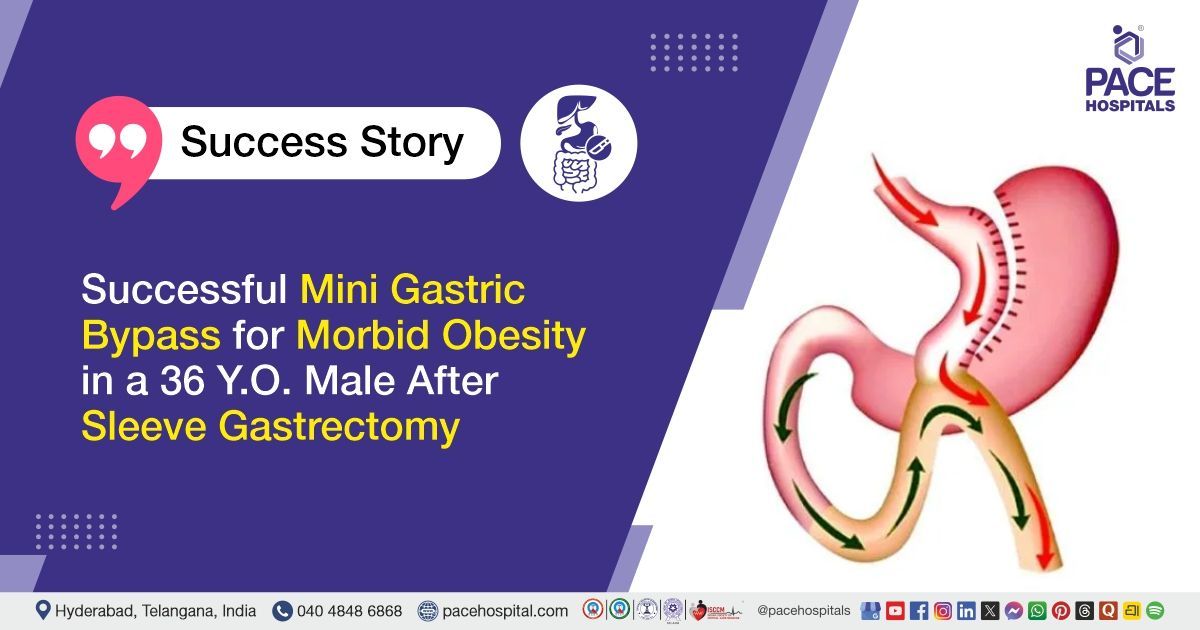
Successful Mini Gastric Bypass for Morbid Obesity in a 36 Y.O. Male After Sleeve Gastrectomy
PACE Hospitals
PACE Hospitals’ expert Bariatric and Metabolic Surgery team successfully performed a Laparoscopic Sleeve Conversion to Mini Gastric Bypass (MGB) on a 36-year-old male patient with morbid obesity who developed significant weight regain after a previous sleeve gastrectomy. The revision metabolic surgery was performed to achieve sustained weight loss, improve metabolic outcomes, and reduce obesity-related health risks.
Chief Complaints
A 36-year-old male patient with a body mass index (BMI) of 40.04 presented to the Bariatric and Metabolic Surgery Department at PACE Hospitals, Hitech City, Hyderabad, seeking revision metabolic surgery due to significant weight regain over the previous two years following sleeve gastrectomy.
Past Medical History
The patient had undergone laparoscopic sleeve gastrectomy in the past for morbid obesity and achieved satisfactory initial weight loss. However, gradual weight regain occurred during the previous two years. He had no known history of diabetes mellitus, hypertension, cardiovascular disease, or other significant medical illnesses. There was no history of complications related to the previous bariatric surgery, and he had no known drug allergies.
On Examination
On examination, the patient was conscious, coherent, oriented, and hemodynamically stable. His BMI was 40.04 kg/m², consistent with morbid obesity. Systemic examination revealed no acute abnormalities. Abdominal examination was soft, non-tender, and without organomegaly or signs of previous surgical complications. The remaining systemic examination was within normal limits.
Diagnosis
Upon admission to PACE Hospitals, following a detailed clinical assessment, the Bariatric and Metabolic Surgery team evaluated the patient for weight regain following previous sleeve gastrectomy, along with a review of his relevant past medical and surgical history.
Clinical examination revealed findings consistent with morbid obesity (BMI 40.04 kg/m²) following previous sleeve gastrectomy, which was primarily established based on history and physical examination findings suggestive of significant weight regain after the initial bariatric procedure.
Routine investigations, including complete blood picture, serum electrolytes, renal function tests, liver function tests, blood glucose levels, electrocardiogram (ECG), and pre-anaesthetic (PAC) evaluation, were performed as part of the preoperative evaluation to assess the patient's general medical status. These investigations were largely within acceptable limits and served as supportive assessments rather than definitive diagnostic tools.
Based on the confirmed diagnosis, the patient was advised to undergo Morbid Obesity Treatment in Hyderabad, India, under the expert care of the Bariatric and Metabolic Surgery Department.
Medical Decision Making (MDM)
After detailed consultation with Dr. Suresh Kumar S (Surgical Gastroenterologist and Bariatric Surgeon), a comprehensive evaluation was performed to determine the most appropriate diagnostic and therapeutic approach.
Considering the patient's history of previous sleeve gastrectomy performed in the past, significant weight regain over the past two years, and persistent, morbid obesity (BMI 40.04 kg/m²), further evaluation confirmed inadequate long-term weight loss following the primary bariatric procedure. Routine laboratory investigations revealed stable hematological, renal, hepatic, and electrolyte parameters, confirming the patient's suitability for revision metabolic surgery.
Based on clinical assessment and routine laboratory investigations showing stable parameters, it was determined that laparoscopic sleeve conversion to mini gastric bypass (MGB) under general anaesthesia was the most appropriate and effective management strategy. This approach was chosen to create a smaller gastric pouch and reroute a portion of the small intestine, thereby promoting sustained weight loss, improving metabolic function, reducing the risk of further weight regain, and achieving better long-term bariatric outcomes.
The patient and his family members were counselled regarding the diagnosis, clinical findings, planned procedure, expected benefits, potential risks, postoperative dietary modifications, lifelong nutritional supplementation, and the importance of postoperative care and regular follow-up.
Surgical Procedure
Following the decision, the patient was scheduled for Laparoscopic Sleeve Conversion to Mini Gastric Bypass (MGB) in Hyderabad at PACE Hospitals, under the expert care of the Bariatric and Metabolic Surgery team.
The following steps were carried out during the procedure:
- Patient Preparation and Anaesthesia: Following complete preoperative evaluation and anaesthetic clearance, the patient was taken up for surgery under general anaesthesia. After appropriate positioning and sterile preparation, laparoscopic access was established.
- Assessment of Previous Sleeve Anatomy: The previously created gastric sleeve was carefully evaluated laparoscopically. Adhesions, if present, were released carefully to facilitate safe revision surgery.
- Creation of Gastric Pouch: A small proximal gastric pouch was created from the existing sleeve stomach while preserving adequate blood supply. This reduced gastric reservoir was designed to improve long-term restrictions.
- Mini Gastric Bypass Reconstruction: A loop of the small intestine was identified and brought up to the newly created gastric pouch. A gastrojejunostomy was performed to establish the mini gastric bypass, allowing food to bypass a portion of the stomach and upper small intestine.
- Hemostasis and Completion: The anastomosis and operative field were inspected carefully for bleeding and leakage. Adequate hemostasis was achieved, and the procedure was completed laparoscopically without intraoperative complications.
Postoperative Care
The patient had an uneventful postoperative recovery and remained hemodynamically stable throughout the hospital stay. He was closely monitored for postoperative complications and received supportive treatment for infection prevention, pain control, gastric protection, and maintenance of hydration. Early ambulation was encouraged to reduce the risk of thromboembolic complications. The patient developed postoperative urinary retention, which was managed with Foley catheterization, and a phased liquid diet was initiated to support healing and recovery.
Discharge Medications
Upon discharge, the patient was prescribed medications for pain relief, protection of the gastric pouch by reducing acid secretion, prevention of postoperative blood clot formation, and lifelong nutritional supplementation to support adequate vitamin and mineral absorption following bariatric surgery. He was advised to take the medications as prescribed.
Advice on Discharge
The patient was advised to continue the prescribed liquid diet for 10 days, followed by gradual progression to a soft diet as recommended. He was encouraged to walk regularly, maintain adequate hydration, avoid strenuous physical activities and heavy lifting for two months, and adhere to the recommended dietary and lifestyle modifications to support healing and long-term weight loss.
Emergency Care
The patient was informed to contact the emergency ward at PACE Hospitals in case of any emergency or development of symptoms such as fever, severe abdominal pain, persistent vomiting, bleeding, or increasing abdominal distension.
Review and Follow-up Notes
The patient was advised to return for a follow-up visit with a weight loss doctor in Hyderabad at PACE Hospitals after 7 days.
Conclusion
This case highlights the successful management of weight regain following sleeve gastrectomy in a patient with morbid obesity using laparoscopic sleeve conversion to mini gastric bypass (MGB). The procedure was completed without significant complications, and the patient recovered well with stable postoperative progress, supporting improved long-term weight loss and metabolic outcomes.
Revision Metabolic Surgery Restores Long-Term Weight Loss After Failed Primary Bariatric Surgery
Weight regain after sleeve gastrectomy is a recognized challenge in bariatric surgery and may occur despite an initially successful outcome. Careful evaluation by a Bariatric surgeon / Weight loss doctor, is essential to identify the underlying cause and determine whether revision surgery is appropriate. In selected patients, laparoscopic sleeve conversion to mini gastric bypass provides an effective solution by combining gastric restriction with intestinal bypass, leading to improved weight loss and metabolic outcomes. The minimally invasive approach supports faster recovery with a low risk of complications. Long-term success depends on adherence to dietary recommendations, nutritional supplementation, regular physical activity, and scheduled follow-up. Early recognition of weight regain and timely revision metabolic surgery can significantly improve long-term health, weight control, and quality of life.
Frequently Asked Questions (FAQs)
Can weight regain after sleeve gastrectomy be treated without another surgery?
Weight regain after sleeve gastrectomy is first managed with dietary changes, regular exercise, and lifestyle modification. However, if these measures do not produce satisfactory results and obesity persists, revision bariatric surgery may be considered. The decision is made only after a detailed evaluation of the patient's previous surgery, current weight, and overall health.
Why is mini gastric bypass chosen instead of repeating sleeve gastrectomy?
Mini gastric bypass may be advised for patients who regain weight after sleeve gastrectomy. The procedure creates a smaller stomach pouch and bypasses a part of the small intestine, which can help improve long-term weight loss. Whether this surgery is suitable depends on the patient's previous operation, current health condition, and a thorough medical evaluation.
Is revision bariatric surgery safe?
Revision bariatric surgery can be performed safely when planned carefully and carried out by an experienced bariatric surgeon. Since it is performed after a previous operation, it requires careful evaluation and meticulous surgical technique. Appropriate patient selection and postoperative care help reduce the risk of complications.
How soon can I return to my normal routine after revision surgery?
Recovery varies from person to person. Most patients are encouraged to start walking soon after surgery, while heavy physical activity should be avoided for several weeks. Daily activities can usually be resumed gradually based on the surgeon's advice and the patient's recovery.
Why is the diet changed in stages after mini gastric bypass?
After surgery, the newly created stomach pouch needs time to heal. Patients are therefore advised to start with liquids and slowly progress to soft foods before returning to regular meals. Following the recommended diet helps the stomach heal properly, makes eating more comfortable, and supports steady weight loss.
Will I have to take nutritional supplements after surgery?
Yes. Since mini gastric bypass changes the absorption of certain nutrients, long-term nutritional supplementation is usually necessary. Regular follow-up and periodic blood tests help identify any deficiencies early and ensure that nutritional needs are adequately maintained.
How important are follow-up visits after revision bariatric surgery?
Regular follow-up visits help the doctor check your recovery, weight loss, and nutritional health after surgery. These visits also help identify any problems early and provide guidance on food habits, physical activity, and nutritional supplements whenever needed. Keeping up with follow-up appointments is important for maintaining weight loss and overall health in the long term.
Can revision mini gastric bypass improve obesity-related health problems?
Many patients experience improvement in obesity-related metabolic problems after successful weight loss. Although the degree of improvement varies from person to person, sustained weight reduction may lower the risk of several obesity-associated conditions and improve overall quality of life.
What can I do to maintain weight loss after revision surgery?
Maintaining weight loss requires long-term commitment to healthy eating, regular physical activity, adequate hydration, and routine follow-up care. Avoiding frequent snacking and high-calorie foods while following the dietary advice provided by the bariatric team helps achieve better long-term results.
How do I know if I need revision bariatric surgery?
Not everyone with weight regain requires another operation. A detailed evaluation is necessary to determine the cause of weight regain and whether revision surgery is the most suitable option. The decision is based on the patient's symptoms, previous surgery, body weight, and overall clinical assessment rather than weight alone.
Share on
Request an appointment
Fill in the appointment form or call us instantly to book a confirmed appointment with our super specialist at 04048486868
Appointment request - health articles
Recent Articles