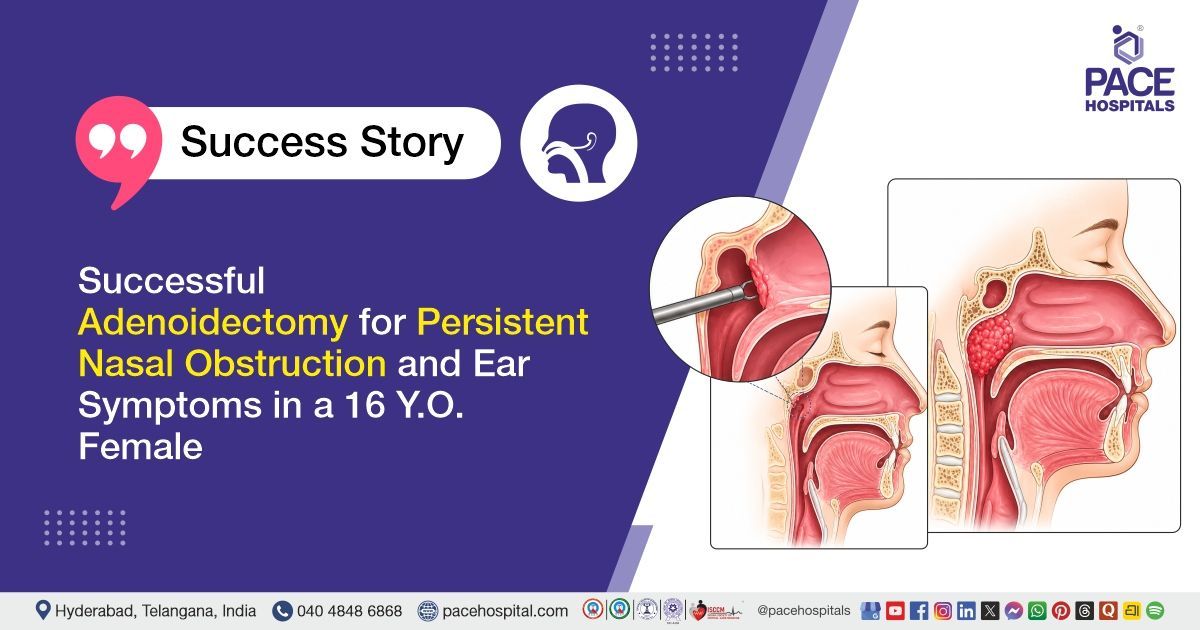
Successful Adenoidectomy for Persistent Nasal Obstruction and Ear Symptoms
PACE Hospitals
PACE Hospitals’ expert ENT team successfully performed an Adenoidectomy on a 16-year-old female patient diagnosed with chronic adenoiditis. The procedure was undertaken to remove the enlarged and chronically infected adenoid tissue. The aim of the procedure was to relieve persistent nasal obstruction, reduce recurrent infections, improve breathing, and enhance overall quality of life.
Chief Complaints
A 16-year-old female patient with a Body Mass Index (BMI) of 20 presented to the ENT Department at PACE Hospitals, Hitech City, Hyderabad, with a history of recurrent nasal obstruction accompanied by intermittent bilateral ear pain and a sensation of ear blockage for the past 1 year. Her symptoms were aggravated by exposure to air-conditioned environments. There was no history of hearing loss, ear discharge, headache, or nasal discharge.
Past Medical History
The patient had no significant past medical or surgical history and was not on any long-term medications. There was no history of chronic illnesses, recurrent ear infections, allergic disorders, or previous ENT surgeries.
On Examination
Upon admission to PACE Hospitals, the patient was clinically stable with no significant abnormalities on general physical assessment. Otoscopic examination revealed intact tympanic membranes bilaterally with evidence of tympanic membrane retraction and no signs of middle ear effusion.
Hearing assessment using tuning fork tests revealed a positive Rinne test bilaterally and a Weber test lateralizing to the left, while the physical presence of grade 2 tympanic membrane retraction was highly indicative of underlying Eustachian tube dysfunction.
Nasal examination showed clear nasal cavities without discharge or obvious pathology, and the oral cavity examination was normal. Overall, the findings were consistent with chronic adenoiditis associated with nasal obstruction and intermittent ear symptoms.
Diagnosis
After the initial examination, the patient underwent a comprehensive evaluation by the ENT team, which included a detailed clinical assessment, otoscopic examination, hearing assessment using tuning fork tests, and nasal cavity examination. These assessments were aimed at identifying the underlying cause of her recurrent nasal obstruction and intermittent bilateral ear symptoms, as well as evaluating the impact of upper airway pathology on Eustachian tube function.
Clinical examination revealed intact bilateral tympanic membranes with retraction changes and no evidence of middle ear effusion. Hearing assessment suggested Eustachian tube dysfunction, while nasal examination demonstrated clear nasal cavities without active discharge or other significant intranasal pathology. Based on the patient's persistent symptoms and clinical findings, chronic adenoid pathology was suspected as the underlying cause of her nasal obstruction and ear-related complaints.
Following a thorough evaluation and correlation of the clinical findings, the patient was diagnosed with Chronic Adenoiditis. The enlarged and chronically inflamed adenoid tissue was considered responsible for the recurrent nasal blockage and Eustachian tube dysfunction leading to intermittent ear symptoms.
Based on this comprehensive evaluation, the patient was advised to undergo Chronic Adenoiditis Treatment in Hyderabad, India, under the expert care of the ENT Department, to remove the chronically infected adenoid tissue, relieve nasal obstruction, improve Eustachian tube function, reduce recurrent symptoms, and enhance overall quality of life.
Medical Decision Making
After a thorough consultation with Dr. Apeksha Neware (ENT Surgeon), a comprehensive evaluation was carried out to determine the most appropriate diagnostic and therapeutic approach for the patient. The assessment focused on identifying the underlying cause of the recurrent nasal obstruction and intermittent bilateral ear pain, with emphasis on evaluating adenoid hypertrophy and associated Eustachian tube dysfunction.
Based on the clinical findings and systemic examination, it was determined that Adenoidectomy under general anaesthesia was the most appropriate and definitive treatment to remove the diseased adenoid tissue, relieve nasal obstruction, restore normal Eustachian tube function, and prevent recurrence of symptoms.
The patient and her family were thoroughly counselled regarding the diagnosis, indication for surgery, expected benefits, and possible risks associated with the procedure. The primary aim of management was to achieve complete symptom relief, improve nasal breathing, reduce ear-related symptoms, and enhance overall quality of life.
Surgical Procedure
Following the diagnosis, the patient was scheduled to undergo Adenoidectomy surgery in Hyderabad at PACE Hospitals, under the expert care of the ENT Department.
The procedure was performed in the following steps:
- Patient Positioning and Anaesthesia: The patient was placed in the Rose position after administration of general anaesthesia with oro-tracheal intubation. Adequate airway protection and surgical access to the nasopharynx were ensured.
- Mouth Opening and Exposure: A Boyle Davis mouth gag was inserted to achieve optimal oral cavity exposure. The soft palate was retracted to visualize the nasopharyngeal area adequately.
- Identification of Adenoid Tissue: The nasopharynx was carefully examined, and hypertrophied adenoid tissue was identified in the posterior nasopharyngeal wall causing airway obstruction.
- Curettage and Tissue Removal: A curette was used to excise and remove the adenoid tissue in a controlled manner until complete clearance of the obstructing lymphoid tissue was achieved.
- Haemostasis and Completion: Meticulous haemostasis was secured throughout the procedure. The surgical field was inspected for residual tissue and bleeding, and complete disease clearance was confirmed before completion of the procedure.
Postoperative Care
The postoperative period was uneventful, with the patient recovering well under observation. She remained hemodynamically stable, tolerated the postoperative course without complications, and showed satisfactory clinical improvement. The patient was discharged in a stable condition with advice for routine follow-up and postoperative care.
Discharge Medications
The patient was prescribed medications for the prevention of postoperative infection, relief of pain and inflammation, and reduction of gastric irritation related to postoperative treatment. Additionally, targeted therapies were administered for the management of localized nasal blockage and mucosal swelling to optimize nasal breathing and reduce congestion following surgery. These medications were advised for a short duration as part of routine post-adenoidectomy care.
Advice on Discharge
The patient was advised to avoid straining and to refrain from blowing the nose during the postoperative recovery period to prevent bleeding and promote proper healing.
Emergency Care
The patient was informed to contact the emergency ward at PACE Hospitals in case of any emergency or development of symptoms such as fever, nasal bleeding, or vomiting.
Review and Follow-up Notes
The patient was advised to return to the ENT specialist at PACE Hospitals, Hyderabad, for a scheduled follow-up appointment after 4 days for further evaluation of the surgical site and overall progress.
Conclusion
This case highlights chronic adenoiditis as a significant cause of persistent nasal obstruction and Eustachian tube dysfunction leading to intermittent ear symptoms. Adenoidectomy under general anaesthesia resulted in the complete removal of the diseased tissue with an uneventful postoperative recovery. The procedure effectively relieved symptoms and restored normal nasal airway function.
Clinical Significance of Adenoidectomy in Chronic Adenoid Disease
Adenoid hypertrophy is a common cause of persistent nasal obstruction and recurrent ear symptoms due to Eustachian tube dysfunction, particularly in children and adolescents. It can significantly affect nasal breathing, sleep quality, and overall quality of life if left untreated. Early recognition and evaluation by an Otolaryngologist / ENT specialist are essential for accurate diagnosis and timely management. Adenoidectomy under general anaesthesia remains the definitive treatment for symptomatic chronic adenoid disease when conservative measures fail. The procedure effectively restores normal nasopharyngeal airway patency and improves middle ear ventilation. With proper surgical technique and postoperative care, outcomes are generally excellent with minimal complications.
Frequently Asked Questions (FAQs)
Why was adenoidectomy advised for this patient?
The patient had nasal blockage and on-and-off ear symptoms for around one year. The enlarged and inflamed adenoids were blocking normal airflow through the nose and affecting ear function. Removal of the adenoid tissue through surgery was advised to reduce symptoms and improve nasal breathing and ear ventilation in the long term.
How can adenoidectomy help with repeated ear blockage?
Enlarged adenoids can block the opening of the Eustachian tubes, which connect the middle ear to the back of the nose. This may lead to ear pressure, blockage, and discomfort. Removing the adenoids helps restore normal airflow and pressure regulation inside the ears.
What is a curette adenoidectomy?
A curette adenoidectomy is a procedure in which the adenoid tissue is removed through the mouth while the patient is under general anaesthesia. No external cuts are required. The surgeon removes the enlarged tissue and controls any bleeding before completing the procedure.
Will nasal breathing improve after adenoidectomy?
After recovery, most patients can breathe through the nose more easily. When the enlarged adenoid tissue is removed, the blockage in the nasopharynx (the space behind the nose) is cleared. This allows air to move freely through the nasal passages. As a result, breathing becomes easier during normal daily activities, and sleep quality often improves as well.
How long does it take to recover after adenoid surgery?
Recovery is usually smooth, and most patients can return to their normal daily activities within one to two weeks. In the first few days after surgery, there may be mild throat discomfort, nasal congestion, or slight irritation. Taking proper rest and following postoperative instructions helps in proper healing and a faster recovery.
Why should nose blowing be avoided after surgery?
Forcefully blowing the nose can disturb the healing area after surgery and increase the risk of bleeding. It may also increase pressure in the nasal passages and middle ear, which can cause discomfort. Patients are advised to avoid blowing the nose until the surgeon confirms that healing is complete.
Can adenoidectomy reduce future ENT-related problems?
Yes, many patients experience fewer nasal and ear complaints after surgery. By removing the chronically infected adenoid tissue, the chances of repeated blockage and related discomfort are often reduced. Regular follow-up helps ensure the best long-term outcome.
Is hospital admission necessary for adenoidectomy?
Adenoidectomy is usually done as a planned surgery under general anaesthesia. Based on the patient’s condition and recovery, a short hospital stay may be advised. Careful medical observation after surgery helps ensure a safe recovery before discharge.
What symptoms should be monitored at home after adenoidectomy?
During recovery, care should be taken to maintain proper eating and drinking, along with comfort in breathing and overall well-being. Any unusual bleeding, persistent fever, severe pain, or difficulty in breathing should be reported to the treating surgeon immediately. Most patients recover smoothly without any major complications.
Why is follow-up important after adenoidectomy?
A follow-up visit allows the ENT surgeon to assess the healing process and confirm improvement in nasal and ear symptoms. It also provides a chance to discuss any concerns and make sure recovery is going as expected. Regular follow-up visits help in achieving the best surgical outcome.
Share on
Request an appointment
Fill in the appointment form or call us instantly to book a confirmed appointment with our super specialist at 04048486868
Appointment request - health articles
Recent Articles