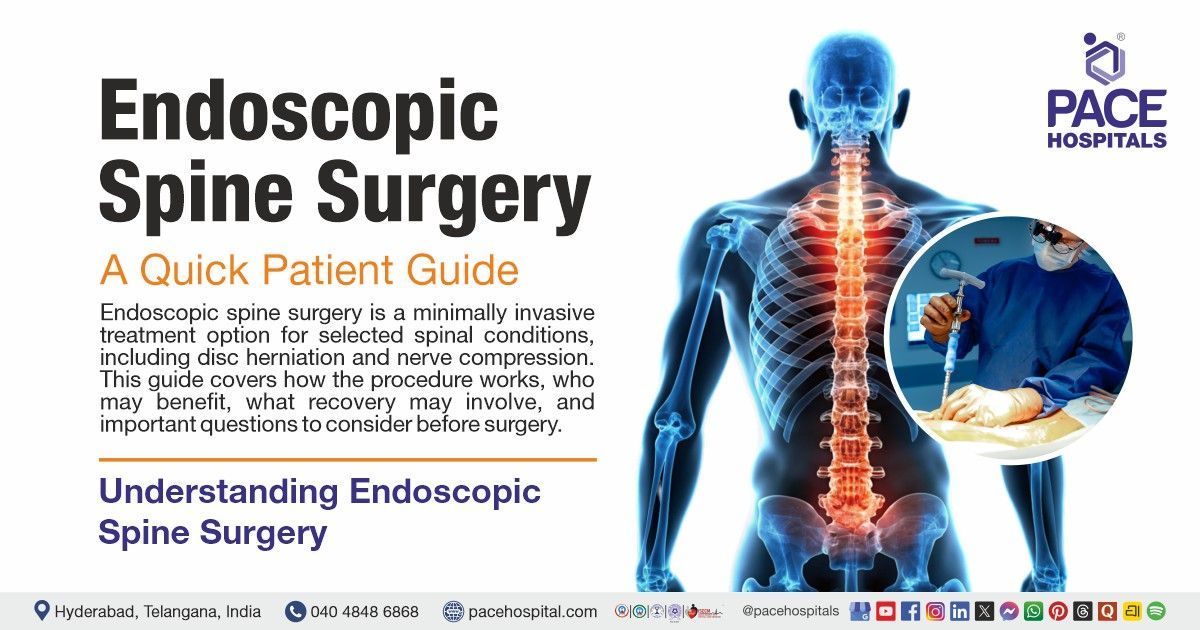
Precision Laparoscopic Nephrectomy for Incidental Right Renal Mass in a 46-Year-Old Patient
PACE Hospitals
The urology team at PACE Hospitals successfully performed
a Right Laparoscopic Radical Nephrectomy on a 46-year-old male patient, who was incidentally diagnosed with a right renal mass.
Chief Complaints
A 46-year-old male presented to the Urology Department at
PACE Hospitals, Hitech City, Hyderabad, with complaints of blood in the urine, unexplained weight loss and fatigue.
Medical History
Further exploration revealed that the patient had allergies to specific nonsteroidal anti-inflammatory drugs (NSAIDs). No significant family history was identified.
Diagnosis
Based on the clinical examination, imaging tests, and incidental findings, the patient was diagnosed with a mass in the right kidney (Right Renal Mass).
Treatment
considerations
The CT and PET CT scans revealed an unusual mass in the middle and lower regions of the right kidney. They also showed inflammation in the surrounding tissues and involvement of fat around the kidney, indicating that the mass may be more advanced and affecting nearby structures. This suggests the mass could be more advanced, possibly affecting neighbouring structures and indicating a local spread of cancer (stage T3). The doctors were likely considering further testing or treatment options to assess the full extent of the cancer and determine the best treatment approach.
Surgical Procedure
Following consultations with
Dr. Vishwambhar Nath, the consultant urologist and renal transplant surgeon, it was concluded that a
right laparoscopic radical nephrectomy would be the optimal approach for treating the patient. The surgery was performed by
Dr. Abhik Debnath and
Dr. K Ravichandra to remove the tumor in the right kidney, as it was affecting the surrounding blood vessels.
Intra operative Findings
The patient underwent a transperitoneal radical nephrectomy to remove a right renal mass located in the mid and lower poles. Three renal arteries and veins were carefully identified, clipped, and divided to ensure proper separation of the kidney.
After achieving haemostasis, the kidney along with the surrounding tissues was removed through a Pfannenstiel incision, providing optimal access and reducing the risk of post-operative complications. The surgery was successful, with no significant bleeding or complications encountered.
Postoperative Care
The recovery following surgery was uneventful, with no complications. The Foley catheter was removed the day after the procedure (which is commonly left in place overnight for bladder drainage). The patient was discharged in a stable condition.
Medications Advised at the stay
During the hospital stay, the patient was advised medications including antibiotic, analgesic and proton pump inhibitors (PPIs).
Discharge Medications
Upon leaving the hospital, the patient received prescriptions for analgesics, proton pump inhibitors (PPIs), alpha-blockers, and multivitamins, with instructions to continue a normal diet.
Advice on Discharge
The patient was advised against lifting heavy weights and bending forward. They were also encouraged to consume 3-4 Liters of fluids daily and to perform regular wound care as recommended.
Emergency Care
The patient was informed to contact the Emergency ward at PACE Hospitals in case of any emergency or the development of symptoms like fever, abdominal pain, or vomiting.
Review notes
The patient was recommended to consult Dr. Vishwambhar Nath after 10 days for wound care, removal of the staples, and review of the biopsy findings.
Significance of Laparoscopy in right radical nephrectomy for renal tumors
Laparoscopy is a minimally invasive approach used in right radical nephrectomy for renal masses, offering benefits such as shorter recovery times, reduced postoperative pain, and better cosmetic results. This technique involves making a small incision to insert a camera and specialized surgical tools, enabling surgeons to perform the nephrectomy with high precision. Compared to traditional open surgery, it has a lower risk of complications, including less blood loss. Laparoscopic radical nephrectomy provides oncological outcomes that are comparable to open surgery, with similar long-term survival rates for patients with localized renal cell carcinoma or other renal tumors.
Share on
Request an appointment
Fill in the appointment form or call us instantly to book a confirmed appointment with our super specialist at 04048486868
Appointment request - health articles
Recent Articles