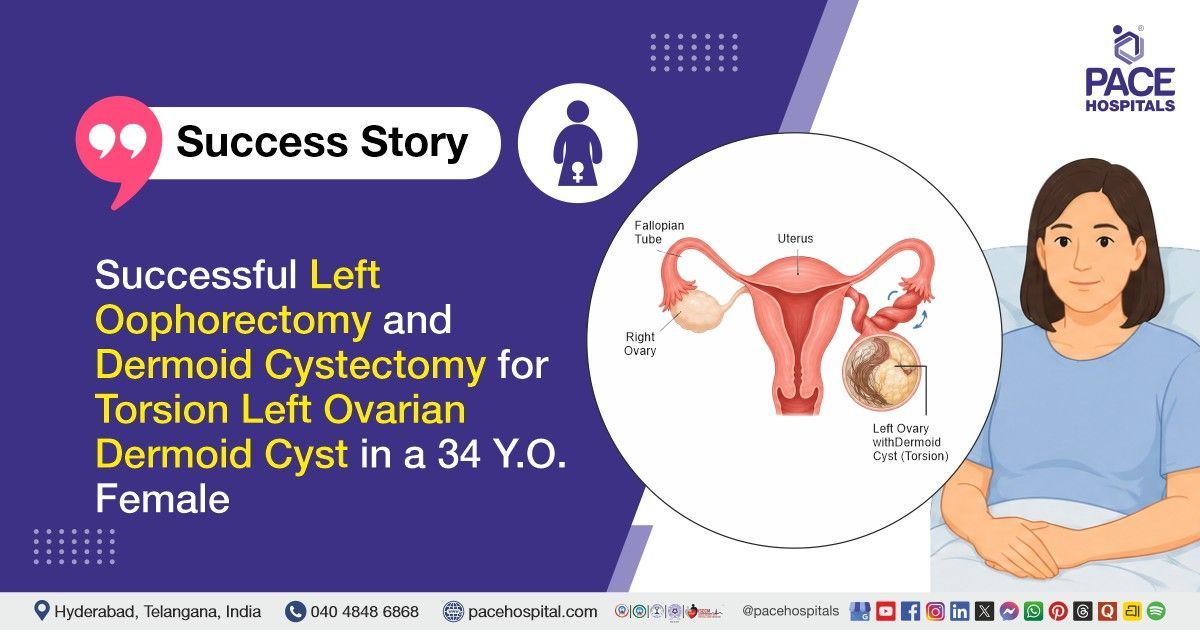
Successful Left Oophorectomy and Dermoid Cystectomy for Torsion Left Ovarian Dermoid Cyst
PACE Hospitals
PACE Hospitals’ expert gynaecology team successfully performed a
Laparoscopic Left Oophorectomy with Dermoid Cystectomy and Left Salpingectomy on a 34-year-old female patient diagnosed with a torsion of the left ovarian dermoid cyst. The aim of the procedure was to remove the twisted ovary, dermoid cyst, and affected fallopian tube, relieve acute pain, prevent further complications such as tissue necrosis and infection, and ensure the patient’s overall gynaecological health and recovery.
Chief Complaints
A 34-year-old female patient with a body mass index (BMI) of 21 presented to the Gynaecology Department at PACE Hospitals, Hitech City, Hyderabad, with complaints of severe pain in the left iliac region, accompanied by nausea and vomiting.
Past Medical History
The patient had no known comorbidities and no history of chronic medical illnesses. There were no known drug or food allergies reported. She had no significant past surgical history.
Menstrual and Obstetric History
The patient had regular menstrual cycles occurring every 30 days, and her last menstrual period (LMP) was on day 2 of menses at the time of admission. No significant obstetric complications or abnormal menstrual history were reported.
On Examination
The patient was conscious, coherent, and cooperative at the time of examination. Vital signs were stable. Respiratory system examination revealed bilateral equal air entry, and cardiovascular system examination showed normal heart sounds. Per abdominal examination revealed tenderness in the left iliac region.
Diagnosis
Upon admission to PACE Hospitals, the patient was evaluated by the Gynaecology team, which included a detailed review of her medical history and a comprehensive clinical examination. The examination revealed tenderness in the left iliac region, and the patient was found to be hemodynamically stable on assessment.
Ultrasound findings were suggestive of a left ovarian dermoid cyst with torsion of the left adnexa in a case presenting with severe pain in the left iliac region associated with nausea and vomiting. Evaluation and investigations revealed neutrophilic leukocytosis and microcytic hypochromic anemia on complete blood picture, while other parameters were within acceptable limits for surgery.
Based on the confirmed findings, the patient was advised to undergo
Left Ovarian Dermoid Cyst Treatment in Hyderabad, India, with torsion of the left adnexa under the expert care of the Gynaecology Department.
Medical Decision-Making
After a detailed consultation with Dr. Mugdha Bandawar, Obstetrician and Gynaecologist, a comprehensive evaluation of the patient was undertaken in coordination with cross consultation from Dr. Mounika Jetti, General Physician. Considering her presentation with severe pain in the left iliac region associated with nausea and vomiting, along with clinical examination findings of tenderness in the left iliac region and hemodynamic stability, the patient was evaluated in detail. Laboratory investigations revealed neutrophilic leukocytosis with microcytic hypochromic anemia, while ultrasound findings were suggestive of torsion left ovarian dermoid cyst in the left adnexal region.
Further assessment confirmed the torsion of the left ovarian dermoid cyst as the underlying cause of the acute abdomen. Based on the clinical, radiological, and laboratory findings, it was determined that laparoscopic left oophorectomy with dermoid cystectomy and left salpingectomy was the most appropriate definitive surgical management to relieve symptoms, prevent ovarian and tubal ischemic damage, and avoid further complications such as necrosis and infection.
The patient and her family members were counselled in detail regarding the diagnosis, need for surgical intervention, procedure details, associated risks and benefits, and expected postoperative recovery, following which informed consent was obtained.
Surgical Procedure
Following the decision, the patient was scheduled to undergo Laparoscopic Left Oophorectomy with Dermoid Cystectomy and Left Salpingectomy Surgery in Hyderabad at PACE Hospitals under the supervision of the expert Gynaecology Department.
The following steps were carried out during the procedure:
- Patient Preparation and Laparoscopic Entry: The patient was taken up for surgery under general anaesthesia with aseptic precautions. Pneumoperitoneum was created and laparoscopic ports were placed to access the pelvic cavity.
- Intraoperative Exploration: On laparoscopic evaluation, a huge 10 × 10 cm cystic mass was seen in the left iliac region, with the left ovary not separately identifiable. The uterus, right ovary, and right fallopian tube appeared normal.
- Identification and Management of Torsion: The left adnexa was found to be rotated on itself involving the left fallopian tube and cyst. Detorsion was performed to untwist the adnexa and assess the operative field.
- Definitive Surgical Procedure and Specimen Removal: Left oophorectomy with left salpingectomy was performed. The dermoid cyst was carefully excised and removed in a specimen retrieval bag. The cyst contained hair and fatty material.
- Completion of Procedure and Specimen Handling: Thorough suction and irrigation of the pelvic cavity were done to clear any debris. Hemostasis was ensured, and the surgical field was inspected. The specimen was sent for histopathological examination (HPE), and the procedure was completed successfully.
Postoperative Care
Postoperatively, the patient was observed in the Surgical Intensive Care Unit (SICU) for close monitoring and later shifted to the ward after stabilization. During her hospital stay, she developed generalized skin rashes, which were evaluated and managed symptomatically with supportive care, leading to improvement. Vital signs remained stable throughout the course of recovery.
Medications during the hospital stay were administered for prevention and treatment of postoperative infection, control of pain and fever, management of nausea and vomiting, treatment of allergic skin reactions, reduction of postoperative inflammation, and maintenance of hydration and electrolyte balance through intravenous fluids. Follow-up ultrasound showed status post left oophorectomy with no evidence of collection or bowel dilatation.
The histopathology report confirmed a benign cystic teratoma (dermoid cyst) of the left ovary with associated fallopian tube tissue, showing no malignant or immature elements. The patient recovered well and was discharged in a hemodynamically stable condition.
Discharge Medications
The patient was discharged with medications prescribed for the prevention of postoperative infection, control of pain and inflammation, reduction of postoperative swelling and adhesions, gastric protection, improvement of postoperative nutritional recovery, relief of constipation, local skin symptom management, and treatment of allergic skin reactions. These were advised to support overall recovery.
Advice on Discharge
The patient was advised to continue a soft diet during the recovery period. She was also instructed to avoid heavy lifting and strenuous physical activities to promote proper healing and prevent postoperative complications following surgery.
Emergency Care
The patient was informed to contact the
emergency ward at PACE Hospitals in case of any emergency or development of symptoms such as severe abdominal pain, fever, vomiting, or any abnormal vaginal bleeding.
Review and Follow-up
The patient was advised to return for a follow-up appointment with the
Gynaecologist in Hyderabad at PACE Hospitals after 1 week.
Conclusion
This case highlights a torsion of the left ovarian dermoid cyst presenting as an acute abdomen with severe left iliac region pain, nausea, and vomiting. The patient was successfully managed with laparoscopic left oophorectomy, dermoid cystectomy, and left salpingectomy. She had a smooth postoperative recovery with resolution of symptoms and was discharged in a hemodynamically stable condition.
Early Recognition and Timely Management of Ovarian Torsion
Ovarian torsion is a true gynecological emergency that requires a high index of suspicion, as delayed diagnosis can lead to irreversible ovarian damage. Patients typically present with acute lower abdominal pain, often associated with nausea and vomiting. Prompt imaging evaluation supports early diagnosis, although definitive confirmation is usually intraoperative. Timely surgical intervention is essential to restore ovarian viability or remove the affected adnexa and prevent complications such as necrosis, infection, or peritonitis.
Laparoscopic management is the preferred approach in most cases due to its minimally invasive nature, faster recovery, and reduced postoperative morbidity. Early intervention significantly improves fertility preservation and overall clinical outcomes. This highlights the importance of rapid assessment and emergency surgical decision-making by a
gynaecologist/gynaecology doctor in suspected adnexal torsion cases.
Frequently Asked Question (FAQs)
What is the long-term impact of removal of one ovary and fallopian tube on overall health?
After one ovary and fallopian tube are removed, the body usually adjusts well because the other ovary keeps working. Periods often continue as normal, but there may be small changes for a short time. The remaining ovary still makes the hormones the body needs. Most people can go back to their normal daily life without much trouble. Regular doctor visits help make sure recovery is going well and everything is fine.
How does ovarian torsion with dermoid cyst affect future fertility outcomes?
Ovarian torsion damages the affected ovary, so it had to be removed in this case. The remaining ovary can still release eggs and support pregnancy. Many women are able to conceive naturally with one healthy ovary. It is important to monitor reproductive health over time. Medical advice may be helpful when planning pregnancy.
What are the risks of recurrence or similar cyst formation in the remaining ovary?
There is a small possibility that a similar cyst could appear in the other ovary. Most of these cysts are benign and tend to grow slowly. Having regular scans helps identify any new growth at an early stage. Finding it early usually makes treatment simpler and safer. Keeping up with routine follow-ups is the best way to stay on the safe side.
What is the significance of findings like mild anemia in this case?
Mild anemia means the body has a slightly lower number of healthy red blood cells than normal. This can cause tiredness or weakness, particularly after surgery. Eating a balanced, nutritious diet can help support recovery and improve blood levels. Doctors may suggest follow-up tests to check progress. With proper care, strength usually improves over time.
Why was laparoscopic surgery preferred instead of open surgery in this condition?
This type of surgery uses small cuts instead of a large opening. It helps reduce pain and allows faster healing. Hospital stay is shorter, and recovery is smoother. There is also less chance of infection. Most people can return to normal activities sooner.
What is the importance of testing the removed cyst after surgery?
The removed cyst is examined in detail to confirm its type. This helps make sure it is not dangerous. It also guides future care and follow-up. The test gives clarity about the condition. It provides peace of mind regarding long-term health.
What could be the reason for rashes developing after surgery during hospital stay?
Rashes after surgery can sometimes occur as a reaction to medicines, dressings, or the environment. They are usually mild and go away on their own. Doctors may examine them to rule out any serious cause. If needed, treatment can help relieve itching or irritation. In most cases, the rash improves within a short period.
What precautions are necessary during recovery after this type of surgery?
Avoid heavy lifting and strenuous physical activity for a while after surgery. Rest plays an important role in proper healing. A healthy, balanced diet can help restore strength. Any unusual signs such as pain or fever should be reported to a doctor. Regular follow-up visits are needed to monitor recovery.
How does increased white blood cell count relate to this clinical condition?
An increased count often shows that the body is reacting to stress, inflammation, or surgery. It is a common finding in such conditions. It usually settles as recovery happens. Doctors monitor it to ensure there is no infection. Improvement over time is a good sign.
What is the role of ultrasound after surgery in this case?
Ultrasound helps check if the surgery area is healing properly. It shows if there is any fluid collection or problem inside. It also confirms that everything is stable after the procedure. This test gives reassurance about recovery. It helps guide further care if needed.
Share on
Request an appointment
Fill in the appointment form or call us instantly to book a confirmed appointment with our super specialist at 04048486868
Appointment request - health articles
Recent Articles