Rare Disease Day, 28 Feb 2026 – Theme and Importance
PACE Hospitals
Rare Disease Day is a worldwide healthcare event, typically observed either on the last day of February or near the last day of February each year, intending to bring together the patients suffering from rare diseases and create a community in which awareness of their rarity profile, their condition, their diagnosis and their treatment are discussed. This year 2026, World Rare Disease Day is observed on 28 February, Saturday.
According to the World Health Organization (WHO), the basis of a rare disease can be identified with its epidemiology. The frequency of any rare disease should be less than 6.5-10 per 10,000 people.
An Indian non-profit company, Organization for Rare Diseases India (ORDI), is set up to provide a collective voice for all Indian patients with rare diseases. Given India's enormous population, ORDI considers an illness rare if it affects one in every 5,000 Indians or less. ORDI has listed 263 rare diseases in India. The first 10 of them are:
- Acanthocytosis Chorea - A neurological disorder that affects movement in many parts of the body).
- Achalasia Cardia - A rare disorder that makes it difficult for food and liquid to pass from the swallowing tube connecting your mouth and stomach (oesophagus).
- Acromesomelic Dysplasia – An inherited, skeletal disorder of short stature known as short-limb dwarfism.
- Acute Inflammatory Demyelinating Polyneuropathy (AIDP) – A general classification of pathologies affecting the nervous system.
- Acute Lymphoblastic Leukaemia – Blood cancer, especially the white blood cells.
- Addison's Disease (adrenal insufficiency) - The adrenal glands in the body don't make enough of certain cortisol and aldosterone hormones.
- Adrenoleukodystrophy (ALD) - A genetic condition damaging the myelin sheath (membrane) that covers nerve cells in the spinal cord and brain.
- Acute inflammatory demyelinating polyneuropathy - An autoimmune disease of the peripheral nervous system, recognised over a century ago.
- Alagille syndrome - An inherited condition of bile that builds up in the liver.
- Alkaptonuria (black urine disease) - an inherited condition of impaired protein breakdown resulting in the build-up of homogentisic acid.
Importance of Rare Disease Day (RDD)
Although all diseases can inflict tremendous suffering on patients, rare diseases pose more significant challenges than common disorders. The families and caretakers are also affected due to the guilt of not providing proper support for the treatment.
These diseases often involve severe, progressive illness and disability and may lead to premature death. In addition, rare diseases frequently affect more than one organ system and require collaborative research structures. Furthermore, being very rare, the treating healthcare team often misdiagnoses the patients due to overlapping symptoms seen with the common (non-rare) diseases.
For all of these above reasons, the awareness of rare diseases and allocation of funding for the research of the same would benefit greatly from improvements in translational research.
Rare Disease Day 2026 Theme
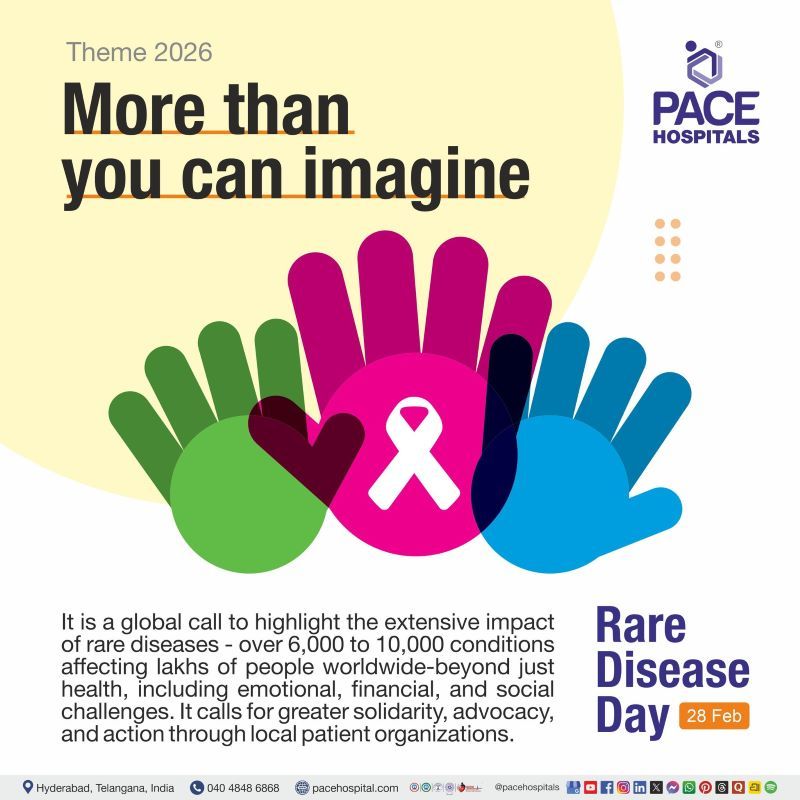
This year, Rare Disease Day 2026 theme is “More than you can imagine”. This slogan highlights the extensive impact of rare diseases—over 6,000 to 10,000 conditions affecting lakhs of people worldwide—beyond just health, including emotional, financial, and social challenges. It calls for greater solidarity, advocacy, and action through local patient organizations.
Year by Year Theme of Rare Disease Day
- RDD 2025 Theme - More than you can imagine; an anthology of rare experiences.
- RDD 2024 Theme - Share Your Colours!
- RDD 2023 Theme - Share Your Colours!
- RDD 2022 Theme - Share Your Colours!
- RDD 2021 Theme - Rare is many, rare is strong, rare is proud!
- RDD 2020 Theme - Rare is many, rare is strong, rare is proud!
- RDD 2019 Theme - Bridging health and social care.
- RDD 2018 Theme - Show your rare, show your care.
History of Rare Disease Day (RDD)
Organized by EURORDIS and coordinated by 65+ national alliance patient organization partners, the Rare Disease Day has aimed to spread awareness of various rare diseases in their respective countries since 2008.
The National Center for Advancing Translational Sciences (NCATS) and the National Institutes of Health (NIH) Clinical Center were involved in and sponsored these campaigns from 2011. Since then, this global observance of Rare Disease Day has touched the lives of affected people and their caretakers and raised awareness about NIH collaborations addressing the novel challenges brought by the advancement of scientific research for new treatments.
Goals of Rare Disease Day at NIH
Some of the goals of NIH attempting to accomplish on the occasion of Rare Disease Day are:
- Through research, demonstrate the dedication of NIH in assisting patients with rare diseases.
- Bringing the research on uncommon illnesses, development of diagnostics and therapies sponsored by the NIH into the limelight.
- Commence a mutually beneficial dialogue among the patients affected by uncommon diseases.
- Gathering diverse people, including patients, patient advocates, carers, health care professionals, researchers, trainees, students, industry representatives, and government employees.
Share on
Request an appointment
Fill in the appointment form or call us instantly to book a confirmed appointment with our super specialist at 04048486868
Appointment request - health articles
Recent Articles