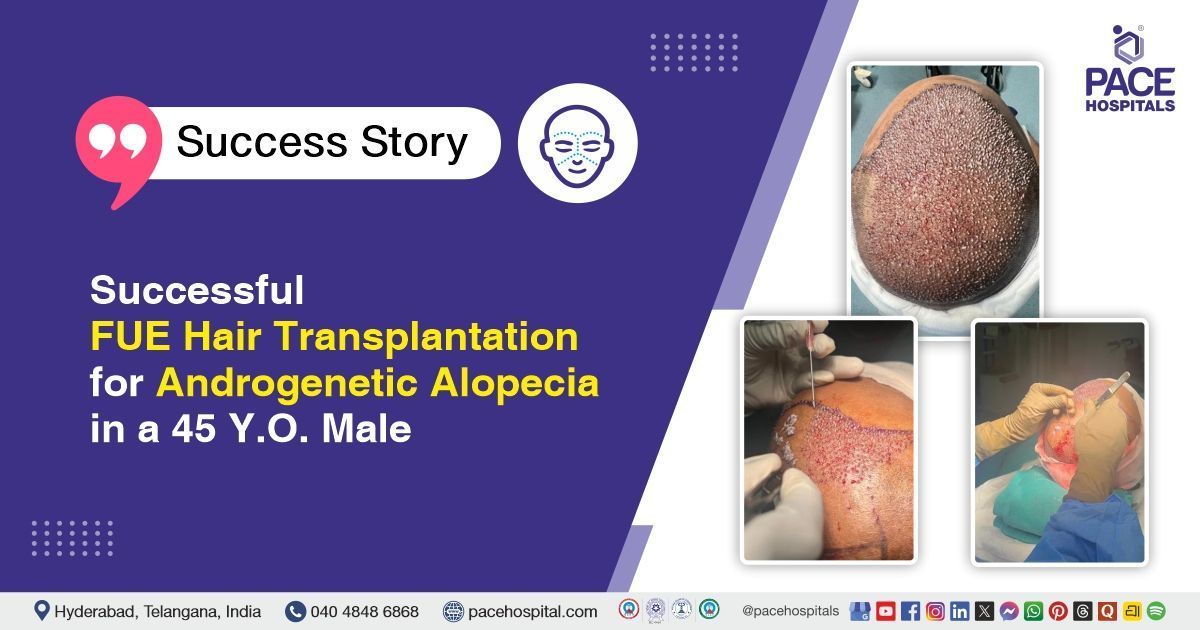
Successful FUE Hair Transplant for Androgenetic Alopecia in a 45 Y.O. Male
PACE Hospitals
PACE Hospitals' expert Plastic and Reconstructive Surgery team successfully performed a Follicular Unit Extraction(FUE) hair transplantation involving 3,900 follicular unit grafts in a 45-year-old male patient diagnosed with Grade VI androgenetic alopecia, with the aim of restoring natural hair density, improving scalp coverage, and enhancing overall cosmetic appearance.
Chief Complaints
A 45-year-old male patient with a
body mass index (BMI) of 22 presented to the Plastic and Reconstructive Surgery Department at
PACE Hospitals, Hitech City, Hyderabad, with complaints of gradually progressing baldness and a receding hairline over the past few years.
Past Medical History
The patient had no known medical illnesses and no history of prior surgeries. He had previously undergone a one-month course of topical treatment for hair loss. He had no known allergies.
On Examination
The patient was conscious, coherent, and cooperative. General physical examination was normal, with no evidence of pallor, icterus, cyanosis, lymphadenopathy, clubbing, or pedal edema. Vital signs were within normal limits.
Diagnosis
Following the clinical examination, the Plastic and Reconstructive Surgery team conducted a thorough assessment, including a detailed review of the patient’s medical and surgical history, with presenting complaints of progressive baldness and a receding hairline over the past few years. A focused evaluation of the scalp was performed to assess the pattern and severity of hair loss. Relevant investigations, including viral screening, were carried out to ensure patient suitability for surgery.
To confirm the diagnosis and determine the extent of involvement, the scalp was carefully examined. The assessment revealed Grade VI androgenetic alopecia, with significant hair thinning over the frontal, mid-scalp, and vertex areas. The occipital and temporoparietal regions were identified as suitable donor sites for graft extraction. No local or systemic abnormalities had been noted at the time of examination.
Based on the confirmed diagnosis, he was advised to undergo Follicular Unit Extraction (FUE) Hair Transplantation Treatment in Hyderabad, India, with 3,900 grafts under the care of the Plastic and Reconstructive Surgery team to restore hair density and improve cosmetic appearance.
Medical Decision Making (MDM)
After a detailed consultation with
Dr. Kantamneni Lakshmi, Senior Consultant Plastic, Reconstructive & Aesthetic Surgeon, a thorough clinical evaluation was performed focusing on the patient’s presentation of progressive baldness and a receding hairline over several years. A thorough evaluation was conducted considering the patient’s complaints of progressive baldness and a receding hairline over the past few years. All relevant investigations, including viral screening, systemic evaluation, and scalp assessment, were reviewed to determine suitability for surgery and donor site adequacy.
Based on these clinical findings, it was determined that Follicular Unit Extraction (FUE) Hair Transplantation with implantation of 3,900 grafts was identified as the most appropriate intervention to restore hair density, improve cosmetic appearance, and achieve the patient’s aesthetic goals. The occipital and temporoparietal regions were identified as suitable donor sites, and the frontal, mid-scalp, and vertex areas were targeted for implantation.
The patient and his family members were counseled about the diagnosis, procedure, potential risks, and expected benefits, including restoration of hair density and improved appearance.
Surgical Procedure
Following the decision, the patient was scheduled to undergo Follicular Unit Extraction (FUE) hair transplantation in Hyderabad at PACE Hospitals under the supervision of the expert Plastic and Reconstructive Surgery Team.
The following steps were carried out during the procedure:
- Anesthesia and Preparation: The patient was placed under intravenous sedation along with local anesthesia to ensure comfort during the procedure. The scalp was thoroughly cleaned, painted with antiseptic solution, and draped under sterile conditions to maintain asepsis.
- Donor Area Identification and Extraction: The occipital and bilateral temporoparietal regions were selected as donor sites. Follicular units were carefully extracted using the Follicular Unit Extraction (FUE) technique, ensuring minimal trauma to surrounding tissue and preserving graft viability.
- Recipient Area Preparation: The frontal, mid-scalp, and vertex areas were evaluated and marked according to the patient’s desired hairline and density requirements. Tiny recipient sites were created using specialized instruments to match the natural angle and direction of hair growth.
- Graft Implantation: The harvested 3,900 follicular unit grafts were meticulously implanted into the prepared recipient sites. Care was taken to maintain natural hair pattern, density, and orientation for optimal cosmetic outcome.
- Adjunctive PRP Therapy and Hemostasis: Platelet-Rich Plasma (PRP) was injected into both donor and recipient areas to enhance healing and graft survival. Hemostasis was confirmed, and the scalp was cleaned before concluding the procedure. The surgery was uneventful, and all grafts were successfully implanted.
Postoperative Care
The postoperative period was stable and uneventful. During the hospital stay, the patient was managed with treatment to prevent infection and control pain and fever. Postoperative instructions for hair transplantation were provided, including spraying the recipient area with saline every 30 minutes on the day of surgery, except while sleeping. From the following day until day five, the saline spray was continued every hour and could be used to relieve any itching in the scalp. The patient showed symptomatic improvement and was discharged in a stable condition with medications for continued postoperative care and instructions for follow-up.
Discharge Medications
Upon discharge the patient was discharged with medications for the prevention and treatment of infection, management of gastrointestinal acidity, relief of pain and inflammation, reduction of allergic symptoms, support for tissue healing, and supplementation of vitamins and minerals. A topical treatment was also advised for local care of the donor area on the scalp.
Advice on Discharge
The patient was instructed not to touch the implanted area for the first five days and to avoid bending forward during this period. Use of helmets, riding a bike, and wearing caps or woolen mufflers were restricted for 45 days, while swimming was to be avoided for 30 days. The patient was advised not to cut hair at the implanted site for six months and at the donor site for three months.
Heavy workouts, weight lifting, yoga, aerobics, and gym activities were to be avoided, with a return to exercise after 45 days. Alcohol consumption was prohibited for 15 days while taking medications, and the patient was advised to avoid sun exposure for at least four weeks. Spicy or hard foods were to be avoided for seven days, as well as prolonged use of laptops or mobile phones during the same period.
Chemical hair products such as dyes, colors, and gels were to be avoided for six months, and smoking was prohibited for one month. The patient was instructed to sleep on his back or use a horse-shoe shaped pillow for the first five days and to replace bed sheets and pillow covers daily for seven days, washing them with an antiseptic solution. Button-up shirts were recommended for 45 days. Saline spray was to be applied as instructed every 30 minutes on the implanted area for the first five days, and medications including antibiotics and painkillers were to be taken for five days as advised.
The patient was informed that hair shedding would occur from the 15th day post-surgery until the fourth month, with final transplant results visible after 9–12 months. Mild swelling on the forehead and upper eyelids was noted as normal and expected to subside in 2–3 days, with application of an ice pack 3–4 times per day if required.
Dietary Advice
The patient was advised to follow a high-protein diet with low salt and minimal spices to support healing, reduce inflammation, and promote overall recovery.
Emergency Care
The patient was informed to contact the emergency ward at PACE Hospitals in case of any emergency or development of symptoms such as excessive pain, swelling or bleeding.
Review and Follow-up Notes
The patient was advised to return for a follow-up consultation with the Plastic, Reconstructive & Aesthetic Surgeon in Hyderabad at PACE Hospitals 2 days after discharge to assess the healing of the transplanted and donor areas, monitor for any complications, and review postoperative care instructions.
Conclusion
This case highlights a patient with Grade VI androgenetic alopecia who underwent FUE hair transplantation under IV sedation and local anesthesia. The procedure was uneventful, and the patient remained stable throughout the hospital stay. The patient was discharged with appropriate medications, detailed postoperative care instructions, and dietary guidance. Follow-up was advised to monitor healing, graft survival, and overall recovery.
Advanced Hair Restoration with Follicular Unit Extraction (FUE)
FUE hair transplantation is a minimally invasive and precise technique for treating hair loss, involving the careful harvesting of individual follicular units from donor areas and their implantation into thinning or bald regions. The procedure focuses on achieving a natural hairline and uniform density while minimizing visible scarring. A Plastic Surgeon / Plastic Surgery Doctor plays a key role in planning and executing the procedure to ensure optimal aesthetic outcomes. Success depends heavily on structured postoperative care, including proper scalp hygiene, prescribed medications, activity limitations, and nutritional support to promote graft survival.
Adjunct treatments such as platelet-rich plasma (PRP) therapy can further enhance healing and stimulate hair growth. Regular follow-up is essential to monitor graft integration, detect any complications early, and ensure optimal long-term results. This approach highlights how meticulous surgical technique combined with comprehensive aftercare can achieve safe, effective, and natural-looking hair restoration.
Share on
Request an appointment
Fill in the appointment form or call us instantly to book a confirmed appointment with our super specialist at 04048486868
Appointment request - health articles
Recent Articles