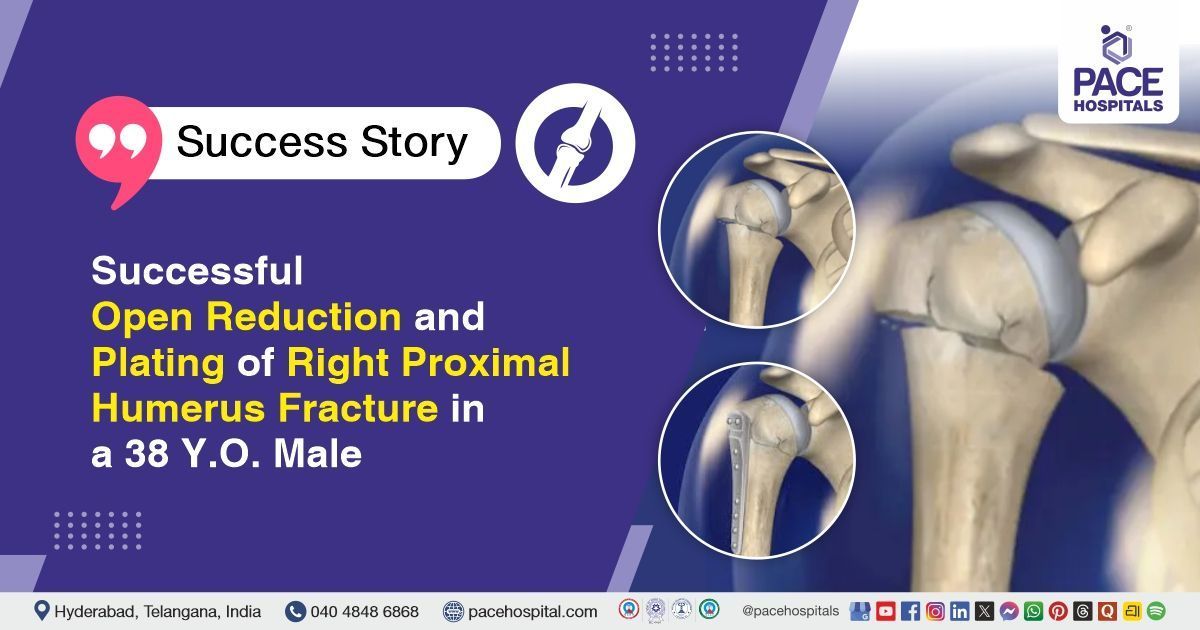
Successful Open Reduction and Plating of Right Proximal Humerus Fracture in a 38 Y.O. Male
PACE Hospitals
PACE Hospitals’ expert Orthopaedic team successfully performed an
Open Reduction and Internal Fixation with Plating of the right proximal humerus in a 38-year-old male patient, who was diagnosed with a fracture of the greater tuberosity of the right shoulder. The aim of the procedure was to anatomically realign the fractured bone fragments, restore shoulder function, and ensure stable fixation to facilitate proper healing.
Chief Complaints
A 38-year-old male patient, with a
body mass index (BMI) of 21, presented to the Orthopaedics Department at
PACE Hospitals, Hitech City, Hyderabad, with complaints of pain, swelling, and inability to use the right upper limb for the past 3 days.
Past Medical History
The patient had a history of seizures, causing anterior shoulder dislocation (reduced emergently). There were no other injuries, and he was not under the influence of alcohol at the time. He was evaluated and managed by a neurologist. The patient was also newly diagnosed with type 2 diabetes during this admission.
On Examination
On examination, the patient was conscious, alert, and oriented to time, place, and person. General examination revealed no pallor, icterus, lymphadenopathy, clubbing, or cyanosis. Systemic examination showed the right shoulder to be abnormal, with swelling, tenderness, and reduced range of motion due to pain, while all other systems, including chest, cardiovascular, abdomen, and central nervous system, were normal.
Diagnosis
Following the clinical examination, the Orthopaedics team conducted a comprehensive assessment, including a detailed review of the patient’s medical history and a focused evaluation of the right shoulder.
To confirm the diagnosis and evaluate the extent of the injury, a comprehensive clinical and systemic examination was performed. The patient exhibited swelling, tenderness, and limited range of motion in the right shoulder due to pain, while distal neurovascular status remained intact, and systemic examination revealed no significant abnormalities.
Initial X-rays of the right shoulder were obtained to assess the type and severity of the injury. Radiographic findings confirmed a fracture of the greater tuberosity of the right humerus. These clinical and radiological findings established the diagnosis and guided the treatment plan.
Based on the confirmed diagnosis, the patient was advised to undergo
Right Shoulder Fracture Treatment in Hyderabad, India, under the care of the Orthopaedic Department, ensuring effective stabilization and optimal functional recovery.
Medical Decision Making
After a detailed consultation with Dr. Raghuram, Senior Orthopaedic Consultant, and cross consultation with endocrinologist Dr. Tripti Sharma and neurologist Dr. S Pramod Kumar a comprehensive evaluation was performed to determine the most appropriate diagnostic and therapeutic approach. Considering the patient’s history of seizure-related anterior shoulder dislocation, clinical presentation of pain, swelling, tenderness, and restricted range of motion over the right shoulder, a focused local examination was undertaken to formulate an optimal treatment strategy.
Based on the clinical findings, which confirmed a fracture of the greater tuberosity of the right shoulder, it was determined that open reduction and internal fixation (ORIF) with a titanium PHILOS plate and screws was identified as the most suitable surgical intervention to achieve anatomical realignment, ensure fracture stability, relieve pain, and prevent long-term complications such as non-union, malunion, or impaired shoulder function.
The patient and family members were thoroughly counselled regarding the severity of the injury, the necessity of surgery, the surgical procedure, the associated risks, and the expected recovery process.
Surgical Procedure
Following the diagnosis, the patient was scheduled to undergo Right Shoulder Open Reduction and Plating of the Proximal Humerus Surgery in Hyderabad at PACE Hospitals, under the supervision of the expert Orthopaedic Department.
The surgical procedure involved the following steps:
- Patient Positioning and Preparation: The patient was positioned in the beach chair position under general anesthesia to provide optimal access to the right shoulder. The surgical site was sterilized with antiseptic solutions, and sterile draping was applied to maintain a clean surgical field.
- Surgical Approach: A deltopectoral incision was made along the anterior aspect of the shoulder. Soft tissues were carefully dissected to expose the proximal humerus while protecting neurovascular structures, including the axillary nerve.
- Fracture Reduction: The fracture fragments of the greater tuberosity were identified and evaluated for alignment. The fragments were carefully reduced manually to restore the anatomical position of the proximal humerus, with temporary K-wires or clamps used to maintain correct positioning. Reduction was confirmed visually and through gentle manipulation.
- Internal Fixation: A titanium PHILOS plate was positioned on the lateral aspect of the proximal humerus. Screws were inserted to secure the fracture fragments while ensuring proper alignment and avoiding joint penetration. Final stability and alignment were confirmed.
- Closure and Immobilization: The soft tissues, including deltoid and pectoral fascia, were sutured in layers using absorbable and non-absorbable sutures. The skin was closed, a sterile dressing was applied, and the shoulder was immobilized using a sling or shoulder immobilizer to protect the fixation during the early postoperative period.
Postoperative Care
The postoperative period was uneventful. The patient was gradually mobilized during the hospital stay. He was evaluated by the consultant neurologist and
endocrinologist for his seizure disorder and newly diagnosed type 2 diabetes, and appropriate management was initiated. Medications for infection prevention, pain relief, and supportive care were administered as required. Wound dressings were regularly performed and remained clean throughout the hospital stay. He was discharged in a hemodynamically stable condition with prescribed medications and discharge instructions.
Discharge Medications
Upon discharge, the patient was prescribed medications for infection prevention, acid suppression, blood sugar control, and general nutritional support, as well as supplements to aid tissue healing and recovery.
Advice on Discharge
On discharge, the patient was advised to continue physiotherapy with the application of a shoulder immobilizer and to maintain a normal diet.
Emergency Care
The patient was informed to contact the
emergency ward at PACE Hospitals in case of any emergency or development of symptoms such as fever, shoulder pain, and vomiting.
Review and Follow-up Notes
The patient was advised to return for a follow-up visit with the Orthopaedic Doctor in Hyderabad at PACE Hospitals after one week for a change of dressings.
Conclusion
This case highlights a patient with a fracture of the greater tuberosity of the right shoulder and newly diagnosed type 2 diabetes. He underwent successful open reduction and plating of the proximal humerus, with an uneventful postoperative course. The patient was discharged in stable condition with plans for follow-up and rehabilitation for optimal recovery.
Comprehensive Management of Complex Shoulder Fractures
Complex shoulder fractures, such as greater tuberosity or proximal humerus fractures, require careful surgical planning to restore anatomical alignment and ensure stable fixation. Open reduction and plating enables precise realignment of fracture fragments and supports early mobilization to maintain shoulder function. Multidisciplinary care, including evaluation by an orthopaedic doctor / orthopaedic surgeon and assessment of comorbidities, is essential for optimal perioperative outcomes.
Proper postoperative monitoring, pain management, and physiotherapy help prevent complications. Early follow-up and patient education on rehabilitation are crucial to maintain mobility and prevent stiffness. Integrating surgical expertise, supportive care, and rehabilitation ensures the best long-term functional recovery.
Share on
Request an appointment
Fill in the appointment form or call us instantly to book a confirmed appointment with our super specialist at 04048486868
Appointment request - health articles
Recent Articles