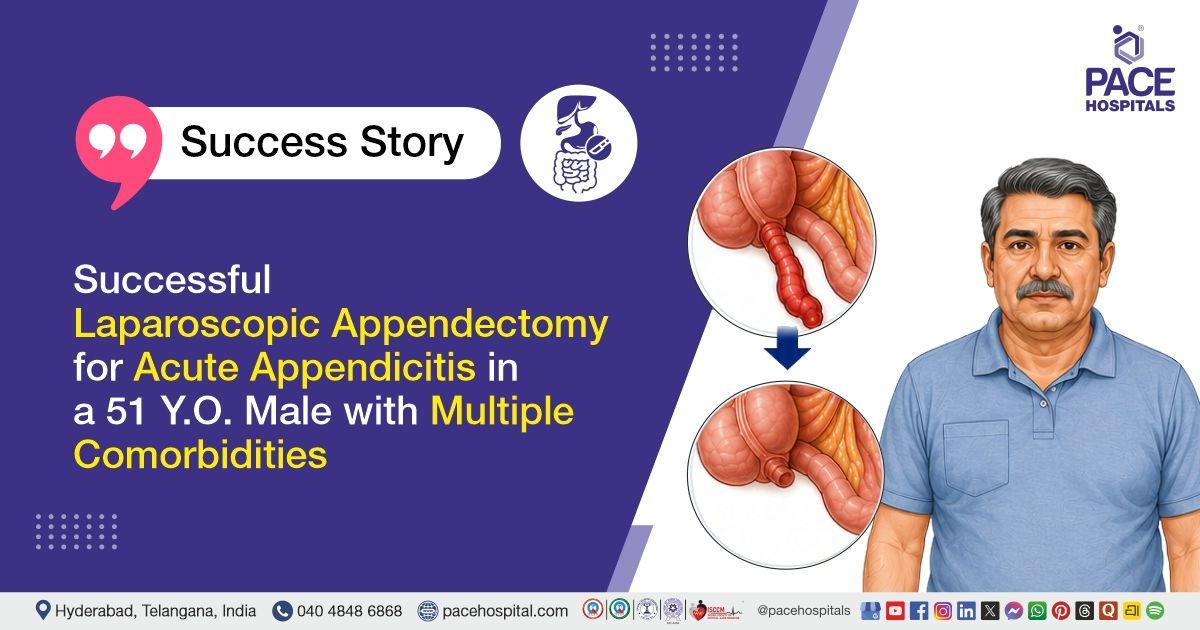
Successful Laparoscopic Appendectomy for Acute Appendicitis in a 51 Y.O. Male
PACE Hospitals
PACE Hospitals’ expert Surgical Gastroenterology team successfully performed a Laparoscopic Appendectomy on a 51-year-old male patient diagnosed with Acute Appendicitis. The procedure was undertaken to remove the inflamed appendix, prevent rupture and related complications, alleviate symptoms, and facilitate a safe and speedy recovery. The surgery was completed successfully using a minimally invasive approach, ensuring optimal patient outcomes.
Chief Complaints
A 51-year-old male patient with a body mass index (BMI) of 20 presented to the Surgical Gastroenterology Department at PACE Hospitals, Hitech City, Hyderabad, with complaints of abdominal pain and fever for the past three days.
The patient was apparently well until three days prior to presentation, then he developed continuous pain in the right iliac fossa. He also reported fever during the same period, which was not associated with chills or rigors. The patient had received intravenous antibiotics at home for three days before presenting to the hospital.
There was no history of vomiting, diarrhoea, burning micturition, or any other associated urinary or gastrointestinal symptoms.
Past Medical History
The patient had a known history of cardiac arrhythmia and had undergone radiofrequency ablation in the past. He also had a history of cerebrovascular accident (CVA), for which he underwent thrombolytic therapy and had subsequently been maintained on dual antiplatelet therapy.
In addition, he was a known case of hypertension and diabetes mellitus and had been receiving regular medical treatment for both conditions. There was no history of any previous abdominal surgeries or other significant surgical interventions.
On Examination
On examination, the patient was conscious, coherent, and oriented. He was febrile and hemodynamically stable. Abdominal examination revealed tenderness localized to the right iliac fossa with guarding in the corresponding region. There was no evidence of generalized peritonitis, abdominal distension, or palpable mass. Bowel sounds were present, and the remainder of the systemic examination was normal.
Diagnosis
Upon admission to PACE Hospitals, following a detailed clinical assessment, the Surgical Gastroenterology team evaluated the patient for complaints of continuous right iliac fossa pain and fever of three days' duration, along with a review of his relevant past medical history, including cardiac arrhythmia, cerebrovascular accident, hypertension, and diabetes mellitus.
Clinical examination revealed localized tenderness and guarding in the right iliac fossa, suggestive of an acute inflammatory process involving the appendix. The diagnosis of acute appendicitis was established based on the patient's characteristic clinical presentation, physical examination findings, and radiological evaluation.
Routine investigations, including complete blood count, serum biochemistry, and other preoperative assessments, were performed to evaluate the patient's overall medical condition and fitness for surgery. These investigations supported clinical diagnosis and helped in perioperative planning.
Based on the confirmed diagnosis, the patient was advised to undergo Acute Appendicitis Treatment in Hyderabad, India, under the expert care of the Surgical Gastroenterology Department.
Medical Decision Making (MDM)
After a detailed consultation with Dr. Suresh Kumar S, (Consultant Surgical Gastroenterologist) a comprehensive clinical evaluation was performed to determine the most appropriate diagnostic and therapeutic approach for the patient presenting with right iliac fossa pain and fever of three days’ duration. Given the patient’s significant comorbidities, including cardiac arrhythmia status post radiofrequency ablation, history of cerebrovascular accident on dual antiplatelet therapy, hypertension, and diabetes mellitus, a careful preoperative assessment was undertaken to optimize perioperative safety.
Considering the patient’s classical clinical presentation of continuous right iliac fossa pain, associated fever, and localized tenderness with guarding on examination, a diagnosis of acute appendicitis was made primarily on clinical grounds, supported by routine laboratory investigations. These investigations were performed as part of the standard preoperative workup and were found to be acceptable for proceeding with surgical management.
Based on clinical assessment and preoperative evaluation, it was determined that laparoscopic appendectomy was the most appropriate and effective management strategy to remove the inflamed appendix, prevent progression to perforation and generalized peritonitis, achieve source control of infection, and promote early recovery with reduced postoperative morbidity.
The patient and his family members were counselled regarding the diagnosis, surgical plan, intraoperative findings, postoperative course, and the importance of follow-up and adherence to medical advice for optimal recovery.
Surgical Procedure
Following the decision, the patient was scheduled to undergo Laparoscopic Appendectomy Surgery in Hyderabad at PACE Hospitals, under the expert care of the Surgical Gastroenterology Department.
The procedure involved the following steps:
- Port Placement and Exploration: The patient was taken under general anesthesia and pneumoperitoneum was created using a standard laparoscopic technique. Ports were inserted in appropriate positions, and the abdominal cavity was systematically explored. The appendix was identified along with surrounding inflammatory changes.
- Assessment of Pathology and Adhesiolysis: Intraoperative findings revealed an inflamed appendix with a thickened mesoappendix and dense adhesions between the caecum, terminal ileum, and parietal peritoneum. Careful adhesiolysis was performed to release the bowel loops and clearly delineate the appendix and surrounding structures.
- Dissection of Appendix and Mesoappendix Control: The appendix was dissected from surrounding tissues. The mesoappendix was found to be inflamed and was controlled using Ligasure to achieve secure hemostasis and minimize bleeding.
- Management of Perforation and Appendix Removal: A perforation was noted at the tip of the appendix. Thorough peritoneal lavage was performed to reduce contamination. The base of the appendix was secured and ligated using an endoloop, following which the appendix was completely excised and retrieved.
- Drain Placement and Completion: After ensuring hemostasis and adequate lavage, a 20 Fr pelvic drain was placed to prevent fluid collection and monitor postoperative drainage. The ports were removed under vision, and the procedure was completed without any immediate complications.
Postoperative Care
Postoperatively, the patient had an uneventful recovery with stable hemodynamics and satisfactory clinical improvement. He was managed with intravenous fluids, treatment for intra-abdominal infection, and supportive care for pain control, gastric protection, and fever management. The postoperative period remained smooth without fever, abdominal distension, or wound-related complications. Ultrasound at discharge showed no residual intra-abdominal collection, and the surgical drain was removed on postoperative day 2 after minimal output. Histopathology showed acute appendicitis with inflammation spreading to the surrounding tissues of the appendix (periappendicitis). The patient was discharged in a stable condition with advice for follow-up and postoperative care.
Discharge Medications
At the time of discharge, the patient was advised oral medications for gastric protection, pain control, fever management, and continued treatment of intra-abdominal infection. The patient was instructed regarding compliance with the prescribed medications and adherence to the advised duration of therapy.
Advice on Discharge
The patient was advised to resume a normal diet as tolerated, with gradual progression based on gastrointestinal comfort and postoperative recovery. Adequate hydration and a balanced nutritional intake were also recommended to support healing and recovery.
Emergency Care
The patient was advised to report to the emergency ward at PACE Hospitals in case of fever, abdominal pain, or vomiting.
Review and Follow-up Notes
The patient was advised to return for a follow-up visit with the Surgical Gastroenterologist in Hyderabad at PACE Hospitals after 1 week.
Conclusion
This case highlights acute appendicitis with intraoperative findings of an inflamed appendix, dense adhesions, and localised perforation at the tip. The patient was managed successfully with a laparoscopic appendectomy and appropriate perioperative care. Postoperative recovery was uneventful, and the patient was discharged in stable condition.
Laparoscopic Management of Acute Appendicitis
Acute appendicitis is a common surgical emergency that requires timely diagnosis and prompt intervention to prevent complications. Laparoscopic appendectomy is widely preferred due to its minimally invasive nature, enhanced visualization, and reduced postoperative morbidity. Even in complicated cases, careful surgical technique allows safe dissection, effective source control, and adequate peritoneal lavage. Early decision-making by a Surgical gastroenterologist / Surgical gastroenterology doctor plays a key role in preventing progression to perforation, peritonitis, and sepsis. The approach is associated with reduced postoperative pain, shorter hospital stay, and faster recovery. Overall, it remains a safe and effective standard of care in both uncomplicated and selected complicated cases of appendicitis.
Frequently Asked Questions (FAQs)
Why was a laparoscopic appendectomy performed in this patient?
The patient had acute appendicitis, causing persistent pain in the lower right side of the abdomen along with fever for three days. During the operation, the appendix was found to be inflamed and perforated at the tip. Removing the appendix was necessary to treat the source of infection, prevent further spread within the abdomen, and promote recovery.
What does perforation at the tip of the appendix mean?
A perforation at the tip of the appendix means that a small hole had developed due to severe inflammation. When this happens, infected material can escape into the abdominal cavity, increasing the risk of infection and abscess formation. To reduce these risks, the surgical team removed the appendix, cleaned the abdominal cavity thoroughly, and placed a drain.
Why was a drain placed after appendix surgery?
Because the appendix had perforated, there was a possibility of fluid collecting inside the abdomen after surgery. A drain was inserted to allow any remaining fluid or infected material to leave the body. In this case, the patient's recovery progressed well, and the drain was removed on the second day after surgery when imaging showed no significant fluid collection.
Why was adhesiolysis done during the appendectomy?
During the procedure, the surgeons found dense adhesions around the caecum, terminal ileum, and surrounding tissues. These adhesions can make it difficult to safely identify and remove the appendix. By carefully releasing them, the surgical team was able to clearly visualize the appendix and complete the operation safely.
What does it mean that the base of the appendix was secure?
This finding indicates that the severe inflammation and perforation were limited to the body and tip of the appendix. Because the base (where the appendix connects to the large intestine) was stable, it could be safely tied off using an endoloop without requiring a more complex or extensive bowel resection.
Is laparoscopic appendectomy safe in a patient with diabetes, hypertension, and a previous stroke history?
Yes, laparoscopic appendectomy can be performed safely in patients with conditions such as diabetes, hypertension, and a previous stroke, provided that careful assessment and monitoring are carried out before and after surgery. In this case, the patient also had a history of cardiac arrhythmia and radiofrequency ablation. With appropriate precautions, the surgery was completed successfully, and recovery was uneventful.
Why was postoperative monitoring important in this case?
Close monitoring after surgery was important because the patient had a perforated appendix as well as several existing medical conditions. The healthcare team observed for signs of infection, fever, increasing abdominal pain, vomiting, bleeding, or fluid collection. Regular monitoring helped ensure that recovery remained on track, and the patient stayed stable throughout the hospital stay.
How long does recovery take after a laparoscopic appendectomy with drain placement?
Recovery from laparoscopic appendectomy is generally quicker than recovery from open surgery. However, when the appendix has perforated, and a drain is required, healing may take a little longer. Most patients can return to light daily activities within a few days, but strenuous exercise, heavy lifting, and activities that strain the abdomen should be avoided until cleared by the surgeon. Follow-up visits are important to assess healing and review test results.
Why is the histopathology report important after appendix removal?
After the appendix is removed, it is examined under a microscope in the laboratory. This examination confirms the diagnosis and helps identify any unexpected findings. In this case, the patient was advised to return after one week with the histopathology report so that the results could be reviewed and further guidance provided if needed.
When should a patient seek urgent care after a laparoscopic appendectomy?
Medical attention should be sought promptly if symptoms such as fever, worsening abdominal pain, repeated vomiting, abdominal swelling, wound discharge, bleeding, severe weakness, or difficulty passing urine or stools develop after surgery. These symptoms may suggest a complication that requires evaluation and treatment. Early assessment can help prevent more serious problems and support a smooth recovery.
Share on
Request an appointment
Fill in the appointment form or call us instantly to book a confirmed appointment with our super specialist at 04048486868
Appointment request - health articles
Recent Articles