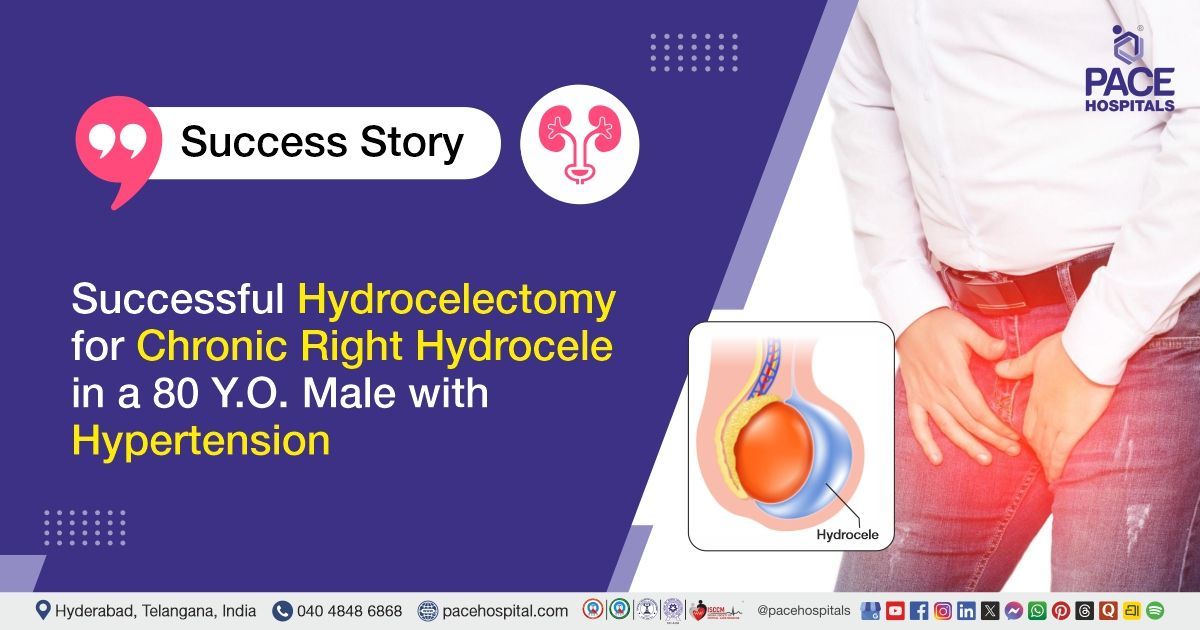
Successful Right Hydrocelectomy for Chronic Right Hydrocele in an 80 Y.O. Male
PACE Hospitals
PACE Hospital’s expert Urology team successfully performed a Right Hydrocelectomy on an 80-year-old male patient diagnosed with a right hydrocele. The aim of the procedure was to surgically excise the hydrocele sac and drain the accumulated fluid around the right testicle, thereby relieving scrotal swelling, improving comfort, and preventing recurrence or related complications.
Chief Complaints
An 80-year-old male patient with a body mass index (BMI) of 21 presented to the Urology Department at PACE Hospitals, Hitech City, Hyderabad, with complaints of right-sided scrotal swelling.
Past Medical History
The patient had a history of hypertension and a previous right open inguinal hernia repair performed in the past at another hospital. No other significant comorbidities were reported.
On examination
On examination, the patient was conscious, coherent, and oriented to time, place, and person. He presented with right-sided scrotal swelling. The scrotum was found to be enlarged, consistent with a hydrocele. Both testes were palpable and felt normal in consistency. A small swelling was also noted in the left inguinal region, suggestive of a left inguinal hernia. No signs of acute inflammation were observed.
Diagnosis
Upon admission to PACE Hospitals, the patient was thoroughly evaluated by the Urology team, including a detailed review of his medical history and a comprehensive clinical examination. He presented with right-sided scrotal swelling. Based on the initial assessment, a provisional diagnosis of right hydrocele was made.
The patient was further evaluated with relevant investigations, including scrotal ultrasonography, which confirmed a gross chronic right hydrocele with internal echoes, moderate left scrotal fluid collection suggestive of a chronic hydrocele, bilateral epididymal cysts, scrotal wall thickening, and a left inguinal hernia with herniation of bowel and omentum through a defect in the left inguinal region. Cardiac evaluation revealed normal chamber sizes with good ventricular function and no significant abnormalities.
Based on these confirmed findings, the patient was advised to undergo Right Hydrocele Treatment in Hyderabad, India, under the expert care of the Urology Department.
Medical Decision Making (MDM)
After a detailed consultation with Dr. Abhik Debnath, Consultant Laparoscopic Urologist, a comprehensive evaluation was conducted focusing on the patient’s presentation of right-sided scrotal swelling. Clinical examination and diagnostic assessment confirmed the presence of a right hydrocele with an associated small left inguinal hernia and hypertension, with no evidence of acute scrotal infection or other significant acute pathology.
It was determined that right hydrocelectomy was the most appropriate intervention to relieve scrotal swelling, improve patient comfort, and prevent recurrence or further complications related to the hydrocele. The left inguinal hernia was noted as a coexisting condition and kept under observation, with no immediate surgical intervention planned during this admission.
The patient and his family members were informed about the diagnosis of right hydrocele with small left inguinal hernia, the planned surgical management, the associated risks, benefits, and expected outcomes, and consent was obtained for proceeding with surgical treatment.
Surgical Procedure
Following the decision, the patient was scheduled to undergo Right Hydrocelectomy Surgery in Hyderabad at PACE Hospitals, under the expert care of the urology department.
The procedure involved the following steps:
- Anaesthesia and Positioning: The patient was taken to the operating room and placed in a supine position. Under strict aseptic precautions, spinal anaesthesia was administered. After achieving an adequate anaesthetic effect, the surgical field was cleaned and draped in a sterile manner.
- Scrotal Incision and Exposure: A scrotal incision was made over the right hemiscrotum. The layers were carefully dissected to expose the tunica vaginalis sac containing the hydrocele fluid.
- Delivery and Opening of Hydrocele Sac: The hydrocele sac was isolated and delivered into the operative field. The tunical sac was then carefully opened, and clear serous fluid was drained completely. The right testis was inspected and found to be normal.
- Sac Management (Eversion and Excision): The hydrocele sac was everted to prevent recurrence, and redundant sac tissue was managed appropriately. The edges of the sac were then sutured meticulously to maintain proper anatomical positioning.
- Haemostasis and Closure: Complete haemostasis was achieved to ensure no active bleeding. The surgical site was irrigated, and layers were closed in a standard fashion. A sterile dressing was applied, and the patient was shifted to recovery in stable condition.
Postoperative Care
The patient’s intraoperative and postoperative course was uneventful, with smooth recovery and no complications noted during the hospital stay. Postoperatively, he was managed with adequate pain control for surgical site discomfort, measures for prevention of infection, and supportive care to reduce inflammation and promote wound healing. Urinary catheter care was provided with monitoring of urine output and prevention of urinary retention, along with scrotal support to minimize edema and improve comfort. Early mobilization was encouraged to aid recovery. The patient was discharged in stable condition.
Discharge Medications
Upon discharge, the patient was prescribed medications to prevent postoperative infection for a short duration, control postoperative pain and fever, and reduce inflammation to promote wound healing and decrease swelling. Supportive treatment was advised for gastric protection during recovery, along with therapy to improve urinary flow and reduce the risk of urinary retention. He was advised to continue his regular blood pressure medications as per the prior regimen
Advice on discharge
The patient was advised to continue a normal diet as tolerated. Scrotal support using tight-fitting underwear was recommended to reduce swelling and improve comfort. Careful handling and maintenance of the urinary catheter were advised to prevent blockage or infection until removal as instructed.
Emergency Care
The patient was instructed to contact the emergency ward at PACE Hospitals in the event of an emergency or if symptoms such as fever, severe groin or scrotal pain, or catheter blockage.
Review and Follow-up Notes
The patient was advised to have the catheter removed in their hometown after 1 day under the supervision of a doctor and to return for a follow-up visit with the Urologist in Hyderabad at PACE Hospitals after 3 days for dressing and drain removal.
Conclusion
This case highlights a right hydrocele with an associated small left inguinal hernia in a patient with hypertension, managed surgically with right hydrocelectomy under spinal anaesthesia. The procedure was successfully performed without complications, and intraoperative findings confirmed a clear hydrocele sac with a normal testis. The postoperative course was uneventful, and the patient recovered well with a stable clinical status at discharge.
Comprehensive Surgical Management of Chronic Hydrocele in an Elderly Patient
Hydrocele is a common benign scrotal condition that often presents as a painless, gradually enlarging scrotal swelling, especially in elderly patients. A thorough clinical evaluation supported by imaging is essential to confirm the diagnosis and to exclude associated conditions such as inguinal hernia, epididymal pathology, or other scrotal abnormalities. Preoperative assessment plays a crucial role in optimizing patient safety, particularly in individuals with comorbidities or increased surgical risk.
Hydrocelectomy remains the definitive treatment, performed under suitable anaesthesia, and involves drainage of fluid with either excision or eversion of the sac to prevent recurrence. Careful intraoperative technique is required to protect testicular structures and ensure adequate haemostasis. Postoperative care includes pain control, infection prevention, scrotal support, and encouragement of early mobilization to enhance recovery.
Overall, hydrocelectomy is a safe and effective procedure with excellent outcomes when performed by a urologist/urology doctor with proper evaluation and surgical precision.
Frequently Asked Questions (FAQs)
Can a hydrocele come back even after surgery?
Hydrocele surgery usually gives long-lasting relief, and most patients recover without the problem returning. In a few cases, fluid may collect again around the testicle after some time. This can happen due to incomplete healing or other underlying scrotal conditions. Regular check-ups after surgery help doctors monitor recovery properly.
How much time does it take to recover after hydrocelectomy?
Recovery after hydrocele surgery is usually smooth, but complete healing may take a few weeks. Mild pain, swelling, or heaviness in the scrotum can remain for some days after the procedure. Most patients can walk and do light work within a short time. Proper rest and following medical advice help in faster recovery.
Why is scrotal support advised after hydrocele surgery?
Scrotal support helps reduce swelling and gives comfort to the operated area after surgery. It helps hold the scrotum in a proper position and reduces strain during movement. Many patients feel more comfortable while walking or sitting when support is used. Doctors usually advise using it for a few days during recovery.
Is hydrocele surgery safe for elderly patients?
Hydrocele surgery is commonly done in elderly patients after checking their overall health condition. Doctors evaluate blood pressure, heart function, and general fitness before surgery to reduce risks. With proper precautions and careful monitoring, most older patients recover well after the procedure.
Why are follow-up visits important after hydrocele surgery?
Follow-up visits help the doctor check how well the wound is healing after surgery. These visits are useful for monitoring swelling, dressing condition, and any signs of infection. Patients are also guided regarding activity levels and recovery progress during these visits. Early follow-up helps in identifying and preventing complications and supports proper healing.
Can a hydrocele and an inguinal hernia occur together?
Yes, hydrocele and inguinal hernia can sometimes occur together, especially in older adults. An inguinal hernia develops when part of the intestine or tissue pushes through a weak area in the groin. Imaging tests help identify both conditions before treatment. Early management of associated conditions helps reduce discomfort and prevent complications.
What activities should be avoided after hydrocele surgery?
Activities like heavy lifting, strenuous exercise, running, cycling, and prolonged standing are usually avoided for some time after surgery. These activities can increase pressure on the operated area and delay healing. Patients are usually advised to take proper rest during the early recovery period.
Can swelling remain after hydrocele surgery?
Mild swelling after hydrocele surgery is common and usually not a cause for concern. A hydrocele happens when fluid builds up around the testis inside the scrotum. After the surgery, the body needs some time to heal and adjust after the fluid is removed and the area is repaired. Because of this, some swelling may remain for a few days or even a few weeks.
Recovery can differ from person to person based on age and overall health. Wearing scrotal support can help reduce discomfort and provide better support during healing. Following the doctor’s advice and taking proper care after surgery can help ensure a smooth recovery.
When can normal daily activities be resumed after hydrocelectomy?
Most patients can gradually resume light daily activities within a few days after surgery. Walking and simple routine tasks are usually permitted based on comfort level. However, heavy physical work and strenuous activities should be avoided for a few weeks. Patients are generally advised to return to normal activities slowly as recovery progresses.
What signs after hydrocele surgery should not be ignored?
Certain signs like severe pain, fever, unusual swelling, vomiting, bleeding, wound discharge, or difficulty in passing urine after surgery should not be ignored. These symptoms may be a sign of infection or other complications and may need immediate medical attention. Getting medical help early can stop the problem from becoming serious and help with proper healing. Patients should contact the hospital immediately if they notice any of these symptoms.
Share on
Request an appointment
Fill in the appointment form or call us instantly to book a confirmed appointment with our super specialist at 04048486868
Appointment request - health articles
Recent Articles