International Albinism Awareness Day (IAAD) 13 June, 2024 - Theme and Importance
Pace Hospitals
International Albinism Awareness Day (IAAD) is organized annually on June 13th to raise awareness of albinism. This is an uncommon, genetically inherited condition that results in skin devoid of pigmentation, causing unusually pale skin, hair, and eyes.
Individuals who have albinism needs to comply with lifetime precautions against exposure to sunlight as they are more vulnerable to ultraviolet (UV) rays. It is essential to educate people with this condition about the potential hazards of both extended UV light exposure and medications that aggravate photosensitivity. The typical characteristics of Albinism are mainly expressed in eyes and on skin, hence its phenotype syndrome is also called as Oculocutaneous Albinism.
Significance of International Albinism Awareness Day
All kinds of albinism are caused by genetic mutations that result in melanocytes that are defective and unable to carry or produce melanin across dermal tissues. As albinos do not produce enough melanin, they are more susceptible to skin cancer. In some countries, skin cancer claims the life of the majority of people with albinism between 30- 40years of age.
When individuals who have albinism enjoy their right to health, skin cancer is usually avoidable. This includes having access to routine medical examinations, sunscreen, sunglasses, and clothing that protects from solar radiation. These life-saving resources are either inaccessible or unavailable to them in a significant proportion of countries. As such, individuals with albinism historically have been and remain to be among those "left furthest behind" in terms of development indicators. Hence, they ought to be the focus of human rights initiatives in the context that the Sustainable Development Goals intend.
International Albinism Awareness Day (IAAD) theme
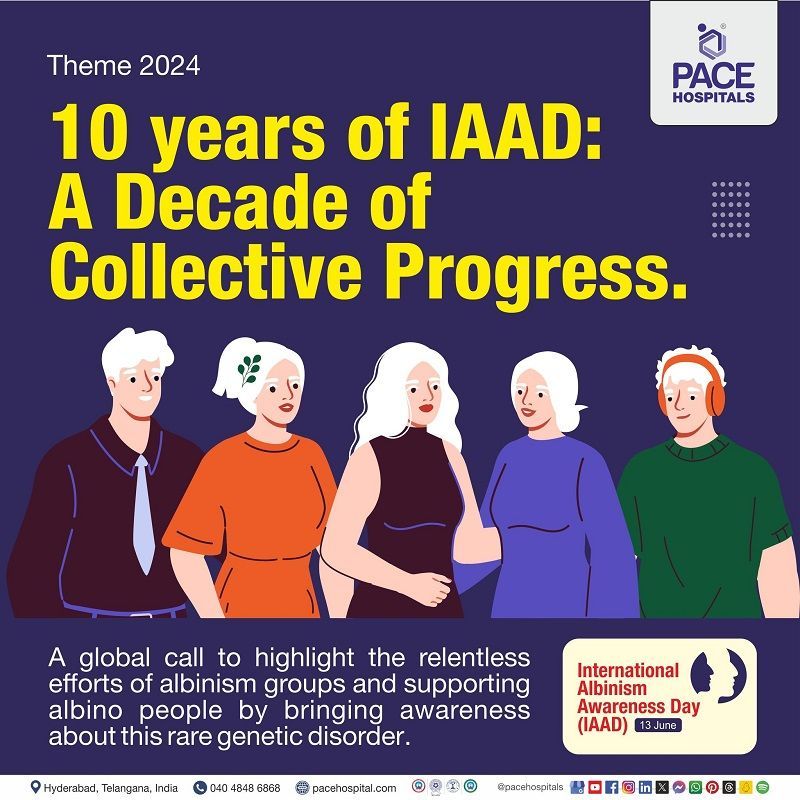
The theme of International Albinism Awareness Day this year is “10 years of IAAD: Adecade of collective progress.” This theme highlights the importance of supporting Albino people by bringing awareness about this rare genetic disorder. Educating them about complications of oculocutaneous albinism phenotype which saves them from melanoma and blindness.
Year- by- Year, the themes for International Albinism Awareness Day are:
- International Albinism Awareness Day theme 2023- Inclusion is strength
- International Albinism Awareness Day theme 2022-United in making our voice heard
- International Albinism Awareness Day theme 2021-Strength beyond all odds
- International Albinism Awareness Day theme 2020-Made to shine
History of albinism
Throughout most of the documented history, an individual with white hair, white skin, and blue eyes who also displayed a strong red reflex, photophobia, and poor vision was commonly referred to as an albino, also known as an oculocutaneous albino. This describes the conventional perfect or complete albino. While few people possess a little melanin in their skin, hair, or eyes, such individuals were referred to as imperfect, incomplete, or partial albinos. However, it was unclear about which biological foundation distinguished complete from partial albino forms. Saint Hilaire initially described the "perfect albino" in 1832 and highlighted a distinction between perfect albinism and partial or imperfect albinism.
Recommendations
The following recommendations can be implemented to handle albinism:
- Make sure to adopt health and disability policies, along with the training programs for health-related professions
- Add sunscreen on the essential medicines list promptly, and make sure that high-quality sunscreen is easily accessible, cost-effective, and available in both urban and rural places
- Ensuring that skin cancer treatments are accessible, affordable, high-quality, and free from discrimination. In order to prevent future prejudice based on appearance, such treatment should involve both curative therapies and cosmetic procedures to restore or improve appearance.
- As a fair exemption, make it easier to import equipment and glasses, for instance, eliminating the taxes and other expenses related to their importation
Share on
Request an appointment
Fill in the appointment form or call us instantly to book a confirmed appointment with our super specialist at 04048486868
Appointment request - health articles
Recent Articles