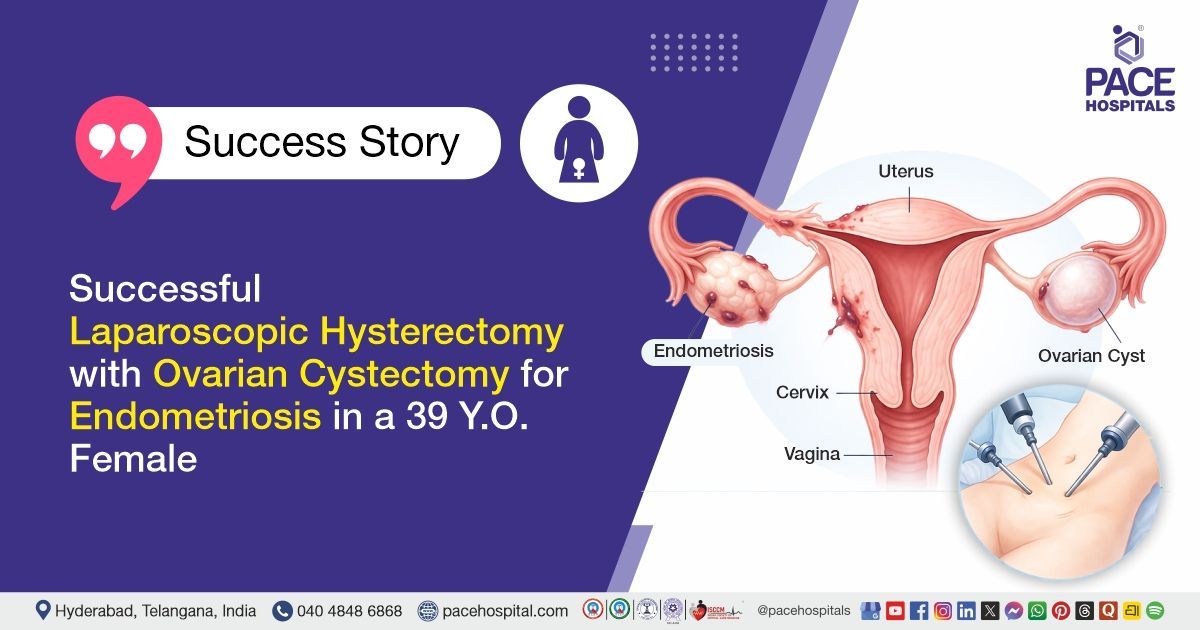
Successful Laparoscopic Hysterectomy with Ovarian Cystectomy for Endometriosis in a 39 Y.O. Female
PACE Hospitals
PACE Hospitals’ expert gynaecology team successfully performed a Laparoscopic Hysterectomy with Bilateral Salpingectomy, Dense Adhesiolysis, and Ovarian Cystectomy on a 39-year-old female diagnosed with abnormal uterine bleeding, pelvic inflammatory disease, adenomyosis, endometriosis, and an ovarian cyst. The aim of the procedure was to relieve heavy bleeding and pelvic pain, remove diseased uterine and adnexal tissue, treat infection and endometriosis, and excise the ovarian cyst while restoring pelvic health through a minimally invasive approach.
Chief Complaints
A 39-year-old female patient with a body mass index (BMI) of 23 presented to the Gynaecology Department at PACE Hospitals, Hitech City, Hyderabad, with complaints of known adenomyosis and prolonged spotting for the past three months. She had a Mirena intrauterine device in situ.
Past Medical History
The patient had no history of hypertension, diabetes mellitus, asthma, tuberculosis, or thyroid disease. She had a known allergy to Betadine.
Obstetric History
The patient had P3L3 (three pregnancies and three live births) and had previously undergone a lower segment caesarean section (LSCS) followed by tubectomy.
On Examination
The patient was conscious, coherent, and oriented. Her vital signs were within normal limits. On systemic examination, the respiratory and cardiovascular systems were normal, and the abdomen was soft and non-tender. Breast examination was normal, with no lumps. Per speculum and per vaginal examination revealed a bulky cervix positioned high, with no tenderness in the fornices.
Diagnosis
Upon admission to PACE Hospitals, the patient was evaluated by the Gynaecology team, which included a detailed review of her medical and obstetric history and a comprehensive clinical examination revealing a bulky, non-tender cervix and uterus. Per speculum and per vaginal examination showed the cervix positioned high with no fornices tenderness.
Ultrasound imaging and preoperative evaluation confirmed adenomyosis, endometriosis, and a left ovarian cyst measuring 5 × 4 cm, along with features of pelvic inflammatory disease. There were no abnormal findings in the urinary system or free fluid collections in the pelvis. Preoperative blood investigations revealed neutrophilic leukocytosis, mild thrombocytosis, and normocytic normochromic hemoglobin, indicating chronic inflammation with adequate renal and electrolyte function.
Based on the confirmed findings, the patient was advised to undergo
Endometriosis Treatment in Hyderabad, India, associated with adenomyosis, endometriosis, pelvic inflammatory disease, and a left ovarian cyst under the expert care of the Gynaecology Department.
Medical Decision Making (MDM)
After a detailed consultation with Dr. Mugdha Bandawar, a Gynaecologist, a comprehensive evaluation of the patient was undertaken. Considering her history of adenomyosis, prolonged abnormal uterine bleeding, previous lower segment caesarean section (LSCS), tubectomy, and the presence of a Mirena intrauterine device, the gynaecologist reviewed her clinical findings, including a bulky cervix and uterus, left ovarian cyst, and features of pelvic inflammatory disease confirmed on ultrasound and laboratory investigations.
Further evaluation, including preoperative blood tests and imaging, confirmed the presence of adenomyosis, endometriosis, a left ovarian cyst measuring 5 × 4 cm, and pelvic adhesions, with no evidence of urinary system involvement. Based on these findings, it was determined that laparoscopic hysterectomy with bilateral salpingectomy, dense adhesiolysis, and ovarian cystectomy was identified as the most appropriate intervention to relieve symptoms, treat underlying pathology, and prevent further gynaecological complications.
The patient and her family were counselled in detail regarding the diagnosis, the planned procedure, associated risks, expected benefits, and anticipated recovery, following which informed consent was obtained.
Surgical Procedure
Following the decision, the patient was scheduled to undergo a Laparoscopic Hysterectomy Surgery in Hyderabad at PACE Hospitals with Bilateral Salpingectomy with Dense Adhesiolysis with Ovarian Cystectomy under the supervision of the expert Gynaecology Department.
The following steps were carried out during the procedure:
- Initial Assessment and Preparation: The patient was placed under general anesthesia, and standard aseptic precautions were followed. Laparoscopic ports were inserted, and the abdominal cavity was inspected. The uterus and cervix were noted to be bulky with congestion. The Mirena intrauterine device was identified and removed.
- Evaluation of Adnexa: The right fallopian tube and ovary appeared normal. The left fallopian tube was densely adherent to the lateral pelvic wall due to adhesions; partial retrieval was achieved, though some portion could not be mobilized. The left ovary was found to be bulky with a cyst measuring 5 × 4 cm, which was carefully excised (cystectomy).
- Adhesiolysis and Bladder Mobilization: Dense adhesions were observed between the left lower side of the uterus and the pelvic wall, as well as between the bladder and lower uterine segment. Adhesiolysis was meticulously performed to free the uterus and adnexa, taking care to avoid injury to surrounding structures, including the bladder.
- Hysterectomy and Specimen Retrieval: The uterus with the cervix and both fallopian tubes was separated and retrieved vaginally. Hemostasis was carefully ensured throughout the procedure. The excised tissues were sent for histopathological examination (HPE) to confirm the diagnosis and rule out any malignancy.
- Closure and Final Assessment: The vaginal vault was closed, hemostasis was achieved, and the pelvic cavity was inspected to ensure no residual bleeding or complications. The remainder of the abdomen appeared normal. The laparoscopic ports were removed, and the procedure was concluded successfully.
Postoperative Care
Postoperatively, the patient was closely monitored for hemodynamic stability, pain, and signs of infection. Supportive care included maintenance of fluids and electrolytes, pain management, and measures to prevent postoperative bleeding. Vital signs and urine output were regularly assessed, and gradual mobilization was encouraged to reduce the risk of complications. The patient remained stable throughout her hospital stay and was discharged in good condition. Postoperative histopathology revealed no malignancy, with largely normal uterine and cervical findings and only minor benign changes in the fallopian tubes.
Discharge Medications
Upon discharge, the patient was advised medications for prevention of infection, control of pain and inflammation, gastric protection, nutritional support, regulation of bowel movements, and local wound care. Additional therapy was prescribed to support recovery and maintain metabolic and glycemic balance. All medications were scheduled with appropriate doses and duration to ensure optimal postoperative healing and patient comfort.
Advice on Discharge
Upon discharge, the patient was advised to refrain from heavy lifting and strenuous physical activity and to maintain a normal, balanced diet.
Emergency Care
The patient was informed to contact the emergency ward at PACE Hospitals in case of any emergency or development of symptoms like pain in abdomen, heavy menstrual bleeding and fever.
Review and Follow-up Notes
The patient was advised to return for a follow-up appointment with the Gynaecologist in Hyderabad at PACE Hospitals after 10 days. A subsequent review was scheduled after 15 days with an Endocrinologist for evaluation of fasting and postprandial blood sugar reports.
Conclusion
This case highlights the surgical management of abnormal uterine bleeding associated with adenomyosis, endometriosis, pelvic inflammatory disease, and an ovarian cyst. It was successfully treated through laparoscopic hysterectomy, bilateral salpingectomy, dense adhesiolysis, and ovarian cystectomy. The procedure was completed without complications, and postoperative recovery was uneventful. The patient was discharged in stable condition with appropriate supportive care to facilitate healing.
Key Considerations in Gynecological Surgical Management
Effective gynecological surgery relies on accurate diagnosis, careful preoperative evaluation, and meticulous surgical technique, guided by a gynaecologist/gynaecology doctor. Handling adhesions, cysts, or endometriosis requires skill and planning to reduce intraoperative risks. Postoperative care emphasizes recovery support, complication prevention, and patient comfort. Clear communication with patients regarding procedures and recovery expectations improves satisfaction and adherence.
Multidisciplinary collaboration can optimize both surgical outcomes and long-term health. Additionally, individualized care plans that consider patient comorbidities, reproductive goals, and lifestyle factors contribute to safer surgeries and faster recovery. Continuous monitoring, early intervention for complications, and integration of minimally invasive techniques further enhance both clinical outcomes and quality of life.
Share on
Request an appointment
Fill in the appointment form or call us instantly to book a confirmed appointment with our super specialist at 04048486868
Appointment request - health articles
Recent Articles