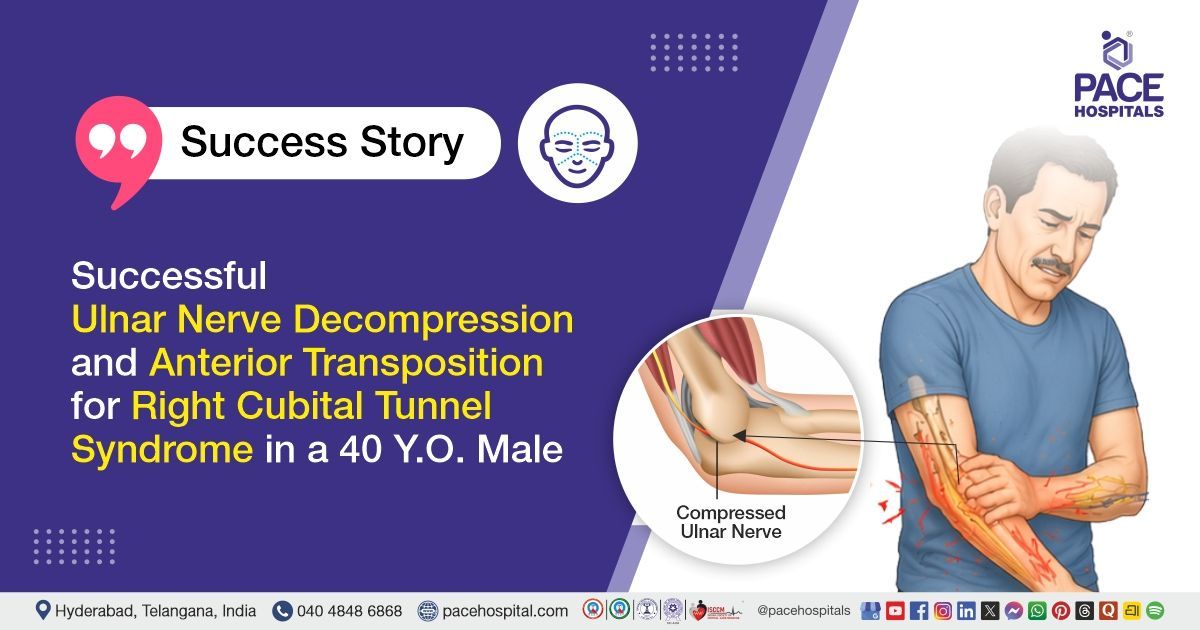
Successful Ulnar Nerve Decompression & Anterior Transposition for Right Cubital Tunnel Syndrome in a 40 Y.O. Male
PACE Hospitals
PACE Hospitals’ expert Plastic and Reconstructive Surgery team successfully performed a Right Ulnar Nerve Decompression with Anterior Transposition on a 40-year-old male patient diagnosed with right ulnar nerve compressive neuropathy at the cubital tunnel. The aim of the procedure was to relieve pressure on the ulnar nerve, restore normal nerve function, and alleviate symptoms such as pain, numbness, and weakness in the affected limb.
Chief Complaints
A 40-year-old male with a body mass index (BMI) of 20 presented to the Plastic and Reconstructive Surgery Department at PACE Hospitals, Hitech City, Hyderabad, with complaints of intermittent numbness in the right forearm and the 4th and 5th fingers for the past two years, along with episodes of weakness in the right hand over the last four weeks. The patient also has a history of previous trauma to the elbow.
Past Medical History
The patient had no known history of chronic medical illnesses and no known drug allergies. He had previously undergone anterior cruciate ligament (ACL) reconstruction and surgery for hemorrhoids. He also had a history of chronic smoking and alcohol consumption.
On Examination
On examination, the patient was conscious, coherent, and oriented. There were no signs of pallor, icterus, cyanosis, clubbing, lymphadenopathy, or pedal edema. The vital parameters, including pulse rate, blood pressure, temperature, and oxygen saturation, were within normal limits. The overall general physical examination was normal, and the patient was hemodynamically stable.
Diagnosis
Following the clinical examination, the Plastic and Reconstructive Surgery team conducted a thorough assessment, including a detailed review of the patient’s medical and surgical history, with presenting complaints of intermittent numbness of the right forearm and fourth and fifth fingers for two years, along with recent onset weakness of the right hand for four weeks. A focused examination of the right upper limb was performed to assess sensory deficits, motor weakness, and nerve involvement around the elbow. Clinical evaluation, along with a history of prior elbow trauma, was suggestive of right ulnar nerve compressive neuropathy at the cubital tunnel, presenting with features of chronic nerve compression and evolving motor involvement.
To confirm the diagnosis and assess the severity of nerve involvement, a detailed clinical and diagnostic evaluation was carried out. The assessment revealed findings consistent with ulnar nerve dysfunction affecting the sensory distribution of the fourth and fifth digits and motor function of the hand. General laboratory investigations were within normal limits, and there were no signs of systemic infection or metabolic abnormalities. Based on clinical findings and history, the condition was localized to the cubital tunnel region without evidence of widespread neurological disease. Overall assessment confirmed right ulnar nerve compressive neuropathy at the cubital tunnel.
Based on the confirmed diagnosis, the patient was advised to undergo Right Cubital Tunnel Syndrome Treatment in Hyderabad, India, under the Plastic and Reconstructive Surgery team.
Medical Decision Making (MDM)
After a detailed consultation with Dr. Kantamneni Lakshmi, Senior Consultant Plastic, Reconstructive & Aesthetic Surgeon, a comprehensive evaluation was performed to determine the most appropriate diagnostic and therapeutic approach. Considering the patient’s history of intermittent numbness in the right forearm and fourth and fifth fingers for two years, along with recent onset weakness of the right hand and a history of prior elbow trauma, a focused local examination of the right upper limb was undertaken to assess sensory and motor deficits and nerve involvement around the elbow. Clinical findings were suggestive of ulnar nerve compression at the cubital tunnel with both sensory disturbance and early motor weakness.
Based on the clinical findings, which confirmed right ulnar nerve compressive neuropathy at the cubital tunnel, it was determined that right ulnar nerve decompression with anterior transposition was identified as the most suitable intervention to relieve pressure on the ulnar nerve, prevent further neurological deterioration, restore motor and sensory function, and alleviate symptoms, as the patient had progressive symptoms with recent motor involvement.
The patient and his family members were thoroughly counselled regarding the diagnosis, need for surgery, procedure details, potential risks, and expected recovery process. Informed consent was obtained, ensuring their understanding and active participation in the treatment plan.
Surgical Procedure
Following the diagnosis, the patient was scheduled to undergo Right Ulnar Nerve Decompression with Anterior Transposition Surgery in Hyderabad at PACE Hospitals, under the supervision of the expert Plastic and Reconstructive Surgery team.
The surgical procedure involved the following steps:
- Anesthesia and Patient Preparation: The patient was taken to the operating room and placed under general anesthesia. The right upper limb was positioned appropriately, and the surgical site was prepared under strict aseptic precautions. The entire operative field was painted and draped to maintain sterility.
- Surgical Exposure and Identification of Ulnar Nerve: An incision was made over the medial aspect of the arm and extended across the elbow into the proximal forearm. The incision was carefully deepened through the subcutaneous tissue. The ulnar nerve was identified at the cubital tunnel and meticulously dissected free from the surrounding structures.
- Ulnar Nerve Decompression: All compressive structures around the ulnar nerve, including fibrous bands and tight fascial elements at the cubital tunnel, were released. Adequate decompression of the nerve was ensured along its course to relieve pressure. Care was taken to preserve all branches of the ulnar nerve during the procedure.
- Anterior Transposition of the Ulnar Nerve: Following decompression, the ulnar nerve was mobilized and transposed anteriorly. It was repositioned into a subcutaneous fascial tunnel to prevent further compression and irritation during elbow movement. The nerve was placed in a tension-free position, ensuring smooth gliding.
- Hemostasis, Wound Closure, and Immobilization: Hemostasis was achieved, and the surgical wound was closed in layers using appropriate sutures. A sterile aseptic dressing was applied. An above-elbow slab was placed with the elbow in flexion to protect the surgical site and support proper healing. The patient tolerated the procedure well with no intraoperative complications.
Postoperative Care
The postoperative period was uneventful, and the patient recovered well following the surgical procedure. During the hospital stay, he received medications for infection prevention, gastric protection, pain control, reduction of postoperative inflammation, and supportive recovery care. The patient remained clinically stable throughout the hospital course and showed satisfactory improvement. He was discharged in a stable condition with advice for continued recovery and follow-up care.
Discharge Medications
Upon discharge, the patient was prescribed medications for continued prevention of postoperative infection, adequate pain control, reduction of inflammation, gastric protection, and support for nerve healing and functional recovery. These medications were advised to ensure optimal wound healing, symptom relief, and overall recovery following right ulnar nerve decompression and anterior transposition surgery. The patient was instructed to adhere strictly to the prescribed regimen and follow up as scheduled for postoperative evaluation.
Advice on Discharge
The patient was advised to follow a high-protein diet to support wound healing and recovery. He was instructed to maintain right upper limb elevation, perform active finger and hand movements to prevent stiffness and improve function, and adhere to proper wound care measures. He was also counseled to avoid smoking and alcohol consumption to promote optimal healing and reduce the risk of complications.
Emergency Care
The patient was informed to contact the emergency ward at PACE Hospitals in case of any emergency or development of symptoms such as fever, increasing pain or swelling at the surgical site, wound discharge, numbness or weakness in the right upper limb, or any other unusual or worsening symptoms.
Review and Follow-up Notes
The patient was advised to return for a follow-up consultation with the Consultant Plastic, Reconstructive & Aesthetic Surgeon in Hyderabad at PACE Hospitals after 2 days.
Conclusion
This case highlights right ulnar nerve compressive neuropathy at the cubital tunnel with progressive sensory and motor symptoms. The condition was successfully managed with ulnar nerve decompression and anterior transposition under general anesthesia. The postoperative course was uneventful, and the patient achieved stable clinical recovery at discharge. Appropriate follow-up was advised for functional assessment and further recovery.
Importance of Timely Surgical Intervention in Cubital Tunnel Syndrome
Cubital tunnel syndrome is a common compressive neuropathy of the ulnar nerve that can progressively lead to sensory disturbances and motor weakness if not addressed early. Persistent nerve compression may result in irreversible nerve damage and functional impairment of the hand. Surgical decompression with or without anterior transposition, performed by a Plastic surgeon / Plastic surgery doctor, is indicated when conservative measures fail or when neurological deficits progress.
The primary goal of surgery is to relieve pressure on the ulnar nerve, restore normal nerve conduction, and prevent further deterioration. Preservation of nerve integrity and meticulous handling of neural structures are essential for optimal outcomes. Postoperative rehabilitation, including early mobilization and activity modification, plays a key role in functional recovery. Early diagnosis and timely intervention by a plastic surgeon are crucial in preventing long-term disability and improving patient quality of life.
Frequently Asked Questions (FAQs)
What are the potential risks of not addressing ulnar nerve compression early?
If ulnar nerve compression is not treated promptly, it can lead to permanent nerve damage, that results in muscle weakness, hand numbness, and loss of coordination. This can make it difficult to perform simple tasks like gripping or writing. Early intervention helps preserve nerve function and prevent irreversible damage.
How long should one expect to wear the elbow slab after the ulnar nerve surgery?
The elbow slab is typically worn for 3-5 days following surgery. It helps maintain the elbow in a flexed position to promote healing and prevent undue strain on the surgical site. The slab may be removed after a follow-up consultation when the surgeon deems it appropriate.
What exercises should one perform after ulnar nerve decompression surgery to regain strength?
After surgery, it's important to perform gentle, active finger and hand movements to prevent stiffness and improve circulation. Your doctor or a rehabilitation therapist will provide specific exercises to strengthen your hand and wrist. Regularly performing these exercises will help regain mobility and strength over time.
Can smoking or alcohol consumption affect my recovery from this surgery?
Smoking and alcohol can significantly slow down the healing process by reducing blood flow and impairing immune function. Both habits increase the risk of infection and delayed recovery. It is important to stop smoking and limit alcohol consumption during the healing period for better surgical outcomes.
When will I be able to return to normal activities after my surgery?
Most patients can resume non-strenuous activities, such as light walking or desk work, within 4-6 weeks after surgery. However, more intense activities, like heavy lifting or sports, may require up to 8 weeks. Follow your doctor's advice for the best recovery and gradual return to daily tasks.
What should I do if I experience any signs of infection or unusual pain after surgery?
If you notice symptoms like increasing redness, swelling, warmth, fever, or excessive pain at the surgical site, contact your doctor immediately. These could indicate an infection or complications requiring prompt medical attention. Your surgeon will provide guidance on next steps for proper treatment.
How can I manage the pain following the surgery, and when will it subside?
Pain after surgery can be managed with prescribed medications such as paracetamol and Ultracet. Most patients experience a reduction in pain within a few days. You may still feel mild discomfort, but this should gradually improve over 1-2 weeks as the healing process progresses.
Are there any long-term lifestyle changes I should make following the surgery to prevent recurrence?
After surgery, it is essential to maintain a healthy body mass index (BMI) to reduce pressure on your joints. Avoid repetitive movements that strain the elbow, and practice good posture. Using ergonomic tools or supports may help prevent additional nerve compression and reduce the risk of future problems.
How soon can I resume driving after my surgery?
It is advisable to wait 2 to 4 weeks before resuming driving, depending on your recovery. You should be able to control the steering wheel and have full use of your arm and hand. Consult your doctor before driving to ensure you are ready and that you are not experiencing any discomfort or restricted movement.
What follow-up care will be required after my ulnar nerve surgery?
After surgery, you will need a follow-up visit to monitor your healing progress. The doctor will check for signs of infection, remove stitches if needed, and evaluate nerve function. Physical therapy may also be recommended to improve strength and mobility in the affected hand and arm.
Share on
Request an appointment
Fill in the appointment form or call us instantly to book a confirmed appointment with our super specialist at 04048486868
Appointment request - health articles
Recent Articles