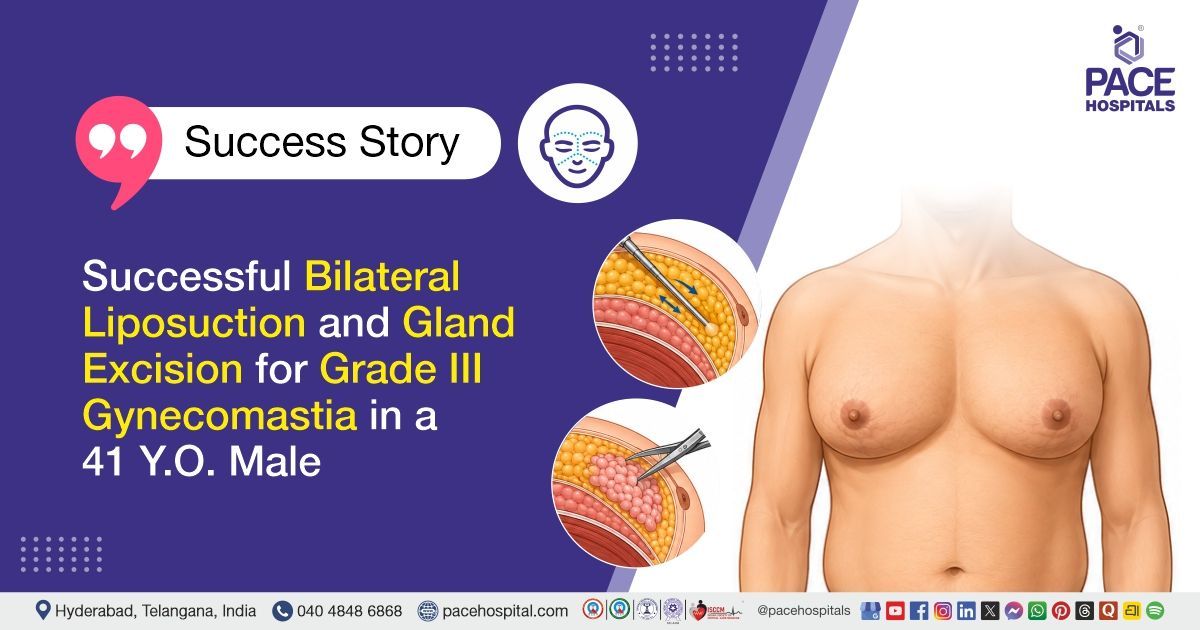
Successful Bilateral Liposuction and Gland Excision for Grade III Gynecomastia in a 41 Y.O. Male
PACE Hospitals
PACE Hospitals' expert Plastic and Reconstructive Surgery team successfully performed bilateral liposuction and gland excision on a 41-year-old male patient diagnosed with bilateral Grade III gynecomastia. The procedure aimed to remove excess glandular and fatty tissue, restore a flatter, more masculine chest contour, and improve the patient's physical comfort and self-confidence.
Chief Complaints
A 41-year-old male patient with a body mass index (BMI) of 21 presented to the Plastic and Reconstructive Surgery Department at PACE Hospitals, Hitech City, Hyderabad, with a history of bilateral breast enlargement for the past 7–8 years. The enlargement had gradually progressed over time, prompting the patient to seek medical evaluation and surgical management.
Past Medical History
The patient had a history of gender dysphoria and previous therapy, which was discontinued 2 months before surgery. The patient had also undergone orchiectomy, penectomy with
urethroplasty, and
rhinoplasty. There were no other known medical illnesses or drug allergies.
On Examination
On admission, the patient was conscious, coherent, and cooperative. General physical examination revealed no pallor, icterus, cyanosis, lymphadenopathy, clubbing, or pedal edema. The patient's vital signs were stable, and no other significant systemic abnormalities were noted.
Diagnosis
Upon admission to PACE Hospitals, the patient underwent a comprehensive evaluation by the Plastic and Reconstructive Surgery team, including a detailed review of the medical history and a thorough clinical examination to assess the severity of the bilateral breast enlargement.
Following clinical assessment and appropriate preoperative evaluation, the patient was diagnosed with bilateral Grade III gynecomastia. The diagnosis was based on the patient's long-standing, progressively enlarging bilateral breast tissue and clinical findings consistent with advanced gynecomastia.
Based on the confirmed diagnosis, the patient was advised to undergo
Bilateral
Gynecomastia Grade III Treatment in Hyderabad, India, to remove excess glandular and fatty tissue, restore a flatter and more masculine chest contour, and improve physical comfort and aesthetic appearance.
Medical Decision Making (MDM)
After a thorough evaluation by Dr. Kantamneni Lakshmi (Senior Consultant Plastic, Reconstructive & Aesthetic Surgeon), a comprehensive assessment was carried out to determine the most appropriate management plan for the patient diagnosed with bilateral gynecomastia.
Based on the clinical findings of long-standing progressive bilateral breast enlargement involving both glandular and fatty components, it was determined that bilateral liposuction with gland excision under general anaesthesia was the most appropriate treatment approach. This decision was made after careful evaluation of the extent of tissue hypertrophy, exclusion of secondary causes through multidisciplinary assessment, and the need for effective contour correction and symptomatic improvement.
The patient and his family members were counselled regarding the condition, the need for surgical management, associated risks and benefits, and the importance of postoperative care, including wound care, use of compression garments, activity restriction, medication adherence, and regular follow-ups.
Surgical Procedure
Following the diagnosis, the patient was scheduled to undergo a Bilateral Liposuction Surgery in Hyderabad at PACE Hospitals, along with Gland Excision under the supervision of the expert Plastic and Reconstructive Surgery team.
The surgical procedure involved the following steps:
- Anaesthesia and Patient Preparation: The patient was prepared for surgery under general anaesthesia. Under strict aseptic precautions, the operative field was painted and draped in a sterile manner.
- Incision and Tumescent Infiltration: A 5 mm incision was made in the anterior axillary fold bilaterally. A total of 750 ml of tumescent fluid was infiltrated bilaterally.
- Liposuction Procedure: Liposuction was performed bilaterally, and approximately 400 ml of aspirate was removed from each side to reduce the fatty component of the breast tissue.
- Gland Excision and Contouring: An inferior periareolar incision was made bilaterally, and the glandular breast tissue was excised. Superior periareolar mastopexy was performed to achieve proper contour and chest symmetry.
- Haemostasis and Wound Closure: Haemostasis was secured. The wound was closed in layers using 3-0 Vicryl and 3-0 Monocryl sutures. An aseptic dressing was applied, and a compression garment was placed to support healing and contour maintenance.
Postoperative Care
The patient was managed postoperatively with intravenous fluids to maintain hydration and physiological stability, infection prevention, postoperative pain management, and gastric protection during the hospital stay. The postoperative period remained uneventful without any complications, and the patient demonstrated satisfactory recovery with stable vital signs and healthy wound status. The histopathology showed benign breast tissue changes with fibro-fatty tissue and no malignancy, confirming bilateral gynecomastia. The patient was subsequently discharged in stable condition with advice for routine follow-up and proper wound care.
Discharge Medications
Upon discharge, the patient was prescribed medications for the prevention of postoperative wound infection, local wound care to promote healing, gastric protection to prevent medication-induced stomach irritation, pain relief for postoperative discomfort, nutritional supplementation to support recovery, prevention of postoperative thromboembolic complications, and additional rescue pain relief as needed.
Advice on Discharge
The patient was advised to follow a high-protein diet, maintain proper wound care, avoid excessive shoulder and chest movements, and refrain from heavy exercises for 6 weeks. He was also instructed to continue using a compression garment for 6 weeks to support healing and contour maintenance.
Emergency Care
The patient was advised to contact the
emergency ward at PACE Hospitals in case of any emergency or development of symptoms such as fever, increased pain or swelling at the surgical sites, wound discharge, bleeding, or any signs of infection.
Review and Follow-up Notes
The patient was advised to return for a follow-up consultation with the
Consultant Plastic, Reconstructive & Aesthetic Surgeon in Hyderabad at PACE Hospitals after 2 days for dressing.
Conclusion
This case highlights the successful surgical management of bilateral Grade III gynecomastia using liposuction and gland excision with satisfactory aesthetic and functional outcomes. The postoperative course was uneventful with stable recovery and no complications. The patient was discharged in stable condition with appropriate follow-up and postoperative care advice.
Comprehensive Approach to Gynecomastia Management and Outcomes
Gynecomastia management requires a systematic and stepwise evaluation to identify underlying causes and exclude secondary etiologies, often involving a multidisciplinary approach to ensure safe and appropriate treatment planning. Management is individualized based on the severity and composition of breast enlargement, as well as patient-specific factors.
When surgical intervention is indicated, meticulous operative technique is essential to achieve optimal chest contour, symmetry, and aesthetic outcome while minimizing complications under the care of a Plastic Surgeon / Plastic Surgery Doctor. Careful attention to hemostasis and tissue handling further supports smooth recovery. Postoperative care, including compression support and activity modification, plays a crucial role in healing and maintaining results. Overall, successful outcomes depend on accurate assessment, individualized treatment, and consistent follow-up.
Frequently Asked Questions (FAQs)
Is surgery necessary for Grade III gynecomastia?
In Grade III gynecomastia, the breast enlargement is usually more prominent and may also involve excess fat, gland tissue and skin laxity. Medicines or lifestyle changes usually do not fully correct long-standing Grade III gynecomastia. Surgery is commonly advised when the enlargement is persistent, progressive, cosmetically concerning or causing discomfort. In this case, surgical correction helped remove both fat and gland tissue.
Why were both liposuction and gland excision done together?
Liposuction helps remove excess fatty tissue from the chest, while gland excision removes the firm breast gland tissue that cannot be removed properly with liposuction alone. In Grade III gynecomastia, both components are often present. Combining both techniques gives a flatter, more natural chest contour and reduces the chance of residual gland prominence.
What does gland excision mean in gynecomastia surgery?
Gland excision means surgically removing the enlarged breast gland tissue, usually through a small cut near the areola. This is an important step when the chest has firm tissue under the nipple area. Removing the gland helps correct puffiness and improve chest shape. The removed tissue may also be sent for histopathology testing to confirm it is benign.
Why is a compression garment needed after gynecomastia surgery?
A compression garment helps reduce swelling, supports the operated chest area and helps the skin settle properly over the new chest contour. It also reduces fluid collection risk and improves healing comfort. In this case, the patient was advised to continue the compression garment for 6 weeks. Wearing it regularly is important for better cosmetic results.
What is periareolar mastopexy in gynecomastia surgery?
Periareolar mastopexy is a tightening procedure done around the areola to improve nipple and skin position. In Grade III gynecomastia, the skin may become loose due to long-standing enlargement. This technique helps reshape the chest and gives a better final appearance. It is commonly used when skin tightening is required along with gland removal.
Can gynecomastia come back after surgery?
Gynecomastia recurrence is uncommon if the gland tissue is adequately removed and the underlying cause is controlled. However, recurrence can happen if there is weight gain, hormonal imbalance, anabolic steroid use or certain medications. In patients with a history of hormonal therapy, proper endocrine evaluation before surgery is important. Regular follow-up helps monitor healing and long-term results.
How long does recovery take after Grade III gynecomastia surgery?
Most patients can return to light daily activities within a few days, depending on pain, swelling and surgeon advice. Chest tightness, mild bruising and swelling are common in the early recovery period. Heavy exercise, gym workouts and excessive shoulder or chest movements are usually avoided for about 6 weeks. Final chest shape improves gradually as swelling comes down.
Will there be visible scars after gynecomastia surgery?
Small scars can occur near the areola and at liposuction entry points, but they usually become less noticeable over time. The periareolar incision is placed around the natural border of the areola, which helps the scar blend better. Scar healing depends on skin type, wound care and follow-up. Proper dressing care and avoiding strain help improve scar appearance.
When should a patient seek urgent care after gynecomastia surgery?
A patient should contact the hospital urgently if there is fever, increasing pain, sudden swelling, bleeding, foul-smelling discharge, breathing difficulty or repeated vomiting. Mild swelling and discomfort can be normal, but worsening symptoms need medical attention. Follow-up visits are also important for dressing changes, wound checks, and recovery guidance. Early review helps prevent complications.
What activity restrictions are needed after gynecomastia surgery?
The patient should avoid excessive shoulder and chest movements during the early recovery period. Heavy exercises and strenuous activities should be avoided for around 6 weeks or as advised by the surgeon.
Share on
Request an appointment
Fill in the appointment form or call us instantly to book a confirmed appointment with our super specialist at 04048486868
Appointment request - health articles
Recent Articles