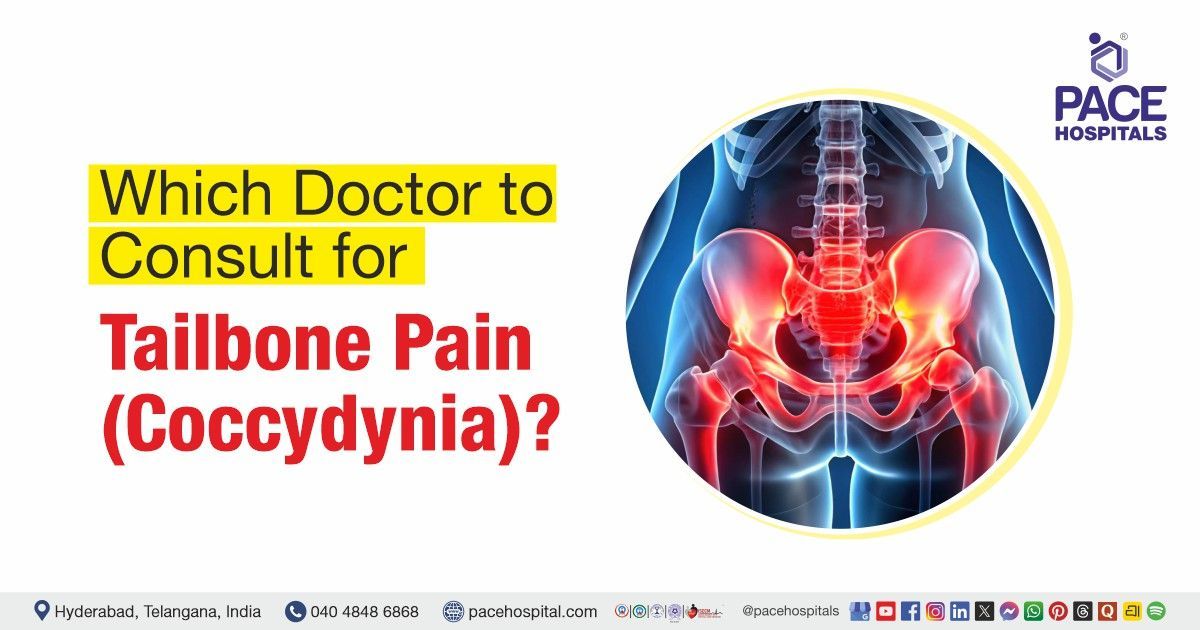
Which Doctor to Consult for Tailbone Pain (Coccydynia)?
PACE Hospitals
Written by: Editorial Team
Medically reviewed by: Dr. Raghuram - Orthopaedic Consultant, Trauma, Shoulder and Knee Arthroscopic Surgeon, Hip and Knee Joint Replacement Specialist
Introduction
Tailbone pain — medically called coccydynia — is more common than most people realise. It can appear after a fall, during or after pregnancy, after prolonged sitting, or even without an obvious cause. The pain sits right at the bottom of the spine, making everyday activities like sitting, driving, or bending extremely uncomfortable.
Most patients who experience tailbone pain are unsure which doctor to approach first. Should they see a general physician, an orthopaedic surgeon, or a spine specialist? Can a physiotherapist help? Is surgery ever needed?
This complete guide answers all those questions clearly. It explains which specialist to consult for each type of tailbone pain, when to seek urgent care, what tests doctors order, and what treatment options are available at PACE Hospitals, Hyderabad.
Quick Answer
For tailbone pain or coccydynia, consult an Orthopaedic doctor or Spine specialist, especially if pain continues after a fall, worsens while sitting, persists for more than a few days or weeks, or affects normal daily routine activities. A Physiotherapist may help after diagnosis with posture and sitting modifications. If there is pus, swelling, fever, or a painful lump near the tailbone, a General Surgeon may be needed to rule out pilonidal sinus or abscess.
What Is Tailbone Pain or Coccydynia?
The coccyx is the small triangular bone at the very base of the spine. It is commonly called the tailbone. Coccydynia refers to persistent pain in and around this region.
The coccyx consists of three to five fused vertebral segments. Although small, it plays an important role in weight distribution while sitting and serves as an attachment point for several muscles, tendons, and ligaments of the pelvic floor and lower body.
Pain in this area can range from a dull, constant ache to sharp, stabbing discomfort that worsens with sitting, standing up, or bending forward. It may also worsen during bowel movements.
According to data referenced in clinical literature and scientific observational studies, coccydynia affects women approximately four times more often than men. This is partly because the female pelvis is wider and more exposed during activities like childbirth, making the coccyx more susceptible to injury or displacement.
Coccydynia is not a single condition — it is a symptom with multiple possible causes. That is why an accurate medical evaluation is always the essential first step before any treatment is started.
Tailbone Pain Should Not Be Ignored
Many patients assume tailbone pain will resolve on its own and delay consulting a doctor thinking it's not serious problem. While mild, brief discomfort after a minor bruise may settle with rest, persistent or worsening pain requires medical evaluation.
Untreated coccydynia can significantly affect quality of life. It can interfere with work, sleep, physical activity, and daily comfort. In some cases, pain that appears to be coming from the tailbone may actually have a more serious underlying cause — including a spinal nerve problem, a pelvic floor disorder, an abscess, or rarely, a tumour near the sacrococcygeal region.
Delaying evaluation means delayed diagnosis. Seeking the right specialist early leads to faster relief and prevents unnecessary worsening of the condition.
Doctor Selection Guide
The table below is a practical guide to help patients identify the right specialist based on their specific symptoms or situation.
| Situation | First Doctor to Consult | Specialist Needed If |
|---|---|---|
| Pain after a fall or direct trauma to the tailbone | Orthopaedic Doctor or Spine Specialist | Fracture confirmed, neurological symptoms present, or pain persists beyond 6–8 weeks |
| Persistent pain while sitting or standing up from a seated position | Orthopaedic Doctor or Spine Specialist | Pain unresponsive to conservative care after 4–6 weeks |
| Tailbone pain during or after pregnancy | Gynaecologist first, then Orthopaedic or Physiotherapist | Neurological symptoms, severe pain, or postpartum structural injury |
| Chronic tailbone pain not responding to treatment | Pain Medicine Specialist | Injections, nerve blocks, or radiofrequency procedures needed |
| Swelling, redness, pus, or painful lump near the tailbone | General Surgeon | Pilonidal sinus, abscess, or surgical drainage required |
| Pain with numbness, weakness in legs, or bowel/bladder problems | Emergency Care or Spine Specialist | Spinal cord or nerve root involvement confirmed |
| Pain after diagnosis, needing posture correction and rehabilitation | Physiotherapist or Rehabilitation Specialist | Persistent pelvic floor dysfunction or chronic postural imbalance |
| Pain in tailbone region with unexplained weight loss or cancer history | Orthopaedic or Spine Specialist | Tumour workup required (MRI, biopsy) |
| Pain after spinal surgery | Spine Specialist | Assessment for post-surgical structural changes |
| Fever, chills, and swelling near the tailbone | General Surgeon or Emergency Care | Drainage or infection control required |
When Tailbone Pain Needs Urgent Medical Attention?
Certain symptoms associated with tailbone pain require immediate medical evaluation and should not be waited out at home. These are considered red flags.
Red-Flag Symptoms — Seek Immediate Care If You Have:
- Tailbone pain following a major fall, accident, or high-impact trauma
- Severe pain that makes it completely impossible to sit or walk
- Numbness, tingling, or weakness in the legs, buttocks, or groin
- Loss of bladder or bowel control (inability to hold urine or stools)
- Fever, sweating, or chills along with pain and swelling near the tailbone
- Pus discharge, foul smell, or skin opening near the tailbone or buttock crease
- A painful lump or swelling near the tailbone that is growing or becoming tender
- Rectal bleeding along with tailbone pain
- Unexplained weight loss in addition to tailbone or lower back pain
- Known history of cancer with new onset of tailbone pain
- Severe night pain that does not improve with any position change
- Tailbone pain after childbirth with neurological symptoms such as leg weakness or numbness
If any of these symptoms are present, visit an emergency department or call your hospital's emergency helpline without delay.
When to See an Orthopaedic Doctor or Spine Specialist?
An Orthopaedic Doctor or Spine Specialist is the primary and most appropriate specialist for the majority of tailbone pain presentations.
You Should See an Orthopaedic or Spine Specialist When:
- Pain in the tailbone area began after a fall, slip, or direct blow to the base of the spine
- The pain has been present for more than a few days and is not improving
- Pain worsens consistently while sitting, especially on hard surfaces
- You feel sharp pain when rising from a seated position
- You have coccyx tenderness on touch or when pressure is applied
- You suspect a coccyx fracture, dislocation, or hypermobility of the sacrococcygeal joint
- You have lower back pain that extends to the tailbone region
- You have had a previous spinal surgery and now experience new tailbone discomfort
- Pain is affecting your work, sleep, or quality of life without a clear improving trend
An Orthopaedic or Spine Specialist will take a full clinical history, perform a physical examination, and order imaging studies (X-ray or MRI) as needed to confirm the diagnosis and rule out structural problems or nerve involvement.
At PACE Hospitals, Hyderabad, the Orthopaedic and Spine department is equipped to evaluate and manage all forms of coccydynia — from post-traumatic coccyx fractures to chronic idiopathic tailbone pain.
When to See a Pain Medicine Specialist?
Some patients with coccydynia do not respond adequately to conservative management, including rest, sitting modifications, anti-inflammatory medications, and physiotherapy. In such cases — particularly when pain has persisted for more than three to six months — a Pain Medicine Specialist becomes a valuable addition to the care team.
A Pain Medicine Specialist Can Offer:
- Corticosteroid injections into the sacrococcygeal joint to reduce inflammation and provide pain relief
- Ganglion impar block — a nerve block targeting the ganglion impar, a nerve cluster near the coccyx responsible for pelvic and perineal pain
- Caudal epidural block for more widespread sacral pain
- Pulsed Radiofrequency (PRF) therapy targeting the sacral nerve roots or ganglion impar
- Neurolysis procedures for refractory cases
Clinical evidence shows that corticosteroid injections into the sacrococcygeal joint or the ganglion impar can provide significant and sometimes long-lasting relief in carefully selected patients. A Pain Medicine Specialist works in close coordination with the treating Orthopaedic or Spine Specialist to ensure that interventional procedures are used appropriately and safely.
When Women Should See a Gynaecologist?
In women, tailbone pain can sometimes overlap with pelvic pain conditions or may arise during or after pregnancy. A Gynaecologist should be involved in certain specific situations.
See a Gynaecologist When:
- Tailbone pain began during pregnancy or worsened progressively as the pregnancy advanced
- You are experiencing postpartum tailbone pain — pain that began after a difficult or prolonged vaginal delivery, particularly if instruments were used (forceps or vacuum)
- Tailbone pain is associated with pelvic floor dysfunction, heavy periods, or pelvic pressure
- There is uncertainty about whether pain is coming from the coccyx, uterus, rectum, or pelvic structures
- Tailbone pain is associated with pain during intercourse (dyspareunia) that may suggest pelvic floor involvement
During vaginal delivery, the coccyx can be temporarily displaced or fractured under the pressure of the baby's head passing through the birth canal. This is a recognised, though uncommon, cause of postpartum tailbone pain. After evaluation by a Gynaecologist, many such patients are referred to an Orthopaedic Specialist or Physiotherapist for further management.
When to See a General Surgeon?
Not all tailbone-region pain comes from the coccyx itself. Some patients have conditions that mimic tailbone pain but require surgical evaluation and management.
See a General Surgeon When:
- There is a painful lump, swelling, or nodule near the tailbone or in the buttock crease
- You notice pus, foul-smelling discharge, or bleeding from a skin opening near the tailbone
- The area is red, warm, swollen, and tender — suggesting infection or abscess
- You have been told or suspect you may have a pilonidal sinus or pilonidal abscess
- There is a recurring infection or skin breakdown in the same area despite antibiotic treatment
- You have fever along with localised pain and swelling near the tailbone
A General Surgeon will evaluate the area for pilonidal disease, perianal abscess, sacrococcygeal tumours, or other surgical conditions. Drainage of an abscess or excision of a pilonidal sinus is a surgical procedure that an Orthopaedic Specialist cannot manage — a General Surgeon is the correct specialist in these situations.
Tailbone Pain After a Fall or Injury
A backward fall onto a hard surface — such as falling off a chair, slipping on a wet floor, or landing on a staircase — is one of the most common causes of acute tailbone pain. Sports injuries, cycling accidents, and road traffic accidents can also result in coccyx injury.
After a fall, the coccyx may be bruised, partially displaced, or fractured. A coccyx fracture is typically managed conservatively — with rest, a coccyx cushion, pain management, and avoiding prolonged sitting — in approximately 90% of cases.
An Orthopaedic Doctor should be consulted promptly after a significant fall to:
- Assess the severity of the injury
- Order imaging (X-ray or MRI) to confirm or rule out fracture
- Rule out neurological injury affecting the sacral nerves
- Guide pain management and suggest for activity modification
- Advise on recovery timeline and return to normal activities
Do not attempt exercises, stretching, or physiotherapy on your own after a fall until a fracture or structural injury has been formally excluded by a doctor.
Tailbone Pain While Sitting
Pain that worsens specifically when seated and improves somewhat when standing or walking is a hallmark feature of coccydynia. Some patients often describe finding relief by leaning forward slightly on a firm surface or sitting on the edge of a chair to shift weight away from the coccyx part of the body.
While prolonged or repetitive sitting is a recognised aggravating factor, not all sitting-related tailbone pain is purely postural. In some patients, the coccyx has an abnormal degree of mobility (hypermobility) at the sacrococcygeal joint, causing pain when the bone shifts position under body weight during sitting.
Other patients may have degenerative changes, scar tissue from an old injury, or calcified spurs on the coccyx that cause pain on pressure.
An Orthopaedic Specialist or Spine Specialist will assess sitting-related tailbone pain using clinical examination and, if needed, weight-bearing X-rays in both standing and sitting positions to detect dynamic instability of the sacrococcygeal joint.
A Physiotherapist can later guide the patient on ergonomic adjustments, coccyx cushion use, and posture correction — but only after the structural evaluation is complete.
Tailbone Pain After Delivery
Postpartum tailbone pain is a real and often underreported condition. It affects a major proportion of women following vaginal delivery, particularly after prolonged labour, large babies, instrumental deliveries (forceps or vacuum), or labour in unusual positions.
During delivery, the coccyx can be pushed backward to allow the baby's head to pass through the birth canal. In most cases, it returns to its normal position. But in some women, the coccyx remains slightly displaced or is fractured, leading to excessive and persistent postpartum pain.
Symptoms related with tailbone pain after delivery include pain at the base of the spine that worsens when sitting, breastfeeding in certain positions, getting up from a chair, or walking. Some women also experience discomfort during bowel movements.
What to Do:
- Consult your Gynaecologist at the postpartum visit if tailbone pain persists beyond two to four weeks
- Your Gynaecologist may refer you to an Orthopaedic or Spine Specialist for imaging and structural evaluation
- A Physiotherapist specialising in pelvic floor rehabilitation may also be part of the care team
If postpartum tailbone pain is accompanied by leg numbness, weakness, or difficulty with bladder or bowel control, this should be treated as an urgent situation requiring immediate specialist evaluation.
Tailbone Pain with Swelling or Pus
When tailbone region pain is associated with visible swelling, redness, a palpable lump, skin opening, pus discharge, or foul smell — this is NOT coccydynia in the usual sense. These features suggest a different diagnosis entirely.
The most likely possibilities include:
- Pilonidal sinus — a chronic tract or cavity under the skin near the tailbone, often containing hair and debris, prone to repeated infection
- Pilonidal abscess — an acute, painful collection of pus in the pilonidal region requiring surgical drainage
- Perianal or sacrococcygeal abscess — an infection near the rectum or in the tissue over the coccyx
- Infected sebaceous cyst in the gluteal region
A General Surgeon is the appropriate specialist in all these situations. Antibiotics alone are usually insufficient for a formed abscess — surgical drainage is typically required, and this must be performed by a surgeon.
Do not apply home remedies, squeeze the area, or delay evaluation if pus or fever is present. These conditions can worsen rapidly if not treated promptly and correctly.
Tailbone Pain vs Lower Back Pain
Patients often confuse tailbone pain with lower back pain or lumbar spine problems. Understanding the difference helps identify the right specialist faster and take correct decision sooner.
| Feature | Tailbone Pain (Coccydynia) | Lower Back Pain (Lumbar) |
|---|---|---|
| Location of pain | Base of the spine, between the buttocks | Middle or lower back, above the buttocks |
| Aggravating position | Sitting, rising from sitting | Bending, lifting, twisting |
| Radiation | Usually localised; rarely radiates | May radiate to legs (sciatica) |
| Tenderness on touch | Present directly over the coccyx | Present over the lumbar spine/muscles |
| Common causes | Fall, childbirth, prolonged sitting | Disc prolapse, muscle strain, arthritis |
| Neurological symptoms | Rare unless severe injury | More common (leg pain, weakness) |
| Relevant specialist | Orthopaedic/Spine Specialist | Orthopaedic/Spine/Neurologist |
Both conditions can sometimes coexist, and pain referred from the lumbar spine can occasionally be perceived near the tailbone region. An Orthopaedic Spine Specialist can evaluate both regions and determine the true source of pain through clinical examination and imaging.
Tailbone Pain vs Pilonidal Sinus
This is a common source of confusion among patients, since both conditions cause pain near the tailbone. However, they are entirely different conditions requiring different specialists.
| Feature | Tailbone Pain / Coccydynia | Pilonidal Sinus |
|---|---|---|
| Nature of pain | Deep bone-level or joint pain | Superficial skin-level pain and swelling |
| Visible skin changes | None | Redness, lump, skin opening, pus |
| Discharge | None | Pus, blood, foul-smelling fluid |
| Fever | Rare (unless infection develops) | Common during abscess phase |
| Aggravated by | Sitting, rising from sitting | Pressure, movement, hair growth |
| Relevant specialist | Orthopaedic / Spine Specialist | General Surgeon |
| Treatment | Conservative or injection; surgery rarely | Incision and drainage, excision of sinus tract |
If there is any doubt about the diagnosis, a clinical examination by a doctor will clarify the source of pain. Self-diagnosis based on symptoms alone is not recommended.
Chronic Coccydynia
Coccydynia is considered as chronic condition when pain persists for more than three months despite initial conservative treatment. Chronic coccydynia can significantly affect quality of life, mental health, work performance, and sleep.
Common Causes of Chronic Coccydynia Include:
- Unresolved post-traumatic displacement of the coccyx
- Sacrococcygeal joint hypermobility or instability
- Degenerative changes and calcification at the sacrococcygeal joint
- Chronic inflammation of the surrounding soft tissues
- Psychological factors, including central sensitisation
- Failed healing of an old coccyx fracture
- Post-surgical pain following lumbar spinal procedures
Management of Chronic Coccydynia:
Chronic coccydynia often requires a multidisciplinary approach involving:
- Orthopaedic or Spine Specialist — for ongoing structural evaluation and monitoring
- Pain Medicine Specialist — for interventional procedures including ganglion impar block, corticosteroid injections, or pulsed radiofrequency therapy
- Physiotherapist — for long-term posture, pelvic floor, and mobility management
- Psychological support — where central sensitisation or chronic pain behaviour is contributing
Surgery (coccygectomy — removal of the coccyx) is considered only in carefully selected patients with confirmed structural pathology who have failed at least six months of conservative and interventional treatment. When appropriately performed and in well-selected patients, coccygectomy has shown satisfactory outcomes in clinical studies.
Conditions and Causes of Tailbone Pain and Which Doctor or Specialist to Consult?
| Condition / Cause | Common Features | Doctor / Specialist to Consult | Why? |
|---|---|---|---|
| Post-traumatic coccyx fracture or bruise | Sudden onset after fall, localised tenderness, pain on sitting | Orthopaedic / Spine Specialist | To confirm fracture via imaging and guide recovery |
| Coccyx hypermobility or instability | Sitting pain, pain on rising, dynamic coccyx movement | Orthopaedic / Spine Specialist | Needs weight-bearing X-ray assessment and management planning |
| Chronic idiopathic coccydynia | Persistent sitting pain without clear trauma, no skin changes | Orthopaedic / Spine Specialist + Pain Medicine | Needs structural and interventional evaluation |
| Postpartum coccyx injury | Onset after vaginal delivery, pain while sitting and feeding | Gynaecologist → Orthopaedic / Physiotherapist | To assess pelvic and structural changes post-delivery |
| Pilonidal sinus or abscess | Skin lump, pus, redness, smell, fever near tailbone | General Surgeon | Requires drainage, excision, and infection management |
| Lumbar disc disease with referred pain | Lower back pain extending toward coccyx, possible leg radiation | Orthopaedic / Spine Specialist | To differentiate lumbar vs coccyx origin of pain |
| Sacrococcygeal tumour (rare) | Night pain, unexplained weight loss, cancer history | Orthopaedic / Spine Specialist | MRI and biopsy for exclusion of malignancy |
| Pelvic floor dysfunction | Pelvic pressure, pain with intercourse, associated with coccydynia | Gynaecologist + Physiotherapist | Pelvic floor assessment and rehabilitation needed |
| Sacral nerve root irritation | Coccyx pain with leg numbness, weakness, or bowel/bladder symptoms | Spine Specialist / Neurosurgeon | Urgent neurological evaluation required |
| Prolonged sitting (occupational overload) | Gradual onset in office workers, cyclists, truck drivers | Orthopaedic / Spine Specialist → Physiotherapist | To rule out structural pathology before ergonomic management |
Tests Doctors May Recommend
After a clinical history and physical examination, the doctor may order one or more investigations to confirm the diagnosis and guide treatment.
Imaging Studies:
- X-ray of the Coccyx (Lateral View): Usually the first test ordered. Identifies obvious fractures, dislocations, or calcification. Standing and sitting X-rays are sometimes taken together (dynamic X-rays) to detect coccyx hypermobility.
- MRI of the Sacrum and Coccyx: Recommended when there is suspicion of soft tissue injury, tumour, infection, or when neurological symptoms are present. MRI provides excellent detail of the discs, nerve roots, and surrounding structures.
- CT Scan of the Pelvis / Coccyx: Used when more detailed bony anatomy is needed, especially before surgical planning.
- Ultrasound: Occasionally used to evaluate soft tissue swellings near the tailbone (e.g., cysts or abscesses).
Other Tests:
- Blood Tests (CBC, CRP, ESR): Ordered when infection, inflammation, or systemic disease is suspected.
- Rectal / Pelvic Examination: The doctor may perform a gentle internal examination to assess coccyx mobility, localise tenderness, and rule out other pelvic causes of pain. This is standard practice in specialist coccyx assessment.
- Diagnostic Local Anaesthetic Injection: In some cases, injecting a small amount of local anaesthetic into the sacrococcygeal joint confirms whether the coccyx is truly the source of pain (if pain resolves temporarily with the injection, it confirms the diagnosis).
- Bone Scan (rarely): Considered in complex or atypical cases where tumour or metabolic bone disease needs to be excluded.
Treatment Options for Tailbone Pain
Treatment for coccydynia depends on the cause, severity, duration of pain, and the patient's overall health. Most patients — especially those with post-traumatic or acute coccydynia — respond well to conservative management.
Conservative (Non-Surgical) Treatment:
- Coccyx Cushion (Donut or Wedge Cushion): Reduces direct pressure on the coccyx while sitting. Recommended for most patients as an immediate comfort measure.
- Activity Modification: Avoiding prolonged sitting, hard surfaces, cycling, and activities that load the tailbone. Standing breaks during desk work.
- Pain Management: Short-term use of anti-inflammatory medications (NSAIDs) or analgesics as prescribed by the treating doctor. Long-term use without medical supervision is not recommended.
- Application of Ice or Heat: Ice packs in the first 48–72 hours after an acute injury; heat packs for longer-term muscle relaxation. Each application for 20–30 minutes.
- Physiotherapy: Posture correction, pelvic floor coordination exercises, manual therapy, and sitting modification guidance — after structural assessment has been completed.
- Stool Softeners: If pain worsens during bowel movements, a doctor or pharmacist may advise a short course of stool softeners to reduce straining.
Interventional (Non-Surgical) Treatment:
- Corticosteroid and Local Anaesthetic Injection: It is injected into the sacrococcygeal joint under imaging guidance. This mode of treatment is effective for moderate-to-severe coccydynia that has not responded to conservative care.
- Ganglion Impar Block: A nerve block targeting the sympathetic ganglion near the coccyx. Particularly useful for chronic, refractory coccydynia with a neuropathic component.
- Caudal Epidural Block: For patients with sacral nerve involvement contributing to pain.
- Pulsed Radiofrequency (PRF) Therapy: Applied to the sacral nerve roots or ganglion impar to modulate chronic pain signals. Used for carefully selected cases.
- Intra-Rectal Manipulation: Performed by a specialist — gentle manipulation of the coccyx through the rectum under anaesthesia. Used in selected cases of coccyx hypermobility or post-traumatic displacement.
Surgical Treatment:
- Coccygectomy (Removal of the Coccyx): This is reserved for patients with confirmed structural coccyx pathology who have failed at least six months of conservative and interventional treatment. The surgical procedure involves partial or total removal of the coccyx. Different observational clinical studies show satisfactory outcomes in well-selected patients, with most reporting significant pain relief.
All treatment decisions should be made by a qualified specialist after thorough evaluation. Self-medicating, self-manipulating, or attempting home exercises without a diagnosis is not advisable.
Specialists at PACE Hospitals, Hyderabad
PACE Hospitals, Hyderabad, has a dedicated Orthopaedic and Spine department with experienced specialists who manage the full spectrum of coccyx and spine conditions — from acute tailbone injuries to chronic coccydynia requiring interventional procedures.
The department at PACE Hospitals provides:
- Expert Orthopaedic and Spine Consultation for coccyx pain evaluation
- Advanced Imaging including X-ray, MRI, and CT for accurate diagnosis
- Guided Interventional Procedures — corticosteroid injections, nerve blocks, and radiofrequency therapy
- Physiotherapy and Rehabilitation Services — tailored programmes for coccydynia recovery
- General Surgical Services — for pilonidal sinus, abscess drainage, and related conditions
- Emergency and Trauma Care — for acute coccyx injuries following falls or accidents
- Gynaecology Services — for postpartum tailbone pain and pelvic floor-related concerns
- Pain Medicine Services — for chronic and refractory coccydynia
The multidisciplinary structure at PACE Hospitals ensures that patients with tailbone pain receive a comprehensive, coordinated evaluation and are directed to the most appropriate specialist from their very first appointment.
Why Choose PACE Hospitals, Hyderabad, India?
PACE Hospitals, Hyderabad, is a leading tertiary care hospital known for its patient-centred approach, advanced diagnostic infrastructure, and experienced team of clinical specialists.
Reasons patients choose PACE Hospitals for tailbone pain and coccydynia:
- Highly experienced Orthopaedic and Spine Specialists with expertise in coccyx conditions, spinal fractures, and chronic spine pain
- Advanced Imaging Services with digital X-ray, high-field MRI, and CT available under one roof for prompt diagnosis
- Multidisciplinary Team — Orthopaedics, Spine Surgery, Physiotherapy, Pain Medicine, Gynaecology, and General Surgery — all in one hospital
- State-of-the-Art Operation Theatres for spine and orthopaedic procedures when required, Critical Care Unit for patients needing intensive monitoring or support
- Dedicated Physiotherapy and Rehabilitation Unit with specialists trained in coccydynia and pelvic rehabilitation
- Convenient Location in Hyderabad with easy access and online appointment booking
- Transparent, Well-coordinated Patient-Friendly Care with clear communication and active patient involvement in treatment decisions
- Emergency Orthopaedic Care available for acute coccyx injuries and trauma
Key Takeaway
- For most cases of tailbone pain, an Orthopaedic Doctor or Spine Specialist is the right first specialist.
- If pain follows a fall or trauma, see an Orthopaedic Specialist promptly to rule out fracture.
- If you are a woman with postpartum tailbone pain, start with your Gynaecologist, who may refer to Orthopaedics or Physiotherapy.
- If pain persists for more than a few weeks despite rest, see a specialist — do not wait.
- A Physiotherapist can assist with recovery after a diagnosis is confirmed — not before.
- If there is swelling, pus, or a lump near the tailbone, see a General Surgeon to rule out pilonidal disease.
- For chronic, resistant coccydynia, a Pain Medicine Specialist may offer injections or nerve block procedures.
- Red-flag symptoms — leg weakness, bowel/bladder loss, severe fever, or post-trauma severe pain — require immediate emergency care.
- Do not self-medicate or attempt exercises before getting a proper diagnosis.
Frequently Asked Questions (FAQs)
Which doctor should I consult for tailbone pain?
For tailbone pain, the most appropriate first specialist is an Orthopaedic Doctor or Spine Specialist. They can evaluate the coccyx through clinical examination and imaging, confirm the cause of pain — whether it is a fracture, displacement, joint instability, or another condition — and guide treatment. If pain is associated with pregnancy or childbirth, a Gynaecologist may also be involved. For pain with swelling, pus, or fever near the tailbone, a General Surgeon is the right specialist. Always consult a doctor before attempting home treatments, as the cause of tailbone pain needs to be identified first.
Can a fall cause tailbone pain?
Yes, a fall — especially a backward fall onto a hard surface — is one of the most common causes of tailbone pain. The impact can bruise, displace, or fracture the coccyx. After a significant fall, pain typically begins immediately or within a few hours and worsens on sitting, standing up, or pressing on the area. An Orthopaedic Specialist should be consulted promptly. Imaging (X-ray or MRI) will confirm whether the coccyx is fractured or displaced. Most post-fall coccyx injuries are managed conservatively, but a doctor must assess severity before recommending treatment or activity.
Can childbirth cause tailbone pain?
Yes, childbirth — particularly difficult or prolonged vaginal delivery — can cause tailbone pain. During delivery, the baby's head puts pressure on the coccyx, which may push it backward temporarily or, in some cases, fracture or permanently displace it. Postpartum tailbone pain is more common after instrumental deliveries using forceps or vacuum. Symptoms include pain while sitting, breastfeeding in certain positions, or during bowel movements. Women with postpartum tailbone pain should discuss this with their Gynaecologist, who may refer them to an Orthopaedic Specialist or Physiotherapist. If neurological symptoms are present, urgent evaluation is necessary.
What is the difference between tailbone pain and pilonidal sinus?
Tailbone pain (coccydynia) and pilonidal sinus are different conditions that both cause pain near the base of the spine. Coccydynia is a deep, bone-level pain inside the coccyx — worsened by sitting, with no skin changes, no discharge, and no visible lump. Pilonidal sinus is a skin-level condition — a tract or cavity near the tailbone crease that becomes infected, causing a visible lump, pus, redness, foul smell, and fever. Coccydynia is managed by an Orthopaedic Specialist, while pilonidal sinus requires a General Surgeon. A doctor's examination will distinguish between the two, as self-diagnosis can lead to delayed and incorrect treatment.
When is tailbone pain serious?
Tailbone pain becomes serious and needs urgent medical attention when it is accompanied by signs observed by an individual with loss of bladder or bowel control, leg weakness or numbness, inability to sit or walk, fever with swelling or pus near the tailbone, rectal bleeding, unexplained weight loss, or pain following a significant accident or trauma. A history of cancer with new tailbone pain also warrants urgent evaluation to rule out metastatic disease. Severe night pain that does not respond to position changes is another warning sign. If any of these features are present, visit an emergency department immediately and do not wait for a routine appointment.
Can tailbone pain be treated without surgery?
Yes, the majority of patients with tailbone pain are successfully treated without surgery. Conservative treatment — including a coccyx cushion, activity modification, short-term anti-inflammatory medications as prescribed, physiotherapy, and posture correction — is effective for most cases. Corticosteroid injections into the sacrococcygeal joint or ganglion impar blocks are used when conservative measures are insufficient. Surgery (coccygectomy) is reserved only for carefully selected patients with confirmed structural coccyx pathology who have failed at least six months of non-surgical treatment. All treatment decisions must be guided by a qualified specialist.
Which is the best hospital for tailbone pain treatment in Hyderabad, India?
PACE Hospitals, Hyderabad, is a trusted destination for tailbone pain treatment, offering a complete, comprehensive, multidisciplinary approach to coccydynia and related conditions. The hospital provides expert Orthopaedic and Spine consultation, advanced imaging (digital X-ray, MRI, CT Scans), guided interventional procedures, dedicated physiotherapy and rehabilitation, and General Surgery for pilonidal sinus and abscess. Emergency care is also available for acute coccyx injuries. Patients benefit from a coordinated team of experienced specialists under one roof, with transparent communication and patient-centred care. To book an appointment, call 040-4848-6868 or visit the online booking platform.
Which doctor treats coccydynia?
Coccydynia — the medical term for tailbone pain — is primarily treated by an Orthopaedic Doctor or Spine Specialist. A Physiotherapist assists with posture correction and rehabilitation after diagnosis. A Pain Medicine Specialist is involved when conservative treatment fails and injections or nerve blocks are needed. In postpartum cases, a Gynaecologist coordinates care. When a pilonidal sinus, abscess, or skin infection is identified near the tailbone, a General Surgeon manages those conditions. Coccydynia often requires a team approach, and PACE Hospitals, Hyderabad, provides all these specialists under one roof.
Should I see an orthopaedic doctor for tailbone pain?
Yes, an Orthopaedic Doctor is the most appropriate specialist for tailbone pain in most situations. They are trained to assess the bony and joint structures of the spine and pelvis, diagnose coccyx fractures or displacement, interpret imaging reports, and guide conservative method of treatment or surgical management, prioritising the patient's well-being. An Orthopaedic Spine Specialist is especially recommended when pain follows a fall, persists beyond a few days, worsens on sitting, or is associated with lower back symptoms. If nerve symptoms such as leg weakness or numbness are present, the Orthopaedic Specialist may also coordinate with a Neurosurgeon or Neurologist.
When should I see a spine specialist for tailbone pain?
See a Spine Specialist if your tailbone pain is accompanied by radiating pain into the legs or buttocks, numbness or tingling in the lower limbs, bowel or bladder changes, or if a previous lumbar spine condition may be contributing to the tailbone pain. A Spine Specialist is also appropriate when imaging suggests a complex coccyx deformity, instability at the sacrococcygeal joint, or when you have a history of prior spinal surgery. If chronic coccydynia has not responded to initial management, a Spine Specialist can assess whether surgical options like coccygectomy are appropriate for your situation.
Why does my tailbone hurt while sitting?
Coccydynia is characterised by tailbone pain that is exacerbated when sitting. When you sit, the weight of your upper body is partially transmitted through the coccyx. If the coccyx is damaged, hypermobile, or degenerative, this loading creates discomfort. The pain frequently intensifies while rising from a seated position, as the coccyx moves with the shift in body weight. Prolonged sitting on hard surfaces, certain chair positions, or activities like cycling can aggravate the condition. A coccyx cushion can help in the short term, but an Orthopaedic or Spine Specialist should evaluate the cause — especially if pain persists beyond a few days.
What tests are done for tailbone pain?
The most common tests for tailbone pain treatment include a lateral X-ray of the coccyx to identify fractures, displacement, or calcification. If the diagnosis is unclear or if neurological symptoms persist, an MRI scanning of the sacrum and coccyx is ordered for detailed assessment of soft tissues, nerves, and discs. Furthermore, Dynamic X-rays (in sitting and standing positions are evaluated) help detect coccyx hypermobility. Blood tests (CBC, CRP, ESR) are ordered when infection or inflammation is suspected. In some cases, a diagnostic injection of local anaesthetic into the sacrococcygeal joint is used both to confirm the diagnosis and to provide temporary relief.
Is X-ray needed for tailbone pain?
A lateral X-ray of the coccyx is usually the first imaging test ordered for tailbone pain — especially when pain follows a fall or trauma. It can confirm or rule out a coccyx fracture and show displacement, deformity, or calcification. However, not all X-rays will show subtle injuries, and a normal X-ray does not always exclude significant coccyx pathology. In such cases, or when neurological symptoms are present, an MRI is preferred. The decision about which imaging test to order is made by the treating Orthopaedic or Spine Specialist based on the clinical assessment and your specific symptoms.
Is physiotherapy helpful for coccydynia?
Yes, physiotherapy can be very helpful for coccydynia — but only after a doctor has evaluated the patient and confirmed there is no fracture, abscess, infection, or neurological emergency. A Physiotherapist can assist with posture correction, ergonomic sitting advice, coccyx cushion guidance, pelvic floor rehabilitation, and gentle stretching of the hip and gluteal muscles. Research supports physiotherapy — including manual therapy and pelvic floor rehabilitation — as an effective component of coccydynia management. Patients should not begin physiotherapy exercises on their own without a prior clinical assessment, as incorrect exercises can worsen an undiagnosed coccyx fracture or infection.
What should I avoid with tailbone pain?
With tailbone pain, avoid prolonged sitting on hard surfaces, activities that place repeated pressure on the tailbone (cycling, rowing), leaning backward while sitting, and straining during bowel movements. Do not attempt unsupervised stretching or exercises before seeing a doctor — especially after a fall, as this can worsen a fracture. Avoid self-medicating with long-term painkillers without a prescription. Do not ignore worsening pain, fever, swelling, pus, or neurological symptoms. Avoid soft mattresses that cause the pelvis to sink and increase coccyx pressure. A coccyx cushion can help during rest periods, but it does not replace medical evaluation.
Conclusion
Tailbone pain or coccydynia is a condition that affects people across all age groups and can arise from a variety of causes — trauma, childbirth, prolonged sitting, joint instability, or even infection near the coccyx region. The right specialist for tailbone pain is most often an Orthopaedic Doctor or Spine Specialist, who can diagnose the condition accurately, order the right investigations, and guide the most appropriate treatment pathway.
Physiotherapy adds meaningful value after a proper diagnosis, helping patients recover function through targeted exercises and joint mobilization help and prevent recurrence. Pain Medicine Specialists step in for chronic or resistant cases, while Gynaecologists and General Surgeons handle specific presentations in women and patients with suspected pilonidal disease, respectively.
At PACE Hospitals, Hyderabad, patients with tailbone pain receive a thorough, evidence-based evaluation from experienced specialists in a comfortable, patient-friendly environment. Whether the pain is acute after a fall or has been chronic for months, the right help is available.
Do not let tailbone pain limit your daily life. Early evaluation leads to faster, more effective relief.
Share on
Request an appointment
Fill in the appointment form or call us instantly to book a confirmed appointment with our super specialist at 04048486868
Appointment request - health articles
Recent Articles