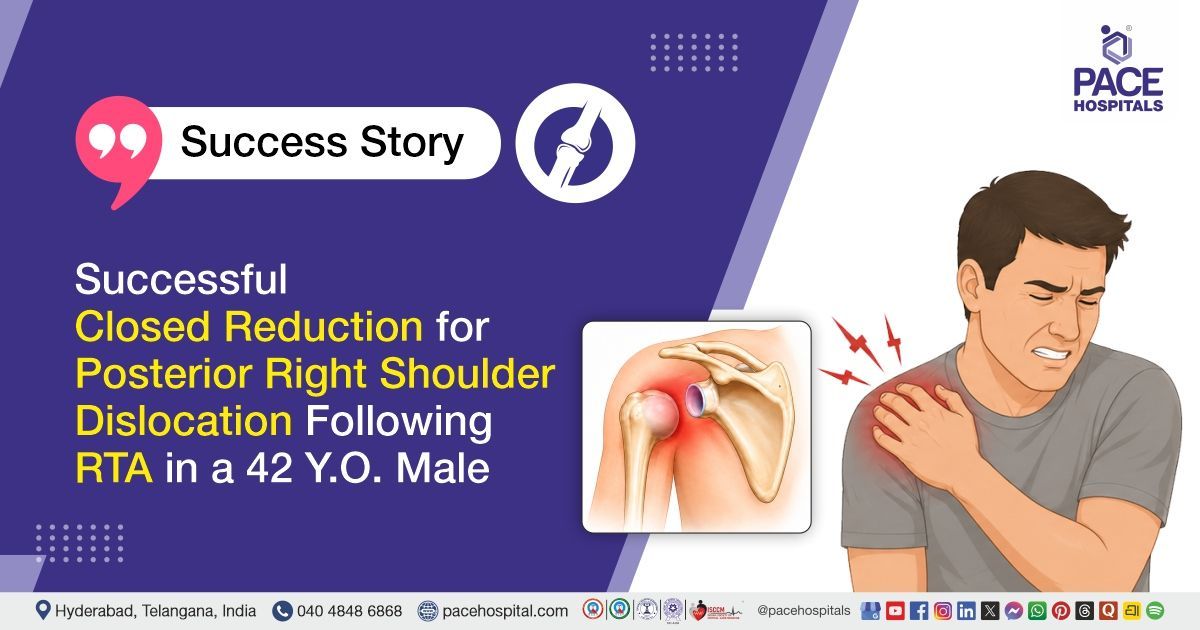
Successful Closed Reduction for Posterior Right Shoulder Dislocation
PACE Hospitals
PACE Hospitals’ expert orthopaedic team successfully performed Closed Reduction Procedure on a 42-year-old male patient diagnosed with posterior dislocation of the right shoulder. The procedure was performed with the aim of restoring normal shoulder joint alignment, relieving pain, improving joint stability, and enabling the patient to regain optimal shoulder function and mobility.
Chief Complaints
A 42-year-old male patient with a body mass index (BMI) of 21 presented to the Orthopaedic Department at PACE Hospitals, Hitech City, Hyderabad, with complaints of pain and swelling in the right shoulder following an alleged history of a road traffic accident (RTA).
Past Medical History
The patient had no significant past medical or surgical history. There was no history of loss of consciousness, seizures, vomiting, or alcohol intoxication at the time of injury. The patient was not known to have any chronic illnesses such as diabetes mellitus, hypertension, or epilepsy, and there was no previous history of shoulder dislocation or major trauma.
On Examination
On examination, the patient was conscious, coherent, oriented and hemodynamically stable. General examination revealed no pallor, icterus, lymphadenopathy, clubbing, or cyanosis. Local examination of the right shoulder showed swelling and tenderness over the shoulder joint, along with restriction of external rotation and abduction movements. The patient also had difficulty using the right upper limb due to pain. Distal neurovascular examination was normal, with no evidence of distal neurovascular deficit.
Diagnosis
Following the clinical evaluation, the Orthopaedic team at PACE Hospitals conducted a detailed assessment of the patient’s complaints of right shoulder pain and swelling associated with difficulty in using the right upper limb following a road traffic accident.
A thorough clinical and systemic examination was performed. The examination revealed swelling and tenderness over the right shoulder, along with restriction of external rotation and abduction movements. The patient experienced pain and difficulty in performing routine shoulder movements. No distal neurovascular deficit was noted, and general systemic examination findings were within normal limits. X-ray imaging of the right shoulder demonstrated posterior dislocation of the shoulder with the characteristic light bulb sign.
Based on these findings, the patient was advised to undergo
Right Shoulder Dislocation Treatment in Hyderabad, India, under the care of the Orthopaedic Department to achieve proper joint reduction, restore shoulder alignment and stability, relieve pain, improve functional mobility, and prevent long-term complications.
Medical Decision Making (MDM)
After a detailed evaluation by Dr. Raghuram, Consultant Orthopaedic Surgeon at PACE Hospitals, the patient was assessed for right shoulder pain and swelling following a road traffic accident, associated with significant difficulty in using the right upper limb and performing routine shoulder movements. Clinical examination revealed swelling, tenderness, and restriction of external rotation and abduction movements of the right shoulder, while distal neurovascular status was intact. Radiological assessment of the right shoulder demonstrated posterior shoulder dislocation with the characteristic light bulb sign.
Based on the clinical and radiological findings, it was determined that closed reduction of the posterior right shoulder dislocation under sedation was the most appropriate management approach. This decision was made with the intent to achieve anatomical reduction of the shoulder joint, restore joint congruency and stability, relieve pain, improve shoulder mobility, and prevent long-term complications such as recurrent instability or functional impairment.
The patient and his family members were counselled regarding the diagnosis, the planned reduction procedure, possible risks and benefits, postoperative immobilization with shoulder belt application, rehabilitation protocol, expected recovery course, and the importance of regular follow-up for optimal functional recovery.
Surgical Procedure
Following the diagnosis, the patient was scheduled for Closed Reduction of Posterior Dislocation of the Right Shoulder in Hyderabad at PACE Hospitals, under the care and supervision of the Orthopaedic Department.
The procedure involved the following steps:
- Pre-procedure Preparation and Sedation: The patient was taken to the procedure room and appropriately positioned. After obtaining informed consent and completing the necessary pre-procedural assessment, sedation was administered to ensure adequate muscle relaxation and patient comfort.
- Positioning and Stabilization: The patient was placed in a supine position. The right upper limb was carefully positioned to allow controlled manipulation while maintaining stability of the shoulder girdle.
- Traction Application: Closed reduction was performed using the traction and counter-traction technique. Gentle, sustained traction was applied along the longitudinal axis of the humerus to disengage the humeral head from its posterior dislocated position.
- Counter-traction and Reduction Maneuver: Counter-traction was applied to stabilize the scapula and surrounding structures. Controlled and gradual maneuvers were carried out to guide the humeral head back into its anatomical position within the glenoid cavity.
- Confirmation of Reduction: Intraoperative C-arm imaging of the right shoulder confirmed successful reduction with restoration of normal joint congruency in a good anatomical position.
Postoperative Care
Postoperatively, the patient had an uneventful recovery with stable vital parameters and no immediate complications. Post-reduction radiological evaluation confirmed satisfactory alignment of the shoulder joint with good congruency. The patient was managed with appropriate pain control measures, supportive care, and limb immobilization using a shoulder belt to maintain joint stability and facilitate healing.
Regular monitoring was carried out to assess neurovascular status, pain levels, and shoulder function. The patient remained clinically stable throughout the hospital stay and was discharged in stable condition with advice for continued immobilization and follow-up care.
Discharge Medications
Upon discharge, the patient was in stable condition and was prescribed medications for pain relief and inflammation control following the procedure, gastric protection to prevent acidity-related complications, nutritional support to aid recovery and tissue healing, and antibiotic coverage to prevent or treat potential post-procedural infection. The patient was advised to adhere strictly to the prescribed regimen and complete the full course of treatment as instructed.
Advice on Discharge
The patient was advised to continue a normal diet as tolerated. Upon discharge, the patient was instructed to continue using the shoulder belt as advised by the treating orthopaedic team to ensure adequate immobilization of the shoulder, maintain joint stability, and support proper recovery.
Emergency Care
The patient was advised to contact the emergency ward at PACE Hospitals immediately in case of any emergency or if symptoms such as right shoulder swelling, redness, fever, restricted movement, or any other unusual or worsening symptoms develop.
Review and Follow-up Notes
The patient was advised to return for follow-up with the Orthopaedic Doctor in Hyderabad at PACE Hospitals after 2 weeks.
Conclusion
This case highlights a posterior dislocation of the right shoulder following a road traffic accident, which was successfully managed with closed reduction under sedation. Post-procedure evaluation confirmed satisfactory joint alignment with restoration of shoulder congruency and stability. The patient had an uneventful postoperative course and remained clinically stable at the time of discharge. Early intervention and appropriate reduction techniques contributed to a good immediate outcome.
Understanding Posterior Shoulder Dislocation: Key Clinical Considerations in Orthopaedic Practice
Posterior shoulder dislocation is a relatively rare but clinically significant injury that is often associated with trauma, seizures, or electrical injuries. It is frequently underdiagnosed initially due to subtle clinical signs and the absence of obvious deformity compared to anterior dislocations. A high index of suspicion by the Orthopaedic Doctor/Orthopaedic Surgeon, along with appropriate imaging, is essential for accurate diagnosis. Early recognition and prompt management play a crucial role in preventing long-term complications such as chronic instability, stiffness, and functional impairment. Closed reduction is commonly the first-line treatment when diagnosed early, aiming to restore normal joint anatomy and stability. Post-reduction immobilization and structured rehabilitation are important to ensure optimal recovery and restoration of shoulder function.
Frequently Asked Questions (FAQs)
Why was closed reduction chosen instead of surgery for this shoulder dislocation?
Closed reduction is usually the first treatment when the shoulder can be put back into its normal position without open surgery. It is a simple and less invasive procedure that helps bring the joint back into alignment with minimal injury to nearby tissues. This method is preferred as it generally leads to quicker and safer recovery. Surgery is done only if closed reduction is not successful or if the joint continues to remain unstable.
How is the success of the reduction confirmed during the procedure?
The success of the procedure is checked using real-time imaging guidance (C-arm). This allows the Orthopaedic Surgeon to clearly see if the humeral head is properly placed inside the glenoid socket. It helps confirm that the joint is correctly aligned before finishing the procedure. This immediate check reduces the risk of any missed or incorrect positioning.
Will I need to stay in the hospital after this procedure?
In most cases, the hospital stay is short after a closed reduction. The patient is observed for a few hours or a short period to ensure stability, pain control, and normal neurovascular status of the limb. Once the patient is stable and comfortable, discharge is usually planned. A longer stay is needed only if there are complications or other medical concerns.
Why is shoulder immobilization necessary after reduction?
Immobilization is needed to keep the shoulder in the correct position after reduction. It allows the surrounding ligaments and soft tissues to heal properly. It also prevents unwanted movements that may lead to the shoulder dislocating again. A shoulder belt or support is used to maintain stability during the early healing phase.
When can normal shoulder movements be resumed?
Normal shoulder movements should be started slowly and only as advised by the Orthopaedic Surgeon. In the beginning, the shoulder is kept in a supported and immobilized position to allow proper healing. After that, gentle and controlled movements are started in a stepwise manner along with physiotherapy. Full use of the shoulder is allowed only after proper recovery is confirmed by the doctor.
What is the purpose of follow-up after discharge?
Follow-up visits are required to monitor healing of the shoulder and confirm that the joint remains stable. The Orthopaedic Surgeon will check pain levels, shoulder movement, and overall progress during recovery. These visits also help in detecting any early issues such as stiffness or instability. Regular follow-up supports proper healing and a safe return to normal activities.
What precautions should be taken after discharge to avoid complications?
The patient should not make sudden, forceful, or overhead movements of the shoulder. Lifting heavy objects or putting stress on the affected arm should be avoided completely. The shoulder support must be used as instructed by the doctor to keep the joint stable. Following these precautions helps in proper healing and reduces the chance of the shoulder dislocating again.
What are the possible risks after a successful reduction?
Even after a successful reduction, there is still a small chance that the shoulder may dislocate again. Some patients may feel stiffness or mild pain during the healing period. In rare cases, soft tissue injury can also affect shoulder movement. Attending regular follow-up visits and following proper rehabilitation greatly helps in reducing these risks.
How is pain managed after this procedure without specifying medications?
Pain is controlled using standard medical treatment to reduce discomfort after the procedure. Keeping the shoulder rested and properly immobilized also helps in easing pain. Swelling and inflammation are managed with supportive care given by the treating team. In most cases, the pain gradually improves as the shoulder heals over time.
What should a patient do if symptoms worsen after discharge?
If symptoms such as increasing pain, swelling, redness, or difficulty in movement occur, the patient should immediately return to the hospital. These may indicate a complication that needs prompt evaluation. Early assessment by the Orthopaedic team is important for safe management. Timely care helps prevent further problems and ensures better recovery.
Share on
Request an appointment
Fill in the appointment form or call us instantly to book a confirmed appointment with our super specialist at 04048486868
Appointment request - health articles
Recent Articles