CRE Balloon Dilatation Relieves Gastric and Duodenal Obstruction in an Elderly Patient
PACE Hospitals
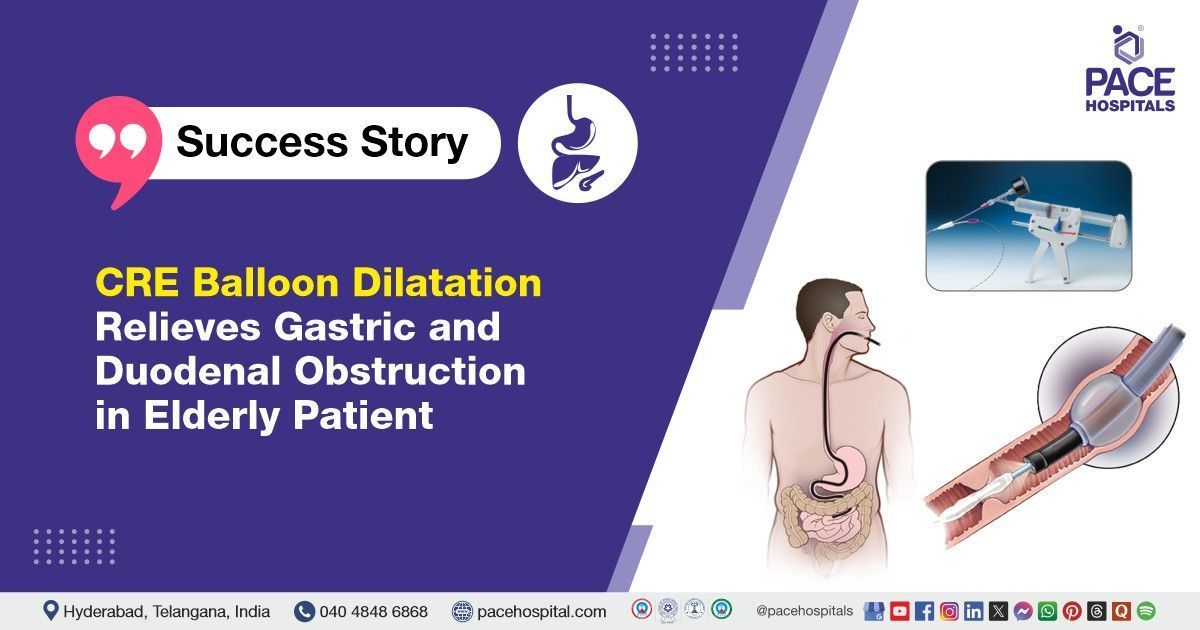
PACE Hospitals' Gastroenterology team successfully performed a CRE balloon dilatation to improve gastric emptying in a 68-year-old male patient with left-sided abdominal pain and black-coloured vomiting over the past four days. An UGIE revealed a hiatus hernia, significant food residue, and narrowing at the D1/D2 junction of the duodenum. This finding prompted the team to proceed with the CRE balloon dilatation, effectively relieving the obstruction and restoring normal digestive flow to enhance the patient's recovery.
Chief Complaints
A 68-year-old male patient presented to the Gastroenterology Department at
PACE Hospitals, Hyderabad, with left-sided abdominal pain accompanied by multiple episodes of black-coloured vomiting over the past four days.
Diagnosis
Upon admission to PACE Hospitals, the gastroenterology team thoroughly reviewed the patient's medical history and conducted a detailed clinical examination. Based on these assessments, the patient was diagnosed with gastric outlet obstruction, with a narrowing identified at the D1/D2 junction of the duodenum. This diagnosis highlighted the need for timely intervention to relieve the obstruction and restore normal digestive function.
Given the patient's condition, he was advised to undergo
Gastric Outlet Obstruction Treatment in Hyderabad, India, under the expert care of the Gastroenterology Department, to effectively address and relieve his symptoms.
Medical Decision Making
After consulting with the consultant gastroenterologist and hepatologist Dr. Padma Priya, along with other specialists, Dr. Govind R Verma, Dr. M Sudhir, and Dr. Suresh Kumar S, a comprehensive evaluation was conducted to determine the most appropriate diagnostic approach for the patient. Based on their expert assessment, it was decided that CRE balloon dilatation would be the most effective procedure.
Surgical Procedure
Following the confirmed diagnosis and the collective expertise of the medical team, the patient was scheduled for a CRE balloon dilatation in Hyderabad at PACE Hospitals to improve gastric emptying under the expert supervision of the Gastroenterology Department.
The patient was admitted with the previously mentioned symptoms, and an upper GI endoscopy revealed a hiatus hernia, food residue in the stomach (undigested or partially digested food remaining after eating), a diverticulum in the first part of the duodenum (D1), and a narrowing at the D1/D2 junction. To address the narrowing, a successful CRE balloon dilatation was performed, expanding to 18 mm. A contrast-enhanced CT (CECT) scan of the abdomen revealed signs of cholecystitis. However, after assessment, it was determined that no immediate surgical intervention was required.
Postoperative Care
The patient’s initial recovery following the procedure was smooth, with no complications or signs of distress. Given the patient’s stable condition and positive progress, the medical team determined it was appropriate to discharge him. The patient was instructed on post-operative care and follow-up visits to ensure continued recovery.
Condition at Discharge
The patient was discharged in a stable condition.
Discharge Medications
Upon discharge, the patient was prescribed a combination of medications, including a proton pump inhibitor (PPI), antiemetics, and gastrointestinal agents to support healing and manage symptoms. In addition, the patient was advised to continue a low-residue diet to ease digestion and prevent further complications. Detailed instructions were provided to ensure proper medication adherence and dietary adjustments for optimal recovery.
Emergency Care
The patient was informed to contact the Emergency ward at PACE Hospitals in case of any emergency or development of symptoms like fever, abdominal pain, or vomiting.
Review and follow-up notes
The patient was advised to return for a follow-up appointment with Gastroenterologist in Hyderabad at PACE Hospitals after three weeks to repeat the dilatation procedure, as part of the ongoing management plan for the gastric outlet obstruction.
Conclusion
This case highlights the significance of a multidisciplinary approach to managing complex gastrointestinal conditions and the need for careful monitoring to prevent future complications.
Importance of Minimally Invasive CRE Balloon Dilatation in Treating Gastric Outlet Obstruction
Restoring digestive flow through balloon dilatation guided by upper GI endoscopy is a minimally invasive procedure performed by a gastroenterologist/gastroenterology doctor to treat blockages or narrowing in the digestive tract. In this case, the endoscopy revealed a narrowed segment in the upper part of the small intestine, along with signs of delayed stomach emptying. Using a balloon catheter, the doctor gently widened the constricted area, enabling food to pass more easily from the stomach into the intestines. This technique provides significant symptom relief while helping patients avoid more invasive surgical procedures, making it a safe and effective treatment option for those diagnosed with gastric outlet obstruction.
Share on
Request an appointment
Fill in the appointment form or call us instantly to book a confirmed appointment with our super specialist at 04048486868
Appointment request - health articles
Recent Articles