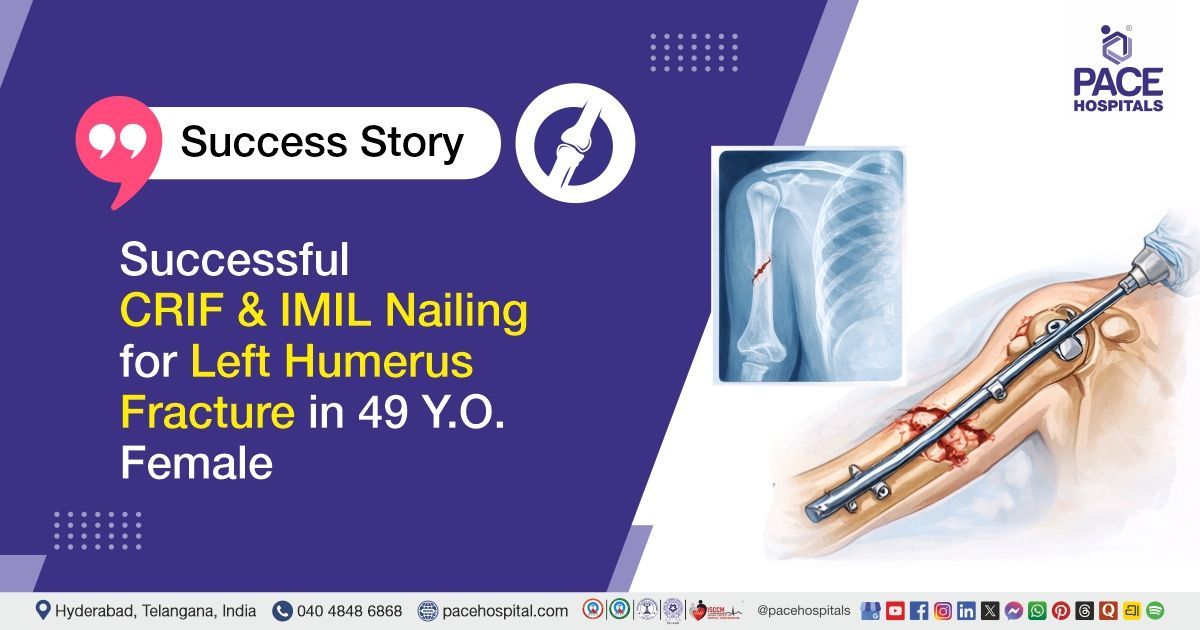
Successful CRIF & IMIL Nailing for Left Humerus Fracture in 49 Y.O. Female
PACE Hospitals
PACE Hospitals’ expert Orthopaedic team successfully performed a Closed Reduction and Internal Fixation (CRIF) using an Intramedullary Interlocking (IMIL) Nail with Titanium Proximal Distal Locking (PDL) on a 49-year-old female patient, diagnosed with a left humerus displaced spiral fracture with the aim of realigning the fractured bone without open surgery and stabilizing it internally to promote proper healing, restore limb function, and enable early mobilization.
Chief Complaints
A 49-year-old female patient with a body mass index (BMI) of 23 presented to the Orthopaedic Department at PACE Hospitals, Hitech City, Hyderabad, with a history of a road traffic accident involving a four-wheeler injury.
Past Medical History
The patient was a known case of Hypothyroidism and was on regular treatment. There was no history suggestive of any known drug allergies or other significant past medical or surgical conditions.
On Examination
On examination, the patient’s general condition was not stable, with vital signs within acceptable limits. The Glasgow Coma Scale score was reduced, indicating drowsiness and decreased responsiveness. Local examination of the left arm revealed swelling, tenderness, crepitus, and abnormal mobility, with a restricted and painful range of movements at the left shoulder and elbow, while no distal neurovascular deficit was noted. Respiratory system examination was abnormal with decreased air entry on the right side, whereas cardiovascular and abdominal examinations were normal. Central nervous system examination was abnormal, with the patient responding only to deep stimuli.
Diagnosis
Following the clinical evaluation, the Orthopaedics team at PACE Hospitals conducted a detailed assessment focusing on the patient’s complaints following a history of road traffic accident involving a four-wheeler injury, which resulted in pain, swelling, and inability to use the left upper limb for routine activities.
A comprehensive clinical and systemic examination was performed to assess the severity of the injury. Local examination of the left arm revealed swelling, tenderness, crepitus, abnormal mobility, and restricted, painful movements at the shoulder and elbow. The patient’s general condition was altered with a reduced Glasgow Coma Scale score, indicating decreased responsiveness. Imaging and radiological evaluation, including X-ray of the left arm, confirmed a displaced spiral fracture of the shaft of the left humerus.
Based on these findings, the patient was advised to undergo Left Humerus Displaced - Spiral Fracture Treatment in Hyderabad, India, under the care of the Orthopaedic Department, to achieve fracture stabilization, promote bone healing, restore upper limb function, and enable early return to daily activities.
Medical Decision Making (MDM)
After a detailed consultation with Dr. Anand Agroya, Senior Orthopaedic Consultant, a comprehensive evaluation was performed to determine the most appropriate diagnostic and therapeutic approach. Considering the patient’s history of road traffic accident with a four-wheeler injury, associated pain, swelling, and inability to use the left upper limb, along with clinical findings of tenderness, crepitus, abnormal mobility, and restricted movements, a focused local examination and radiological assessment were undertaken to formulate an optimal treatment strategy.
Based on the clinical findings and imaging, which confirmed a displaced spiral fracture of the shaft of the left humerus, it was determined that closed reduction and internal fixation (CRIF) with IMIL nailing was identified as the most suitable approach to achieve proper fracture alignment, ensure stable fixation, promote early bone healing, and restore functional mobility of the limb.
The patient and her family members were thoroughly counselled regarding the diagnosis, need for surgery, procedure details, potential risks, benefits, and postoperative recovery process.
Surgical Procedure
Following the diagnosis, the patient was scheduled to undergo Closed Reduction and Internal Fixation (CRIF) Surgery in Hyderabad at PACE Hospitals, using an IMIL Nail with Titanium PDL under the supervision of the expert Orthopaedic Department.
The surgical procedure involved the following steps:
- Anesthesia and Preparation: The patient was administered general anesthesia to ensure unconsciousness and pain-free surgery. The left arm was cleaned and draped under strict aseptic conditions, and the limb was positioned to provide optimal access for fracture management.
- Fracture Reduction: A closed reduction technique was performed to realign the displaced middle one-third fracture of the left humerus. Traction and manipulation were applied carefully to restore proper anatomical alignment without making an open incision.
- Entry Point and Nail Insertion: A small entry point was created near the proximal humerus, and a Titanium IMIL (Intramedullary Interlocking) Nail was inserted into the medullary canal. The nail was guided across the fracture site to stabilize the bone internally, with position confirmed using fluoroscopic imaging.
- Interlocking and Fixation: The nail was secured with proximal and distal interlocking screws to prevent rotation or shortening of the humerus. This provided rigid internal fixation and maintained proper alignment of the fracture fragments.
- Operative Findings: Intraoperatively, the fracture was identified as a displaced middle one-third humeral shaft fracture. Reduction and fixation were achieved successfully with the IMIL nail, restoring anatomical alignment and stability of the humerus.
Postoperative Care
The patient was monitored in the Intensive Care Unit (ICU), for a few hours and remained hemodynamically stable. Analgesics were administered for pain relief, and antibiotics were given to prevent infection at the surgical site, which was maintained under aseptic conditions. The operated arm was supported in an arm pouch, dressing was done, and gentle finger exercises were initiated to preserve hand mobility.
Discharge Medications
Upon discharge, the patient was prescribed medications for infection prevention, pain management, and gastric protection, to be taken as per the recommended schedule.
Advice on Discharge
The patient was advised to keep the operated arm supported in an arm pouch and to avoid wetting the dressing. Physiotherapy exercises for the left-hand fingers were continued as previously advised.
Emergency Care
The patient was informed to contact the emergency ward at PACE Hospitals in case of any emergency or development of symptoms such as severe pain at the operated site, swelling or discoloration of the operated site, excessive bleeding or discharge from the surgical site, chest pain, sudden shortness of breath, changes in consciousness, low urine output, persistent nausea or vomiting, allergic reactions, or high-grade fever.
Review and Follow-up Notes
The patient was advised to return for a follow-up visit with the Orthopaedic Doctor in Hyderabad at PACE Hospitals after 1 week for wound dressing.
Conclusion
This case highlights a post-traumatic displaced spiral fracture of the left humerus. The fracture was managed successfully with closed reduction and internal fixation using an IMIL nail. The patient remained hemodynamically stable throughout the hospital stay, regained partial wrist movement, and was discharged in a stable condition with appropriate postoperative care.
Successful Management of Complex Humerus Fracture
The effective management of complex humerus fractures relies on accurate assessment, careful surgical planning, and precise execution to achieve proper alignment and stabilization of the bone. Maintaining hemodynamic stability and close postoperative monitoring are critical for patient safety. Early initiation of mobility exercises helps preserve joint and hand function while preventing stiffness. Comprehensive patient education and adherence to rehabilitation protocols enhance recovery outcomes. Multidisciplinary coordination between orthopaedic doctor/orthopaedic surgeon, nursing staff, and physiotherapists plays a vital role in optimizing functional restoration. Timely intervention and structured postoperative care significantly reduce complications and improve long-term results in complex orthopedic injuries.
Share on
Request an appointment
Fill in the appointment form or call us instantly to book a confirmed appointment with our super specialist at 04048486868
Appointment request - health articles
Recent Articles