Successful Laparoscopic Left Ovarian Cystectomy for a Large Benign Ovarian Cyst
PACE Hospitals
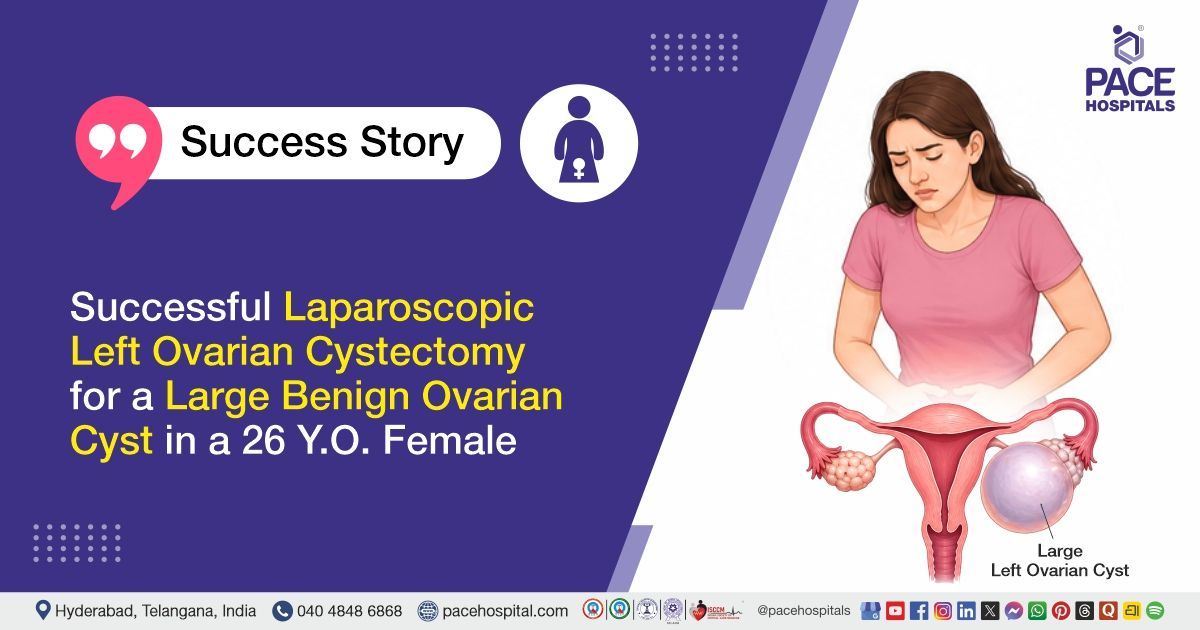
PACE Hospital’s expert gynaecology team successfully performed a Laparoscopic Left Ovarian Cystectomy on a 26-year-old female patient diagnosed with a large left ovarian benign serous cystadenoma (simple ovarian cyst). The aim of the procedure was to remove the large ovarian cyst safely, relieve abdominal discomfort, preserve the ovary, and reduce the risk of future complications such as cyst enlargement, torsion, rupture, or pressure-related symptoms.
Chief Complaints
A 26-year-old female patient with a body mass index (BMI) of 20 presented to the Gynaecology Department at PACE Hospitals, Hitech City, Hyderabad, with complaints of vague abdominal pain for 10 days. She also reported dyspnoea (shortness of breath) and delayed menses for the last two cycles.
Past Medical History
The patient had no known history of diabetes mellitus, hypertension, or hypothyroidism. She had a history of documented medication allergies and multiple food allergies, which were considered during treatment planning and postoperative medication selection.
Menstrual and Obstetric History
The patient had a history of regular menstrual cycles. However, she reported a delay in the last two cycles.
On Examination
On general examination, the patient was conscious, coherent, and oriented. She appeared hemodynamically stable. Systemic examination revealed equal air entry bilaterally in the respiratory system. Cardiovascular examination showed normal heart sounds. Breast examination was normal, with no palpable lumps. Abdominal examination revealed a soft, mobile pelvic mass arising from the pelvis, approximately corresponding to a 20-week uterus size.
Diagnosis
Upon admission to PACE Hospitals, the patient was evaluated by the Gynaecology team with a detailed clinical history, physical examination, and relevant investigations. The clinical findings suggested a large pelvic mass arising from the pelvis.
Ultrasound imaging and preoperative evaluation revealed the presence of a large left ovarian simple cyst measuring approximately 18 × 7 cm, extending into the broad ligament and displacing the left ovary and fallopian tube towards the right side of the pelvis.
The right ovary and Fallopian tube appeared normal. The uterus was normal, and the rest of the abdomen showed no abnormal findings.
Based on the confirmed diagnosis, the patient was advised to undergo Simple Ovarian Cyst Treatment in Hyderabad, India, under the expert care of the Gynaecology Department.
Medical Decision Making (MDM)
After a detailed consultation with Dr. Mugdha Bandawar, (Obstetrician, Gynaecologist, Laparoscopic Surgeon and Infertility Consultant), a comprehensive evaluation of the patient was undertaken. The patient had vague abdominal pain for 10 days, dyspnoea, and a delay in the last two menstrual cycles. On abdominal examination, a large mobile pelvic mass was felt, approximately corresponding to a 20-week uterus size.
Based on the clinical findings and investigations, a large left ovarian simple cyst was diagnosed. The cyst was large in size and was causing displacement of the left ovary and fallopian tube towards the right side of the pelvis. As the cyst was large and symptomatic, observation alone was not considered suitable. Surgical removal was advised to relieve symptoms, prevent further enlargement, and reduce the risk of complications such as torsion, rupture, pressure effects, or future reproductive concerns.
Considering the patient’s young age, it was determined that laparoscopic left ovarian cystectomy was the most appropriate definitive surgical management.
During counselling, the patient and her relatives were clearly informed about the severity of the cyst, the need for surgery, the benefits of a minimally invasive approach, and the possible risks involved. They were also informed about the future risk of tubal blockage because the fallopian tube had been displaced and overstretched by the large cyst and required surgical manipulation during the procedure.
Surgical Procedure
Following the decision, the patient was scheduled to undergo a Laparoscopic Left Ovarian Cystectomy Surgery in Hyderabad at PACE Hospitals under the supervision of the expert Gynaecology Department.
The following steps were carried out during the procedure:
- Patient Preparation and Laparoscopic Entry: The patient was taken up for surgery under general anaesthesia with aseptic precautions. Pneumoperitoneum was created, and laparoscopic ports were placed to access the pelvic cavity.
- Laparoscopic Access and Evaluation: Laparoscopic access was obtained, and the abdominal and pelvic organs were carefully inspected.
- Intraoperative Findings: A large left ovarian simple cyst measuring approximately 18 × 7 cm was seen. The cyst was extending into the broad ligament and had displaced the left ovary and fallopian tube towards the right side of the pelvis.
- Assessment of Other Pelvic Organs: The right ovary and right fallopian tube appeared normal. The uterus was normal, and the rest of the abdomen appeared normal.
- Left Ovarian Cystectomy: Cystectomy was performed, and the cyst wall was removed carefully. The left ovary was preserved during the procedure.
- Hemostasis and Closure: Hemostasis was achieved and confirmed. Port closure was done after completing the procedure. The patient tolerated the procedure well.
Postoperative Care
Postoperatively, the patient was observed in the Surgical Intensive Care Unit (SICU) for close monitoring and later shifted to the ward after stabilisation. During the hospital stay, she received supportive treatment for infection prevention, gastric protection, nausea control, pain relief, hydration, and postoperative recovery. Her condition improved well, and she was discharged in a hemodynamically stable condition.
The removed left ovarian cyst wall was sent for histopathological examination. The report showed a thin-walled cyst lined by cuboidal to columnar epithelium, with no evidence of atypical cells or malignancy.
The final histopathology impression was suggestive of benign serous cystadenoma, confirming that the ovarian cyst was non-cancerous.
Discharge Medications
Upon discharge, the patient was advised of medications for the prevention of postoperative infection, pain relief, swelling reduction, gastric protection, and local wound care. The medication plan was selected carefully, considering her known history of drug and food allergies.
Advice on Discharge
The patient was instructed to follow a normal diet. She was advised to avoid heavy lifting and strenuous exercise during the recovery period. She was instructed to take adequate rest and follow the postoperative care instructions given by the treating team.
Emergency Care
The patient was advised to contact the emergency ward at PACE Hospitals in case of any emergency or development of symptoms such as abdominal pain, heavy menstrual bleeding, fever, or any other concerning postoperative symptoms.
Review and Follow-up
The patient was advised to return for follow-up with the Gynaecologist in Hyderabad at PACE Hospitals after 1 week.
Conclusion
This case highlights the successful laparoscopic management of a large left ovarian cyst in a 26-year-old female patient. The large cyst was removed through laparoscopic left ovarian cystectomy while preserving the ovary. Although the cyst had displaced and stretched the left ovary and fallopian tube, the surgery was completed safely, and the patient recovered well.
Key Considerations in the Management of a Large Ovarian Cyst with Ovarian Preservation
Effective management of a large ovarian cyst requires careful clinical evaluation, imaging assessment, and planned surgical treatment by an experienced gynaecologist/gynaecology doctor. In young patients, ovarian preservation is an important goal whenever safely possible.
Laparoscopic ovarian cystectomy allows removal of the cyst through a minimally invasive approach, helping reduce surgical trauma, postoperative discomfort, and recovery time. In large cysts extending into nearby pelvic structures, careful dissection is important to protect the ovary and fallopian tube.
Histopathological examination after cyst removal is essential to confirm the exact nature of the cyst and rule out malignancy. Proper postoperative monitoring, discharge counselling, and follow-up care help support safe recovery and long-term reproductive health.
Frequently Asked Questions (FAQs)
Why was laparoscopic ovarian cystectomy advised in this case?
Laparoscopic ovarian cystectomy was advised because the patient had a large left ovarian cyst with abdominal pain and menstrual delay. The cyst was large enough to extend into the broad ligament and displace the left ovary and fallopian tube. Removing the cyst helped relieve symptoms and reduce the risk of complications such as torsion, rupture, pressure effects, or further enlargement.
Why was the ovary preserved during cyst removal?
The patient was young, so preserving the ovary was important for maintaining hormonal function and future fertility. During surgery, only the cyst wall was removed, while the ovarian tissue was preserved as much as possible. This approach helps treat the cyst while protecting reproductive health whenever it is safe to do so.
What does a large ovarian cyst mean?
A large ovarian cyst means the cyst has grown to a large size and may occupy significant space in the pelvis or abdomen. In this case, the left ovarian cyst measured around 18 × 7 cm and was felt as a pelvic mass corresponding to approximately a 20-week uterus size. Large cysts can cause pain, bloating, pressure symptoms, menstrual changes, or displacement of nearby organs.
Can a large ovarian cyst affect menstrual cycles?
Yes, a large ovarian cyst may sometimes be associated with delayed or irregular menstrual cycles. In this case, the patient had delayed periods for the last two cycles. However, menstrual changes can also occur due to hormonal imbalance, stress, weight changes, or other gynaecological conditions, so proper evaluation by a gynaecologist is important.
What is benign serous cystadenoma?
Benign serous cystadenoma is a non-cancerous ovarian cyst that usually contains clear, watery fluid. It arises from the surface lining cells of the ovary. In this case, histopathology confirmed features suggestive of benign serous cystadenoma, with no atypical cells or malignancy.
Does benign serous cystadenoma mean cancer?
No, benign serous cystadenoma does not mean cancer. “Benign” means non-cancerous. The histopathology report in this case showed no evidence of atypical cells or malignancy, which confirmed that the cyst was not cancerous.
Why was histopathology important after ovarian cystectomy?
Histopathology was important because it confirmed the exact nature of the removed ovarian cyst. Even when a cyst appears simple or benign on imaging and during surgery, laboratory examination of the cyst wall helps rule out cancer or abnormal cells. In this case, histopathology confirmed a benign serous cystadenoma.
Can a large ovarian cyst affect the fallopian tube?
Yes, a large ovarian cyst can stretch, displace, or put pressure on the fallopian tube. In this case, the large left ovarian cyst displaced the left ovary and fallopian tube towards the right side of the pelvis. The patient and relatives were counselled about the possible future risk of tubal blockage due to displacement, overstretching, and surgical manipulation of the tube.
What precautions are needed after laparoscopic ovarian cystectomy?
After laparoscopic ovarian cystectomy, the patient should avoid heavy lifting, strenuous exercise, and activities that put pressure on the abdomen during the early recovery period. Wound care should be followed as advised by the doctor. The patient should take prescribed medications properly and attend the follow-up visit with the biopsy report.
When should urgent medical care be taken after ovarian cyst surgery?
Urgent medical care should be taken if the patient develops severe abdominal pain, heavy menstrual bleeding, fever, wound discharge, vomiting, dizziness, breathing difficulty, or worsening weakness after surgery. These symptoms may indicate infection, bleeding, or other postoperative complications and should not be ignored.
Share on
Request an appointment
Fill in the appointment form or call us instantly to book a confirmed appointment with our super specialist at 04048486868
Appointment request - health articles
Recent Articles