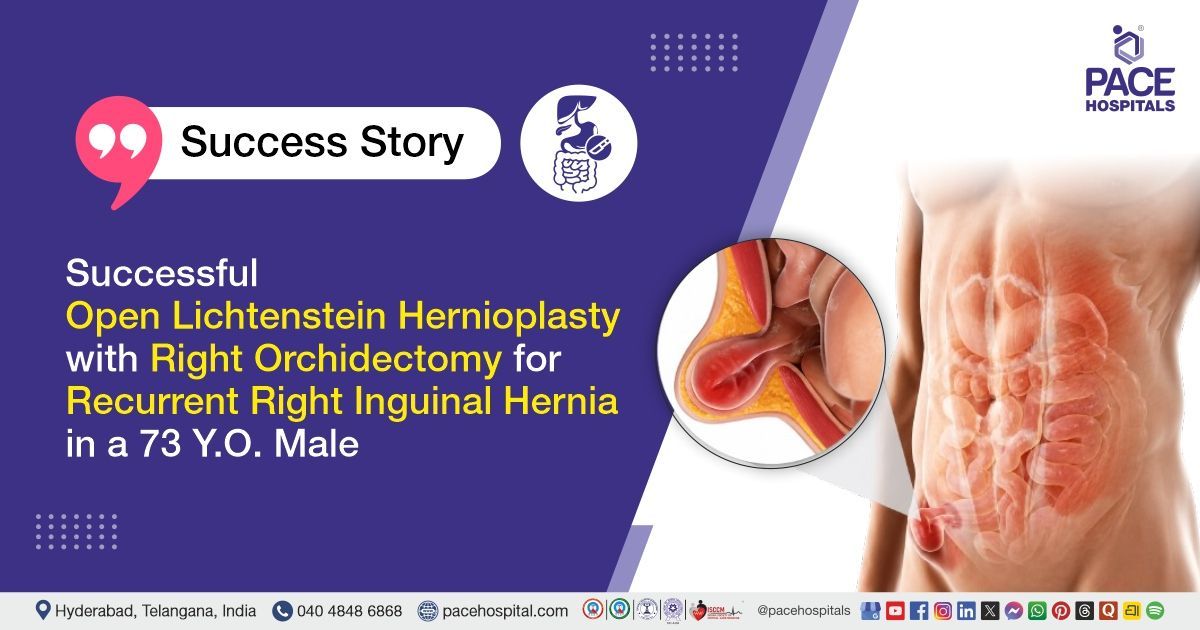
Successful Open Lichtenstein Hernioplasty with Right Orchidectomy for Recurrent Right Inguinal Hernia
PACE Hospitals
PACE Hospitals’ expert Surgical Gastroenterology team successfully performed a Right Open Lichtenstein Hernioplasty with Right Orchidectomy on a 73-year-old male patient diagnosed with a right recurrent inguinal hernia. The procedure was undertaken to repair the recurrent hernia, reinforce the weakened inguinal wall to prevent future recurrence, and remove the diseased right testis, thereby relieving symptoms, reducing the risk of complications, and improving the patient’s overall quality of life.
Chief Complaints
A 73-year-old male patient with a body mass index (BMI) of 19 presented to the Surgical Gastroenterology Department at PACE Hospitals, Hitech City, Hyderabad, with complaints of swelling in the right inguinal region for the past 8 years, which had been gradually increasing in size. The patient had previously undergone laparoscopic right inguinal hernia repair 10 years ago. He now presented with a recurrent right inguinal hernia and was admitted for further evaluation and surgical management.
Past Medical History
The patient had a past surgical history of laparoscopic right inguinal hernia repair performed 10 years prior to the current admission.
On Examination
On examination, the patient was conscious, coherent, oriented and was hemodynamically stable. Local examination revealed a swelling in the right inguinal region, consistent with a recurrent right inguinal hernia. The swelling was gradually progressive, with no clinical signs of obstruction or gangrene. The remainder of the abdominal and systemic examination was normal.
Diagnosis
Upon admission to PACE Hospitals, following a detailed clinical assessment, the Surgical Gastroenterology team evaluated the patient for complaints of a gradually enlarging swelling in the right inguinal region that had been present for eight years. His relevant past surgical history included a laparoscopic right inguinal hernia repair performed ten years earlier, following which he developed a recurrent right inguinal hernia.
Clinical examination revealed a swelling in the right inguinal region consistent with a recurrent inguinal hernia, without clinical evidence of obstruction or gangrene. The diagnosis of right recurrent inguinal hernia was established based on the patient's characteristic clinical presentation, physical examination findings, and relevant preoperative evaluation.
Routine investigations, including complete blood count, serum biochemistry, and other preoperative assessments, were performed to evaluate the patient's overall medical condition and fitness for surgery. These investigations supported the diagnosis and assisted in perioperative planning.
Based on the confirmed diagnosis, the patient was advised to undergo
Right Recurrent
Inguinal Hernia Treatment in Hyderabad, India, under the expert care of the Surgical Gastroenterology Department.
Medical Decision Making (MDM)
After a detailed consultation with Dr. Suresh Kumar S (Consultant Surgical Gastroenterologist), a comprehensive clinical evaluation was performed to determine the most appropriate diagnostic and therapeutic approach for the patient presenting with a gradually enlarging swelling in the right inguinal region of eight years' duration. The patient had a significant past surgical history of laparoscopic right inguinal hernia repair performed ten years earlier, following which he developed a recurrent right inguinal hernia. A thorough preoperative assessment and pre-anesthetic check-up were undertaken to evaluate the patient's fitness for surgery.
Considering the patient's clinical presentation and examination findings, a diagnosis of right recurrent inguinal hernia was established. Routine laboratory investigations and standard preoperative assessments were performed to evaluate the patient's overall medical condition and were found to be satisfactory for proceeding with surgical intervention.
Based on the clinical assessment and preoperative evaluation, it was determined that Right Open Lichtenstein Hernioplasty with Right Orchidectomy was the most appropriate management strategy. The procedure was planned to repair the recurrent hernia by reinforcing the weakened posterior wall with mesh, prevent further recurrence, relieve the patient's symptoms, and perform right orchidectomy for the non-viable or compromised testis encountered during surgical management.
The patient and his family members were counselled regarding the diagnosis, the proposed surgical procedure, its benefits and potential risks, expected postoperative recovery, and the importance of adherence to postoperative instructions and scheduled follow-up for optimal outcomes.
Surgical Procedure
Following the clinical evaluation and confirmation of the diagnosis, the patient was scheduled to undergo Right Open Lichtenstein Hernioplasty with Right Orchidectomy Surgery in Hyderabad at PACE Hospitals, under the expert care of the Surgical Gastroenterology Department, to repair the recurrent inguinal hernia, reinforce the posterior inguinal wall with mesh, and address the diseased right testis.
The procedure involved the following steps:
- Incision and Surgical Exposure: After adequate anesthesia and sterile preparation, a right inguinal incision was made. Skin, subcutaneous tissue, and fascia were carefully dissected to expose the inguinal canal. The external oblique aponeurosis was opened to access the surgical field and identify the cord structures.
- Dissection of Hernia Sac: The recurrent hernia sac was identified within the inguinal canal. It was carefully dissected from adhesions and separated from the spermatic cord structures, taking care to avoid injury due to previous surgical changes.
- Management of Hernial Contents: The hernia sac was opened, and contents, including omentum and bowel loops, were inspected for viability. The contents were reduced back into the peritoneal cavity after confirming adequate blood supply and viability. The sac was then managed appropriately.
- Right Orchidectomy and Mesh Placement: Right orchidectomy was performed by isolating the spermatic cord, securing and ligating the cord structures, and excising the right testis. Following this, a polypropylene mesh was placed over the posterior wall of the inguinal canal using the Lichtenstein tension-free technique to reinforce the defect and prevent recurrence.
- Hemostasis, Drain Placement, and Wound Closure: Meticulous hemostasis was achieved. A surgical drain was placed in the operative field to prevent fluid collection. The external oblique aponeurosis was closed, followed by layered closure of subcutaneous tissue and skin. A sterile dressing was applied, and the patient was shifted to recovery in stable condition.
Postoperative Care
The postoperative period was uneventful. The patient received supportive care, including infection prevention measures, gastric protection, intravenous fluid support for hydration, and pain management. Regular wound care and monitoring of the surgical site and drain were carried out, along with encouragement of early mobilisation. The patient showed good clinical recovery and was discharged in a hemodynamically stable condition with appropriate postoperative advice and follow-up instructions.
Discharge Medications
Upon discharge, the patient was prescribed medications for the prevention and treatment of postoperative wound infection, the reduction of gastric acid secretion to prevent gastric irritation and stress-related mucosal injury, the management of postoperative pain and inflammation, and the relief of constipation to ensure smooth bowel movements during recovery. The patient was also advised to continue prescribed medications as directed prior to discharge.
Advice on Discharge
The patient was advised to follow a normal diet, use scrotal support, avoid strenuous activities, and maintain proper wound care.
Emergency Care
The patient was advised to report to the emergency ward at PACE Hospitals in case of fever, abdominal pain, wound discharge, bleeding, vomiting, severe pain, drain-related concerns, or any other emergency symptoms.
Review and Follow-up Notes
The patient was advised to return for a follow-up visit with the Surgical Gastroenterologist in Hyderabad at PACE Hospitals after 1 week for wound assessment, recovery evaluation, and further postoperative guidance.
Conclusion
This case highlights a patient with a recurrent right inguinal hernia following previous laparoscopic hernia repair, managed successfully with right open Lichtenstein hernioplasty and right orchidectomy. The surgery was completed without intraoperative or postoperative complications. The patient had an uneventful recovery and was discharged in stable condition. He was advised to undergo regular follow-up and adhere to postoperative instructions.
Management of Recurrent Inguinal Hernia
Recurrent inguinal hernia is a surgically challenging condition that often occurs due to weakened abdominal wall structures or failure of previous repair. It requires careful preoperative evaluation to assess the defect, surrounding tissue quality, and patient-related factors. Open mesh repair techniques are commonly preferred in complex or recurrent cases to provide strong reinforcement and reduce the risk of further recurrence. Dense adhesions from prior surgery may make dissection more difficult, requiring meticulous surgical technique and expertise. In select cases, additional procedures may be needed based on intraoperative findings and tissue involvement.
Successful management depends on individualized surgical planning, precise operative technique, and careful postoperative care to ensure optimal outcomes and minimize recurrence. The role of a
Surgical Gastroenterologist / Surgical Gastroenterology doctor is crucial in evaluating, planning, and performing such complex hernia repairs with a focus on patient safety and long-term results.
Frequently Asked Questions (FAQs)
What does a recurrent right inguinal hernia mean after a previous laparoscopic hernia repair?
A recurrent right inguinal hernia means the hernia has come back on the same side after an earlier repair. In this case, the patient had laparoscopic hernia surgery around 10 years ago and later developed swelling again in the right groin. Recurrence can happen due to tissue weakness, ageing, strain, previous surgical changes, or gradual weakening of the repaired area.
Why was an open Lichtenstein hernioplasty done for this recurrent hernia?
Open Lichtenstein hernioplasty is a commonly used mesh-based repair for inguinal hernia. In recurrent cases, especially after previous laparoscopic repair, an open approach may help the surgeon access the weakened area from a different tissue plane. In this case, the posterior wall defect was closed and reinforced with mesh to give stronger support to the groin region.
What does it mean when the hernia sac contains omentum and bowel?
It means fatty tissue from inside the abdomen and a part of the intestine had moved into the hernia sac. This can make the hernia larger and more complex, especially when it has been present for many years. Surgery helps place the contents back safely and repairs the weak area to reduce the risk of future complications such as obstruction or strangulation.
Is recurrent inguinal hernia surgery more complicated than first-time hernia surgery?
Yes, recurrent hernia surgery can be more complex than first-time hernia repair. Previous surgery may cause scar tissue, altered anatomy, and weakness in the already repaired area. In elderly patients, careful evaluation is also needed before surgery. That is why proper pre-anaesthesia check-up, surgical planning, mesh reinforcement, and post-operative care are important.
Why was the right orchidectomy done along with hernia repair?
Right orchidectomy means the removal of the right testis. In some complex recurrent hernia cases, the testis or its blood supply may be affected due to long-standing hernia, scarring, adhesions, or surgical difficulty. In this case, the surgeon performed right orchidectomy along with hernia repair as part of the operative management. The exact reason should always be explained by the operating surgeon during follow-up.
Does orchidectomy affect daily life after hernia surgery?
Most elderly patients are able to resume their usual daily activities after adequate healing, depending on their general health and recovery progress. In cases where one testis is removed, the remaining testis may continue to perform normal hormonal functions in most individuals. Recovery outcomes, postoperative comfort, swelling, and any concerns related to sexual health should be discussed with the treating surgeon during follow-up, particularly after combined hernia repair and orchidectomy.
Why is scrotal support advised after this surgery?
Scrotal support helps reduce pulling, swelling, and discomfort in the groin and scrotal area after surgery. It gives support to the operated side, especially after hernia repair and orchidectomy. The patient should wear it as advised by the surgical team and avoid tight or uncomfortable clothing that may press on the wound.
What activities should be avoided after open inguinal hernia repair with mesh?
The patient should avoid strenuous activities, heavy lifting, sudden bending, forceful coughing without support, and intense exercise until the surgeon allows. These activities can increase pressure inside the abdomen and may strain the repair site. Gentle walking is usually encouraged, but return to regular activity should be gradual and based on follow-up advice.
How should wound care be done after discharge?
The surgical wound should be kept clean and dry as advised. The patient should avoid touching, rubbing, or applying anything over the wound without medical advice. Any dressing change should be done as instructed by the hospital team. Redness, pus discharge, increasing pain, wound opening, or foul smell should be reported immediately.
When should emergency care be taken after recurrent hernia surgery?
Emergency care is needed if the patient develops fever, severe abdominal pain, repeated vomiting, increasing groin swelling, severe scrotal pain, bleeding from the wound, pus discharge, breathing difficulty, or inability to pass urine. These signs may indicate infection, bleeding, bowel-related issues, or other post-surgery complications. Early medical attention can prevent the condition from becoming serious.
Share on
Request an appointment
Fill in the appointment form or call us instantly to book a confirmed appointment with our super specialist at 04048486868
Appointment request - health articles
Recent Articles