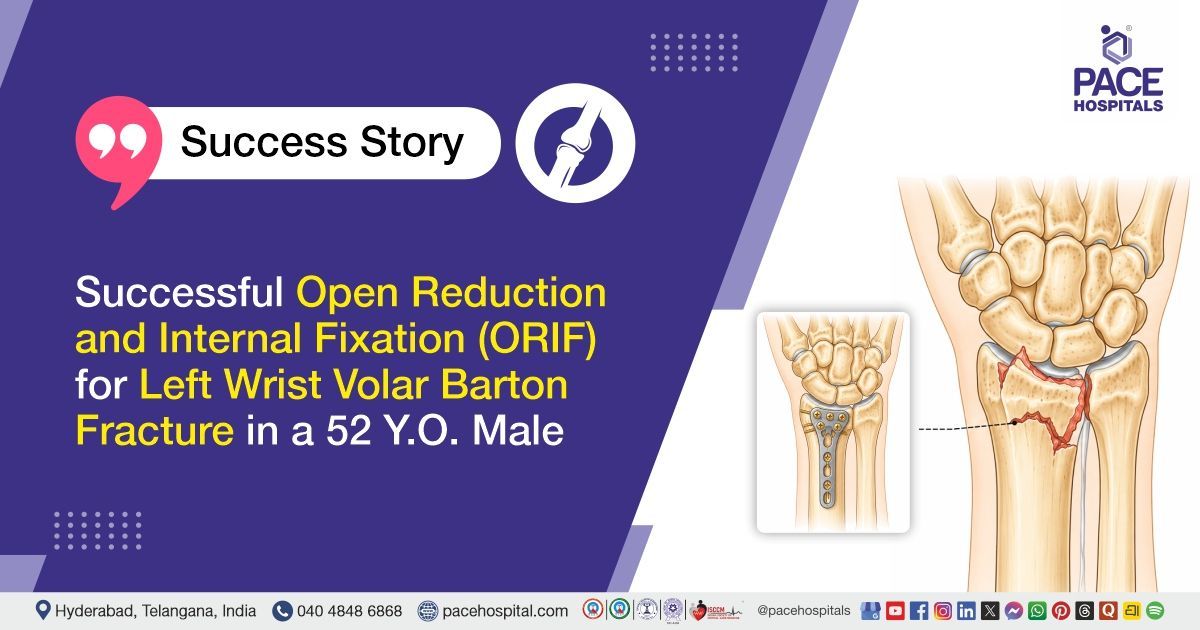
Successful Open Reduction and Internal Fixation (ORIF) for Left Wrist Volar Barton Fracture
PACE Hospitals
PACE Hospitals’ expert Orthopaedic team successfully performed an Open Reduction and Internal Fixation (ORIF) using a titanium plate and screws (PDL) on a 52-year-old male patient diagnosed with left wrist volar barton fracture. The aim of the procedure was to accurately realign the displaced bone fragments, restore normal wrist anatomy, and provide stable internal fixation to promote proper healing, preserve joint function, and ensure early mobilization of the wrist.
Chief Complaints
A 52-year-old male patient with a body mass index (BMI) of 22 presented to the Orthopaedic Department at PACE Hospitals, Hitech City, Hyderabad, with complaints of left wrist pain associated with difficulty moving the left wrist joint. The patient had an alleged history of a self-fall on the left wrist.
Past Medical History
The patient was a known case of coronary artery disease (CAD), for which he had undergone percutaneous transluminal coronary angioplasty (PTCA) for double vessel disease involving the left anterior descending (LAD) artery and right coronary artery (RCA). He had no history suggestive of other chronic medical illnesses such as diabetes mellitus, hypertension, or long standing systemic diseases, and no additional significant comorbid conditions.
On Examination
On general examination, the patient was conscious, oriented, and hemodynamically stable with no signs of fever or respiratory distress, and vital parameters were within normal limits. On clinical and systemic examination of the left wrist, swelling and deformity were present over the distal aspect, with tenderness over the distal end of the left radius. The range of motion of the left wrist was grossly restricted and painful. No distal neurovascular deficits were noted, and distal circulation, sensation, and motor functions were intact.
Diagnosis
Following the clinical evaluation, the Orthopaedic team at PACE Hospitals conducted a detailed assessment of the patient’s complaints of pain and swelling in the left wrist, associated with difficulty moving the left wrist joint, with a history of a self-fall onto the left wrist.
A thorough clinical examination revealed swelling, deformity, and tenderness over the distal end of the left radius, with a grossly restricted and painful range of motion of the left wrist. The distal neurovascular status was intact, and no significant abnormalities were noted on general physical examination.
Further radiological evaluation confirmed a volar Barton type fracture of the distal end of the left radius. Based on the clinical presentation, examination findings, and imaging results, the patient was diagnosed with a fracture of the distal end of the left radius (volar Barton type).
Based on these findings, the patient was advised to undergo
Left Wrist Volar
Barton Fracture Treatment in Hyderabad, India, under the care of the Orthopaedic Department to achieve anatomical reduction of the fracture, restore wrist joint alignment and stability, relieve pain, preserve joint function, and enable early mobilization of the affected limb while preventing long-term complications.
Medical Decision Making (MDM)
After a detailed evaluation by Dr. Anand Agroya (Consultant Orthopaedic Surgeon), the patient was assessed for pain, swelling, and deformity of the left wrist associated with difficulty in performing daily activities following a history of a self-fall onto the left wrist. Clinical examination revealed swelling, deformity, and tenderness over the distal end of the left radius, with gross restriction and painful movements of the left wrist. Distal neurovascular status was intact, and the patient was hemodynamically stable with no significant systemic abnormalities.
Radiological evaluation confirmed a fracture of the distal end of the left radius consistent with a volar Barton type fracture.
Based on the clinical findings, it was determined that Open Reduction and Internal Fixation (ORIF) with a titanium plate and screws for the left distal radius fracture was the most appropriate management approach. This decision was made to achieve anatomical reduction of the fracture, restore wrist joint alignment and stability, relieve pain, preserve joint function, enable early mobilization, and prevent long-term complications such as stiffness and malunion.
The patient and his family members were counselled regarding the diagnosis, the need for surgical fixation, the procedure details including implant usage and fixation technique, potential risks and benefits, postoperative care including immobilization and rehabilitation, physiotherapy requirements, expected recovery course, and the importance of regular follow-up to ensure optimal functional outcome.
Surgical Procedure
Following the diagnosis, the patient was scheduled to undergo Open Reduction and Internal Fixation (ORIF) Surgery in Hyderabad at PACE Hospitals, with a titanium plate and screws (PDL) under the supervision of the expert Orthopaedic Department.
The surgical procedure involved the following steps:
- Anaesthesia and Preparation: The patient was taken up for surgery under left supraclavicular block anaesthesia. The operative limb was prepared and draped under strict aseptic precautions.
- Surgical Approach: A volar modified Henry’s approach was used to access the distal radius on the palmar (volar) side of the left wrist.
- Fracture Exposure and Reduction: The distal radius fracture (volar Barton type) was identified. The fracture fragments were carefully exposed, aligned, and anatomically reduced to restore normal wrist joint alignment.
- Internal Fixation: Stable fixation was achieved using a titanium plate with 6 locking screws (PDL system) to maintain proper alignment and ensure rigid stabilization of the fracture site.
- Closure and Immobilization: After achieving satisfactory fixation, the wound was closed with subcuticular sutures, and a plaster of Paris (POP) cast was applied to immobilize the wrist and support healing.
Postoperative Care
The postoperative course was uneventful. On the first postoperative day, the dressing was changed, and the surgical wound was found to be healthy with no signs of active discharge or infection. During the hospital stay, the patient received intravenous medications for infection prevention, pain management, gastric protection, and overall supportive care. The patient showed satisfactory clinical improvement and was discharged in a hemodynamically stable condition with appropriate postoperative advice and instructions for follow-up care.
Discharge Medications
Upon discharge, the patient was prescribed medications for infection prevention, gastric acid suppression for gastrointestinal protection, and pain management to control postoperative pain. These were advised for a duration of five days as part of the standard postoperative care protocol.
Advice on Discharge
The patient was advised to keep the surgical dressing dry and avoid wetting it. The arm pouch or support was to be continued until further medical advice. The patient was also instructed to continue the previously prescribed medications as advised by the cardiologist.
Emergency Care
The patient was informed to contact the emergency ward at PACE Hospitals in case of any emergency or development of symptoms such as severe pain in the operated left wrist, increasing swelling at the surgical site, fever, wound discharge, numbness, or discoloration of the fingers.
Review and Follow-up Notes
The patient was advised to return for a follow-up visit with the Orthopaedic Doctor in Hyderabad at PACE Hospitals after 5 days for a dressing change.
Conclusion
This case highlights a distal end of left radius volar Barton’s fracture following a fall, which was managed with Open Reduction and Internal Fixation using a titanium plate and screws. The fracture was successfully reduced and stabilized, restoring proper wrist alignment. The postoperative period was uneventful with satisfactory recovery and no complications. The patient was discharged in a stable condition with advised follow-up care.
Surgical Management and Clinical Considerations in Distal Radius Fractures
Distal radius fractures are common injuries typically resulting from a fall on an outstretched hand and may range from simple extra-articular breaks to complex intra-articular patterns. Management depends on fracture type, displacement, and patient factors, with both conservative and surgical options considered. When surgical intervention is required, Open Reduction and Internal Fixation is commonly performed to restore anatomical alignment and ensure stable fixation. Various surgical approaches are used to access the fracture site while minimizing soft tissue and neurovascular injury.
Internal fixation with plates and screws provides rigid stability, supports early mobilization, and improves functional recovery as determined by the orthopaedic doctor / orthopaedic surgeon. Postoperative care includes immobilization when required, pain control, and gradual rehabilitation. Regular follow-up is essential to monitor bone healing and prevent complications such as stiffness, malunion, or reduced wrist function.
Frequently Asked Questions (FAQs)
Why is surgery recommended for a Volar Barton fracture of the distal radius?
A Volar Barton fracture affects the wrist joint and often causes a piece of the bone to move out of its normal position toward the palm. Because the fracture involves the joint surface, a cast alone may not be enough to keep the bones properly aligned. Surgery is often advised to reposition the bone accurately, stabilize the joint, and lower the chances of future problems such as stiffness, deformity, or arthritis.
What is Open Reduction and Internal Fixation for a distal radius fracture?
Open Reduction and Internal Fixation (ORIF) is a procedure used to treat certain wrist fractures. During surgery, the orthopedic surgeon places the broken bone fragments back into their correct position and secures them with a metal plate and screws. This helps keep the fracture stable while the bone heals.
Why are titanium plates and screws used in wrist fracture surgery?
Titanium implants are commonly used in medical treatment because they are strong, lightweight, and generally compatible with the human body. In wrist fracture surgery, doctors use metal plates and screws to hold the broken bone pieces in place so they stay properly aligned while healing. This stability helps the bone heal in the correct position and supports a smoother recovery, allowing the wrist to gradually regain strength and normal movement over time.
What is the purpose of POP after plate fixation surgery?
A POP (Plaster of Paris) support may be applied after surgery to protect the wrist and limit unnecessary movement during the early stages of healing. Although the fracture is already stabilized with a plate and screws, the additional support can help reduce discomfort, swelling, and accidental stress on the operated area. Patients should follow their surgeon’s instructions regarding its care and use.
When can hand and wrist movement start after distal radius fracture surgery?
Finger exercises are usually started soon after surgery to help reduce swelling and prevent stiffness in the fingers. Wrist movements are started later, depending on how well the fracture is healing. The exact timing is decided by the surgeon based on clinical examination and follow-up X-rays. Physiotherapy may be recommended in some cases to improve wrist movement and rebuild strength.
What precautions are important after wrist fracture fixation surgery?
Patients should keep the dressing and POP clean and dry. The arm should be supported as advised, often with an arm sling or pouch. Activities that place stress on the wrist, such as lifting heavy objects or pushing and pulling, should be avoided until the surgeon permits them. Any unusual symptoms such as increasing swelling, numbness, severe pain, or changes in finger color should be reported promptly.
How is recovery monitored after distal radius ORIF surgery?
Recovery is checked through regular follow-up visits. During these visits, the surgeon examines the surgical wound, checks pain and swelling, and assesses finger and wrist movements. If needed, X-rays are taken to see how the fracture is healing. These checks help ensure proper bone healing and guide decisions on rehabilitation and return to normal activities.
Can a patient with a heart-related medical history undergo wrist fracture surgery?
Yes, many patients with heart conditions can safely undergo wrist fracture surgery. Before the procedure, a detailed medical evaluation is performed, and clearance may be obtained from a physician or cardiologist if necessary. The healthcare team takes existing medical conditions and medications into account when planning treatment.
What warning signs need urgent medical attention after wrist fracture surgery?
Patients should seek medical help right away if they have a fever, worsening pain, or any discharge from the wound. Urgent attention is also needed if there is severe swelling, the cast or splint feels too tight, or there is numbness or tingling in the hand. Fingers turning pale or bluish, or difficulty in moving them, are also important warning signs. These symptoms may point to complications and should not be ignored.
Will wrist function return to normal after Volar Barton fracture surgery?
Most patients experience significant improvement in wrist function after surgery and rehabilitation. The final outcome depends on factors such as the severity of the fracture, involvement of the joint surface, overall health, and commitment to recovery exercises. Some temporary stiffness or weakness is common, but with proper treatment and rehabilitation, many people are able to return to their usual daily activities.
Share on
Request an appointment
Fill in the appointment form or call us instantly to book a confirmed appointment with our super specialist at 04048486868
Appointment request - health articles
Recent Articles