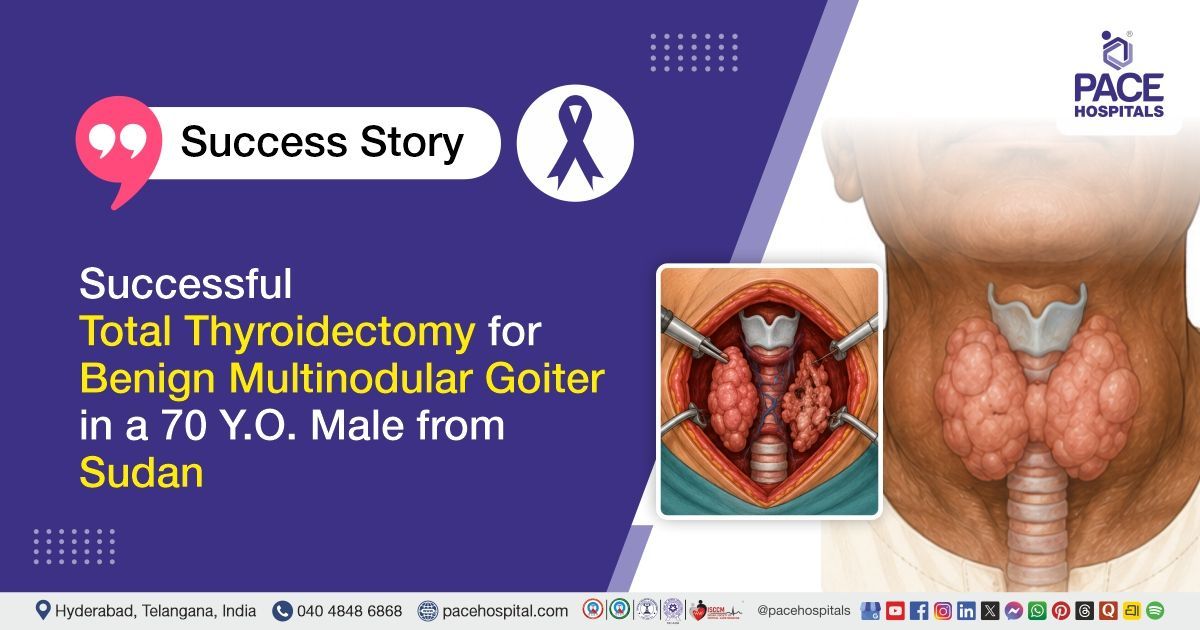
Successful Total Thyroidectomy for Benign Multinodular Goiter Treatment
PACE Hospitals
PACE Hospitals’ expert Oncology team successfully performed a Total Thyroidectomy on a 70-year-old male patient from Sudan diagnosed with Multinodular Goiter. The aim of the procedure was to completely remove the enlarged thyroid gland to relieve compressive symptoms, prevent further complications, and improve the patient’s overall quality of life.
Chief Complaints
A 70-year-old male patient with a body mass index (BMI) of 20 presented to the Oncology Department at PACE Hospitals, Hitech City, Hyderabad, with complaints of swelling in the front region of the neck at the thyroid gland site for the past 1 year. The patient also reported occasional mild discomfort during deglutition (swallowing). The swelling had gradually increased in size over time.
Past Medical History
The patient had a past history of thyroid gland surgery, likely thyroidectomy; however, no surgical details or histopathological reports were available for review. He was also a known case of diabetes mellitus and hypertension, both of which were on regular medication and were well controlled at the time of presentation.
On Examination
On examination, the patient was conscious, coherent, and well oriented, and was afebrile with stable vital signs. Local examination of the neck revealed bilateral thyromegaly. A non-tender nodule measuring approximately 6 × 3 cm with minimal mobility was palpable in the left lobe of the thyroid gland, and another nodule measuring approximately 3 × 2 cm was palpable in the right lobe. No obvious signs of local compressive effects were observed. The patient appeared clinically stable at the time of examination.
Diagnosis
Upon admission to PACE Hospitals, the patient underwent a comprehensive evaluation including detailed clinical assessment, physical examination, and preoperative investigations by the Oncology, Cardiology, and Anesthesiology teams. The patient presented with complaints of progressive neck swelling, and clinical examination revealed an enlarged, bilateral nodular thyroid gland involving both lobes, suggestive of multinodular thyroid disease.
A complete preoperative diagnostic workup was performed. Laboratory investigations included hemoglobin, which was within normal limits, and fasting blood sugar, which was also within normal range. The patient was clinically euthyroid. Preoperative evaluation by the cardiology and anesthesiology teams was conducted as part of the surgical fitness assessment. Overall findings were consistent with multinodular goitre.
Based on the confirmed findings, the patient was advised to undergo
Multinodular Goiter Treatment in Hyderabad, India, under the expert care of the Oncology Department.
Medical Decision-Making
After a thorough consultation with Dr. Ramesh Parimi, Consultant Surgical Oncologist, and cross-consultation with Dr. Tripti Sharma, Consultant Endocrinologist, Dr. S Pramod Kumar Consultant Neurologist, along with preoperative evaluation by the cardiology and anesthesiology teams, a comprehensive assessment was conducted to determine the most appropriate management for the patient’s condition, diagnosed as multinodular goiter (FNAC negative for atypical cells or malignancy).
Based on the patient’s clinical presentation of progressively increasing bilateral thyroid swelling and diagnostic findings suggestive of multinodular enlargement of both thyroid lobes, it was determined that total thyroidectomy was the appropriate treatment approach. The decision was made following a detailed clinical evaluation, including physical examination findings of bilateral thyromegaly with dominant nodules in both lobes, and preoperative investigations confirming surgical fitness.
The patient and his family members were counselled in detail regarding the diagnosis, the need for surgical intervention, and the potential risks and benefits associated with total thyroidectomy. They were also informed about the importance of surgery in preventing progression of disease, relieving local symptoms, and ensuring optimal clinical outcomes.
Surgical Procedure
Following the multidisciplinary decision, the patient was scheduled for Total Thyroidectomy Surgery in Hyderabad at PACE Hospitals, under the expert care and supervision of the Oncology team.
The following steps were carried out during the procedure:
- Anesthesia and Patient Preparation: The patient was taken up for surgery under general anesthesia after appropriate preoperative evaluation and fitness clearance. Standard aseptic precautions were followed, and the patient was positioned supine with neck extension to facilitate optimal surgical exposure of the thyroid region.
- Surgical Exposure and Thyroid Gland Assessment: A transverse cervical incision was made, and dissection was carried out through the subcutaneous tissue and platysma. The strap muscles were separated to expose the thyroid gland. Intraoperative assessment revealed a left lobe measuring approximately 8 × 5 cm with cystic nodular changes and a right lobe measuring approximately 3 × 2 cm with nodular enlargement.
- Mobilization and Protection of Vital Structures: Careful dissection was performed to mobilize both thyroid lobes while preserving critical anatomical structures. The recurrent laryngeal nerves on both sides were identified and meticulously safeguarded throughout the procedure to prevent nerve injury. Parathyroid glands were also preserved to maintain calcium homeostasis.
- Total Thyroidectomy and Specimen Evaluation: Complete excision of both thyroid lobes was performed, achieving a total thyroidectomy. A frozen section analysis of the excised thyroid specimen was carried out intraoperatively, which confirmed the absence of malignancy.
- Hemostasis, Wound Closure: Meticulous hemostasis was achieved, and a surgical drain was placed to prevent fluid accumulation. The wound was closed in layers under sterile conditions.
Postoperative Care
The postoperative period was uneventful, and the patient remained stable. The frozen section report was negative for atypical cells or malignancy, correlating with intraoperative findings. The surgical site was monitored for bleeding, infection, and fluid collection, with appropriate drain care provided. Calcium levels and vocal cord function were assessed to rule out postoperative complications. The patient received supportive care for pain control, infection prevention, and gastric protection, and was discharged in stable condition with advice for follow-up.
Discharge Medications
Upon discharge, the patient was prescribed medications for short-term infection prevention, gastric acid suppression for gastrointestinal protection, and analgesia for postoperative pain control related to the surgical site. These were provided as part of routine postoperative care following total thyroidectomy to support recovery and comfort.
Advice on Discharge
The patient was advised to continue the previously prescribed medications for the management of hypertension and diabetes mellitus as per the existing treatment regimen.
Emergency Care
The patient was informed to contact the emergency ward at PACE Hospitals in case of emergency or development of any concerning symptoms, including fever, neck swelling, breathing difficulty, voice changes, or wound discharge.
Review and Follow-up
The patient was advised to schedule a follow-up appointment with the Oncologist in Hyderabad at PACE Hospitals after 5 days.
Conclusion
This case highlights successful surgical management of multinodular goiter with appropriate preoperative evaluation and multidisciplinary planning. Histopathological assessment confirmed the absence of malignancy, and the procedure was completed without intraoperative or postoperative complications. The overall outcome was favorable with an uneventful recovery and stable discharge.
Importance of Multidisciplinary Evaluation in Thyroid Surgery
Thyroid disorders require a comprehensive and systematic approach for accurate diagnosis and effective management. Multidisciplinary evaluation involving an endocrinologist, surgeon, anesthesiologist, and Oncologist / cancer specialist helps integrate clinical findings with imaging and cytological results to guide appropriate treatment decisions. Surgical planning should prioritize patient safety, with careful identification and preservation of vital structures such as the recurrent laryngeal nerves and parathyroid glands. Intraoperative assessment further enhances diagnostic accuracy and helps confirm the nature of the disease. Proper perioperative care and monitoring significantly reduce complication rates and improve recovery outcomes. Overall, a coordinated approach ensures safe surgical outcomes and optimal patient care in thyroid surgery cases.
Frequently Asked Questions (FAQs)
Why was total thyroidectomy recommended for multinodular goiter even when FNAC showed no malignancy?
Total thyroidectomy may be advised in large multinodular goiter cases when the swelling continues to increase in size, causes difficulty while swallowing, or affects both lobes of the thyroid gland. Even when FNAC does not show cancer cells, surgery helps prevent future compressive problems and removes suspicious or recurrent nodules completely. It also helps avoid repeated surgeries in elderly patients.
Can multinodular goiter return after previous thyroid surgery?
Yes, multinodular goiter can recur even many years after previous thyroid surgery if some thyroid tissue remains. This is more likely when only part of the thyroid gland was removed earlier (partial thyroidectomy). Recurrent thyroid enlargement means that thyroid swelling returns or increases again over time. Regular follow-up visits and imaging tests help detect any regrowth early and allow timely treatment if required.
Why are recurrent laryngeal nerves protected during thyroid surgery?
The recurrent laryngeal nerves control the movement of the vocal cords and are located very close to the thyroid gland. During thyroidectomy, surgeons carefully identify and preserve these nerves to prevent complications such as hoarseness of voice, weak speech, or breathing difficulty. Nerve preservation is considered one of the most important parts of safe thyroid surgery.
What is the purpose of frozen section examination during thyroidectomy?
Frozen section examination is a rapid laboratory analysis performed during surgery to check whether the thyroid tissue contains cancerous cells. The tissue sample is immediately examined under a microscope while the operation is ongoing. This helps surgeons decide whether additional surgical steps are required during the same procedure.
Why is a drain placed after thyroid surgery?
A surgical drain is a small tube placed in the surgical area after thyroidectomy to remove any blood or fluid that may collect at the site of surgery. This helps reduce swelling and pressure in the neck and also allows early detection of any bleeding or fluid buildup. The drain is generally removed when the fluid coming through it becomes very little, and the patient’s condition is stable.
Can swallowing discomfort improve after the removal of a large thyroid swelling?
Yes, patients with large multinodular goiter often feel better with swallowing after surgery. This is because removing the enlarged thyroid reduces pressure on nearby structures like the esophagus (food pipe) and trachea (windpipe). Relief may not be immediate since some swelling after surgery takes time to settle. However, symptoms usually improve slowly during recovery.
Why is monitoring important after total thyroidectomy in elderly patients with diabetes and hypertension?
Older adults with diabetes and high blood pressure require close follow-up after major surgery because recovery can influence blood sugar, blood pressure (BP), and healing. These conditions may become unstable during the post-operative period, which can increase the chance of complications. Careful monitoring helps reduce risks such as slow wound healing, infection, and added stress on the heart and blood vessels during recovery.
What follow-up evaluations are commonly advised after total thyroidectomy?
Follow-up after thyroidectomy usually involves checking the surgical wound for proper healing and looking for any signs of infection. The doctor may also assess voice changes and, if needed, monitor calcium levels. Thyroid hormone levels are evaluated to decide on further management. Additional tests or imaging may be recommended based on the surgical findings and final pathology report.
How long does recovery usually take after total thyroidectomy?
Recovery takes place gradually over a few weeks after surgery. Mild neck pain, tightness, or slight trouble swallowing is common and usually gets better with time. Normal activities are restarted slowly depending on age, general health, and how the patient is healing during follow-up visits.
When should urgent medical attention be sought after thyroid surgery?
Seek medical help immediately if there is fever, increasing swelling in the neck, difficulty breathing, severe or worsening pain, repeated vomiting, noticeable voice change, or discharge from the surgical wound. Early evaluation helps identify problems quickly and supports a safer recovery after thyroid surgery.
Share on
Request an appointment
Fill in the appointment form or call us instantly to book a confirmed appointment with our super specialist at 04048486868
Appointment request - health articles
Recent Articles