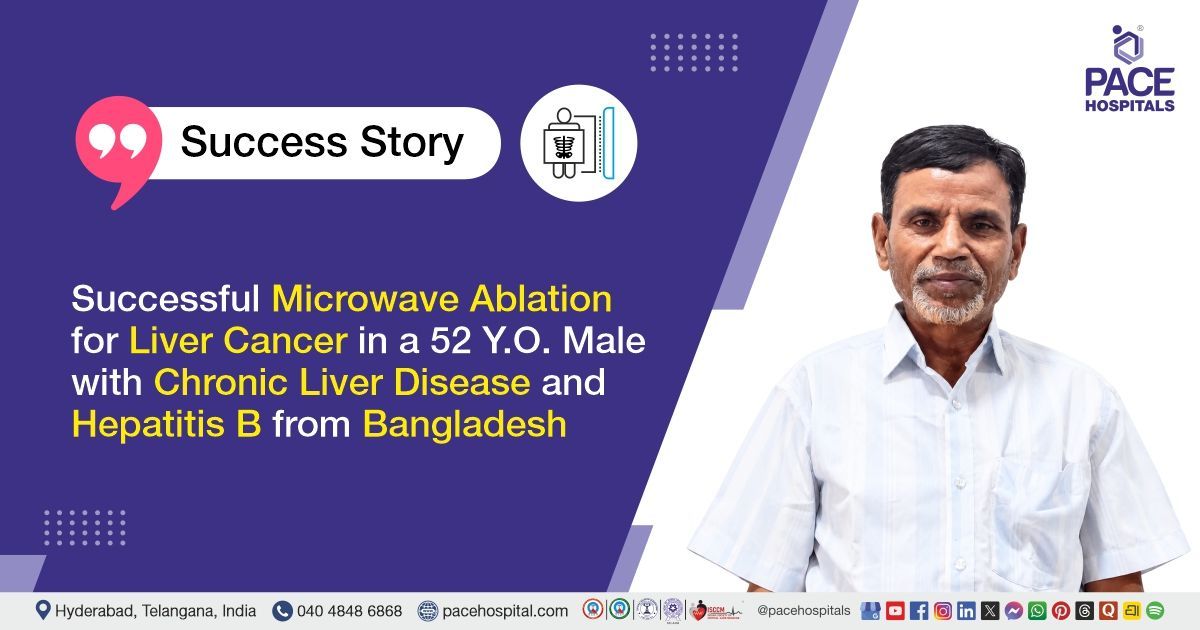
Successful Microwave Ablation for Liver Cancer in a 52 Y.O. Male with Chronic Liver Disease & Hepatitis B
PACE Hospitals
PACE Hospitals’ expert Interventional Radiology team successfully performed Microwave Ablation of a liver lesion in a 52-year-old male patient from Bangladesh with Chronic Hepatitis B related chronic liver disease and Hepatocellular Carcinoma (HCC). The aim of the procedure was to precisely destroy the cancerous liver lesion using targeted heat energy while preserving the surrounding healthy liver tissue, thereby achieving local tumor control through a minimally invasive approach.
Chief Complaints
A 52-year-old male with a body mass index (BMI) of 18 presented to the Interventional Radiology Department at PACE Hospitals, Hitech City, Hyderabad, with a known history of chronic liver disease status post EVL banding and a recently diagnosed Hepatocellular Carcinoma (HCC) detected on contrast-enhanced CT (CECT) abdomen. The patient was admitted for microwave ablation of the liver lesion as a minimally invasive treatment for HCC.
Past Medical History
The patient had a history of chronic liver disease secondary to Chronic Hepatitis B. He had previously undergone endoscopic variceal ligation (EVL) banding for portal hypertension-related varices. Recent imaging revealed Hepatocellular Carcinoma involving segment 8 of the liver.
On Examination
On examination, the patient was conscious, coherent, oriented, and hemodynamically stable. Abdominal examination revealed a soft abdomen with no significant tenderness or guarding. Clinical findings were consistent with chronic liver disease.
Diagnosis
Following the clinical evaluation, the Interventional Radiology team conducted a comprehensive assessment, which included a detailed review of the patient’s medical history, prior treatment records, and radiological investigations. Contrast-enhanced computed tomography (CECT) of the abdomen demonstrated a liver lesion in segment 8, suggestive of Hepatocellular Carcinoma (HCC) in the background of chronic liver disease secondary to Chronic Hepatitis B. The patient also had a prior history of endoscopic variceal ligation (EVL) banding for portal hypertension-related varices.
Considering the patient’s clinical history, imaging findings, and overall liver status, a provisional diagnosis of Hepatitis B-related chronic liver disease with hepatocellular carcinoma was established.
Based on the confirmed diagnosis, the patient was advised to undergo
Chronic liver disease (Hepatitis B-related) and
Hepatocellular Carcinoma (HCC) Treatment in Hyderabad, India,
under the care of the Interventional Radiology Department, to ensure comprehensive management of his condition.
Medical Decision Making (MDM)
After consultation with Dr. Lakshmi Kumar Chalamarla, Interventional Radiologist, a comprehensive evaluation was undertaken to determine the most appropriate management strategy for the patient’s liver lesion. Following detailed clinical assessment, review of prior medical history, and correlation with contrast-enhanced CT (CECT) abdomen findings, it was determined that the patient had Hepatocellular Carcinoma (HCC) arising in the background of chronic liver disease secondary to Chronic Hepatitis B, with associated fibrosis and cirrhosis.
Considering the localized nature of the segment 8 liver lesion and the patient’s underlying liver condition, it was determined that microwave ablation of the liver lesion was the most suitable minimally invasive therapeutic option to achieve effective local tumor control while preserving the surrounding healthy liver parenchyma. The procedure was planned under image guidance and general anesthesia to ensure precise targeting and complete ablation of the lesion.
The patient and family were thoroughly counselled regarding the diagnosis, proposed microwave ablation procedure, expected benefits, potential risks, post-procedural care, and the importance of regular follow-up with liver function tests and imaging surveillance for long-term disease monitoring.
Surgical Procedure
Following the decision, the patient was scheduled to undergo Microwave Ablation of Liver Lesion in Hyderabad at PACE Hospitals under the supervision of the expert Interventional Radiology Department.
The following steps were carried out during the procedure:
- Pre-Procedure Preparation: The patient was evaluated with review of clinical history, CECT abdomen findings, and relevant laboratory investigations. Informed consent was obtained after explaining the procedure, risks, and benefits. The patient was kept nil per oral and pre-procedure antibiotics were administered.
- Anaesthesia and Positioning: The procedure was performed under general anesthesia. The patient was placed in a supine position, and standard monitoring was established. The abdominal region was prepared and draped under strict aseptic precautions.
- Image-Guided Localization: Using ultrasound and/or CT guidance, the segment 8 liver lesion was precisely localized. A safe trajectory was planned to avoid injury to adjacent vascular and biliary structures.
- Microwave Ablation: A microwave ablation probe was inserted percutaneously into the lesion under image guidance. Ablation was performed at 40 W for 10 minutes, creating a 4 × 3 cm ablation zone with complete thermal destruction of the tumor tissue.
- Post-Procedure Care: Post-ablation imaging confirmed adequate lesion coverage with no immediate complications. The probe was removed, hemostasis was achieved, and the patient was shifted to recovery in stable condition for observation.
Postoperative Care
The procedure and post-procedural course were uneventful. The patient was advised of medications for infection prevention, pain control, gastric protection, and other supportive care measures as part of post-procedure management. The patient remained hemodynamically stable throughout the hospital stay and was discharged in stable condition.
Discharge Medications
Upon discharge, the patient was advised of medications for the prevention of post-procedure infection, medications for pain relief as needed, and drugs for gastric protection. In addition, the patient was instructed to avoid lifting heavy weights and to avoid straining during bowel movements to reduce abdominal pressure. The patient was also advised to continue other regular medications as prescribed by the treating physicians.
Emergency Care
The patient was informed to contact the emergency ward at PACE Hospitals in case of any emergency or development of symptoms like fever, severe abdominal pain, jaundice, vomiting, or any other unusual or worsening symptoms following the procedure.
Review and Follow-up Notes
The patient was advised to return for a follow-up visit with the Interventional Radiologist in Hyderabad at PACE Hospitals, after 3 days, along with the liver function test (LFT) report.
Conclusion
This case highlights a patient with chronic liver disease secondary to Chronic Hepatitis B complicated by Hepatocellular Carcinoma (HCC), who underwent microwave ablation of a segment 8 liver lesion. The procedure was successfully completed without complications, achieving effective local tumor control. The patient remained stable throughout the hospital course and was discharged in satisfactory condition with follow-up advised.
Clinical Significance of Microwave Ablation in Liver Tumors
Microwave ablation is a minimally invasive image-guided technique used for the treatment of primary and secondary liver tumors, including Hepatocellular Carcinoma. It is commonly performed by interventional radiologist/interventional radiology doctor, as part of advanced interventional oncology care. The procedure works by delivering high-frequency microwave energy to generate heat, leading to coagulative necrosis and destruction of tumor tissue. It is particularly valuable in patients with underlying chronic liver disease, where surgical options may be limited due to reduced liver reserve. The technique allows precise targeting of lesions while preserving surrounding healthy liver parenchyma. Compared to conventional surgery, it is associated with reduced morbidity, shorter hospital stay, and faster recovery. It is performed under real-time imaging guidance to enhance accuracy and safety. Regular follow-up with imaging is essential to assess treatment response and detect recurrence early.
Frequently Asked Questions (FAQs)
Why was microwave ablation recommended for this liver cancer case?
Microwave ablation was advised because the liver tumor was small and suitable for this treatment. It helps destroy the cancer without removing a large part of the liver. This is important in patients who already have chronic liver disease or cirrhosis. The procedure is less invasive compared to open surgery. It also helps in faster recovery and shorter hospital stay.
Is microwave ablation a major surgery?
Microwave ablation is not usually considered a major surgery. It is a minimally invasive procedure done using a small needle-like probe. The treatment is performed under imaging guidance and anesthesia. Compared to open surgery, there is less pain and smaller cuts. Most patients recover more quickly after the procedure.
How does microwave ablation treat liver cancer?
Microwave ablation uses heat to destroy the cancer cells inside the liver tumor. A special probe is placed directly into the lesion during the procedure. The heat generated by microwaves damages and kills the tumor tissue. Doctors use scans to guide the treatment accurately. Over time, the treated tumor area gradually shrinks.
Can patients with liver cirrhosis undergo microwave ablation safely?
Yes, many patients with liver cirrhosis can safely undergo microwave ablation after proper evaluation. Doctors evaluate liver function and overall health before the procedure. Since it treats only the tumor area, more healthy liver tissue can be preserved. This makes it a useful option for many cirrhosis patients. Regular follow-up is still important after treatment.
How long does recovery take after microwave ablation?
Recovery is usually faster when compared to major liver surgery. Most patients recover within a few days to one week. Mild pain, tiredness, or low fever may occur for a short time after the procedure. Heavy work and lifting should be avoided during recovery. Doctors may advise follow-up tests to monitor healing.
Why are liver function tests needed after the procedure?
Liver function tests (LFTs) help doctors check how the liver is working after treatment. These tests can show if the liver is healing properly. Patients with hepatitis B and cirrhosis need regular monitoring even after successful treatment. The tests also help detect any early complications. Follow-up reports guide further treatment decisions if needed.
What precautions should be followed after microwave ablation?
Patients are usually advised to avoid heavy lifting and hard physical activity for a few days. Straining while passing stools should also be avoided. Adequate rest and drinking enough fluids are important during recovery. Follow-up appointments and blood tests should be attended regularly. Any unusual symptoms should be reported to the doctor immediately.
What symptoms need urgent medical attention after ablation?
Patients should seek medical help if they develop severe abdominal pain, high fever, or yellowing of the eyes and skin. Persistent vomiting or breathing difficulty should also not be ignored. Sudden weakness or abdominal swelling may need urgent evaluation. These symptoms could indicate complications after the procedure. Early treatment can help prevent serious problems.
Can liver cancer come back after microwave ablation?
Yes, liver cancer may recur even after successful treatment due to the presence of underlying chronic liver disease or Chronic Hepatitis B. In some cases, new tumors can also develop in different areas of the liver over time. Regular follow-up imaging and clinical evaluations are important for early detection of any recurrence. Identifying recurrence at an early stage allows timely management and better outcomes.
Why is regular follow-up important after liver cancer treatment?
Regular follow-up allows doctors to monitor liver function and detect any signs of cancer recurrence at an early stage. Patients with Chronic Hepatitis B and cirrhosis require continued medical supervision even after treatment. Routine blood tests and imaging studies are typically recommended during scheduled visits. These evaluations help identify any changes in liver health promptly. Consistent follow-up care plays an important role in maintaining long-term liver stability and improving outcomes.
Share on
Request an appointment
Fill in the appointment form or call us instantly to book a confirmed appointment with our super specialist at 04048486868
Appointment request - health articles
Recent Articles