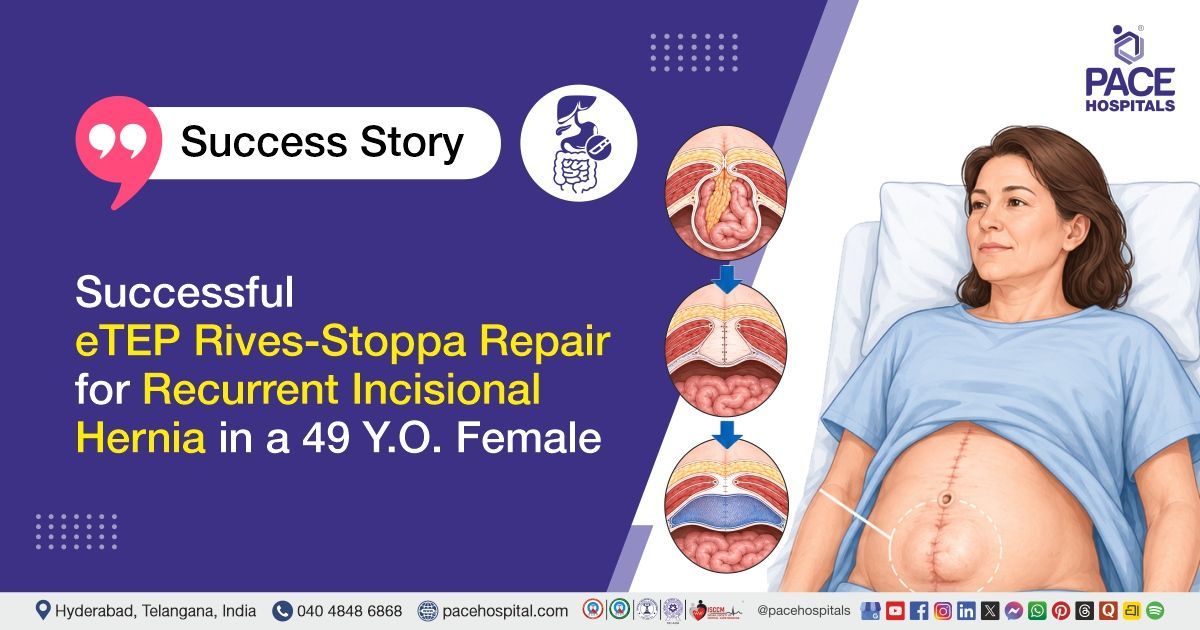
Successful eTEP Rives-Stoppa Repair for Recurrent Incisional Hernia in a 49 Y.O. Female
PACE Hospitals
PACE Hospitals’ expert Surgical Gastroenterology team successfully performed Extended / Enhanced View Totally Extraperitoneal (eTEP) Rives-Stoppa Repair on a 49-year-old female patient diagnosed with recurrent infraumbilical incisional hernia. The aim of the procedure was to reduce the hernia contents, close the abdominal wall defect, reinforce the weakened area with mesh, relieve abdominal swelling and pain, improve abdominal wall strength, and reduce the risk of further recurrence.
Chief Complaints
A 49-year-old female patient with a body mass index (BMI) of 20 presented to the Surgical Gastroenterology Department at PACE Hospitals, Hitech City, Hyderabad, with complaints of swelling in the lower abdomen for the past 45 days. The swelling was associated with intermittent, moderate-intensity pain. She had no complaints of constipation or vomiting.
Past Medical History
The patient had a history of open hysterectomy in the past and had previously undergone open onlay meshplasty, after which the swelling recurred. She was a known case of diabetes mellitus and hypertension and was on regular medications. Outside ultrasound abdomen showed an infraumbilical hernia defect measuring approximately 5 × 5 cm, with omentum and small bowel loops as hernia contents.
On Examination
On examination, the patient was conscious, coherent, oriented and hemodynamically stable. Local abdominal examination was suggestive of an infraumbilical incisional hernia, corresponding to the swelling in the lower abdomen. There were no symptoms of bowel obstruction, such as constipation or vomiting.
Diagnosis
Upon admission to PACE Hospitals, following a detailed clinical assessment, the Surgical Gastroenterology team evaluated the patient for lower abdominal swelling and intermittent abdominal pain with a history of previous open hysterectomy and prior open onlay meshplasty.
Clinical assessment and ultrasound abdomen findings were consistent with recurrent infraumbilical incisional hernia. The ultrasound showed an infraumbilical hernia defect measuring approximately 5 × 5 cm, with omentum and small bowel loops as contents. The diagnosis was confirmed as recurrent incisional hernia without obstruction or gangrene.
Routine investigations, including complete blood picture, renal function tests, serum electrolytes, liver function tests, viral screening, and coagulation profile, were performed to assess the patient’s overall fitness for surgery. Complete blood picture, renal function tests, serum electrolytes, and coagulation parameters were within acceptable limits. Viral screening was non-reactive.
Based on the confirmed diagnosis, the patient was advised to undergo Recurrent Incisional Hernia Treatment in Hyderabad, India, under the expert care of the Surgical Gastroenterology Department.
Medical Decision Making (MDM)
After a detailed consultation with Dr. Suresh Kumar S (Consultant Surgical Gastroenterologist), a comprehensive evaluation was conducted, considering the patient’s history of lower abdominal swelling for 45 days, intermittent moderate-intensity pain, a previous open hysterectomy, and a prior open onlay meshplasty with recurrence of swelling.
Clinical assessment and ultrasound abdomen findings confirmed recurrent infraumbilical incisional hernia, with omentum and small bowel loops as contents. The patient was also a known case of diabetes mellitus and hypertension and was on regular medications, which were considered during preoperative planning.
Based on the recurrent nature of the hernia, previous mesh repair, defect location, and hernia contents, it was determined that Extended / Enhanced View Totally Extraperitoneal Rives-Stoppa Repair was the most appropriate therapeutic intervention. The procedure was planned to reduce the hernia contents, close the abdominal wall defect, reinforce the weakened abdominal wall with mesh, and reduce the risk of further recurrence.
The patient and family members were counselled regarding the diagnosis, proposed surgical procedure, expected benefits, possible risks, need for drain care, abdominal binder use after surgery, and postoperative follow-up.
Surgical Procedure
Following the decision, the patient was scheduled to undergo Extended / Enhanced View Totally Extraperitoneal (eTEP) Rives-Stoppa Repair in Hyderabad at PACE Hospitals, under the expert care of the Surgical Gastroenterology Department.
The procedure involved the following steps:
- Patient Preparation and Anaesthesia: The patient was taken to the operating room after obtaining informed consent and completing pre-anaesthetic evaluation. Under appropriate anaesthesia, standard aseptic precautions were followed throughout the procedure.
- Port Placement and Access: A 10 mm Palmer’s point port was placed under vision using a visiport technique to enter the retro-rectus plane. Scope-guided dissection was then performed in the retro-rectus plane, and additional ports were placed as required.
- Hernia Identification and Reduction: Intraoperative findings showed a 4 × 3 cm infraumbilical defect with omentum and bowel as hernia contents. The hernia was identified as an interparietal type, and the previous onlay mesh was noted. The hernial contents were carefully reduced.
- Rives-Stoppa Repair and Defect Closure: Crossover dissection was performed to create adequate working space. The peritoneum with posterior rectus sheath was closed using V-Loc 2-0 suture. The anterior rectus sheath along with the hernia defect was then closed to restore abdominal wall integrity.
- Mesh Placement and Fixation: A 15 × 15 cm prolene mesh was placed in the prepared plane to reinforce the weakened abdominal wall. The mesh was fixed securely using 2-0 vicryl suture.
- Drain Placement and Completion: A 16 French suction drain was placed. The port sites were clipped, and the surgical area was checked thoroughly before completing the procedure. The patient was shifted for postoperative monitoring and further care.
Postoperative Care
The procedure was uneventful, and postoperative recovery was satisfactory. The patient was closely monitored for abdominal pain, vomiting, drain output, wound condition, bowel recovery, and overall clinical stability. During the hospital stay, she received treatment for hydration support, infection prevention, pain control, blood clot prevention, and other supportive postoperative care.
Discharge Medications
The patient was discharged with medications prescribed for postoperative infection prevention, pain relief, gastric protection, prevention of constipation, and blood clot prevention. Supportive medications were also advised to promote smooth recovery and reduce postoperative discomfort.
Advice on Discharge
The patient was advised to follow a normal diet and continue regular medications for existing medical conditions, as advised by the treating doctor. Proper drain care was explained, as the patient was discharged with the suction drain in situ. She was also advised to use an abdominal binder continuously for 8 weeks to support the abdominal wall, reduce strain over the repair site, and promote better postoperative healing.
Emergency Care
The patient was instructed to contact the emergency ward at PACE Hospitals in case of fever, abdominal pain, vomiting, increasing swelling, wound discharge, bleeding, severe pain, drain-related concerns, or any other emergency symptoms.
Review and Follow-up Notes
The patient was advised to return for a follow-up visit with the Surgical Gastroenterologist in Hyderabad at PACE Hospitals after 7 days for wound assessment, drain review, recovery evaluation, and further postoperative guidance.
Conclusion
This case highlights a recurrent infraumbilical incisional hernia managed successfully with Extended / Enhanced View Totally Extraperitoneal Rives-Stoppa Repair. The procedure was uneventful, and postoperative recovery was satisfactory. The patient was discharged in a hemodynamically stable condition with a suction drain in-situ, along with advice on drain care, abdominal binder use for 8 weeks, normal diet, and regular follow-up with the Surgical Gastroenterology team.
Advanced Abdominal Wall Reconstruction for Recurrent Incisional Hernia
Recurrent incisional hernia is not only a swelling over a previous surgical scar; it also indicates weakness of the abdominal wall that has returned even after earlier repair. Such cases need careful surgical planning because previous surgery, old mesh, scar tissue, and bowel-containing hernia contents can make the repair more complex. In this case, the patient had a recurrent infraumbilical incisional hernia after a previous open hysterectomy and open onlay meshplasty. The hernia contained omentum and bowel, making safe reduction and strong abdominal wall reinforcement important. A Surgical gastroenterologist / Surgical gastroenterology doctor performed an Extended / Enhanced View Totally Extraperitoneal Rives-Stoppa Repair, where the hernia contents were reduced, the defect was closed, and a mesh was placed in a well-supported plane to strengthen the abdominal wall.
Frequently Asked Questions (FAQs)
What is a recurrent incisional hernia?
A recurrent incisional hernia is a hernia that appears again at or near the site of a previous surgical scar after earlier repair. It occurs when the abdominal wall remains weak or becomes weak again. In this case, the patient had a recurrence after a previous open onlay mesh repair.
Why did this patient need surgery for recurrent incisional hernia?
Surgery was advised because the patient had lower abdominal swelling with intermittent pain, and an ultrasound showed a hernia defect containing omentum and small bowel loops. Since the hernia had recurred after previous repair, surgical correction was needed to reduce the contents and strengthen the abdominal wall.
What is an infraumbilical incisional hernia?
An infraumbilical incisional hernia is a hernia that develops below the belly button at the site of a previous abdominal surgery. It may appear as swelling in the lower abdomen. It can contain fatty tissue, omentum, or bowel loops, depending on the size and location of the defect.
Why is recurrent hernia repair more complex than first-time hernia repair?
Recurrent hernia repair can be more complex due to prior surgery, scar tissue, old mesh, and altered abdominal wall layers. Careful dissection is needed to safely reduce hernia contents and avoid injury to surrounding structures. Expert surgical planning enhances repair strength and recovery.
What is the Extended / Enhanced View Totally Extraperitoneal Rives-Stoppa Repair?
It is an advanced abdominal wall repair technique where the hernia is repaired without entering the main abdominal cavity as much as possible. The hernia contents are reduced, the defect is closed, and mesh is placed in a strong supporting plane. This helps reinforce the weakened abdominal wall.
Is bowel inside a hernia a serious finding?
Bowel inside a hernia needs careful evaluation because it can increase the risk of obstruction, pain, or complications if left untreated. In this case, there was no constipation or vomiting, but bowel loops were present in the hernia, so safe surgical reduction and repair were important.
Why was a drain placed after surgery?
Following surgery, a suction drain was placed to remove fluid that had accumulated in the operative area. Drain maintenance is necessary to decrease fluid buildup and promote healing. The patient was discharged with the drain in place and told to follow proper drain care procedures.
Why is an abdominal binder advised after hernia repair?
An abdominal binder helps support the repaired abdominal wall and reduces strain on the surgical site during movement, coughing, and daily activities. In this case, the patient was advised to use an abdominal binder for 8 weeks to support healing and protect the repair.
Can diabetes and hypertension affect hernia surgery recovery?
Yes, diabetes and hypertension can influence wound healing, infection risk, and overall recovery. Good blood sugar and blood pressure control before and after surgery helps support better healing. In this case, the patient was a known case of diabetes and hypertension and was on regular medication.
Is a recurrent incisional hernia dangerous if left untreated?
If untreated, a recurrent incisional hernia may increase in size and may cause pain, bowel obstruction, or, rarely, strangulation, where blood supply to trapped bowel is affected. Not every hernia becomes an emergency, but bowel-containing hernias should be evaluated and treated on time.
Share on
Request an appointment
Fill in the appointment form or call us instantly to book a confirmed appointment with our super specialist at 04048486868
Appointment request - health articles
Recent Articles