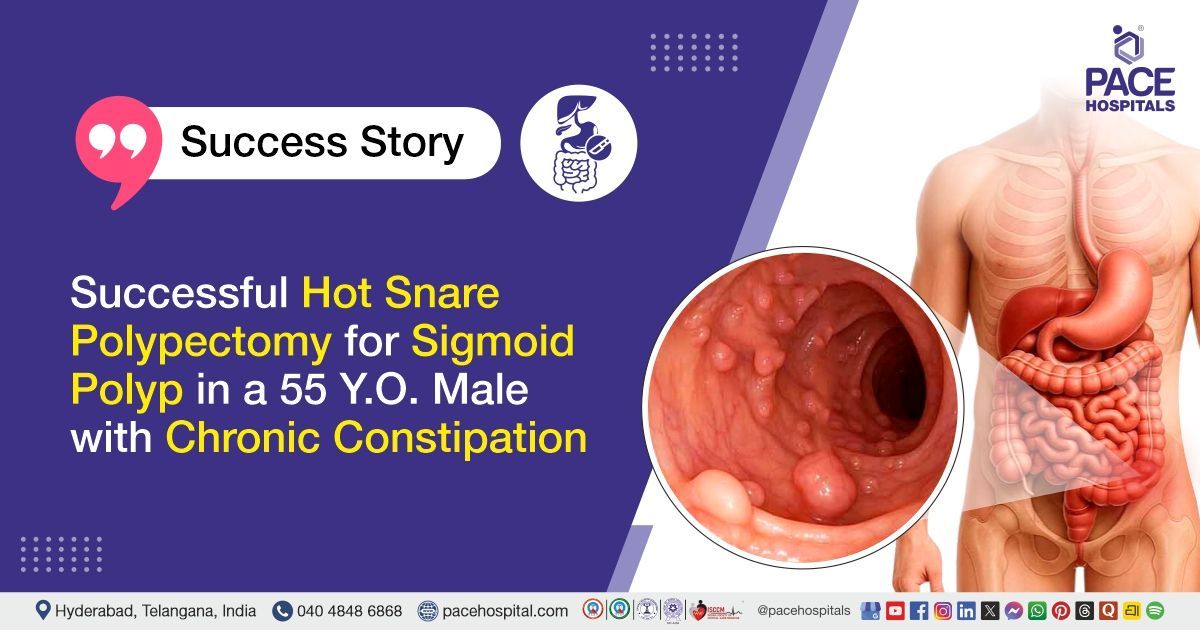
Successful Hot Snare Polypectomy for Sigmoid Polyp in a 55 Y.O. Male with Chronic Constipation
PACE Hospitals
PACE Hospitals’ expert gastroenterology team successfully performed a Sigmoid Polypectomy using the Hot Snare Technique on a 55-year-old male patient diagnosed with a sigmoid polyp and small internal hemorrhoids. The aim of the procedure was to safely remove the polyp, relieve symptoms such as constipation, and prevent potential progression to colorectal cancer by enabling early diagnosis through biopsy.
Chief Complaints
A 55-year-old male patient with a body mass index (BMI) of 20 presented to the Gastroenterology Department at PACE Hospitals, Hitech City, Hyderabad, with complaints of intermittent constipation for the past three months, associated with generalized weakness and anorexia (loss of appetite).
Past Medical History
The patient had no known comorbidities and no significant past medical or surgical history. There was no history of chronic illnesses such as hypertension, diabetes mellitus, cardiovascular disease, or previous gastrointestinal disorders reported.
On Examination
On examination, the patient was conscious, coherent, and well-oriented to time, place, and person. He was hemodynamically stable with vital signs within normal limits. Systemic examination revealed a soft and non-tender abdomen with no signs of organomegaly or guarding. Respiratory and cardiovascular examinations were normal, and oxygen saturation was maintained on room air.
Diagnosis
Upon admission to PACE Hospitals, following the clinical assessment, the Gastroenterology team conducted a comprehensive evaluation of the patient’s symptoms, including intermittent constipation for three months associated with generalized weakness and anorexia, along with a detailed review of his medical history.
Clinical examination and colonoscopic evaluation revealed sigmoid colon polyp and small internal hemorrhoids. Laboratory investigations, including complete blood picture (CBP) and renal function tests (RFT), were largely within normal limits except for mild anemia and mild thrombocytopenia. There was no evidence of systemic instability, and vital parameters remained stable throughout the evaluation.
Based on the confirmed diagnosis, the patient was advised to undergo
Sigmoid Polyp Treatment in Hyderabad, India, under the expert care of the Gastroenterology Department.
Medical Decision Making (MDM)
After a detailed consultation with consultant gastroenterologists, Dr. Govind Verma, Dr. M. Sudhir, and Dr. Padma Priya, a comprehensive evaluation was performed to determine the most appropriate diagnostic and therapeutic approach.
Considering the patient’s history of on-and-off constipation for 3 months associated with generalized weakness and anorexia, and endoscopic findings suggestive of a sigmoid colon polyp along with small internal hemorrhoids, further evaluation and definitive management were planned. The absence of significant comorbidities and stable clinical parameters supported an endoscopic therapeutic approach.
Based on clinical assessment, colonoscopic findings, and routine laboratory investigations showing mild anemia with otherwise stable hematological parameters, it was determined that sigmoid hot snare polypectomy was identified as the most appropriate and effective management strategy. This approach was chosen to ensure complete removal of the lesion, prevent potential malignant transformation, obtain tissue for histopathological examination, and provide symptom relief with minimal invasiveness and faster recovery compared to surgical alternatives.
The patient and his family members were counselled regarding the diagnosis, endoscopic findings, procedure performed, and the importance of follow-up for histopathology report correlation and further management if required.
Surgical Procedure
Following the decision, the patient was scheduled to undergo Sigmoid Hot Snare Polypectomy Procedure in Hyderabad at PACE Hospitals, under the specialized care of the Gastroenterology Department.
The following steps were carried out during the procedure:
- Colonoscopic Access and Localization: A flexible colonoscope was introduced per rectum and advanced through the large bowel. The sigmoid colon was carefully examined, and the polyp was identified under direct visualization.
- Assessment and Preparation of the Lesion: The sigmoid polyp was evaluated in terms of size, morphology, and attachment. The surrounding mucosa was inspected to ensure safe endoscopic resection.
- Submucosal Injection (Polyp Lifting): The base of the polyp was injected with methylene blue solution into the submucosal layer. This created a lifting effect, separating the lesion from deeper muscular layers and reducing the risk of perforation.
- Hot Snare Polypectomy (Polyp Resection): A wire snare was positioned around the base of the lifted polyp, and electrocautery current was applied. This allowed simultaneous cutting and coagulation, resulting in complete excision of the polyp with effective hemostasis.
- Specimen Retrieval and Procedure Completion: The excised polyp was retrieved and sent for histopathological examination (HPE). The resection site was inspected endoscopically, and no immediate bleeding or complications were observed. The procedure was completed successfully.
Postoperative Care
Following the procedure, the patient had an uneventful recovery during the hospital stay. He was managed with supportive care, including hydration, infection prevention, gastric mucosal protection, and bowel regulation measures. The patient showed good symptomatic improvement and remained clinically stable throughout admission. He tolerated diet well and had no post-procedural complications. The histopathology report suggested that the polyp was a benign growth (tubular adenoma) with mild abnormal cell changes (low-grade dysplasia). The patient was discharged in a hemodynamically stable condition with advice for follow-up care.
Discharge Medications
Upon discharge, the patient was prescribed medications for the prevention of post-procedural infection, the reduction of gastric acid secretion to support gastrointestinal mucosal healing, and the maintenance of regular bowel movements to prevent constipation and straining. The management plan was supportive in nature, focusing on post-endoscopic recovery, gastrointestinal protection, and bowel regulation.
Advice on Discharge
The patient was advised to follow a normal diet as tolerated.
Emergency Care
The patient was informed to contact the emergency ward at PACE Hospitals in case of any emergency or development of symptoms such as fever, severe abdominal pain, rectal bleeding, vomiting, or passage of black stools.
Review and Follow-up Notes
The patient was advised to return for a follow-up visit with the Gastroenterologist in Hyderabad at PACE Hospitals, after 1 week to review his condition.
Conclusion
This case highlights a sigmoid colon polyp with small internal hemorrhoids identified during evaluation of chronic constipation and associated symptoms. The polyp was successfully removed by colonoscopic hot snare polypectomy without complications. The patient had an uneventful recovery with symptomatic improvement and remained clinically stable. Histopathological examination was advised for further evaluation and confirmation.
Importance of Early Colonoscopy in Colorectal Disease
Early colonoscopy helps in detecting abnormalities in the large intestine at a very early stage, even before clear symptoms appear. It is highly effective in identifying conditions like polyps, ulcers, inflammation, and early colorectal cancer. During the procedure, abnormal growths can often be removed immediately, preventing them from becoming cancerous later. It also allows doctors, especially a Gastroenterologist / Gastroenterology doctor, to take tissue samples for biopsy, which helps confirm an accurate diagnosis. Early detection through colonoscopy improves treatment planning and increases the chances of successful recovery. It reduces the risk of serious complications and the need for major surgical procedures. Overall, it plays a key role in both prevention and early management of colorectal diseases under the care of a Gastroenterologist.
Frequently Asked Questions (FAQs)
What is the significance of a sigmoid polyp, and why is it important to remove it?
Sigmoid polyps are abnormal growths in the sigmoid colon that can be benign but have the potential to become cancerous over time. Removal of these polyps helps reduce the risk of colon cancer. Regular monitoring and removal of polyps, such as through polypectomy, are essential in preventing future complications and maintaining colon health.
What is a hot snare polypectomy, and how does it work?
A hot snare polypectomy is a procedure in which a heated wire loop is used to remove polyps from the colon. The heat from the wire cauterizes the tissue, minimizing the risk of bleeding and ensuring a clean removal. This procedure, typically performed during a colonoscopy, is effective in removing benign polyps while preventing complications.
What role does colonoscopy play in the removal of sigmoid polyps?
Colonoscopy is a simple procedure that lets a gastroenterologist see inside the colon. It helps find and check polyps, including those in the sigmoid colon. If needed, the doctor can remove polyps safely using special tools during the same procedure. This makes the process effective and helps reduce the risk of complications.
How long does it take to recover after a sigmoid polypectomy?
Most patients recover quickly after a sigmoid polypectomy, typically requiring only a few days of rest. Discomfort or bloating may persist for a short period, but normal activities can generally be resumed within 1–2 days. Full recovery, including any minor side effects, usually takes about one to two weeks.
What follow-up care is required after a sigmoid polypectomy?
After a sigmoid polypectomy, it is important to follow up with a gastroenterologist to discuss the biopsy results and any further recommendations. Monitoring for signs of recurrence is necessary, and regular screenings may be suggested depending on the type of polyp removed and its potential risk for cancer.
What does the biopsy report from the sigmoid polypectomy show, and why is it important?
The biopsy report of the removed polyp shows whether it is benign (non-cancerous), precancerous, or cancerous. This result helps the doctor decide the next step in treatment or follow-up care. If the polyp is benign, there is usually no immediate concern. However, regular check-ups are still advised to prevent future problems. This helps in early detection and better long-term health management.
Are there any long-term effects after having a sigmoid polypectomy?
Most patients do not have any long-term effects after a sigmoid polypectomy. It is a safe and effective procedure to remove harmful polyps from the colon. The recovery is usually smooth without lasting problems. However, depending on the biopsy results, your doctor may suggest regular follow-up check-ups. These screenings help detect any new polyps early. This also helps reduce the risk of colon cancer in the future.
Can a normal diet be resumed after the sigmoid polypectomy procedure?
After a sigmoid polypectomy, most patients can resume a normal diet. It is usually recommended to start with soft and light foods immediately after the procedure. For the first few days, it is best to avoid spicy, oily, and heavy foods that can irritate the stomach. Eat small, simple, and easy-to-digest meals and drink plenty of fluids to help recovery. As you start feeling better, you can slowly go back to your normal diet. Always follow your doctor’s advice for a safe and smooth recovery.
What are the risks associated with sigmoid polypectomy?
Sigmoid polypectomy is usually a safe procedure, but like any medical treatment, it has some small risks. These risks may include bleeding, infection, or in rare cases, a small tear in the colon (perforation). However, such complications are uncommon. The procedure is usually very safe when performed by an experienced gastroenterologist in a well-equipped hospital.
When should urgent medical attention be sought after a sigmoid polypectomy?
Urgent medical attention should be sought if symptoms such as severe abdominal pain, heavy bleeding, fever, or signs of infection occur after the procedure. These could indicate complications that require prompt medical intervention. In such cases, contacting the healthcare provider immediately for evaluation and care is necessary.
Share on
Request an appointment
Fill in the appointment form or call us instantly to book a confirmed appointment with our super specialist at 04048486868
Appointment request - health articles
Recent Articles