Successful L4–L5 Laminectomy and Discectomy for Intervertebral Disc Prolapse
PACE Hospitals
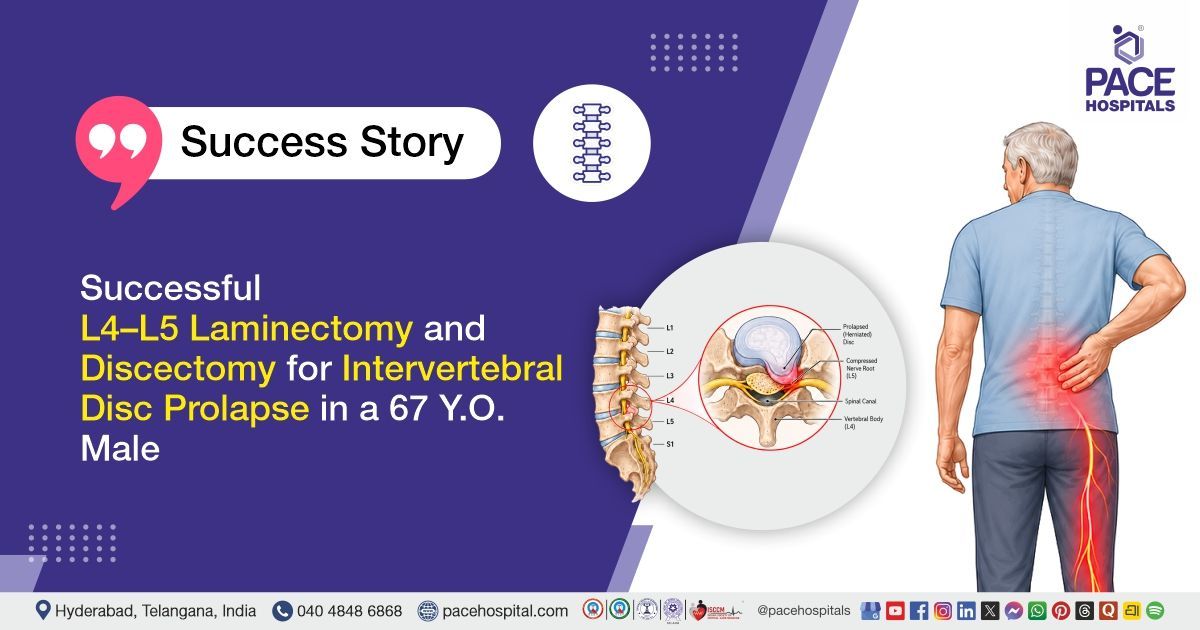
PACE Hospitals’ expert Neurosurgery team successfully performed an L4–L5 Minimally Invasive Laminectomy and Discectomy on a 67-year-old male patient diagnosed with L4–L5 Intervertebral Disc Prolapse. The aim of the procedure was to relieve nerve compression caused by the prolapsed disc, alleviate lower back and leg pain, improve neurological function, and restore mobility and quality of life.
Chief Complaints
A 67-year-old male patient with a body mass index (BMI) of 21 presented to the Neurosurgery Department at PACE Hospitals, Hitech City, Hyderabad, with complaints of persistent low back pain associated with right lower limb radiculopathy for the past 9 months. Initially, the pain was aggravated while walking and bending and was managed with physiotherapy and medical treatment. However, for the past 5 days, the severity of pain had increased, and the patient developed pain even at rest, along with numbness in the right lower limb. There were no associated urinary complaints.
Past Medical History
The patient had a significant past medical history of carcinoma of the stomach, for which he underwent gastrectomy followed by chemotherapy. He was also a known case of diabetes mellitus and was on regular medical management for glycemic control.
On Examination
On examination, the patient was conscious, coherent, and oriented to time, place, and person. He was moderately built and nourished, with stable vital signs. Cardiovascular examination revealed normal heart sounds, while respiratory examination showed bilaterally equal air entry. Abdominal examination was soft and non-tender. Neurological examination demonstrated preserved motor power in both lower limbs, with a positive straight leg raise test on the right side and decreased sensation in the right L5 dermatomal distribution, consistent with right-sided lumbar radiculopathy.
Diagnosis
Upon admission to PACE Hospitals, the patient underwent a comprehensive clinical evaluation along with a detailed review of his medical history and diagnostic investigations conducted by the Neurosurgery team.
Clinical assessment revealed a history of chronic low back pain associated with right lower limb radiculopathy, which had progressively worsened despite conservative management. The patient subsequently developed pain at rest and numbness in the right lower limb. Neurological examination demonstrated a positive straight leg raise test on the right side and decreased sensation in the right L5 dermatome, while motor power was preserved in both lower limbs. There were no urinary complaints or features suggestive of bowel or bladder involvement.
Laboratory investigations revealed mild anemia and mild neutrophilic leukocytosis, while coagulation parameters were within normal limits. The patient also had a significant medical history of carcinoma of the stomach, status post gastrectomy and chemotherapy, along with diabetes mellitus on medical management.
Radiological evaluation of the lumbar spine demonstrated an L4–L5 intervertebral disc prolapse causing compression of the corresponding nerve root, correlating with the patient's clinical symptoms of lumbar radiculopathy and sensory deficits.
Based on the confirmed diagnosis, the patient was advised to undergo L4–L5 Intervertebral Disc Prolapse Treatment in Hyderabad, India, with right-sided lumbar radiculopathy under the expert care of the Neurosurgery Department.
Medical Decision-Making (MDM)
After a detailed consultation with Dr. U. L. Sandeep Varma (Consultant Neurosurgeon), a comprehensive evaluation was conducted focusing on the patient’s presentation of chronic low back pain with right lower limb radiculopathy of several months' duration, which had significantly worsened in the days preceding admission despite conservative treatment with physiotherapy and medications. The patient also reported pain at rest and numbness in the right lower limb, adversely affecting daily activities and quality of life.
Clinical examination, laboratory investigations including complete blood picture, coagulation profile, and preoperative systemic assessment were reviewed. Neurological evaluation revealed a positive straight leg raise test on the right side and decreased sensation in the right L5 dermatomal distribution, while motor strength was preserved. The patient was also a known case of carcinoma of the stomach, status post gastrectomy and chemotherapy, along with diabetes mellitus on medical management. No bowel or bladder dysfunction was reported, and no major medical contraindications to surgery were identified.
Considering the persistent symptoms, worsening pain, sensory involvement, failed conservative treatment, and L4–L5 disc pathology causing nerve root compression, it was determined that L4–L5 minimally invasive laminectomy and discectomy under general anaesthesia was the most appropriate surgical intervention. The procedure was aimed at adequate decompression of the affected nerve root, removal of extruded disc material, relief of radicular pain and numbness, improvement in mobility, and prevention of further neurological deterioration.
The patient and family members were counselled in detail regarding the diagnosis, surgical procedure, expected outcomes, potential risks and benefits, postoperative rehabilitation, activity restrictions, wound care, medication adherence, warning signs requiring urgent medical attention, and the importance of regular follow-up to ensure optimal recovery and long-term functional improvement.
Surgical Procedure
Following the decision, the patient was scheduled to undergo L4–L5 Minimally Invasive Laminectomy and Discectomy Surgery in Hyderabad at PACE Hospitals under the expert supervision of the Neurosurgery Department.
The procedure involved the following steps:
- Patient Positioning, Preparation, and Localization: Under general anesthesia, the patient was positioned appropriately, and the surgical site was prepared under strict aseptic precautions. The operative field was painted and draped in a sterile manner. Using intraoperative fluoroscopic guidance, the L4–L5 level was accurately localized and marked to ensure precise surgical access.
- Surgical Exposure and Approach: A vertical midline skin incision was made over the localized lumbar level and deepened through the subcutaneous tissues. The paraspinal musculature was carefully dissected to expose the right L4–L5 interlaminar space. During the exposure, subcutaneous tissue was excised and sent for histopathological examination (HPE).
- Laminectomy and Neural Decompression: A right-sided L4 laminectomy was performed to gain access to the spinal canal. The ligamentum flavum was meticulously excised, exposing the underlying dura mater and the right L5 nerve root. Careful decompression was carried out while preserving the surrounding neural structures.
- Discectomy and Nerve Root Decompression: Following identification of the neural elements, a bulging and extruded L4–L5 intervertebral disc compressing the inflamed right L5 nerve root was visualized. The extruded disc fragments were removed in a piecemeal fashion, and a thorough discectomy was performed to achieve adequate decompression. At the completion of decompression, the nerve root was noted to be lax and freely pulsatile, indicating successful relief of neural compression.
- Hemostasis and Wound Closure: Meticulous hemostasis was achieved throughout the surgical field. After confirming adequate decompression and absence of active bleeding, the wound was irrigated and closed in anatomical layers. A sterile dressing was applied, and the patient was subsequently transferred to the recovery area in stable condition.
Postoperative Care
Postoperatively, the patient was monitored in the recovery area and transferred to the ward after four hours in stable condition. Neurological status, vital signs, and the surgical site were regularly assessed, with adequate pain control and aseptic dressing care. The patient was encouraged to mobilize early and ambulate gradually as tolerated. Histopathology of the L4–L5 subcutaneous lesion showed benign adipose tissue with features suggestive of a lipoma, with no evidence of malignancy. The patient was discharged in stable condition with advice on wound care, medications, activity restrictions, and scheduled follow-up.
Discharge Medications
Upon discharge, the patient was prescribed medications for the prevention and treatment of infection, control of neuropathic pain, and relief of musculoskeletal pain with associated muscle spasm. Gastric protective therapy was advised to reduce acid-related discomfort and support gastrointestinal tolerance. Supplementation for nerve health, recovery, and immune support was provided to aid overall healing. A topical preparation was also prescribed for local wound care and to promote proper healing at the surgical site.
Advice on Discharge
The patient was advised to take adequate rest for 6 weeks and to avoid travel during this period unless in case of emergency. The patient was allowed to take a bath and encouraged to walk and climb stairs as tolerated. The patient was instructed to avoid strenuous exercises and prolonged sitting for more than 1 hour at a time. The patient was advised to strictly follow the prescribed medications and attend regular follow-up as scheduled.
Emergency Care
The patient was instructed to contact the emergency ward at PACE Hospitals upon development of symptoms such as fever, weakness, discharge from the wound, or severe pain.
Review and Follow-up Notes
The patient was advised to return for follow-up with the Neurosurgeon in Hyderabad at PACE Hospitals after 3 weeks.
Conclusion
This case highlights successful surgical management of L4–L5 intervertebral disc prolapse using minimally invasive laminectomy and discectomy with good neurological recovery. The patient had significant improvement in pain and lower limb function postoperatively with stable recovery. He was discharged in stable condition with advice on rest, medications, and follow-up care.
Minimally Invasive Spine Surgery Improves Recovery and Functional Outcomes in Lumbar Disc Prolapse
Minimally invasive spine surgery has significantly improved the management of lumbar disc prolapse by allowing targeted decompression with minimal tissue disruption. This approach is associated with reduced postoperative pain and quicker functional recovery compared to conventional open procedures. Early surgical intervention helps prevent the progression of neurological deficits and promotes better long-term outcomes. It also facilitates early mobilization, thereby reducing the risk of postoperative complications such as infection and thromboembolism. The technique is particularly beneficial in patients with comorbidities, as it reduces surgical stress and hospital stay. Careful patient selection and perioperative optimization by a neurosurgeon/neurosurgery doctor further enhance safety and effectiveness. Overall, minimally invasive techniques have become a preferred approach for suitable cases of lumbar disc disease.
Frequently Asked Questions (FAQs)
When is a minimally invasive L4-L5 laminectomy and discectomy recommended?
This surgery may be recommended when a slipped disc at the L4-L5 level presses on a nerve and causes ongoing leg pain, numbness, tingling, or difficulty walking. It is usually considered when symptoms do not improve with medicines, physiotherapy, rest, or other non-surgical treatments.
How does an L4-L5 discectomy help with leg pain and numbness?
A slipped disc can put pressure on the nearby nerve, leading to pain, tingling, or numbness that travels down the leg. During a discectomy, the part of the disc causing the pressure is removed, giving the nerve more space and helping symptoms improve over time.
Why was a laminectomy done along with a discectomy?
A discectomy was done to remove the slipped or extruded disc material pressing on the nerve root. A laminectomy was performed along with it to create enough space around the compressed nerve by removing a small part of the bone and thickened ligament. Together, these procedures helped achieve better nerve decompression, reduce radicular leg pain and numbness, and improve mobility.
How soon can leg pain improve after a lumbar discectomy?
Many people notice an improvement in leg pain soon after surgery. However, numbness, tingling, or weakness may take longer to recover. The healing time depends on how severely and how long the nerve was compressed before the operation.
Why should prolonged sitting be avoided after L4-L5 disc surgery?
Sitting continuously for a long time can increase pressure on the lower back and may strain the healing tissues after surgery. During the recovery period, patients are advised to avoid prolonged sitting, take short walking breaks, sit with proper back support, and maintain good posture as recommended by the spine surgeon.
Can patients walk and climb stairs after minimally invasive lumbar surgery?
In most cases, walking is encouraged soon after surgery because it helps improve circulation and recovery. Climbing stairs is often allowed if the patient feels comfortable and stable, but it should be done carefully and according to the surgeon’s advice.
Why is travel restricted after lumbar laminectomy and discectomy?
Long journeys usually require sitting for a long time, which can put extra pressure on the lower back and spine. During travel, small bumps, vibrations, and sudden movements can also affect the healing spine. Avoiding travel in the early recovery period helps reduce strain on the operated area and supports proper healing.
What precautions help prevent recurrent disc prolapse after surgery?
After surgery, patients should avoid heavy lifting, too much bending, twisting of the back, and strenuous activities until the doctor says it is safe. Keeping a healthy weight, doing the advised exercise program, and maintaining good posture can help reduce strain on the spine and support long-term recovery.
What warning signs need urgent medical attention after spine surgery?
Medical attention should be sought immediately if there is fever, redness or discharge from the wound, increasing pain, new weakness in the legs, worsening numbness, or problems with bladder or bowel control. These symptoms should not be ignored.
What does a lipoma finding in the surgical tissue mean?
A lipoma is a non-cancerous growth made up of fatty tissue. If the tissue removed during surgery is reported as a lipoma, it generally means that no cancerous changes were found. The surgeon will explain the findings and whether any further follow-up is needed.
Share on
Request an appointment
Fill in the appointment form or call us instantly to book a confirmed appointment with our super specialist at 04048486868
Appointment request - health articles
Recent Articles