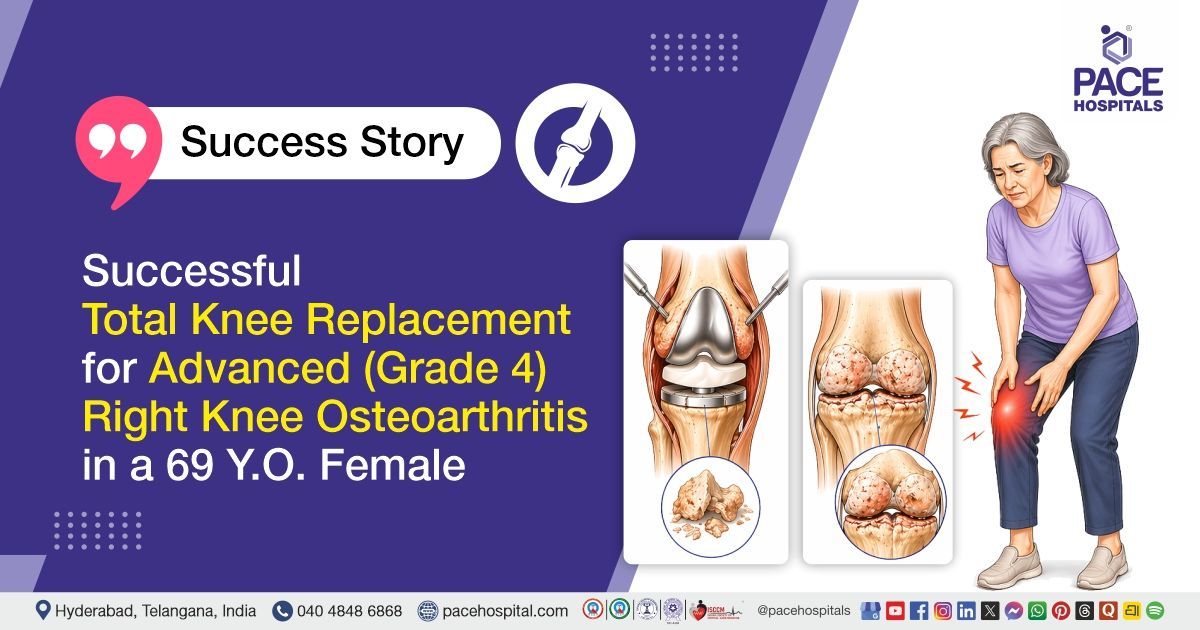
Successful Total Knee Replacement for Grade 4 Knee Osteoarthritis
PACE Hospitals
PACE Hospitals’ expert orthopaedic team successfully performed a Right Total Knee Replacement surgery on a 69-year-old female patient diagnosed with Grade 4 osteoarthritis of the right knee. The aim of the procedure was to relieve chronic pain, restore joint function, improve mobility, and enhance the patient’s overall quality of life.
Chief Complaints
A 69-year-old female patient with a body mass index (BMI) of 21 presented to the Orthopaedic Department at PACE Hospitals, Hitech City, Hyderabad, with complaints of right knee pain for approximately one year. The pain was associated with difficulty in performing daily activities such as walking and standing, along with significant difficulty in climbing and descending stairs. There was no history of trauma or known drug allergies. The patient was admitted for further evaluation and management.
Past Medical History
The patient had a history of left total knee replacement performed at an outside facility. The patient was a known case of diabetes mellitus.
On Examination
On examination, the patient was conscious, coherent, and oriented, and was afebrile with stable vital parameters. General physical examination was normal. Local examination of the right knee revealed a valgus deformity with associated swelling. There was a fixed flexion deformity, with palpable crepitus and tenderness over the medial joint line and suprapatellar region. Medial collateral ligament laxity was noted. The range of motion was grossly restricted and painful. No distal neurovascular deficits were observed.
Systemic examination revealed adequate bilateral air entry in the respiratory system, normal heart sounds without murmurs on cardiovascular examination, a soft and non-tender abdomen with normal bowel sounds, and no focal neurological deficits on central nervous system evaluation.
Diagnosis
Following the clinical evaluation, the Orthopaedics team at PACE Hospitals conducted a detailed assessment focusing on the patient’s complaints of right knee pain associated with difficulty in walking, standing, and performing routine daily activities for the past one year, along with difficulty in climbing and descending stairs.
A comprehensive clinical and systemic examination was carried out to determine the severity of the condition. Examination of the right knee revealed valgus deformity with associated swelling, fixed flexion deformity, and palpable crepitus. There was tenderness over the medial joint line and suprapatellar region, along with medial collateral ligament laxity. The range of motion was significantly restricted and painful. No distal neurovascular deficit was noted. Systemic examination was within normal limits. Radiological evaluation (X-ray of the right knee) was consistent with advanced degenerative changes.
Based on these findings, the patient was advised to undergo Grade 4 Osteoarthritis Treatment in Hyderabad, India, under the care of the Orthopaedic Department to relieve pain, correct deformity, restore joint function, improve mobility, and enhance overall quality of life.
Medical Decision-Making (MDM)
After a detailed consultation with Dr. Anand Agroya, Senior Orthopaedic Consultant, a comprehensive evaluation was performed to determine the most appropriate diagnostic and therapeutic approach. Considering the patient’s history of right knee pain, difficulty in walking, standing, and performing daily routine activities, along with difficulty in climbing and descending stairs, and associated restriction in functional movements, a focused local examination and radiological assessment were undertaken to formulate an optimal treatment strategy. Clinical findings revealed valgus deformity, swelling, fixed flexion deformity, crepitus, medial joint line tenderness, ligament laxity, and restricted, painful range of motion. Radiological evaluation confirmed Grade 4 osteoarthritis of the right knee.
Based on the clinical findings and imaging, which confirmed Grade 4 osteoarthritis of the right knee, it was determined that Right Total Knee Replacement surgery was identified as the most suitable intervention to relieve pain, correct deformity, restore joint alignment, improve mobility, and enhance overall functional outcome, as conservative treatment had failed to provide adequate relief.
The patient and her family members were thoroughly counselled regarding the diagnosis, need for surgery, procedure details, associated risks, and recovery process. Informed consent was obtained, ensuring their understanding and involvement in the treatment plan.
Surgical Procedure
Following the diagnosis, the patient was scheduled to undergo Right Total Knee Replacement surgery in Hyderabad at PACE Hospitals, under the supervision of the expert Orthopaedic Department.
The surgical procedure involved the following steps:
- Anaesthesia, Positioning, and Surgical Preparation: The patient was administered combined spinal epidural anaesthesia and positioned supine on the operating table. The affected right lower limb was flexed to 90 degrees, prepared, and draped in a sterile manner. A tourniquet was applied to maintain a bloodless surgical field. Prophylactic intravenous antibiotics were administered prior to incision.
- Surgical Exposure and Joint Access: A midline skin incision was made over the right knee, followed by careful dissection of subcutaneous tissues. A medial para-patellar arthrotomy was performed to access the joint. The patella was everted, and the joint was exposed. Intraoperative findings revealed Grade 4 osteoarthritic changes. Medial and lateral soft tissue releases were carried out. The anterior cruciate ligament (ACL) was excised, and medial and lateral meniscectomy was performed. Osteophytes from the distal femur and proximal tibia were removed.
- Bone Preparation and Alignment: The knee joint was dislocated using appropriate instrumentation. Proximal tibial resection was performed using a tibial jig, ensuring proper alignment. Distal femoral entry was made, and femoral cuts were carried out using a distal femoral jig with appropriate valgus angulation. Sequential anterior, posterior, and chamfer cuts were completed. Flexion and extension gaps were assessed and balanced. Trial components were inserted to evaluate alignment, stability, and patellar tracking.
- Implant Placement and Fixation: After confirming satisfactory trial reduction, definitive preparation of the tibial and femoral surfaces was done. Thorough irrigation was performed using pulsavac lavage. Bone cement was applied, and the prosthetic components (Femur size D – PS, Tibia size 4, Polyethylene insert 9 mm) were implanted. Stability, alignment, and range of motion were reassessed and confirmed. Synovectomy was performed, and patellar osteophytes were excised.
- Wound Closure: Hemostasis was achieved, and the surgical wound was closed in layers. Skin closure was performed using staples, completing the procedure without intraoperative complications.
Postoperative Care
Postoperatively, the patient was started on medications for infection prevention, pain control, blood thinning, and prevention of blood clots. Dressing was done on postoperative day 1, and mild soakage was noted, followed by appropriate wound care and physiotherapy. The patient was mobilized with a walker on postoperative day 2 and experienced transient giddiness, after which close monitoring of vital signs was continued. Foley’s catheter and epidural catheter were removed on postoperative day 3 after clinical stabilization. By postoperative day 4, the patient showed satisfactory recovery and was discharged in a hemodynamically stable condition with medications and advice.
Discharge Medications
Upon discharge, the patient was prescribed medications for postoperative infection prevention, pain and inflammation control, gastric acid protection, severe pain relief on an as-needed basis, and blood thinning to prevent clot formation. These medications were advised for short-term postoperative recovery along with continued antiplatelet therapy for an extended duration.
Advice on Discharge
At the time of discharge, the patient was advised to keep the surgical dressing dry and not to wet it. She was instructed to avoid sitting cross-legged or using traditional Indian-style toilets. She was also advised to continue regular physiotherapy exercises involving the knee, calf, ankle, toes, and chest as per the total knee replacement rehabilitation protocol to aid recovery and improve joint mobility.
Emergency Care
The patient was advised to contact the emergency ward at PACE Hospitals immediately in case of any emergency or if symptoms such as fever, knee pain, and vomiting.
Review and Follow-Up Notes
The patient was advised to return for follow-up at the Orthopaedic Doctor in Hyderabad at PACE Hospitals, after 5 days for wound dressing review in case of any soakage, and subsequently after 14 days from the date of surgery for staple removal and further clinical assessment.
Conclusion
This case highlights advanced Grade 4 osteoarthritis of the knee managed successfully with total knee replacement surgery. The procedure was completed without intraoperative complications, achieving good implant positioning and restoration of joint alignment. Postoperative recovery was smooth with early mobilization, stable clinical parameters, and satisfactory pain control. The patient was discharged in a stable condition with advice for rehabilitation and follow-up.
Total Knee Replacement in Advanced Degenerative Joint Disease
Total knee replacement is a well-established surgical option for managing end-stage degenerative knee arthritis when conservative treatment fails. It primarily aims to relieve pain, correct deformity, and restore joint function and mobility. Careful preoperative assessment by an Orthopaedician, including medical optimization and imaging, is essential for safe surgical planning. Precise surgical technique with accurate alignment and balanced soft tissues plays a key role in long-term implant success.
Early postoperative mobilization and structured physiotherapy are critical for functional recovery. With appropriate patient selection and rehabilitation, total knee replacement significantly improves quality of life and independence in daily activities. Long-term follow-up with the Orthopaedic Doctor/Orthopaedic Surgeon is important to monitor implant performance and detect any complications early. Continuous advancements in implant design and surgical techniques have further improved outcomes and durability.
Frequently Asked Questions (FAQs)
How will recovery be affected if surgery was already done on the other knee?
Recovery may be slightly easier as the patient is already familiar with exercises and walking methods. This often improves confidence while moving. However, healing still depends on age, muscle strength, and medical conditions like diabetes. Regular physiotherapy is still important for proper recovery.
Why is the knee still stiff after surgery, and is this normal?
Stiffness is common in the early days after surgery due to swelling and healing tissues. Limited movement like 10–40 degrees can happen initially. With daily exercises and physiotherapy, movement improves slowly. Patience and regular practice are necessary.
What precautions should be followed with this knee implant?
Certain activities should be avoided to protect the implant. Sitting cross-legged and using Indian toilets are not advised. High-impact activities like running should be avoided. Maintaining healthy weight and following doctor’s advice helps in long-term success.
How does diabetes affect recovery after knee replacement?
Diabetes can slow down wound healing and increase the chance of infection. Blood sugar levels need to be well controlled after surgery. Proper diet, medicines, and monitoring are important. Good control helps in faster and safer recovery.
Why are blood-thinning medicines given after surgery?
These medicines help prevent blood clots in the legs after surgery. Reduced movement in early days can increase clot risk. Taking medicines as prescribed reduces this complication. Walking and exercises also help improve blood flow.
What warning signs need immediate medical attention?
Warning signs such as fever, chest pain, severe swelling, or persistent vomiting should not be ignored. These symptoms may indicate infection or other complications. Immediate medical attention is required if they occur. Early treatment helps prevent serious health problems.
Why did dizziness happen while walking after surgery?
Dizziness can occur due to anesthesia effects or pain medicines. Sudden movement after rest can also cause lightheadedness. This usually improves within a few days. Walking with support and supervision is important in the beginning.
How long can the knee implant last at this age?
Knee implants generally last about 15 to 20 years. Their durability depends on factors like bone quality, activity level, and overall health. Following proper precautions and maintaining appropriate daily activities helps improve implant lifespan. Regular follow-up visits are important to monitor the implant condition and ensure long-term success.
Why was spinal epidural anesthesia used instead of general anesthesia?
This type of anesthesia is safer for older patients. It reduces stress on heart and lungs. Pain control after surgery is also better. Recovery is usually faster compared to general anesthesia.
What can lead to another surgery in the future?
Another surgery in the future may be needed if complications such as infection, implant loosening, or injury around the operated joint occur. Failure to follow advised physiotherapy or neglecting postoperative precautions can also impact the surgical outcome. Poor rehabilitation may result in stiffness or reduced joint function over time. Regular follow-up visits and proper care help in minimizing these risks and maintaining good long-term results.
Share on
Request an appointment
Fill in the appointment form or call us instantly to book a confirmed appointment with our super specialist at 04048486868
Appointment request - health articles
Recent Articles