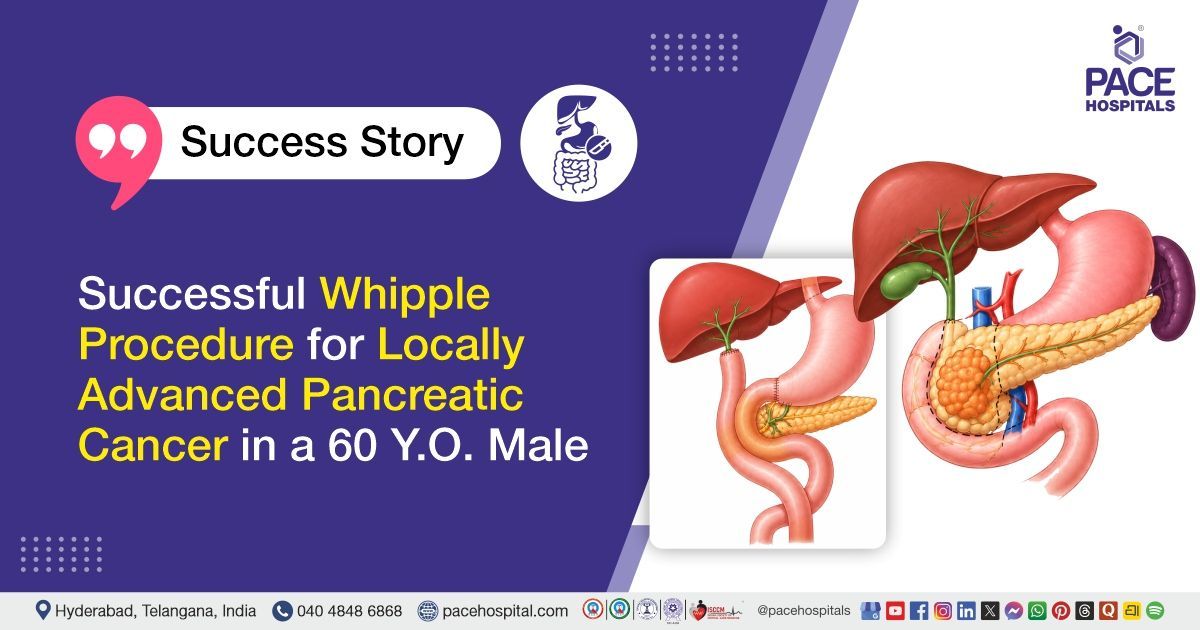
Successful Whipple Procedure for Locally Advanced Pancreatic Cancer
PACE Hospitals
PACE Hospitals' expert surgical gastroenterology team successfully performed a Whipple Procedure (pancreaticoduodenectomy) with Vascular Resection and Reconstruction for a 60-year-old male patient diagnosed with locally advanced carcinoma of the head of the pancreas, status post ERCP with CBD stenting and neoadjuvant chemotherapy, with the aim of removing the tumor, restoring digestive continuity, and improving disease control.
Chief Complaints
A 60-year-old male patient with a body mass index of 17 presented to the Surgical Gastroenterology Department at PACE Hospitals, Hitech City, Hyderabad, with complaints of abdominal pain and obstructive jaundice.
Past Medical History
The patient had a known history of locally advanced carcinoma of the head of the pancreas with obstructive jaundice. He previously underwent ERCP with CBD stenting and later received neoadjuvant chemotherapy before being planned for surgical management.
On Examination
On examination, the patient was conscious, coherent, oriented and hemodynamically stable. General physical examination was done. Cardiovascular and respiratory system examinations were clinically normal. Abdominal examination did not reveal any obvious external abnormality.
Diagnosis
Upon admission to PACE Hospitals, following a detailed clinical assessment, the Surgical Gastroenterology team evaluated the patient for abdominal pain and obstructive jaundice with a known history of carcinoma of the head of the pancreas (pancreatic cancer), status post ERCP with CBD stenting and neoadjuvant chemotherapy.
Clinical assessment and imaging findings were consistent with locally advanced carcinoma of the head of the pancreas with involvement of nearby major blood vessels. Chest X-ray showed abnormal respiratory findings, including basal haziness and pleural effusion-related changes.
Routine investigations, including complete blood picture, serum electrolytes, renal function tests, liver function tests, blood gas analysis, urine examination, serum amylase, drain fluid amylase, drain fluid triglycerides, and procalcitonin, were performed to assess the patient’s overall medical condition. Complete blood picture was abnormal due to thrombocytopenia and intermittent neutrophilic changes. Serum electrolytes showed intermittent abnormalities. Renal function tests were largely within acceptable limits. Liver function tests showed intermittent abnormality. Blood gas analysis showed abnormal findings during the hospital course. Serum and drain fluid amylase were within acceptable limits and drain fluid triglycerides were not suggestive of chyle leak.
Microbiological investigations, including blood culture, urine culture, wound swab culture, drain fluid culture, ascitic fluid culture, and CBD stent tip culture, were performed. Blood culture and CBD stent tip culture were abnormal, showing multidrug-resistant Klebsiella infection. Urine culture, wound swab culture, drain fluid culture, and ascitic fluid culture did not show significant bacterial growth.
Based on the confirmed diagnosis, the patient was advised to undergo Pancreatic Cancer Treatment in Hyderabad, India, under the expert care of the Surgical Gastroenterology Department.
Medical Decision Making (MDM)
After a detailed consultation with Dr. CH Madhusudan, Senior Consultant Surgical Gastroenterologist and Liver Transplant Surgeon, along with the team, including Dr. Suresh Kumar S, Consultant Surgical Gastroenterologist, along with cross consultations from Dr. S Pramod Kumar (Consultant Neurophysician), Dr. Lakshmi Kumar Chalamarla (Senior Interventional Radiologist), Dr. Tripti Sharma (Endocrinologist), a comprehensive evaluation was performed to determine the most appropriate diagnostic and therapeutic approach.
Considering the patient’s history of abdominal pain and obstructive jaundice, along with a known diagnosis of locally advanced carcinoma of the head of the pancreas, the case was carefully reviewed. The patient had previously undergone ERCP with CBD stenting and neoadjuvant chemotherapy, with good response noted on follow-up evaluation.
Based on clinical assessment, imaging findings, response to chemotherapy, and multidisciplinary evaluation, it was determined that Whipple procedure (pancreaticoduodenectomy) at the splenic artery with arterial divestment, portal vein resection, arterial reconstruction using PTFE graft, and end-to-end portal vein anastomosis was the most appropriate and effective management strategy. This approach was chosen to remove the tumour and address the involvement of nearby major blood vessels while aiming for better surgical and functional outcomes.
The patient and his family members were counselled regarding the diagnosis, clinical findings, planned procedure, possible risks, need for vascular reconstruction, postoperative care, and the importance of regular follow-up.
Surgical Procedure
Following the decision, the patient was scheduled for a Whipple procedure (Pancreaticoduodenectomy) in Hyderabad at PACE Hospitals, under the expert care of the Surgical Gastroenterology Department.
The following steps were carried out during the procedure:
- Abdominal Access and Initial Exploration: A rooftop incision was made to access the abdominal cavity. On exploration, there was no evidence of peritoneal deposits, omental deposits, liver deposits, or free fluid. This confirmed that there was no obvious distant spread within the abdomen before proceeding with tumour resection.
- Exposure of Pancreas and Major Blood Vessels: Extended Kocherisation was performed, followed by the Cattell-Braasch manoeuvre to provide wide exposure of the pancreas, duodenum, and major abdominal vessels. The origin of the superior mesenteric artery and celiac axis was identified through a posteromedial approach. The tumour was found arising from the head of the pancreas and was involving the portal vein, proper hepatic artery, gastroduodenal artery, and right hepatic artery.
- Tumour Dissection and Lymphadenectomy: The fibrofatty and lymphatic tissue around the mesopancreas and vascular triangle area was cleared and sent for histopathological examination. Hepatoduodenal ligament lymphadenectomy was performed, and the liver hilum was exposed. The root of the mesentery was carefully dissected, preserving the first jejunal vein and artery. The infrapancreatic superior mesenteric artery was traced and skeletonised to allow safe tumour clearance.
- Whipple Resection with Vascular Resection: A retropancreatic tunnel was created, and the pancreatic neck was divided at the origin of the splenic artery as part of Whipple (pancreaticoduodenectomy) at the splenic artery. The tumour was removed completely along with the involved segment of the portal vein and the involved arterial segments, including the proper hepatic artery, right hepatic artery, and gastroduodenal artery. The specimen was removed in toto.
- Vascular and Gastrointestinal Reconstruction: Arterial reconstruction was performed using a PTFE interposition graft between the proper hepatic artery and the stump of the right hepatic artery. Portal vein reconstruction was done with end-to-end portal vein anastomosis. Digestive tract reconstruction was then completed with hepaticojejunostomy, pancreaticojejunostomy, and gastrojejunostomy. Hemostasis was secured, and the procedure was completed uneventfully.
Postoperative Care
After the surgery, the patient was closely monitored in the Intensive Care Unit (ICU) for breathing difficulty and routine postoperative care. Liver blood flow was checked with serial Doppler scans, and laboratory parameters were monitored regularly. Supportive treatment was given to prevent clot formation after vascular reconstruction. Intermittent breathlessness and wheezing were managed with breathing support and nebulisation as indicated. Drain output was monitored, and evaluation ruled out pancreatic leak and chyle leak.
Postoperative histopathology confirmed residual viable adenocarcinoma of the pancreas with partial response to chemotherapy. The lymph nodes were free of tumour, lymphovascular emboli were not evident, perineural invasion was present, and the final pathological stage was reported as ypT1c N0.
Discharge Medications
Discharge medications were given for infection control, stomach protection, blood-thinning support, digestive enzyme support with meals, bowel symptom control, pain relief, vitamin and mineral supplementation, and blood sugar control. Supportive therapy included feeding jejunostomy nutrition, water flushes before and after feeds, and an oral liquid diet as tolerated. Symptom management focused on pain control, digestive support, and bowel regulation. Long-term management included blood sugar monitoring and continued specialist follow-up.
Advice on Discharge
Upon discharge, the patient was advised to continue jejunal tube feeds as instructed, with proper flushing of the feeding tube before and after each feed to maintain tube patency. Oral liquid diet was allowed as tolerated. Regular blood sugar monitoring was advised on alternate days, including fasting and bedtime readings, as per endocrinology guidance. The patient was also encouraged to continue gradual ambulation and follow the recommended review schedule for further assessment and treatment adjustment.
Emergency Care
The patient was informed to contact the emergency ward at PACE Hospitals in case of any emergency or development of symptoms such as fever, abdominal pain, vomiting.
Review and Follow-up Notes
The patient was advised to return for a follow-up visit with the Surgical Gastroenterologist in Hyderabad at PACE Hospitals after 3 days. A follow-up visit with the Endocrinologist was also advised after 3 days for diabetes management, along with blood sugar charting.
Conclusion
This case highlights the successful surgical management of locally advanced carcinoma of the head of the pancreas after ERCP with CBD stenting and neoadjuvant chemotherapy. The patient underwent Whipple procedure (pancreaticoduodenectomy) with vascular resection and reconstruction. Postoperative complications were managed with multidisciplinary care, and the patient gradually improved. He was discharged in a hemodynamically stable condition with follow-up advice.
Role of a Surgical Gastroenterologist in Complex Pancreatic Surgery
Complex pancreatic surgeries require careful planning, advanced surgical expertise, and coordinated multidisciplinary care. A Surgical gastroenterologist / Surgical gastroenterology doctor plays an important role in evaluating pancreatic disease, planning surgery, and managing complex abdominal procedures. When pancreatic disease involves nearby major blood vessels, treatment may require chemotherapy, detailed imaging, vascular assessment, and surgical reconstruction. Postoperative care is equally important, as patients may need close monitoring for breathing issues, nutrition, blood sugar control, infection, and digestive recovery. Early identification of complications and timely supportive care can improve recovery. This highlights the importance of treatment under an experienced Surgical Gastroenterologist at a centre with critical care, interventional radiology, endocrinology, and rehabilitation support.
Frequently Asked Questions (FAQs)
Why was surgery considered after chemotherapy for pancreatic cancer?
Surgery was considered after the tumour responded well to chemotherapy, with follow-up scans showing a reduction in its size and extent. In some patients, chemotherapy can shrink the tumour enough to make pancreatic surgery a more feasible option. The decision to proceed with surgery is based on several factors, including imaging findings, the patient's overall health, involvement of nearby blood vessels, and assessment by the multidisciplinary team.
What is Whipple’s pancreaticoduodenectomy at the splenic artery?
Whipple’s pancreaticoduodenectomy is a major surgery done to remove cancer from the head of the pancreas along with nearby involved structures. In this case, the resection was extended up to the splenic artery because of the tumour location and extent. This type of surgery is performed by an experienced Surgical Gastroenterologist or Surgical Gastroenterology doctor.
Why was blood vessel reconstruction needed during pancreatic surgery?
Blood vessel reconstruction may be needed when the pancreatic tumour is closely attached to or involving major nearby vessels. In such cases, the affected vessel segment may be removed and reconstructed to restore proper blood flow. This helps achieve better tumour clearance while maintaining circulation to vital organs.
Does involvement of major blood vessels always mean pancreatic cancer surgery is not possible?
Surgery is not always ruled out. In some patients, if there is no evidence of distant spread and the tumour has responded well to treatment, an operation may still be an option. The decision is guided by detailed imaging, the extent of disease, the patient’s overall fitness, and the availability of advanced surgical expertise. These situations require careful planning by a multidisciplinary team.
Why is ICU care needed after Whipple surgery?
ICU care may be needed after complex pancreatic surgery for close monitoring of breathing, blood pressure, fluid balance, blood sugar, drain output, and organ function. It allows early detection and treatment of complications. Patients are shifted out of the ICU once their condition becomes stable.
Why is feeding sometimes delayed after Whipple surgery?
After Whipple surgery, the stomach and intestines may take time to start working normally. This can cause delayed gastric emptying, where food does not move forward properly. In such cases, oral feeding may be delayed, and tube feeding may be used temporarily to maintain nutrition.
Why are drain outputs checked after pancreatic surgery?
Drain output is monitored to check for possible leakage from the pancreas, bile connection, or lymphatic channels. Special tests may be done on the drain fluid to identify any leak. If no leak is found and the patient is improving, drains are managed according to the surgeon’s advice.
Why is blood sugar monitoring important after pancreatic surgery?
The pancreas has an important role in regulating blood sugar levels. After pancreatic surgery, blood glucose can become unstable, particularly in patients already affected by pancreatic disease or the stress of major surgery. Close monitoring allows the endocrinology team to adjust treatment as needed and reduce the risk of both high and low blood sugar complications.
What complications can occur after complex pancreatic cancer surgery?
After complex pancreatic surgery, some patients may develop complications such as breathing difficulty, delayed gastric emptying (slow movement of food from the stomach), infection, changes in blood pressure, increased drain output, nutritional problems, or fluctuations in blood sugar levels. These problems do not happen in every patient, but careful monitoring after surgery is very important. Early detection and timely treatment by the medical team can help reduce risks and support better recovery.
When should urgent medical care be sought after discharge?
Urgent medical attention is required if symptoms such as fever, increasing abdominal pain, repeated vomiting, difficulty in breathing, dizziness, poor oral intake, abnormal blood sugar levels, or sudden weakness occur. These may indicate complications that need prompt assessment by the treating team. Regular follow-up with the Surgical Gastroenterology and Endocrinology departments should be continued as advised.
Share on
Request an appointment
Fill in the appointment form or call us instantly to book a confirmed appointment with our super specialist at 04048486868
Appointment request - health articles
Recent Articles