Successful Arthroscopy, Rotator Cuff Repair & Acromectomy for Left Shoulder Rotator Cuff Tear
PACE Hospitals
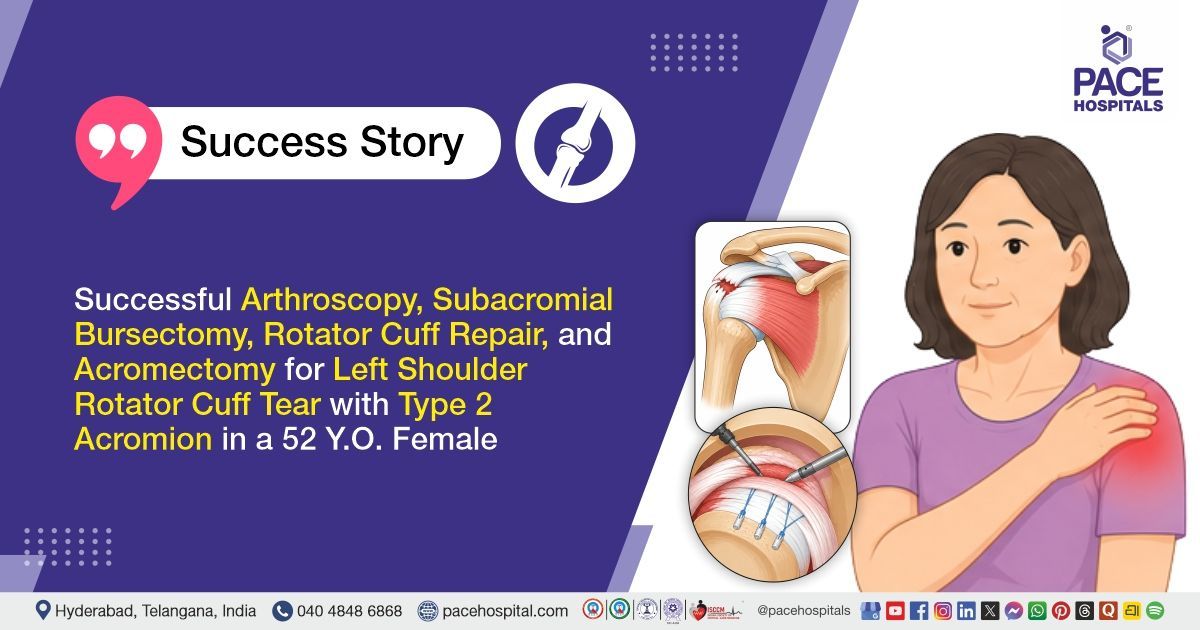
PACE Hospitals’ expert Orthopaedic team successfully performed Diagnostic Arthroscopy, Subacromial Bursectomy, Capsular Release, Rotator Cuff Repair, and Acromectomy on the left shoulder of a 52-year-old female patient diagnosed with a Rotator Cuff Tear with periarthritis component and a Type II acromion of the left shoulder, with the aim of relieving pain and inflammation, improving shoulder mobility, repairing the torn rotator cuff tendon, restoring joint stability and function, and enabling the patient to return to normal daily activities with improved quality of life.
Chief Complaints
A 52-year-old female patient with a body mass index (BMI) of 21 presented to the Orthopaedic Department at PACE Hospitals, Hitech City, Hyderabad, with complaints of shoulder pain, difficulty performing overhead activities for the past few months, and associated difficulty in carrying out daily activities due to pain.
The patient had previously undergone conservative management, including physiotherapy, for her left shoulder condition; however, she did not experience significant symptomatic relief. Owing to the persistent nature of the condition and associated functional limitation, she presented for further evaluation and definitive management.
Past Medical History
The patient had no known history of major medical comorbidities such as diabetes mellitus, hypertension, or other chronic illnesses, and had no history of previous surgeries or significant past medical conditions.
On Examination
On general examination, the patient was conscious, coherent and oriented, with no evidence of pallor, icterus, lymphadenopathy, clubbing, or cyanosis. Local examination of the left shoulder revealed swelling with restriction of movements, particularly reduced internal rotation and abduction beyond shoulder level, along with a positive Jobe’s test suggestive of rotator cuff pathology. No neurovascular deficits were noted in the affected limb.
Diagnosis
Following the clinical evaluation, the Orthopaedic team at PACE Hospitals conducted a detailed assessment of the patient’s complaints of left shoulder pain associated with difficulty in performing daily activities such as shoulder movements and lifting the arm.
A thorough clinical and systemic examination was performed. The examination of the left shoulder revealed swelling with a restricted range of motion, including reduced internal rotation and abduction, along with a positive Jobe’s test suggestive of rotator cuff pathology. No distal neurovascular deficit was noted, and systemic examination findings were within normal limits. Investigations, including X-ray chest, complete urine examination, blood grouping and Rh typing, coagulation profile, and liver function tests, were performed, which were within acceptable limits and did not reveal any significant abnormalities contributing to the condition. Based on the clinical evaluation, examination findings, and investigation correlation, the patient was diagnosed with Rotator Cuff Tear with Periarthritis component and Type II Acromion of the left shoulder.
Based on these findings, the patient was advised to undergo Rotator Cuff Tear Treatment in Hyderabad, India, with Periarthritis component and Type II Acromion of the left shoulder, under the care of the Orthopaedic Department to achieve pain relief, improve range of motion, restore rotator cuff integrity, and enhance overall shoulder function.
Medical Decision Making (MDM)
After a detailed evaluation with Dr. Raghuram, Consultant Orthopaedic Surgeon at PACE Hospitals, the patient was assessed for left shoulder pain associated with difficulty in performing daily activities such as shoulder movements and overhead activities. Clinical examination revealed swelling over the left shoulder with restricted range of motion, including reduced internal rotation and abduction, along with a positive Jobe’s test suggestive of rotator cuff pathology, with no distal neurovascular deficit noted.
Based on the clinical findings and diagnostic correlation, the patient was diagnosed with Rotator Cuff Tear with Periarthritis component and Type II Acromion of the left shoulder.
Based on the above findings, it was determined that Diagnostic Arthroscopy, Subacromial Bursectomy, Capsular Release, Rotator Cuff Repair, and Acromectomy of the left shoulder was the most appropriate surgical management. This decision was made with the intent to relieve pain, improve range of motion, release capsular tightness, repair the rotator cuff tear, restore shoulder biomechanics, and improve overall functional outcome.
The patient and her family members were counselled regarding the diagnosis, planned surgical procedure, possible risks and benefits, postoperative care including physiotherapy and sling immobilization, expected recovery course, and the importance of regular follow-up for optimal recovery.
Surgical Procedure
Following the diagnosis, the patient was scheduled for Diagnostic Arthroscopy, Subacromial Bursectomy, Capsular Release, and Rotator Cuff Repair Surgery in Hyderabad at PACE Hospitals, along with Acromectomy of the left shoulder, under the expert supervision of the Orthopaedic Department.
The surgical procedure involved the following steps:
- Patient Positioning and Anaesthesia: The patient was positioned in the beach chair position and the procedure was performed under general anaesthesia (GA) under strict aseptic precautions.
- Diagnostic Arthroscopy: Diagnostic arthroscopy of the left shoulder was performed, which revealed biceps tendon degeneration. Arthroscopic shaving was done to debride the degenerated tissue and assess intra-articular structures.
- Subacromial Decompression: Subacromial bursectomy was performed to remove inflamed bursal tissue, providing decompression of the subacromial space and improving visualization and shoulder mechanics.
- Capsular Release and Rotator Cuff Repair: Rotator interval synovitis and capsular tightness were noted, following which capsular release was performed to improve joint mobility. A rotator cuff tear was identified and repaired using two Syronix suture anchors, achieving a stable repair construct.
- Acromioplasty and Closure: Acromion burring (acromectomy) was performed to relieve impingement. Hemostasis was secured, and wound closure was done using Ethilon 2-0 sutures. Sterile dressings were applied at the end of the procedure.
Postoperative Care
The postoperative period was uneventful. The patient was mobilized during the hospital stay and was managed with medications for prevention of infection, pain control, and overall postoperative recovery support. Wound dressings were regularly performed and were found to be clean and healthy. The patient was stable at the time of discharge.
Discharge Medications
Upon discharge, the patient was prescribed medications for prevention of postoperative infection, pain control, protection of gastric mucosa from medication-related irritation, and nutritional and antioxidant support to promote wound healing and overall recovery following surgery.
Advice on Discharge
The patient was advised to continue a normal diet as tolerated and she was instructed to follow prescribed physiotherapy with shoulder range of motion exercises as advised and to use an arm sling for support and protection of the operated shoulder during the recovery period.
Emergency Care
The patient was advised to contact the emergency ward at PACE Hospitals immediately in case of any emergency or if symptoms such as fever, increasing pain in the operated shoulder, swelling, redness, wound discharge, or any other unusual or worsening symptoms develop.
Review and Follow-up Notes
The patient was advised to return for follow-up with the Orthopaedic Doctor in Hyderabad at PACE Hospitals after 1 week for wound dressing.
Conclusion
This case highlights a Rotator Cuff Tear with periarthritis component and Type II acromion of the left shoulder, managed surgically with arthroscopic repair and decompression procedures. The patient had an uneventful postoperative course with stable clinical recovery and satisfactory wound healing at the time of discharge. Physiotherapy and shoulder rehabilitation were advised to restore function and ensure optimal long-term recovery.
Arthroscopic Management of Rotator Cuff and Shoulder Disorders
Rotator cuff disorders are a common cause of shoulder pain and functional limitation, often associated with impingement and restricted range of motion. These conditions may arise due to degenerative changes, repetitive strain, or trauma, leading to varying degrees of tendon injury and joint stiffness. Arthroscopy provides a minimally invasive approach for both diagnosis and treatment of shoulder pathology with reduced tissue disruption when performed by an Orthopaedic Doctor/Orthopaedic Surgeon. Procedures may include tendon repair to restore shoulder stability and function. Capsular release is performed when stiffness is present to improve mobility. Subacromial decompression is used to reduce mechanical impingement and prevent ongoing tendon irritation. Early rehabilitation following intervention plays a key role in restoring strength, mobility, and overall shoulder function.
Frequently Asked Questions (FAQs)
What is the purpose of combining arthroscopy with rotator cuff repair in this case?
Arthroscopy helps the surgeon look inside the shoulder joint using a small camera. It gives a clear view of the torn tendon and nearby structures. In this case, it helped confirm the rotator cuff tear and related changes. The repair was then done accurately using this guidance. It also allowed other necessary procedures to be done in the same sitting.
Why was subacromial bursectomy and acromectomy performed along with the repair?
Inflammation of the bursal tissue in the shoulder can lead to pain and limitation of movement. Its removal helps decrease irritation within the joint and improves shoulder function. In this condition, the shape of the acromion was contributing to compression of the tendons. Acromectomy helps by increasing the available space for normal tendon gliding. These procedures together reduce mechanical stress on the repaired tendon and support better healing.
What role does capsular release play in shoulder surgery for periarthritis?
Periarthritis often causes stiffness due to tightening of the joint capsule. Capsular release helps loosen this tight structure. In this case, movements like lifting the arm were already limited. Releasing the capsule helps improve range of motion. It also makes postoperative recovery easier with physiotherapy.
How does the use of suture anchors improve rotator cuff repair outcomes?
Suture anchors are small devices used to fix the torn tendon back to the bone. They hold the tendon firmly in place during healing. In this case, two anchors were used for stability. This method allows proper healing of the tendon. It also reduces the chances of the repair failing.
What is the significance of early mobilization after this type of surgery?
Early gentle shoulder movements help prevent stiffness in the joint and improve blood circulation, which supports healing after surgery. The patient was advised to start these movements only under medical supervision. In the initial phase, movements are kept limited and controlled to avoid stress on the repaired structures. This helps ensure safe recovery while protecting the surgical repair and gradually restoring shoulder function.
Why is an arm sling recommended after rotator cuff repair surgery?
An arm sling supports the shoulder and helps restrict unnecessary movement. It protects the repaired tendon during the early healing period after surgery. In this case, sling use was advised after the operation. It reduces strain on the operated shoulder and helps in recovery. The duration of sling use is based on how the patient’s healing progresses.
How important is physiotherapy after rotator cuff repair and capsular release?
Physiotherapy plays a major role in regaining shoulder movement. It helps restore strength and flexibility step by step. In this case, specific exercises were advised after discharge. Therapy is usually done in stages based on healing. Regular sessions improve long-term function.
What indicates a successful postoperative recovery in this type of surgery?
A clean wound and stable condition after surgery are good signs. Reduction in pain and gradual improvement in movement are expected. In this case, recovery during hospital stay was smooth. The patient was able to start early movement. Continued progress is checked during follow-up.
What precautions are necessary during the early recovery period?
Activities that place stress on the shoulder should be avoided in the early recovery period. Overhead movements and lifting heavy objects are restricted. Proper care of the surgical wound is essential for healing. In this case, follow-up was advised for regular dressing and wound assessment. Adhering to medical instructions helps reduce the risk of complications.
Why is follow-up care important after arthroscopic rotator cuff surgery?
Regular follow-up is important to monitor healing and shoulder function. It helps in identifying and managing any complications at an early stage. In this case, a review was advised after one week. Progress of recovery and rehabilitation exercises is assessed during follow-up visits. Continuous monitoring supports a better functional outcome.
Share on
Request an appointment
Fill in the appointment form or call us instantly to book a confirmed appointment with our super specialist at 04048486868
Appointment request - health articles
Recent Articles