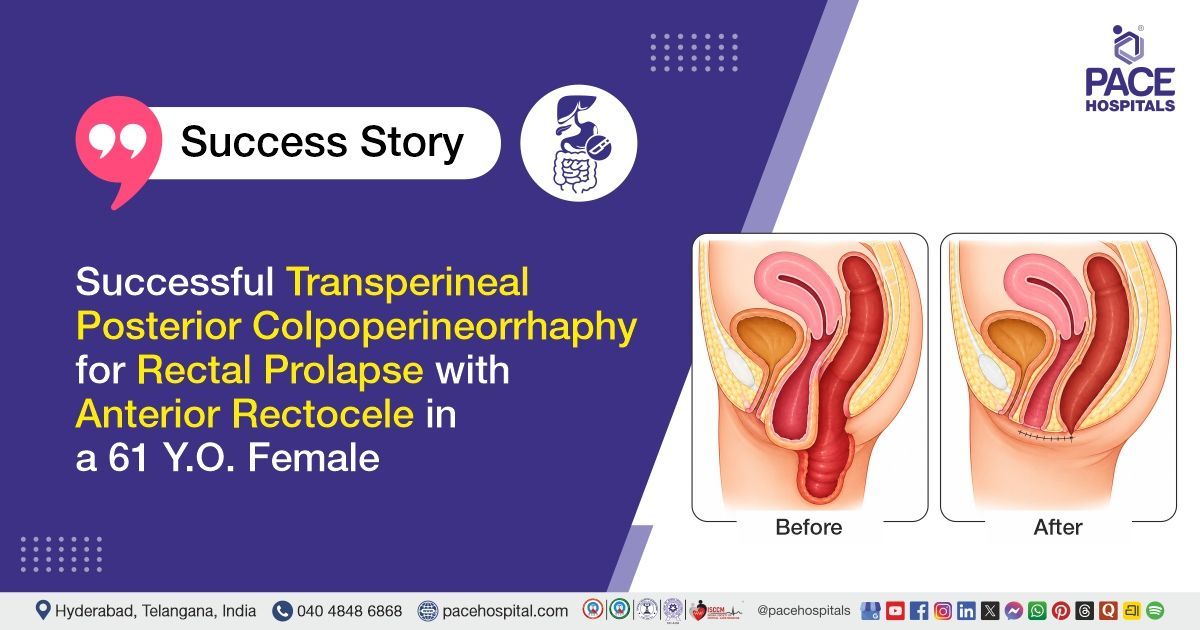
Successful Transperineal Posterior Colpoperineorrhaphy for Rectal Prolapse with Anterior Rectocele
PACE Hospitals
PACE Hospitals’ expert surgical gastroenterology team successfully performed a Transperineal Posterior Colpoperineorrhaphy on a 61-year-old female patient diagnosed with rectal prolapse with anterior rectocele, with the aim of repairing the weakened rectovaginal support, correcting the bulge, and relieving symptoms of constipation and difficulty in bowel evacuation.
Chief Complaints
A 61-year-old female patient with a body mass index (BMI) of 18 presented to the Surgical Gastroenterology Department at PACE Hospitals, Hitech City, Hyderabad, with complaints of chronic constipation and difficulty in bowel evacuation, requiring digital evacuation for relief.
Past Medical History
The patient had a history of hypothyroidism and rheumatoid arthritis, both managed under regular medical care. She had also undergone a laparoscopic cholecystectomy in the past and reported a history of multiple medication allergies.
On Examination
On examination, the patient was conscious, coherent, oriented, and hemodynamically stable. Abdominal examination was soft with no tenderness or distension. Perineal and pelvic evaluation revealed findings consistent with rectal prolapse with anterior rectocele, corresponding to a posterior vaginal wall bulge suggestive of weakened rectovaginal support. No acute signs of infection or peritonitis were noted. The remaining systemic examination was normal.
Diagnosis
Upon admission to PACE Hospitals, following a detailed clinical assessment, the Surgical Gastroenterology team evaluated the patient for complaints of chronic constipation requiring digital evacuation, along with a review of her relevant past medical history.
Clinical examination revealed findings consistent with rectal prolapse with anterior rectocele, which was primarily established based on history and physical examination findings suggestive of pelvic floor weakness and posterior vaginal wall bulge.
Routine investigations, including complete blood picture, serum electrolytes, and renal function tests, were performed as part of the preoperative evaluation to assess the patient’s general medical status. These investigations were largely within acceptable limits and served as supportive assessments rather than definitive diagnostic tools.
Based on the confirmed diagnosis, the patient was advised to undergo
Anterior Rectocele with
Rectal Prolapse Treatment in Hyderabad, India, under the expert care of the Surgical Gastroenterology Department.
Medical Decision Making (MDM)
After a detailed consultation with the surgical gastroenterologist Dr. CH. Madhusudhan, and cross consultation with cardiologist Dr. Seshi Vardhan Janjirala, a comprehensive evaluation was performed to determine the most appropriate diagnostic and therapeutic approach.
Considering the patient’s history of chronic constipation requiring digital evacuation and clinical findings suggestive of rectal prolapse with anterior rectocele, further evaluation confirmed pelvic floor weakness with posterior vaginal wall bulge. Routine laboratory investigations revealed mild anemia with otherwise stable hematological, renal, and electrolyte parameters.
Based on clinical assessment and routine laboratory investigations showing stable parameters, it was determined that Transperineal Posterior Colpoperineorrhaphy under spinal anesthesia was the most appropriate and effective management strategy. This approach was chosen to correct the pelvic floor defect, reinforce the rectovaginal septum, relieve symptoms of obstructed defecation, and improve bowel evacuation while minimizing recurrence and ensuring better functional outcomes.
The patient and her family members were counselled regarding the diagnosis, clinical findings, planned procedure, and the importance of postoperative care and follow-up.
Surgical Procedure
Following the decision, the patient was scheduled for Transperineal Posterior Colpoperineorrhaphy in Hyderabad at PACE Hospitals, under the expert care of the Surgical Gastroenterology Department.
The following steps were carried out during the procedure:
- Patient Preparation and Anaesthesia: The patient was taken up for surgery after proper preoperative evaluation and consent. Under strict aseptic precautions, spinal anaesthesia was administered, and the patient was positioned appropriately for perineal and vaginal access.
- Identification and Exposure of Lesion: A careful per vaginal examination revealed a bulge in the posterior vaginal wall measuring approximately 5 cm. The surgical field was prepared and draped. The introitus was exposed to provide adequate access to the operative site.
- Incision and Tissue Dissection: A curvilinear incision was made at the vaginal introitus over the bulging area. Local infiltration with lignocaine and adrenaline was given submucosally to reduce bleeding. Vaginal mucosal flaps were carefully raised to expose the underlying rectovaginal septum.
- Rectovaginal Septum Repair (Plication): The weakened rectovaginal septum was identified and reinforced by plication, using interrupted 3-0 Vicryl sutures. This step helped restore pelvic floor support and reduce the rectocele component.
- Closure and Completion: After adequate reinforcement, the posterior vaginal wall was closed in layers. A vaginal pack was placed to provide hemostasis and support, and a flatus tube was inserted to allow passage of gas and prevent postoperative discomfort. The procedure was completed without complications.
Postoperative Care
The patient had an uneventful post-procedural recovery. During the hospital stay, she received intravenous medications for infection prevention, pain control, and maintenance of hydration. She was discharged in a hemodynamically stable condition with appropriate postoperative advice.
Discharge Medications
Upon discharge, the patient was prescribed oral medications for prevention and treatment of postoperative infection, reduction of inflammation, control of pain on an as-needed basis, protection of gastric mucosa, nutritional support, and regulation of bowel movements to prevent constipation and avoid straining at the surgical site.
Advice on Discharge
The patient was advised to continue sitz bath regularly to maintain local hygiene, promote healing, and provide symptomatic relief at the surgical site.
Emergency Care
The patient was informed to contact the emergency ward at PACE Hospitals in case of any emergency or development of symptoms such as fever, abdominal pain, vomiting, increasing perineal discomfort, or any unusual discharge.
Review and Follow-up Notes
The patient was advised to return for a follow-up visit with the Surgical Gastroenterologist in Hyderabad at PACE Hospitals after 5 days.
Conclusion
This case highlights chronic constipation secondary to rectal prolapse with anterior rectocele, managed successfully with transperineal posterior colpoperineorrhaphy. The procedure effectively corrected the pelvic floor defect and restored rectovaginal support, leading to an uneventful recovery. The case was discharged in stable condition with improvement in symptoms and advised regular follow-up care.
Importance of Early Surgical Intervention in Pelvic Floor Disorders
Pelvic floor disorders such as rectal prolapse and rectocele can significantly affect bowel function and quality of life if not addressed appropriately. These conditions are often diagnosed by a Surgical gastroenterologist / Surgical gastroenterology doctor based on clinical history and physical examination, while investigations are mainly used to assess overall fitness and rule out associated abnormalities. Surgical correction is considered when symptoms persist and begin to interfere with daily activities. Procedures aimed at restoring pelvic support focus on repairing weakened tissues and improving anorectal function. Proper reinforcement of pelvic structures helps reduce recurrence and improve functional outcomes. Postoperative care is essential in ensuring smooth recovery and preventing complications. Overall, timely intervention in suitable cases leads to effective symptom relief and better long-term patient satisfaction.
Frequently Asked Questions (FAQs)
How does transperineal posterior colpoperineorrhaphy help in rectocele and rectal prolapse?
This surgery works by strengthening the rectovaginal septum, which is the natural support layer between the rectum and vagina. When this support becomes weak, as in rectocele, the rectum can bulge forward and affect normal bowel emptying. The procedure repairs and tightens this weakened area, helping to restore normal alignment of the rectum. As a result, the bulge is reduced, and stool passage becomes easier. It also improves bowel function and helps reduce discomfort during defecation.
What functional improvement can be expected after this surgery?
After recovery, bowel movements usually become easier and more regular. The need for digital assistance to pass stools reduces in most patients. The feeling of incomplete evacuation also improves. Pressure and heaviness in the pelvic region decrease. Overall, daily comfort and quality of life improve.
Why is a perineal approach chosen instead of abdominal surgery?
The perineal approach is done through the area near the anus and does not require opening the abdomen. It is less invasive and usually allows faster recovery. This method is often preferred in elderly patients or those with other medical conditions. It directly corrects the weakened pelvic floor. Hence, it is considered a safer and effective option in suitable cases.
What precautions are necessary to prevent recurrence after surgery?
Straining during bowel movements should be avoided as it can put pressure on the repaired area. Constipation should be prevented by maintaining soft stools. Heavy lifting and strenuous physical activities should be avoided during the recovery period. Pelvic floor strengthening exercises may be advised later if needed. Regular follow-up visits are important to ensure proper healing and to maintain good surgical outcomes.
How important is bowel regulation after this surgery?
Maintaining regular bowel habits is very important after surgery for proper healing. Constipation should be avoided as it can put pressure on the repaired area and affect recovery. A diet rich in fiber helps in keeping stools soft and easy to pass. Adequate fluid intake is also essential for normal bowel function. Proper bowel regulation plays a key role in ensuring good long-term surgical outcomes.
What is the role of a sitz bath in post-operative recovery?
A sitz bath is a simple method in which the patient sits in warm water to gently clean and soothe the operated area. It helps reduce pain, swelling, and local irritation after surgery. The warmth improves blood circulation in the area, which supports healing. It also helps keep the surgical site clean and reduces the risk of infection. Regular use provides comfort and supports smooth recovery.
When should urgent medical attention be sought after discharge?
Immediate medical attention is needed if the patient develops a fever or increasing pain. Persistent vomiting or difficulty in passing stools should not be ignored. Any unusual bleeding or discharge from the surgical site should be reported without delay. Difficulty in passing urine also needs prompt evaluation. Early medical care helps in preventing and managing complications effectively.
How do associated conditions like hypothyroidism and arthritis affect recovery?
Conditions like hypothyroidism may slow down the body’s healing process. Arthritis can reduce mobility and make recovery slower. Proper control of these conditions is important after surgery. Regular follow-up with doctors helps in better recovery. A balanced diet also supports healing.
What is the significance of vaginal packing and flatus tube placement after surgery?
Vaginal packing is placed after surgery to support the operated area and help control minor bleeding. It also helps maintain the stability of the repaired tissues during the early healing phase. A flatus tube is used to allow the passage of gas without straining. This reduces pressure on the surgical site and discomfort. Both are temporary measures that support proper healing and recovery.
What is the expected follow-up plan after this procedure?
A follow-up visit is usually scheduled for a few days after discharge. During this visit, wound healing and overall recovery are assessed. Bowel function and symptom improvement are also reviewed. Further advice regarding diet, activity, and care may be given if needed. Regular follow-up is important to ensure proper healing and good long-term results.
Share on
Request an appointment
Fill in the appointment form or call us instantly to book a confirmed appointment with our super specialist at 04048486868
Appointment request - health articles
Recent Articles