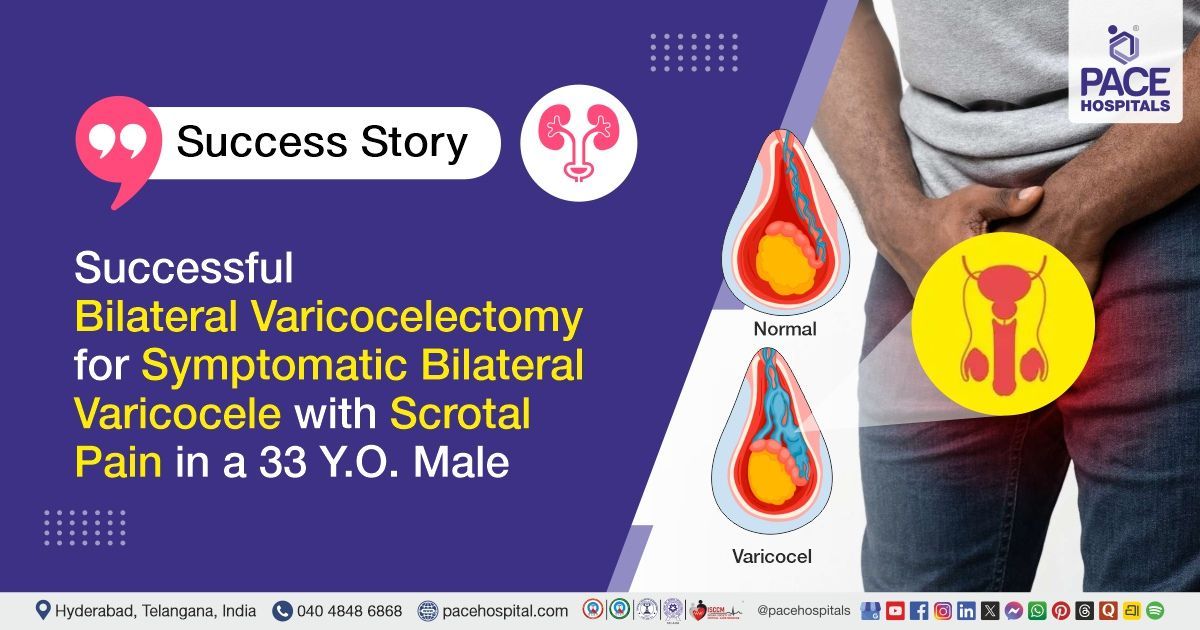
Successful Bilateral Varicocelectomy for Varicocele with Scrotal Pain in a 33 Y.O. Male
PACE Hospitals
The PACE Hospital's expert Urology team successfully performed a Bilateral Varicocelectomy on a 33-year-old male patient diagnosed with bilateral varicocele. The aim of the procedure was to correct the enlarged veins in the scrotum, improve blood circulation to the testes, relieve symptoms, and enhance fertility potential.
Chief Complaints
A 33-year-old male patient with a body mass index (BMI) of 21.2 presented to the Urology Department at PACE Hospitals, Hitech City, Hyderabad, with complaints of scrotal pain.
Past Medical History
The patient had no known history of chronic medical illnesses such as hypertension, diabetes mellitus, or other significant systemic diseases. There was no history of previous surgeries, drug allergies, or major hospitalizations in the past.
On Examination
On general examination, the patient was conscious, coherent, and oriented. His vital signs were within normal limits. Abdominal examination was normal with no tenderness or organomegaly. Local examination of the scrotum revealed abnormal dilated veins in the pampiniform plexus bilaterally, consistent with varicocele, and mild scrotal tenderness was present. The testes were normal in size and consistency, and no other abnormalities were noted.
Diagnosis
Upon admission to PACE Hospitals, the patient underwent a comprehensive evaluation by the Urology team, including a detailed clinical examination and review of medical history. He presented with complaints of scrotal pain.
Clinical examination of the scrotum revealed abnormal dilatation of the pampiniform plexus veins bilaterally, suggestive of varicocele. To confirm the diagnosis and assess its severity, scrotal Doppler ultrasonography was performed, which demonstrated bilateral venous dilatation with reflux. Laboratory investigations, including routine blood tests, and vital signs were within normal limits, with no evidence of acute infection or systemic illness.
Based on the diagnosis and clinical findings, the patient was advised to undergo
Bilateral
Varicocele Treatment in Hyderabad, India, under the expert care of the Urology Department.
Medical Decision Making (MDM)
After a detailed consultation with Dr. Abhik Debnath, Consultant Urologist, a comprehensive evaluation was conducted to determine the most appropriate diagnostic and therapeutic approach for the patient presenting with scrotal pain and bilateral pampiniform vein dilatation. Based on detailed clinical evaluation and imaging studies, including scrotal Doppler ultrasonography, surgical intervention was deemed necessary.
It was determined that the patient had bilateral varicocele, responsible for his symptoms and potential impact on testicular function. Bilateral varicocelectomy was identified as the most effective intervention to ligate the dilated veins, preserve the testicular arteries and vas deferens, relieve scrotal pain, and improve fertility potential.
The patient and his family members were informed about his condition, the planned procedure, associated risks, and its potential to alleviate symptoms and enhance his quality of life.
Surgical Procedure
Following the clinical decision, the patient was scheduled for a Bilateral varicocelectomy Surgery in Hyderabad at PACE Hospitals, under the expert care of the urology department.
The procedure involved the following steps:
- Anesthesia and Positioning: The patient was administered spinal anesthesia to ensure adequate analgesia and muscle relaxation for the procedure. He was positioned supine on the operating table with proper support to expose both inguinal and scrotal regions. The surgical area was cleaned and draped under sterile conditions.
- Incision and Surgical Approach: A subinguinal incision approximately 2–3 cm in length was made just below the external inguinal ring on each side. This approach allowed direct access to the spermatic cord while minimizing disruption to surrounding tissues. 4x magnification loupes were used to clearly visualize small veins, arteries, lymphatics, and the vas deferens during dissection.
- Identification of Critical Structures: The spermatic cord was carefully isolated, and the contents were examined. The vas deferens and testicular artery were identified bilaterally and protected throughout the procedure to prevent injury. The dilated pampiniform plexus veins, responsible for the varicocele, were clearly identified and separated from surrounding structures. Lymphatic channels were preserved to reduce the risk of postoperative hydrocele formation.
- Ligation and Division of Dilated Veins: The abnormal pampiniform veins were carefully ligated using surgical clips and subsequently divided, ensuring that only the dilated veins were interrupted while preserving arterial and lymphatic structures. Hemostasis was meticulously achieved using electrocautery and careful inspection to prevent intraoperative bleeding or hematoma formation.
- Closure: After completion of the vein ligation on both sides, the incisions were closed in layers using absorbable sutures for the subcutaneous tissue and skin. The procedure was completed successfully with no intraoperative complications.
Postoperative Care
The postoperative period was uneventful. The patient received treatment for infection prevention, pain relief, gastric protection, and support of testicular health. The patient was discharged in stable condition with appropriate follow-up instructions.
Discharge Medications
The patient was prescribed medications for infection prevention, pain relief, gastric protection, and support of testicular health.
Advice on Discharge
The patient was advised to use scrotal support and to avoid weight lifting, forward bending, and long journeys on a two-wheeler.
Emergency Care
The patient was informed to contact the emergency ward at PACE Hospitals in case of any emergency or development of symptoms like fever, scrotal Pain, or wound discharge.
Review and Follow-up Notes
The patient was advised to return for a follow-up visit with the Urologist in Hyderabad at PACE Hospitals after 3 days for dressing.
Conclusion
This case highlights the successful management of bilateral varicocele causing scrotal pain. The patient underwent bilateral varicocelectomy via a subinguinal approach with preservation of testicular arteries and vas deferens. The procedure was completed without complications, and the postoperative course was uneventful. Medications and follow-up care were provided to ensure recovery and support testicular health.
Optimizing Testicular Function through Microsurgical Varicocelectomy
Bilateral varicocele is a common cause of scrotal pain and impaired testicular function. This case highlights the importance of precise microsurgical intervention by a skilled
urologist / urology doctor, using magnification to preserve the testicular arteries, vas deferens, and lymphatic channels while selectively ligating dilated pampiniform plexus veins. The subinguinal approach minimized tissue disruption and reduced the risk of complications such as hydrocele or hematoma. Addressing venous reflux directly relieved pain and supported long-term testicular health. Early intervention and careful monitoring ensured rapid recovery. This case emphasizes the value of targeted, organ-preserving surgical strategies under expert urological care.
Share on
Request an appointment
Fill in the appointment form or call us instantly to book a confirmed appointment with our super specialist at 04048486868
Appointment request - health articles
Recent Articles